A Lesson for our Followers from the City of Elad at the Residence of the Gaon
and Tzaddik, Rabbi Eliezer Berland shlit"a
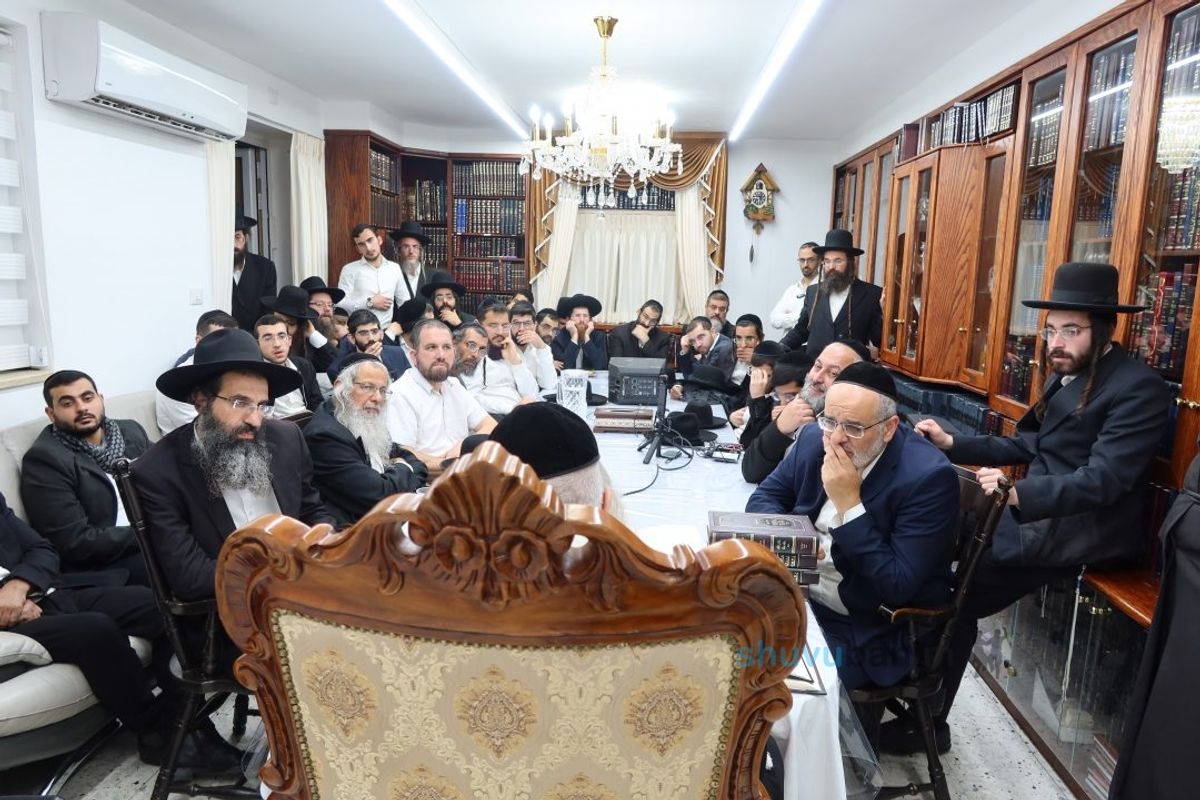
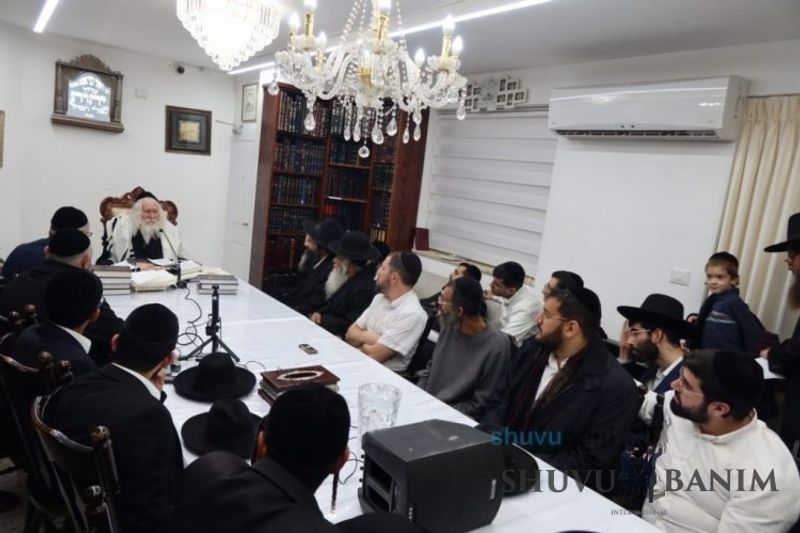
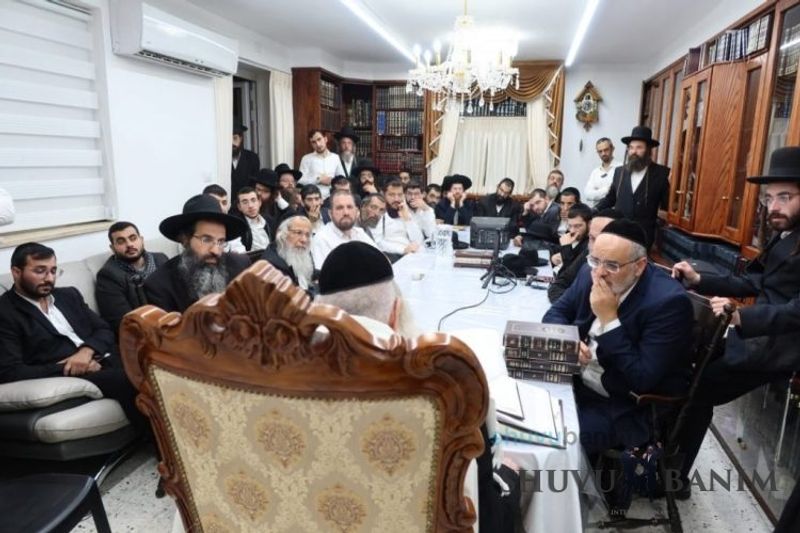
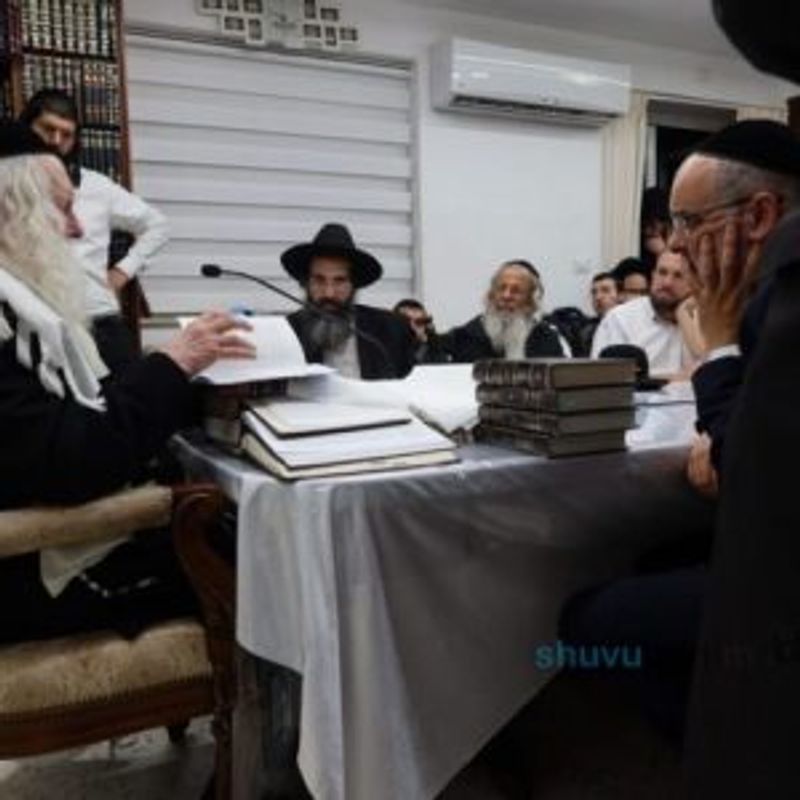
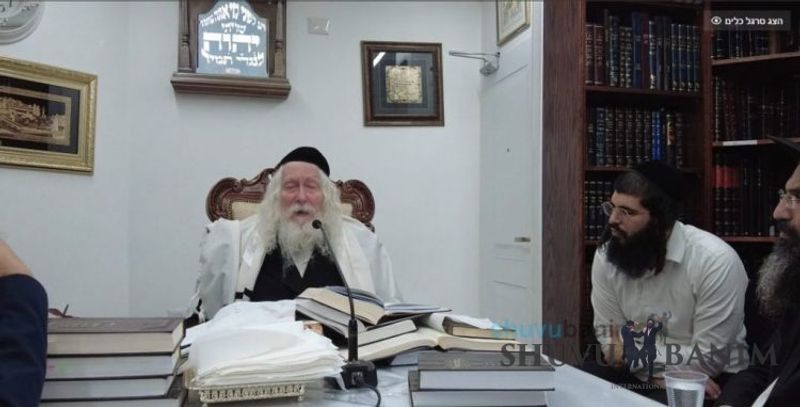
Last Wednesday, the 15th of Teves, in the late afternoon, our followers from the city of Elad entered for a lesson at the residence of the Gaon and Tzaddik, Rabbi Eliezer Berland shlit"a (may he live long and good days). The Rav shlit"a delivered a very long lesson to them, lasting about an hour and a half, featuring words of Torah from all the depths of the Holy Torah, ranging from Agadah (homiletic teachings) to Talmudic analysis, and concluding with stories and words of chizuk (encouragement).
Before you is a summary of the lesson, a tiny fraction of the words delivered by the Rav shlit"a to the participants:
The Rav shlit"a began the lesson by mentioning that Rebbe Nachman says that through the Torah, all requests and prayers are accepted. This "Torah" refers to the study of Gemara (Talmud) and the study of the Rambam (Maimonides). He noted that this coming Sunday will be the hillula (anniversary of passing) of the Rambam, and a person should take it upon themselves to study Rambam every single day. Afterward, he spoke about the miracles that occurred in the war and how the merit of the Baba Sali zt"l (of blessed memory) certainly protected the city of Netivot. He also delved into the matter of "Simeon and Levi are brothers; weapons of violence are their kinship." Following this, he told the story of how the Saba, Rabbi Yisrael Ber Odesser zy"a (may his merit protect us), first drew close to Breslov.
For most of the lesson, he dealt with many issues in the Shas (Talmud) regarding the disputes of the Poskim (halachic decisors). He explained that these were the roots of the disputes between the brothers and Joseph. At the beginning of his words, he brought the dispute between the Radbaz and the Urim V'Tumim regarding the opinion of the Rambam on the issue of whether poultry is halachically considered meat. He also brought another issue over which the brothers and Joseph disagreed: "his father's wives"—whether the brothers were permitted to sell the sons of the handmaids, as brought in the Rambam.
Amidst these words, moving from one subject to another, he brought the story mentioned in the Midrash that in the lesson of Rabbi (Judah the Prince), two deaf-mutes sat for a long time. Rabbi prayed for mercy for them, and they were healed, and it was discovered that they knew the entire Torah. The Rav said that from this we learn that one must attend all the lessons even if they understand nothing. He further brought from the secrets of reincarnation that these were the souls of Eldad and Medad, who, when they walked through the camp and proclaimed the prophecy "Moses is dying and Joshua is bringing [Israel into the Land]," actually meant it for the best, as they did not want their maternal brother to die. However, they were forbidden to reveal the prophecy, because a prophet is forbidden to reveal a prophecy if it was not given with the instruction "to say" (L'emor). During this, he also mentioned Miriam and Aaron who spoke about Moses, saying they meant it for the best, as it is written in Sefer HaMiddos (The Book of Traits) that one who separates from his wife is liable for death; therefore, they wanted to explain to Moses why the decree of death was issued. The Rav said that this was the mistake—because if there is a decree upon the Tzaddik, then the one who needs to do teshuvah (repentance) is you, not the Tzaddik.
He also spoke about the humility of Joshua, whom the spies planned to kill so that the situation of "Moses dies and Joshua brings them in" would not occur. But the truth is that words of prophecy do not change anything; if Moses says to enter the Land, then we enter, even if all considerations suggest otherwise. Truly, if they had entered then, there would have been the Resurrection of the Dead, because one who lives in Eretz Yisrael (the Land of Israel) can revive the dead. The Rav strengthened the point that it is forbidden to live in Chutz La'Aretz (outside the Land). He spoke here about the days of Mashiach (the Messiah) and the process of the Geulah (Redemption).
After these words, he returned to the matter of the disputes and the issue of whether a ben pekuah (an animal found alive inside its slaughtered mother) requires shechitah (ritual slaughter), etc. He brought several examples, such as the sheep of Jacob that were conceived from the water, and therefore their offspring were not considered animal meat. He also mentioned Rabbi Chanina and Rabbi Hoshaiah, who every Friday afternoon would create a "third-born calf" using the Sefer Yetzirah (Book of Creation).
Continuing his words, he dealt with the matter of Nachum Ish Gamzu and told the story in its entirety. He said that a person must know that the very thing that happened to him is the "good"—meaning, the dust itself was the good for Nachum Ish Gamzu. For the king had infinite pearls and would not have nullified the decree, but now that he brought dust that turned specifically into arrows, in that merit, the decree was nullified. This is like Rabbi Akiva, where the fact that the candle went out and the donkey and rooster were devoured was precisely what helped him so that the bandits did not find him. Moving from one subject to another, he said that just like the dust of Nachum Ish Gamzu, so it was in the time of Devorah (Deborah) that the dust turned into arrows and swords. For the one who revealed the pri'ah (uncovering the membrane during circumcision) was Joshua; until Joshua, they did not know that pri'ah was required. He said that if the Jewish people had performed pri'ah, they would not have sinned with the Golden Calf. Afterward, the matter of pri'ah was forgotten again, and the one who renewed the laws of pri'ah was Devorah, and in that merit, they defeated Sisera.
After these words, he dealt with additional topics, including "Miriam's Well," saying that if a person immerses in Miriam's Well, he is healed from all illnesses! He also dealt with the topic of Shalom Bayis (marital harmony) and the need for a person to be pleasant in his home, bringing the Gemara's statement: "A person should never cast excessive fear within his home," regarding the story of the Concubine of Gibeah. He also discussed the tomb of Othniel ben Kenaz, saying that Othniel merited being buried at the end of the Me'aras HaMachpelah (Cave of the Patriarchs).
Toward the end of the lesson, he returned again to the matter of the dispute between the brothers and Joseph, saying that in most of their disputes, the issue at hand was whether they were obligated in Rabbinic laws and whether they were obligated as Bnei Noach (Noahides). He dealt with whether it is considered ever min hachai (a limb from a living animal) if the two "simanim" (the trachea and esophagus) were cut. He brought the Rambam in five places in great detail regarding how the animal is still considered alive—for matters of Kiddushin (betrothal) and Gittin (divorce); sometimes if a man's two simanim are cut, he can still give a Get (divorce document). Similarly, if one saw a man whose two simanim were cut, he cannot permit an Agunah (a woman "chained" to a marriage) to remarry based on his testimony. Likewise, regarding the impurity of a corpse, even if the two simanim are cut, a Kohen (priest) can still remain in the room.
The Rav shlit"a concluded the lesson with the matter of Joseph's revelation and the self-sacrifice of Serach bat Asher, who revealed to Jacob that Joseph was alive, even though in one small moment he could have been exacting about the sale and everyone would have died. The entire story described in these portions—how Joseph revealed himself to the brothers and said to them, "I am Joseph!"—then their souls fled. For when one cries out "I am Joseph" and they know that everything is because of "I am Joseph," then this is the Tikkun (rectification) of the world!
Subscribe to Our Newsletter
Receive Torah articles and inspiration directly in your inbox