
A Lesson for the Residents of Eilat at the Residence of the Gaon and Tzaddik
Rabbi Eliezer Berland shlit"a
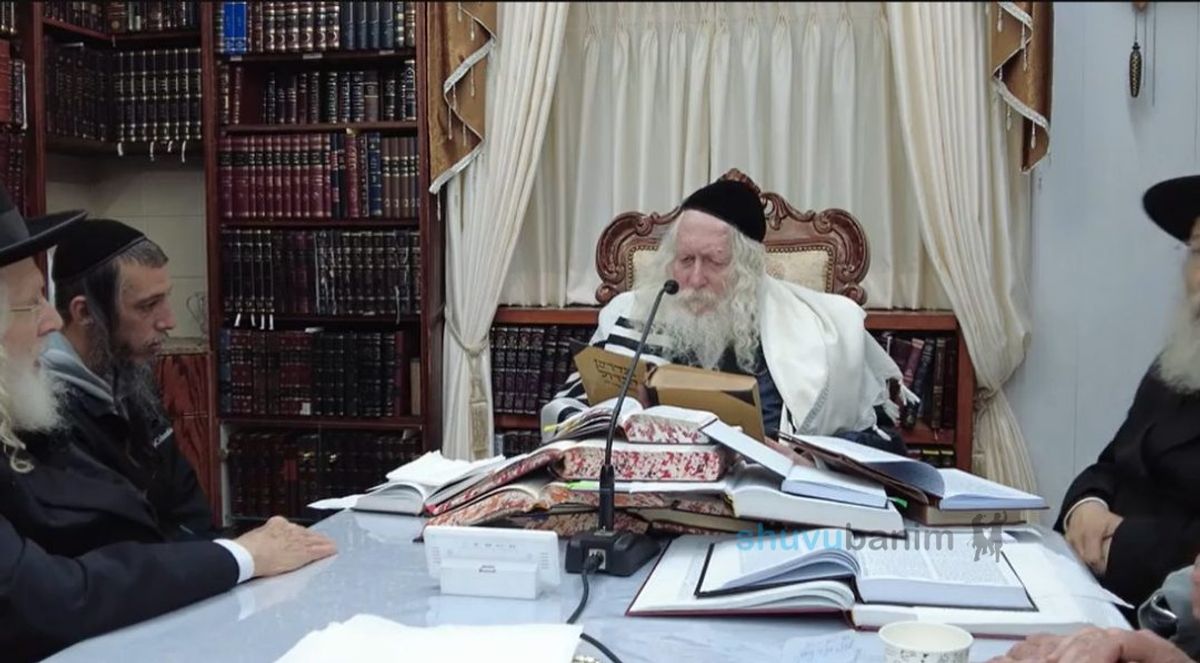
Last night, Wednesday, Parshas Shemos, the eve of the 23rd of Teves—the day of the Ginusia DeMalka (the King's birthday, referring to the Rav's birthday). A large group of our followers from the "City of Teshuvah" (repentance), Eilat, entered for a lesson at the residence of the Gaon and Tzaddik Rabbi Eliezer Berland shlit"a (may he live long and good days).
They made the long journey in a full bus, strengthening themselves throughout the trip with the awesome merit of traveling from their home at the southern tip of the Land of Israel—the City of Teshuvah, Eilat—into the inner sanctum. The lesson lasted about forty minutes, during which the Rav shlit"a (may he live long and good days) strengthened and inspired the public on many topics, as is his holy way. Before you is a summary and some of the words the Rav delivered during the lesson:
The Rav shlit"a (may he live long and good days) began the lesson regarding the beginning of the weekly Torah portion—Shemos—concerning the passing of the sons of Yaakov. He also spoke about the greatness of the day—the day of the Ginusia DeMalka—and said that whatever one requests on this day is accepted. He then moved on to speak about how Sarah did not want to return to the Yetzer Hara (evil inclination) and wanted to bring Yitzchak into the world in holiness, which is the meaning of "After I have grown old, shall I have pleasure?" However, the Rav said that the point is specifically that there is a Yetzer Hara and one must fight against it. Afterward, he spoke about the secret of "Upon Edom I will cast my shoe," which refers to sewing shoes for the Shechinah (Divine Presence). From there, he moved to discuss the selling of Yosef. He also spoke about the greatness of hishtatchus (prostrating oneself) on the grave of Rabbi Naftali Katz zt"l (of blessed memory) and mentioned that Rebbe Nachman, on his way to the Land of Israel, also prostrated himself on his holy Tziyun (gravesite). The Rav said that except for Rebbe Nachman, everyone else passed away on their way to the Land of Israel—the son of the Rosh who is buried in Sofia, as well as Rabbi Naftali Katz—but Rebbe Nachman succeeded in reaching the Land of Israel because he removed his shoes, his hat, and his head-covering. He also told how Rebbe Nachman stopped Napoleon in Akko (Acre), noting that Napoleon said if he had conquered Akko, he would have conquered the entire world.
Later in the lesson, he dealt with many topics from the Tanakh (Bible), the building of the Beis HaMikdash (Holy Temple), the story of Tzafnis the medium (Ba'alas HaOv) who was the mother of Avner ben Ner, and everything mentioned there in the Tanakh. Afterward, he spoke about the feast of the Leviathan, and moving from one subject to another, he returned to Parshas Shemos and cited the Zohar which says that "A man went from the house of Levi and took a daughter of Levi"—that Yocheved was on the level of the "daughter of the Leviathan." He continued with the matter of the Torah portion, offering a Chiddush (original Torah insight) that "And she placed [the basket] in the reeds (ba-suf)"—the word 'Suf' (reeds) has the same Gematria (numerical value) as "Nachman," for only Rebbe Nachman can take us out of this exile. He also cited the Midrash HaGadol that Bithiah, the daughter of Pharaoh, went every night from the day Moshe was born to search for him because she saw in the stars that he was born, and he mentioned that she herself (Bithiah) wanted to convert to Judaism.
Towards the end of the lesson, he dealt with the matter of Serach bas Asher, who showed mesirus nefesh (self-sacrifice) to tell Yaakov Avinu (our father Jacob) that Yosef was alive, even though she knew that at any moment Yaakov might realize the brothers had sold Yosef, and then no trace would remain of the brothers, similar to Yaakov's strictness toward Shimon and Levi in the incident of Shechem. He discussed this matter in light of the dispute between the Ramban (Nachmanides) and the Rambam (Maimonides). During his words, the Rav shlit"a (may he live long and good days) encouraged everyone to finish the entire Rambam every year, mentioning that the Hilula (anniversary of passing) of the Rambam falls this week; therefore, everyone should take it upon themselves to finish the Rambam by next year.
Subscribe to Our Newsletter
Receive Torah articles and inspiration directly in your inbox