
A Lesson for the Worshipers of the 'Baal HaSadeh' Synagogue from the City of
Holon at the Residence of the Gaon and Tzaddik Rabbi Eliezer Berland shlit"a
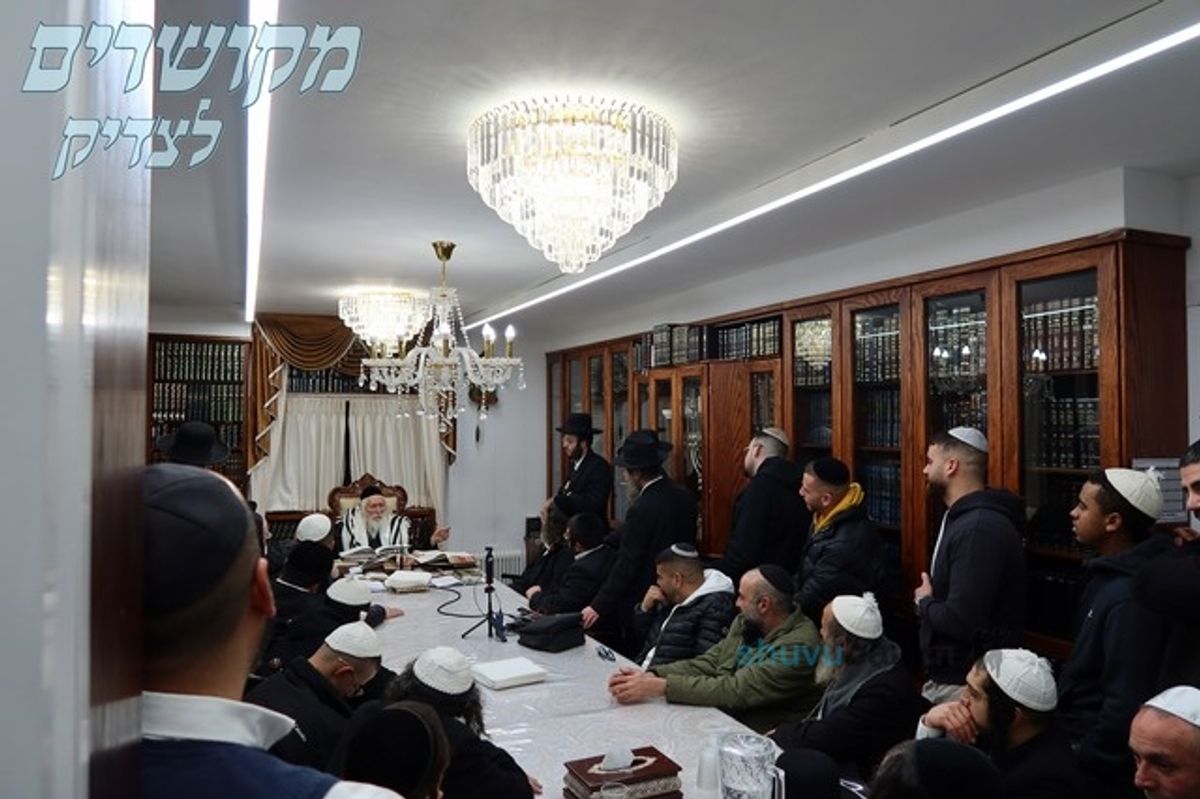
On Wednesday, the eve of the 6th of Adar, Parshas Tetzaveh, a lesson was held at the residence of our teacher, the Rav shlit"a (may he live long and good days), for the worshipers of the 'Baal HaSadeh' synagogue in the city of Holon, led by the Chassid Rabbi Ofer Erez shlit"a.
Below is a summary of the topics discussed by our teacher, Rabbi Eliezer Berland shlit"a, during the lesson which lasted approximately fifty-five minutes:
The Gemara (Talmud) in Megillah discusses how it is possible that there were three different periods of seventy years for the Babylonian exile. Nebuchadnezzar roasted Ahab the son of Kolaiah and Zedekiah the son of Maaseiah in fire because they were false prophets. Yuval was a reincarnation of Iyov (Job), and his name is hinted at by the rearrangement of the letters Aleph-Lamed-Yod-Vav-Beis (E-l Iyov). The entire story of Cain and Abel took place on Erev Pesach (the eve of Passover). Adam HaRishon (the first man) observed Chanukah according to both Beis Hillel (the House of Hillel) and Beis Shammai (the House of Shammai); this is why Yosef (Joseph) asked his brothers "Father or brother" (Av o Ach), corresponding to the initials of Beis Hillel or Beis Shammai. Hashem (God) asked David regarding the matter of his counting the Jewish people: three months of famine, three months of being pursued by enemies, or three months of pestilence. He chose the pestilence, and Hashem sweetened the judgment so that it lasted only the time between the slaughtering of the Tamid (daily offering) and the sprinkling of its blood—less than a second. And the "seventy thousand" who were killed [according to the literal text] actually referred to Avishai ben Zeruiah [who was equal to them all]. From this we learn that through prayer, it is possible to sweeten everything. Abigail was the "daughter of Nachash" (the serpent)—meaning one who had no evil desire; a person should come to a meeting and ask his wife if she is a "daughter of Nachash" (free from base desires). The Tanna D'vei Eliyahu writes that any gentile, if he converts, can even become a prophet. In Egypt, because they closed the mikvaos (ritual baths), Hashem made it so that there were no niddos (menstruating women) in Egypt. And in the desert, they were all at the level of Jewish women, for if a maidservant saw more prophetic vision at the sea than Ezekiel, how much more so a Jewish woman. The calculation shows that the feast of Ahasuerus began on the 3rd of Tishrei, because Jews would not come on Rosh Hashanah. One hundred and eighty days brings us to the 6th of Nissan; with three missing months, it turns out that the feast ended exactly on the 15th of Nissan. The argument between Vashti and Ahasuerus was about in whose merit they ruled over 127 provinces. Similarly, the feast of Belshazzar was on the 15th of Nissan. If your wife tells you to take out the trash, instead of arguing all night, you can throw out the trash in fifty seconds. Belshazzar heard the writing on the wall that his kingdom was ending that night and ordered that no one be let in. Rabbi Naftali Katz explains that the dispute between the "two gardens" refers to the Upper Tzaddik and the Lower Tzaddik. Enosh, at the age of 695, began to get confused and said, "I created the world," but he returned in teshuvah (repentance) after eight years. The hint is in the Ten Utterances: "Then (Az) it was begun to call upon the name of Hashem," but the whole world had already become confused. Manasseh also returned in teshuvah (repentance) after 22 years, but it was no longer possible to annul the decree. "All the kings of the earth shall praise You" (Psalms 138:4), because all the idols would say "I am [the lord]" and "You shall have no [other gods]," but only the Holy One, Blessed be He, says to honor one's parents. "Moab is my washpot" (Psalms 60:10)—Balaam advised Moab, who feared that David (who would descend from Ruth the Moabitess) would destroy Moab, so he advised him to place a barrel of snakes to kill the child. If we have the Beis HaMikdash (Holy Temple), we can conquer Moab. If we have Jerusalem, we can subdue Khomeini and the entire world; one must never leave Jerusalem! The Chasam Sofer zt"l (of blessed memory) writes that the entire earthquake in Safed happened because people did not come to live in Jerusalem. We were in Lebanon to search for the missing soldier Yehuda Katz; we slept for two nights in a military camp and spent six hours at the tziyun (gravesite) of Issachar and Zebulun. One must come at least for Shabbos (the Sabbath) to Jerusalem; now everyone can see the Rav. Shapur the King said that a palanquin is deserved by Rabbi Shimon bar Yochai because he ruled according to Rabbi Meir. The secret of the "two gardens" is the Upper Tzaddik who draws up the Lower Tzaddik. And the Lower Tzaddik must pour "dust" over his desires and improper thoughts, and then he merits "greens" (yerek), which is the secret of the 310 (Shai) worlds.
Subscribe to Our Newsletter
Receive Torah articles and inspiration directly in your inbox