A Lesson for the Young Men of 'Mishmar HaChoma' at the Residence of the Gaon and
Tzaddik Rabbi Eliezer Berland shlit"a
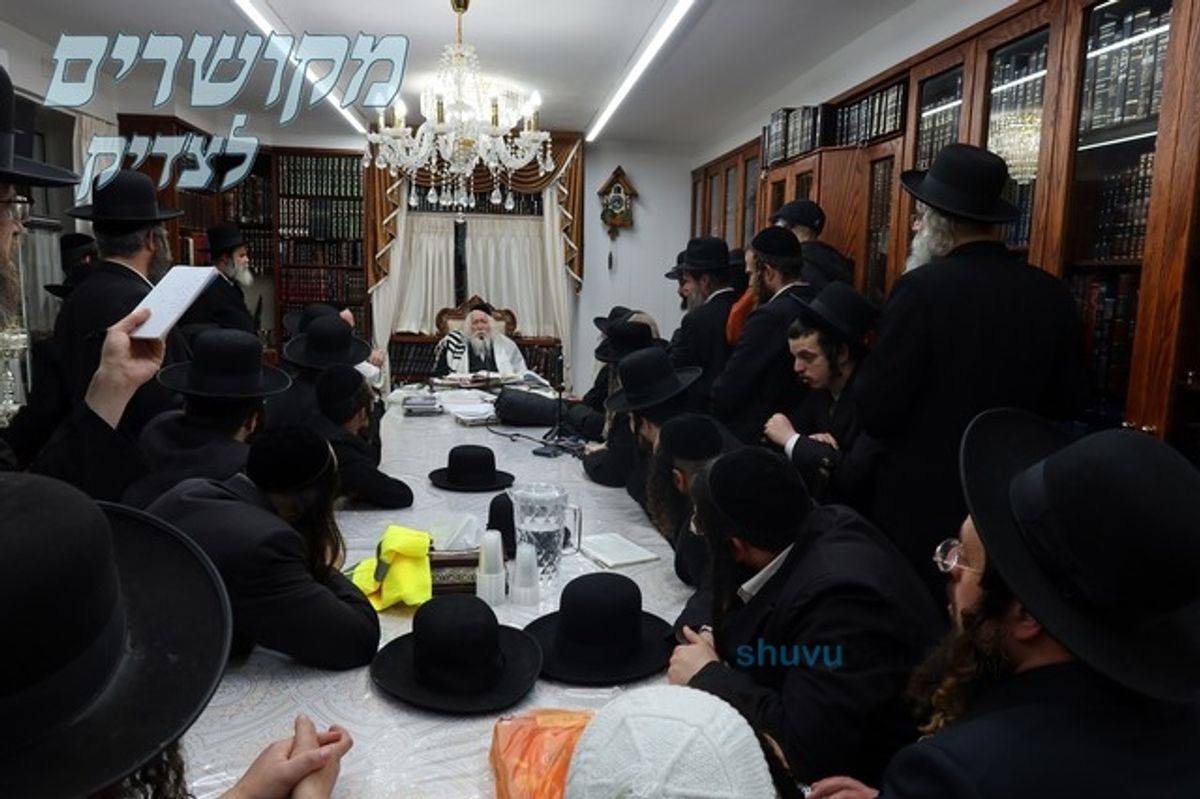
On Sunday, the 9th of Adar, Parshas Ki Tisa, a lesson was held at the home of our teacher, the Rav, Rabbi Eliezer Berland shlit"a (may he live long and good days), for the avreichim (married Torah students) of 'Mishmar HaChoma' (Guardians of the Wall).
These are the same avreichim who answered the call of our teacher, the Rav shlit"a, to stand guard during prayer times so that the children would pray and not, G-d forbid, "graze in foreign fields" (wander off to inappropriate places) or go to the friction points on the road adjacent to our Beis Medrash (study hall). As mentioned, our teacher, the Rav shlit"a, delivered a lesson to them for an hour and five minutes. Before you is a summary of the topics our teacher, the Rav shlit"a, spoke about during the lesson:
There is a halachic (legal) discussion regarding who must fortify the windows that children throw stones at. The Pischei Teshuvah writes that it is the nature of children to throw stones. The Nazis said that when they reached the Holy Land, they would immediately destroy the Kotel (Western Wall). One hundred thousand Germans were approaching, but a minyan (quorum of ten) of Breslovers, including Rav Mordechai Lozer Rubinstein, went on the 17th of Tammuz to the tziyun (gravesite) of the holy Ohr HaChaim, and thus the decree was annulled; they ended up drinking water from a sewage pipe and suffered a defeat at the gates of the Holy Land. There were those who did not want to swear an oath and were thought to be thieves, like Reb Yokel, who thought the shamash (synagogue caretaker) had stolen the money and fired him, and later had to pursue him to ask for forgiveness. There was someone who came to Kfar Chasidim from Ironi Vav and shared that a lecturer from the yeshiva came and told them: "If you don't want to be like Abraham, at least don't be like Terah!" Haman did not agree to give several days of holiday; he wanted it all "in one day." He knew everything would be overturned, but he had a mission from Amalek. However, in the end, from the 11th of Adar one can read the Megillah, and the feast continues until the night of the 17th. On Purim, we do not just drink and get drunk; on Purim, we only dance—"And Esther spoke yet again before the king, and fell down at his feet, and besought him with tears." There were forty children whom bears consumed, and it turned out these children were born from a mother who conceived on Yom Kippur, rachmana litzlan (may the Merciful One save us). When a person studies Torah, the light he possesses is visible upon his children. A child doesn't necessarily need a kiss or a hug; a child knows how to grow on his own. There are four responsa from the time of the Beis Yosef that mention Oznei Haman (Hamantaschen), because this comes to rectify hearing—the light of the ear. "And He called to Moses"—listen, for Hashem is calling you. "Dear to their owners" (Yakar l'va'aleihen), "Yerek" (greenery) as written at the end of Bava Metzia—that there is an "Upper Tzaddik" who sees nothing of this world. Just as Rav Levi Yitzchak asked Rav Mat'as, "How do you walk around with your eyes open?" He replied that he sees nothing. But the "Lower Tzaddik" must pour dust over his desires; he must struggle. The Upper Tzaddik has nothing left to rectify here; he exists only to help people. Thus, the Upper Tzaddik merits the 310 worlds and brings merit to the Lower Tzaddik, as brought in Smichas Chachamim. Then the Tzaddik can create a new soul for everyone. Is the captivity Khan Yunis? The captivity is the lusts! People in captivity have done teshuvah (repentance). In the cleft of the rock, Hashem told Moses, "You cannot see My face, only My back." The Gemara in Berachos says that the Holy One, Blessed be He, showed him the knot of the Tefillin—the Yud of the Tefillin of the hand. Rabbi Akiva is the numerical value (Gematria) of the "small Aleph" (Aleph Ze'ira), and he merited the Shin of the Tefillin, ascending from the level of Heh to the level of Aleph. Moshe Rabbeinu (Moses our Teacher) argued with Hashem, saying, "I want there to be a complete Geulah (Redemption), not a half-redemption; send someone else in my place." Even before descending with the Tablets, he saw Rabbi Akiva and said to the Holy One, Blessed be He, "I want You to give the Torah through the hand of Rabbi Akiva." The whole matter of "Vayigash" (And he approached) is to reveal "I am Joseph!" From Moses to Rabbi Akiva is another 1,380 years. Hashem said it is impossible to bring him forward by 1,380 years. Rabbi Chanina ben Dosa rectified the Names through the eating of a kav (a measure) of carobs. Thus, Rabbi Akiva, who underwent iron combs, merited to see Hashem face to face. In truth, Rabbi Akiva is essentially Moses, who had to undergo iron combs and then cry out "Shema Yisrael," for there is no great wisdom in crying "Shema Yisrael" while eating and drinking... So, whoever merits to die for Kiddush Hashem (sanctification of G-d's name) merits to see the "Face." Those who died for Kiddush Hashem merit to see the Face. All six million who died for Kiddush Hashem merited to see Hashem face to face; they are in Heaven enjoying the radiance of the Shechinah (Divine Presence). Those who were murdered merit to be among the Ten Martyrs of the Kingdom. "O G-d of vengeance, Hashem, O G-d of vengeance, appear"—the initials of this verse form "Ana Ani Ba" (Where am I going?), which Reuben understood: the tikkun (rectification) for the selling of Joseph would only be through those killed among the Ten Martyrs, those killed for Kiddush Hashem.
Subscribe to Our Newsletter
Receive Torah articles and inspiration directly in your inbox