
"And the People Saw that Moshe Delayed in Coming" • Parshat Ki Tisa from the
Gaon and Tzaddik Rabbi Eliezer Berland shlit"a
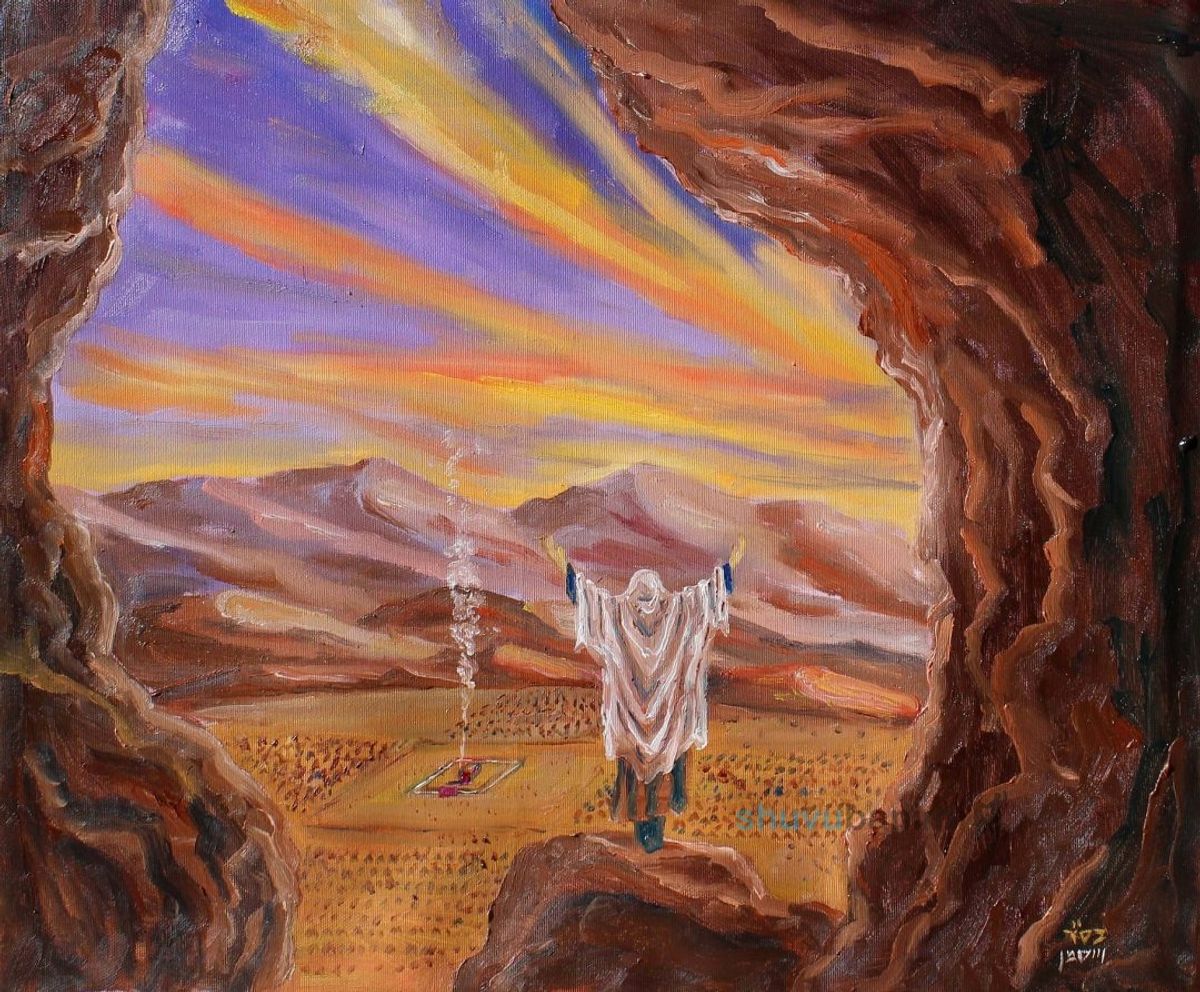
What happened when the fortieth day of Moshe’s ascent to heaven arrived? What caused them to think that Moshe had died? What is the true reason why they thought Moshe died, according to the words of Rabbi Natan?
Insights and pearls for the weekly Torah portion of Ki Tisa from the Gaon and Tzaddik Rabbi Eliezer Berland shlit"a (may he live long and good days); these are his holy words:
"They Don't Understand Who the Tzaddik Is!"
When the Jewish people made the Egel (Golden Calf), they took the image of the ox from the Merkavah (Divine Chariot). As it says in Midrash Rabbah on Shemos, they took the ox from the Merkavah. The Ramban (Nachmanides) brings this Midrash stating that they saw the Merkavah, that Hashem descended with the entire Chariot—the form of a lion, the form of an ox, the form of an eagle, and the form of a man. Hashem warned, saying, "I see that in the end, Moshe will disappear from them, and they won't know what happened to him. Then, their end will be to take this form."
He descended with the four creatures—lion, ox, eagle, and man—and Hashem said, "I see that they will ultimately stumble through the form of the Merkavah, which is the form of the ox; this is the time of Mincha (the afternoon prayer)." Since he delayed (boshesh), and did not descend, the people gathered against Aaron. The Sages say the Satan (the Accuser) found his opportunity; at that hour, Moshe appeared suspended between heaven and earth. They saw Moshe suspended between heaven and earth, poor man, he couldn't move, and they pointed at him with a finger, saying, "For this man Moshe..." what happened to Moshe?
The Gemara (Talmud) says in Tractate Shabbos, and Rashi also brings it in Shemos on the word "Boshesh" (delayed); they describe exactly what happened at that moment. The Jewish people were not so foolish that they would suddenly make a calf. In Parshat Ki Tisa, Rashi says, "And the people saw that Moshe delayed (boshesh) to come"—what is "boshesh"? When Moshe ascended the mountain, he told them that in another 40 days I will come. They calculated from the day he ascended. But on the day he ascended, he only went up, it was only 6 hours, it didn't count as a full day. He meant, "I will come within 6 hours [of the 40th day]," but they included the day he went up in their count. Then the Satan came and told them the 40 days are already over. The Satan came and confused the world; it became dark, gloomy, with voices, lightning, and thunder. Moshe is gone, the world is about to be destroyed. Who sustains the world? Moshe Rabbeinu! It became dark, gloomy, and chaotic; he said, "Moshe has certainly died." They felt they had to do something, to take the lion of the Merkavah, the ox of the Merkavah—they had to do something. Therefore, chaos came to the world.
The Satan told them Moshe died, as the Gemara brings in Shabbos at greater length. Rabbi Yehoshua ben Levi said: What is written, "And the people saw that Moshe delayed (boshesh) to come"? Do not read it as "boshesh" (delayed), but rather "ba shesh" (six hours have come). It was already 6 hours past noon, the time of Mincha. Therefore, the Gematria (numerical value) of Mincha is equal to "Egel" (Calf)—Mincha is 103 and Egel is 103. Today, during Mincha, we rectify the ox of the Merkavah; we rectify the sin of the Golden Calf. But for them, it was exactly the opposite; the Calf took hold of them at the hour Moshe delayed in coming. What did he tell Israel? "At the end of 40 days, at the start of the 6th hour, I will come." At the end of the 40 days, the Satan came and threw the world into turmoil. He made sounds and lightning so there would be darkness, gloom, chaos, voices, lightning, and thunder—"It's over, the end of the world, the world is finished, there is no world." In a few more minutes, the world will end. If they don't grab someone from the Merkavah, some image from the Chariot, and crown it over them, then the world will be destroyed. Just as it is written regarding Lot, he thought the world was destroyed and finished; he was like a block, like Adam HaRishon (the first man) now.
So a person says, "In any case, everything is destroyed, it's the end of the world." So at the end of the 40 days, the Satan came, confused the world, and said to them, "Moshe Rabbeinu—where is he?" Where is Moshe? Where? Why hasn't he come? The Satan spoke to them, appearing in some form and began talking to them. They said to him, "He ascended to the heights." They told him he was just delayed. At first, the Jewish people did not pay attention to the Satan. They weren't like that, to be confused in a single second. They told him, "Stop talking nonsense, Moshe will be here soon." They didn't listen to him. He said, "He's dead. I'm telling you he is already dead." They still didn't listen; Moshe cannot die, there's no such thing. Then he showed them the form of Moshe's bier (coffin); he showed them a funeral in heaven, a funeral in heaven, the bed of Moshe, with angels walking with candles. Then they said, "For this man Moshe..." It was because they saw the funeral in heaven. Rashi says the Satan came and confused the world, and there was the appearance of darkness and gloom, the appearance of cloud and thick darkness and chaos. "Moshe has certainly died."
The Amshinov Rebbe asks: With all due respect to the Jewish people, even if there was chaos, darkness, gloom, voices, lightning, and thunder, and even though they argued with the Satan and didn't want to believe him until he showed them Moshe Rabbeinu's funeral—but what is the meaning of a funeral? Does a tzaddik die?! How could they think the tzaddik died? They all had Ruach HaKodesh (Divine Inspiration); they spoke with Hashem "face to face." Where was their Ruach HaKodesh? People saw Hashem "face to face," their spiritual impurity had ceased—how could it be heard that they did such a thing, to stray after the Calf? Even if we say the Erev Rav (Mixed Multitude) misled them, what does that have to do with it? Can you confuse a person like that? The Erev Rav comes and tells you "Romus and Yamus," the sons of Balaam have arrived—can one be confused by this?! How can we understand this?
Rather, Rabbi Natan says that this is where the mistake lies: that we never know the true greatness of the tzaddikim! We have no grasp at all of the greatness of the tzaddikim! [We think] perhaps a tzaddik is a person with hands, feet, a nose, eyes, and a mouth. Perhaps he went there into the deserts and did Hisbodedus (secluded prayer); well, he did Hisbodedus in the deserts, so because he did Hisbodedus in the deserts, it's understandable—I too, if I had gone for 80 years there, I too would have received prophecy. It's no great trick; he fled from Pharaoh, wandered in the deserts for decades, so Hashem revealed Himself to him. Hashem also revealed Himself to Balaam. What's the problem? If I go do Hisbodedus now, I will also receive such Ruach HaKodesh. Any Jew who goes and does Hisbodedus for 80 years will receive Ruach HaKodesh. Is there some special matter here? So a man went to the deserts and Hashem revealed Himself to him. One day, he abstains from the pleasures of the world, he doesn't eat or drink, he eats only herbs—so he begins to prophesy; it's a simple thing.
So Rabbi Natan says that the whole point we saw is that we have no grasp of what the tzaddik is. To us, the tzaddik is a person with eyes and legs; yes, he merited that Hashem spoke to him because he went to the deserts. But who is the tzaddik??!! What does it mean? How was he born! How did he descend—from which Sefiros (Divine emanations) did he descend! It is true that he had to pass through everything every person passes through; he must pass through it in the blink of an eye, what every single person goes through. But he passes through it in the blink of an eye! He doesn't enter it for a single second! He doesn't enter into any [improper] thought! He doesn't enter into any [improper] looking! This world to him—is not even like the blink of an eye!!
The lesson has undergone editing, and if any error has occurred, it should not be attributed G-d forbid to the Rav shlit"a, but to the writer, and "may our error remain with us."
Illustration courtesy of the artist R' Yehoshua Wiseman. To purchase: www.yehoshuawiseman.com
The Shuvu Banim website wishes all followers and readers a Shabbat Shalom and Mevorach!!
Subscribe to Our Newsletter
Receive Torah articles and inspiration directly in your inbox