"And This Happens Every Chanukah, That We Defeat All the Enemies"
HaGaon HaTzaddik Rabbi Eliezer Berland shlit"a
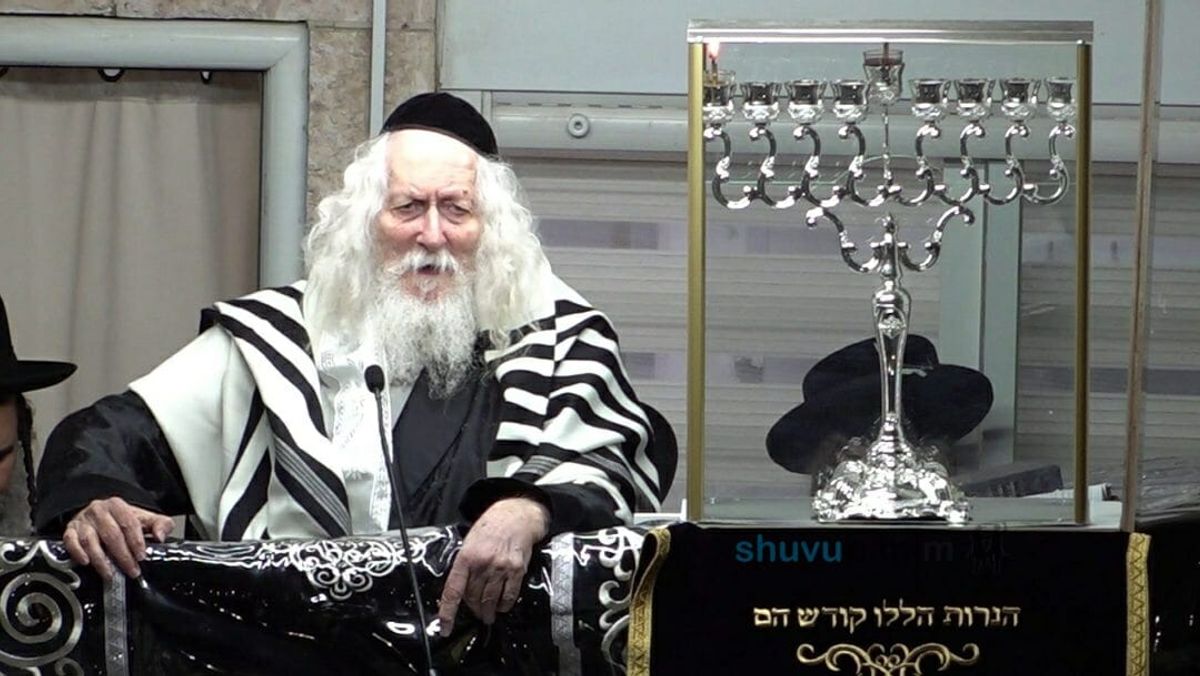
The full lesson delivered by our teacher, the Rav, Rabbi Eliezer Berland shlit"a, on Sunday night, the 25th of Kislev 5785, the first night of Chanukah, after the Maariv (evening) prayer:
Sunday night, the 25th of Kislev, Parshas Miketz, after the Maariv (evening) prayer.
It is written, "And the yoke shall be destroyed because of the oil" (Isaiah 10:27)—this refers to the oil of Chanukah. The oil of Chanukah burns away all the nations, leaving no trace of them. As King Hezekiah said, "Sit at My right hand" (Psalms 110:1). It is written in the Zohar (101a): Hashem said to Abraham, "Sit quietly, stop acting wildly." You went to Shuvu Banim, so you are acting wildly all day. Why are you throwing sand and it becomes swords? Why are you throwing straw and it becomes arrows? Who told you to do this? Why do we need to throw sand for it to become swords, or straw to become arrows? Sit quietly, "Sit at My right hand"—be silent, stop acting wildly, all of you stop acting wildly. Sit quietly and recite Tehillim (Psalms) all day, recite Likutey Tefillos (the collected prayers of Reb Noson of Breslov), and you will see an angel of Hashem come and strike them all down. Like King Hezekiah—learn from Hezekiah. The Gemara says in Sanhedrin 97b: Just as they came against Hezekiah, it is written there were two hundred thousand myriad, which is two billion six hundred million. That is how they came with the four kings who came to conquer the five kings. That is exactly how they will come with Gog and Magog, for it is the exact same number.
The Megaleh Amukos (a classic Kabbalistic work) explains in Parshas Noach: A person has Sh'a (370) myriad lights. Every person has this—the Name "E-l" on the right. The pe'ah (sidelock) begins with "E-l Rachum VeChanun" (G-d, Merciful and Gracious) (Exodus 34:6), so it is beneath the pe'ah. The pe'ah itself is "Hashem, Hashem," which is above the Thirteen Attributes of Mercy. After that, there is "E-l Rachum VeChanun," which begins below the ear, the narrow place beneath the ear—the pe'ah under the ear, the hair under the ear, this is called "E-l." There is one on the right and one on the left. "E-l" in its spelled-out form (Aleph, Lamed, Peh) equals 111. Peh is... Aleph-Lamed is exactly 74—185. Twice 185 is Sh'a (370) myriad lights (Nehorin), which Chava (Eve) possessed. For Chava had all the 370 myriad lights. But after the Tree of Knowledge, this was diminished. However, our entire work of saying "She'asa Nissim" (Who performed miracles)—the Ari z"l (Rabbi Isaac Luria) says—when we say "She'asa Nissim," we should meditate on the 370 myriad lights that return on Chanukah. Every Chanukah, the 370 myriad lights that Chava had return. Adam did not have this; for Adam it was "Do not look at the kankan (vessel)"—Kankan (Kuf-Nun-Kuf-Nun)—he only had a third of the 370. Chava had three times more than Adam HaRishon—370 myriad lights. She illuminated from one end of the world to the other. A person could not even look at Chava's face. And even though Adam's heel outshone the orb of the sun, her face was already such a light, an infinite light, the light of the seven days. "And the light of the moon shall be as the light of the sun, and the light of the sun shall be sevenfold [as the light of the seven days]" (Isaiah 30:26). We will read this Haftarah (prophetic portion) in Parshas Miketz.
Next year, no one will read Miketz, no one. I am warning you, no one will read Miketz. Next year there is no such thing as reading Miketz; I am personally against you reading Miketz. You'll manage without it. I don't know which Parsha you will read, but not Miketz—this is your last opportunity to read Miketz. But the Haftarah is the same Haftarah: seven lamps and seven lamps, and seven pipes and seven pipes—seven times seven times seven is 343—49 times 7 is the numerical value (Gematria) of "For he is also (B'shagam) flesh" (Genesis 6:3), which refers to the 343 (Sh'mag) lights. The Tzaddik illuminates not just like the light of the sun, but he illuminates 343 times the light of the sun! The heel illuminates like the sun. But the face illuminates 343 times the light of the sun. This was Chava's face before the sin, how she would illuminate. For she would receive directly from Arich Anpin (the 'Long Face' or Divine Patience). A man must pass through—ascending from Malchus to Hod, and from Hod to Netzach—from Malchus to Yesod, from Yesod to Hod, from Hod to Netzach, from Netzach he ascends to Tiferes, from Tiferes to Gevurah, from Gevurah to Chesed, from Chesed to Da'as, from Da'as to Binah, and from Binah to Chochmah, and then he merits Keter (the Crown). But the woman directly merits Keter, "When you raise the lamps" (Numbers 8:2). The woman—"A woman of valor is the crown (Ateres) of her husband" (Proverbs 12:4). She only needs to think of Teshuvah (repentance), and as soon as Yom Kippur and Kol Nidrei arrive, she immediately illuminates with all the 370 myriad lights. She only needs to go out in the morning to the dances; they take her by force to the dances.
I personally protested against the dancing, because my mother didn't dance on Yom Kippur, nor did my grandmother, nor my mother's grandmother. Where did this custom to dance on Yom Kippur come from? I didn't know about this thing! It was the Marian family that invented this. Dancing on Yom Kippur, girls—we never heard of such a thing! And the police go and take all the girls out of their houses, take them out of their beds, they have to go and dance. No one understands why. I made signs, all of Shuvu Banim went out to protest—we are against dancing on Yom Kippur. Then someone came and showed me it's a Mishnah; I didn't know.
It is simply a Mishnah at the end of Taanit (4:8), that on Yom Kippur all the daughters of Israel go out in dances and circles. And after that, there is another tragedy, another catastrophe. Suddenly everyone arrived, and all the girls arrived, two million girls arrived, and suddenly a loudspeaker comes out telling them to change their dresses. Truly shocking, a catastrophe! Girls traveled to London, traveled to Manchester, traveled to Switzerland, traveled to China. There are women who prepared dresses worth millions of dollars, with "ruby, topaz, and emerald; turquoise, sapphire, and diamond"—all the diamonds in the world. Suddenly they are told to change; they didn't grasp what was happening. Suddenly a voice comes from the tents—each one should enter a tent and give her dress to that girl from Shuvu Banim who is wearing rags, who is wearing a dress she found in a puddle, she found a dress in the dumpster (green bin). And everyone is crying, everyone is simply... the ocean rose by a hundred meters, and there was flooding in Miami and in New York, there was flooding, people fled their homes. It was a catastrophe. I don't know why they said this, but they said no one should come with her own dress. Each one should go with her friend's dress, take from the neighbor. And everyone had to change their dresses with weeping and shouting, with "Gevald" (a cry of distress)—everyone is shouting Gevald. Why? Because each one had made...
But why the dancing? This still remains a question—what is the purpose of the dancing? On Yom Kippur we don't do dances, excuse me, I don't know the source of this custom. What is this custom to dance on Yom Kippur? Did you start this custom? No, no, not you. You're okay. So where is the custom to dance on Yom Kippur? Rather, the Yerushalmi (Jerusalem Talmud) says in the sixth chapter of Yoma, and it also says in the sixth chapter of Shabbat: that every woman would place her red scarf on the window before Kol Nidrei, or even her red dress, and place it on the window. And within... the moment they say Kol Nidrei, it all turns white. Every moment another child comes from the women's section, "Mother, by us everything has already turned white," everything turned white. Because for a woman, all sins are atoned for in a thousandth of a second; she only says Kol Nidrei, she only sheds a tear, and already everything is atoned for, everything has already turned into merits. The more sins a person has committed—the Gemara says—the more merits there are. How? Because it is impossible to understand what Ba'alei Teshuvah (penitents) are. How can they leave all the impurity, all the filth, all that the Sitra Achra (the 'Other Side' of evil) offers them—how can they leave it at all... No one... I wouldn't have been able to leave. I don't know, like they tell about Ronen Dvash, whose Kippah (skullcap) fell off his head and he went back [to the prison]. A total madman, I would have hospitalized him in Eitanim. Now, I asked him on Thursday: Tell me, are you crazy? Why would you go back for a Kippah? He said, "I'm going back to prison, I don't have a Kippah"—his Kippah fell off on the way, so he went back to prison. Simply crazy, simply insane, but... I'm sorry to say this in public, but what can I do? I wouldn't have done that, in no way. If I had escaped from a prison in India, and I was climbing over the wall and saw I didn't have a Kippah, I would have jumped straight into the street—it's over, we're out. He says no, he says "Without a Kippah I don't move." They told him in prison to cut his Peyos (sidelocks), the other prisoners told him to cut his Peyos, but he wouldn't agree to cut his Peyos. And then when he escaped, all the streets had his picture, but the pictures were without Peyos—they were the pictures from when he entered the prison. In the meantime, he grew Peyos and they could no longer recognize him. Policemen are walking—five policemen arm-in-arm crossing the road, walking and looking at everyone. And he even asks them for a cigarette, "Maybe I could have a cigarette, please." They see someone with Peyos—who knows, maybe some Sheikh who arrived from Tibet or Nepal, who knows who this is, what is this hair, what are these braids? He has braids coming from his ears.
So all this is to say that for women, in one second everything is atoned for; with one tear everything is atoned for, and then they are left to dance. Each one put on a red scarf, put on a red thread, put on a red sweater, and by morning it all becomes white, everything whitens; by the time dawn (Alos HaShachar) arrives, everything whitens. They just need to go out in dances now. And that's how it was in the First Temple—all through the First Temple, and that's how it was in the Second Temple. And that's how it will be in the Third Temple: the women will go out in dances. The men will sit in the synagogue, at the Kotel (Western Wall), and weep and prostrate themselves on the ground, and the women will go out in dances in all the streets, in the vineyards outside the city, so they won't be seen.
So when Chanukah arrives, that is the final seal (Chosem). Now we are in a seal within a seal, and the final signing is on Chanukah. Hashem waits until Chanukah; He waits for everyone until Chanukah. To see how he lights the candle, with all the melodies (Niggunim). The melodies alone take half an hour, because for half an hour it is forbidden to do anything—it is forbidden to cook, forbidden to do anything for half an hour. So the melodies take exactly half an hour. When we say "Lamnatzeach Biniginos" seven times, and "Ana B'Koach." And everyone sings slowly, "Rejoice in Hashem, O you righteous." This is the custom in all communities; they even add more chapters and more melodies. It comes out to exactly the half hour during which it is forbidden to do any work during the lighting of the candles.
Now, we light the candles twice, because it is permissible to light candles even a hundred times. Even in Butshash (Buczacz) they would light the candles a hundred times; the same Shamash (attendant) would go from room to room, and for every candle, he would light a Menorah with blessings. A person can light as many times as he wants, for more houses, for more women, for more people. But if the woman has already lit, the man can no longer light. If the man is currently in Uman, he needs to light before the woman—he lights at four, and she lights at five past four.
So now we return to the matter of Chanukah, to the oil of Chanukah: "And the yoke shall be destroyed because of the oil"—Hashem says to Abraham, "Stop acting wildly, stop throwing swords, stop throwing arrows, enough of these follies. Sit and recite Tehillim, recite Likutey Tefillos, and you will see an angel of Hashem come like with King Hezekiah"—an angel of Hashem came and in a second the souls of two billion six hundred million flew away. And this happens every Chanukah, that we defeat all the enemies, we defeat all the haters, all the enemies.
Now, we traveled to Shechem (Nablus) this past Saturday night; they threw a thousand grenades at us. But everything turned back upon them; the poor things, they all evaporated, they became air. As it is written in the Gemara on page 36 of Sotah, that when they went to the Land of Israel, how did they get to Shechem? How is it possible to pass through a thousand villages—through ten thousand villages that would slaughter everyone? Would the Arabs be silent? Would the enemies be silent? How is it possible to pass? So what does the Gemara in Sotah 36a say? That everyone flew through the air, the entire camp! Billions of people. Each one has four wives, each wife has forty children—that's 160 children for each person. If we multiply six hundred thousand by 160, we reach almost a billion. A billion people flying through the air! They simply take twelve stones from the Jordan at the Gilgal, and they have to carry them. Each stone is forty Seah—that's forty tons; each stone is forty tons, and each person lifted forty tons by himself. And they walk with them—twelve in the Jordan, twelve at Mount Ebal. We saw this past Saturday night, Mount Ebal across from [Mount Gerizim]. It has remained a desolation until today; three thousand three hundred years since the Exodus from Egypt, it still remains a desolation. And there they established the altar, and there they wrote—they managed to write—everything in one day; the sun stood still for sixty hours. So they plastered all the stones with lime and wrote in seventy languages. And Joshua wrote in seventy languages; he had the "Oath of the Quill," he was able to write the entire Torah. They wrote all the Five Books of the Torah in seventy languages. The nations came and peeled it off, and then they all became liable for destruction. For you see the holy Torah, you see the miracles. "And there remained no... spirit in any man" (Joshua 12:1). Even Rahab says, "There remained no spirit in any man," for you crossed the Red Sea. Then Korach said it was an optical illusion, there was no Red Sea, and it was all nonsense, Moses tricked you... and everyone believed him! People in a second believe someone who opposes the Tzaddik! Of course, they were all swallowed by the earth immediately, for anyone who opposes the Tzaddik is ultimately swallowed by the earth!
Except for one man whose wife bought him champagne (On ben Pelet). At the very least, he gained champagne; that's what he gained for opposing the Tzaddik—he received a bottle of champagne, fell fast asleep, slept well, and when he woke up, he saw that everyone else had been swallowed by the earth. So any woman who has a husband who opposes the Tzaddik should buy him a bottle of champagne so he will sleep very, very well until the end of his life.
Subscribe to Our Newsletter
Receive Torah articles and inspiration directly in your inbox