How Does Gideon Release Soldiers Before a War Instead of Recruiting More? The
Gaon and Tzaddik Rabbi Eliezer Berland shlit"a
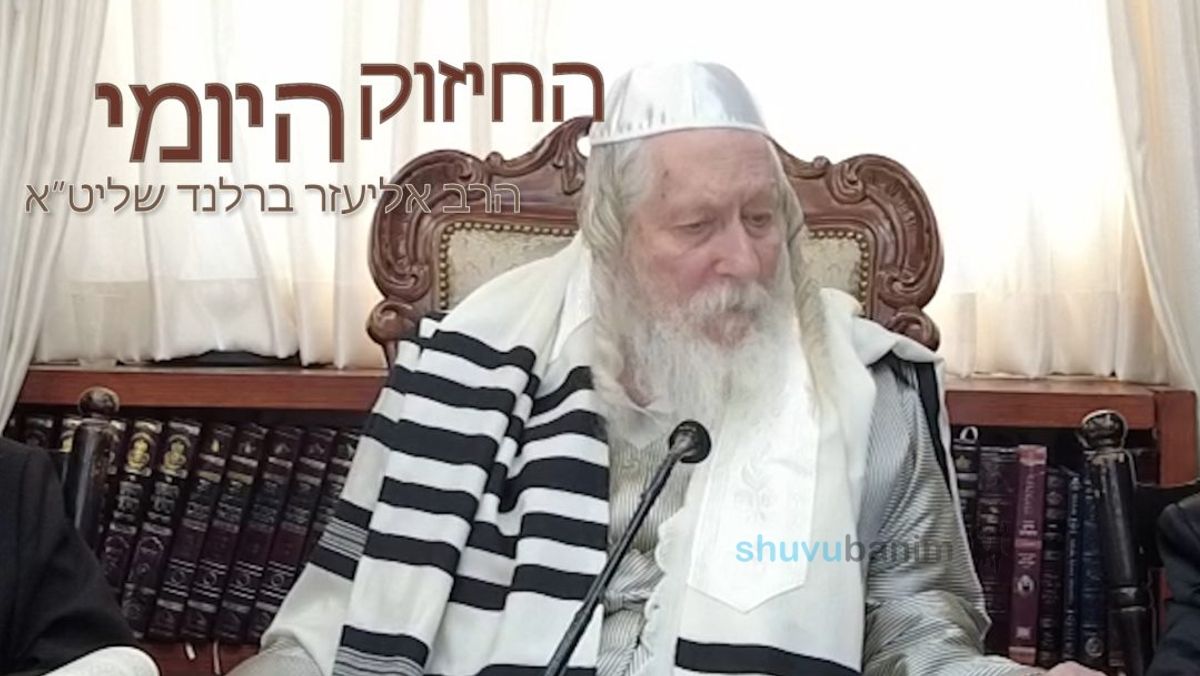
What happens to a boy on the day of his Bar Mitzvah? How did Gideon succeed in defeating a massive army with only 300 soldiers? A fascinating article on emunah (faith), bitachon (trust), and choosing men of valor in the way of Hashem - the daily chizuk (spiritual fortification) from our teacher, the Gaon and Tzaddik Rabbi Eliezer Berland shlit"a
Military logic dictates that to win a war, one needs as many soldiers as possible, but Gideon does exactly the opposite—he sends thousands of fighters home moments before the battle against a vast army. How does this make sense?
Why does specifically a minority of fighters bring the salvation?
And what can we learn from this for our times?
Join the journey following Gideon and Hashem’s leadership in the wars of Israel, under the guidance of the Gaon and Tzaddik Rabbi Eliezer Berland shlit"a.
Wednesday, 28th of Shevat 5785, these are his holy words:
Let us explain what a Bar Mitzvah is - a Bar Mitzvah is when the boy receives a new Neshamah (soul).
The Rav asks the Bar Mitzvah boy: Do you want to be a tzaddik?
The boy answers: Yes!
Then you now have a new soul; now his soul only wants Hashem. We just read, "And behold, Hashem stood over him" (Genesis 28:13). "And behold, Hashem stood over him" at the Bar Mitzvah, because the Bar Mitzvah boy receives a soul from the world of Atzilus (Emanation). The moment he says - yes, I want to be a tzaddik, he receives a soul from the world of Atzilus! Then he only wants holiness, he only wants Hashem.
https://vimeo.com/1060246587?share=copy
The boy must do teshuvah (repentance) for everything that happened until the Bar Mitzvah; if he does teshuvah, he will remain a tzaddik even after the Bar Mitzvah!
Because a person is full of blemishes of the Bris (covenant of purity), "Behold, I was brought forth in iniquity, and in sin did my mother conceive me" (Psalms 51:7). David was a ben temurah (a child born of a substituted intention), therefore a punishment was placed upon his father Yishai to return in a reincarnation as Rabbi Chiya, and then his wife always caused him troubles, all day long ("And so too King David, peace be upon him, did not emerge from the Chitzonim [external forces of evil], except through that act mentioned by our Sages of blessed memory on the verse 'Behold I was brought forth in iniquity,' for Yishai, David’s father, thought he was coming to his concubine, but she was actually his wife... and this is the secret of Tamar, Ruth, Rahab the harlot... for this is the deception and tactic that the Holy One, Blessed be He, performs with the Klipah [the shell of evil], deceiving it to extract a captive soul from within them..." [Sha’ar HaGilgulim by Rabbi Chaim Vital zt"l, Introduction 38]).
It is written that Yishai, David's father, was reincarnated as Rabbi Chiya because David was a ben temurah. Why was he a ben temurah?
Because it is written: "An Ammonite or Moabite shall not enter the congregation of Hashem; even to the tenth generation..." Today we know the Halacha (Jewish law) is "a Moabite man and not a Moabite woman," but back then they did not know the Halacha. "You shall not abhor an Egyptian, you shall not abhor an Edomite," "even to the tenth generation shall they not enter the congregation" (Deuteronomy 23:4).
Avner said, "Whose son is this youth?" (I Samuel 17:55). What does that mean? You don't know who the youth is? You don't recognize him? He has been playing music for you (Saul) for half a year!
Perhaps Saul recognized his father? For it is written in the Gemara Berachos (58a) that David's father would go out with 600,000 people. Today they ask: to enlist, or not to enlist? Whereas then there were 600,000 soldiers, all of whom were Breslovers and Yeshiva students—six hundred thousand soldiers (Tractate Berachos page 58).
Saul asks about David: Who is this? Whose son is he? He doesn't recognize his father. Saul asks Avner, do you know his father? "And Avner said: As your soul lives, O King, I do not know." He swore that he did not know him nor his father, "As your soul lives."
The entire army today is a hundred thousand; then there were 600,000, all of them Yeshiva students. They only took to war those who did not speak between Yishtabach and Yotzer Or (parts of the morning prayer), and who also did not speak between the Tefillin of the hand and the Tefillin of the head (Tractate Sotah page 42a). If a person accidentally spoke between the Tefillin of the hand and the Tefillin of the head, they did not accept him into the army.
Gideon arrived at the war with 32,000 soldiers (Judges, Chapter 7), all of them Yeshiva students. He told them, you are going straight home; he sent them home—"draft dodgers." What about "bearing the burden"? "Equality in the burden"? What kind of equality is this? How will 10,000 succeed? They had to manage a war against a million people; they were "like the sand of the sea," without number, there was no number to the camels.
Gideon started with 32,000 soldiers, then he said that 22,000 should go home. What is this? This is not "bearing the burden," it’s not equality, it’s not fair—that’s not how you prepare an army. Excuse me, if you are ever the Chief of Staff, you should know: he should have brought another 32,000, yet he sent them home instead. He sent them all home; he didn't need them.
Gideon did not know the Halachos (laws); he hadn't studied in Shuvu Banim and he didn't know the Halachos. He fattened a bull for seven years for the sake of Avodah Zarah (idolatry); for seven years he fattened a bull until the bull became so fat it couldn't fit under the door. Besides that, he threshed wheat in a winepress (and not in a threshing floor as is customary), and this is a Torah prohibition—it is Dash (threshing), to thresh the wheat and separate the grains from the stalks.
Gideon sat at the Seder night, and the next day he already went to thresh wheat in the winepress and to drive out Midian. What does it mean to drive out Midian? Because the Midianites would take (rob) the wheat from Israel, so they would process the wheat in the winepress. In a winepress (Gat) one makes wine, a Beit HaBad is for oil, and in a threshing floor (Goren) one threshes wheat. So they made the wine in the threshing floor and the wheat in the winepress—all this to confuse the Midianites who would take everything. They would wait for Israel to make wine and then take all the wine; it was like this for 7-8 years.
Then Hashem said to Gideon: I don't need an army, I don't need soldiers. Send everyone home, and 10,000 remained. Then Hashem said to him: this is also too many. Now take the 10,000 and bring them to the stream; whoever puts his head in the water when he drinks, we will release him. A person arrived at the stream after not drinking for three days, so he put his head in the water so he could drink. Hashem said to Gideon: whoever puts his head in the water, send him home—he was left with 300 men, while against them Midian were like locusts, millions.
Subscribe to Our Newsletter
Receive Torah articles and inspiration directly in your inbox