
How They Returned from Rabbi Meir Baal HaNes and Immediately Began to Grow Rich
• A Fascinating Story from the Gaon and Tzaddik Rabbi Eliezer Berland shlit"a
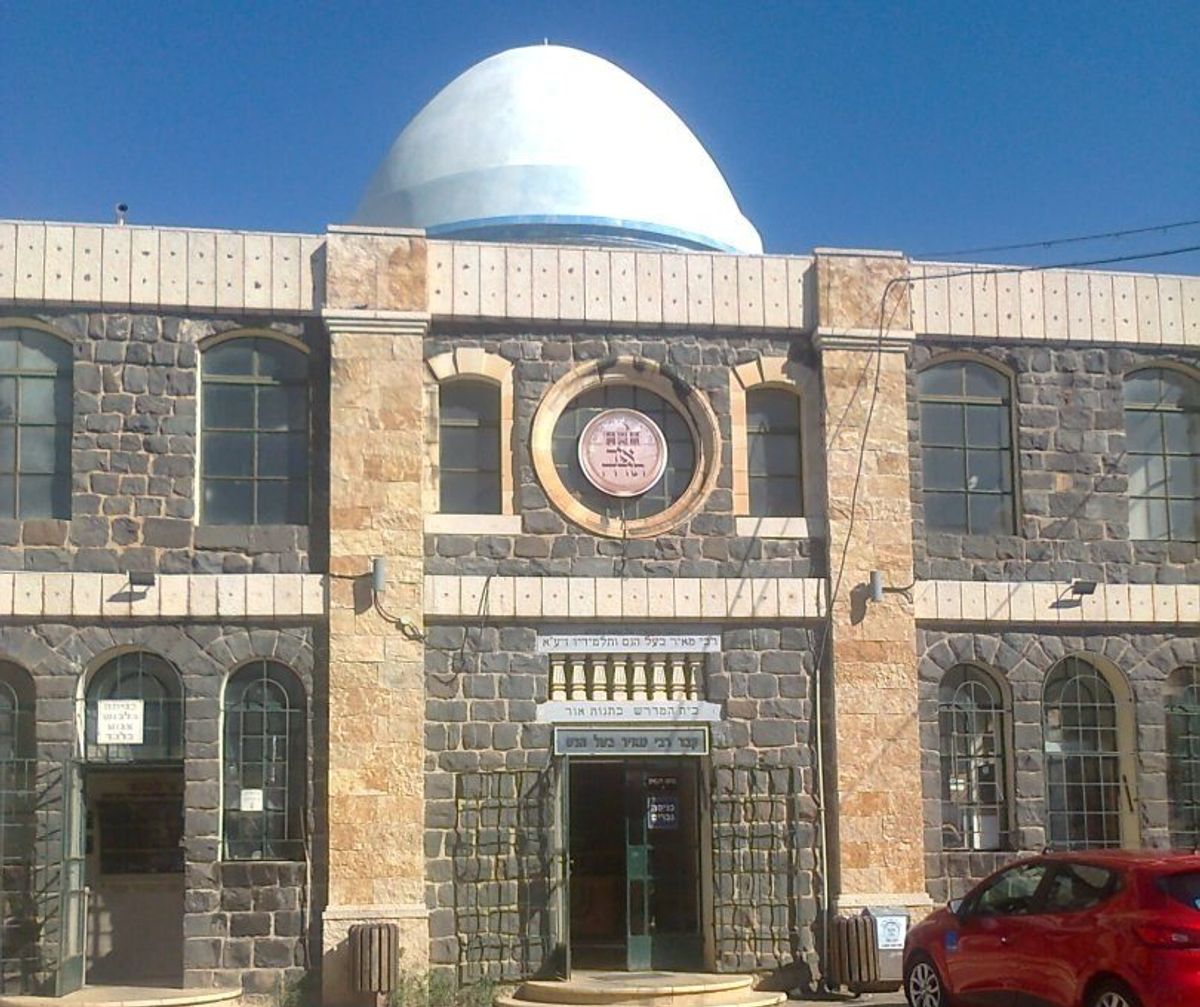
How did a poor kallah (bride) who jumped out of a taxi on the way to Rabbi Meir Baal HaNes merit to receive everything for her wedding? A special and fascinating story from the Gaon and Tzaddik Rabbi Eliezer Berland shlit"a (may he live long and good days) in honor of the 14th of Nissan—Pesach Sheni (the Second Passover)—the hillula (anniversary of passing) of Rabbi Meir Baal HaNes zy"a (may his merit protect us).
Now we will tell a story—the story belongs to Pesach Sheni [the hillula] of Rabbi Meir Baal HaNes. Today was [the hillula] of Rabbi Meir Baal HaNes; everyone will eat matzos. We are talking about a girl seventeen and a half years old who was a kallah (bride). A girl of seventeen and a half becomes a kallah, but she doesn't have a penny to her name, coming from a poor family. She needs four hundred thousand shekels for the wedding, to bring her share. She doesn't have a cent, and the wedding is in six months. Well, she decided to travel across the country to relatives and friends [of the family] to collect the entire four hundred thousand. First thing, they travel to Tiberias; it was exactly Pesach Sheni. They travel to Tiberias because there is a wealthy aunt there who will give five hundred shekels. The trip to Tiberias costs two hundred shekels—three hundred shekels—so two hundred shekels will remain. This too is for the best; one must give thanks for every penny, "penny by penny adds up." She will have two hundred shekels left, and that too—slowly but surely she will reach four hundred thousand.
So she gets into a taxi in Jerusalem—taxis to Tiberias—everyone is secular, and she is the only religious one. And he [the driver] starts to turn on the radio, his impure device—the source of all impurity! He turns on all kinds of songs, the source of all impurity! She cannot stand the music; she says to him, "Turn it down, lower it, turn it off..." He doesn't agree. They already reach the Caesarea junction—leaving Jerusalem, from Caesarea they turn toward Hadera, and from Hadera to Wadi Ara. He arrives—and two secular young men get in, also going to Tiberias, and they say to him, "Turn it up louder, louder, louder..." and it is impossible to bear. That's it, she says she will jump out in the middle of the ride, she doesn't care! She will jump out of the taxi in the middle of the ride. She says to him, "I'm jumping, I'm jumping in another second!" He says, "Fine, I'll let you out." But where will he let her out? This is Wadi Ara, it's all Arabs—a million Arabs. Wadi Ara is a million Arabs; they'll all kidnap her, she'll be a hostage. Where is he letting her out? The driver says, "I won't let you out here, you won't jump from the car under any circumstances, no! Wait until we reach the Megiddo junction; in a little while it's the Megiddo junction, we'll let you out there."
They arrive after half an hour at the Megiddo junction; he lets her out at the Megiddo junction. As soon as she gets out of the taxi, a taxi stops immediately behind her, and an old woman of ninety is sitting there. She says, "Who wants to go to Tiberias for free, Tiberias for free?" She says, "I do, I do!", "Fine, then get in." Well, she gets in with this old woman, and the old woman begins to tell her her story: that now it is Pesach Sheni and she is traveling to Rabbi Meir Baal HaNes. Today she is one of the wealthiest women in Jerusalem; they have a three-story villa, a swimming pool, all the luxuries in the world [and the old woman tells her miracle:]
"Once, a hundred years ago—we are talking about 5674 (1914), a hundred and eight years ago—there was nothing. They didn't have a slice of bread, there wasn't... there was a slice of bread with olive oil. All the food was—in the morning a slice of bread with olive oil, and in the evening..."
Rabbi Yisrael Grossman relates that he was a five-year-old boy, so his mother gave him a slice of bread without any spread, no margarine, no butter, no [olive] oil. On the way, he was in Meah Shearim, and someone there had a barrel of herring. There was Reb Naftali; Reb Naftali Cohen was the wealthiest man in Uman, he built the Kloiz (synagogue/study hall). He said the first thing is Eretz Yisrael (the Land of Israel). What do I care about the Kloiz, what do I care about everything—I am for Eretz Yisrael first and foremost; it is forbidden to live outside the Land for even a second! He left everything and came to sell a barrel of herring. Until his final day, he stood in Meah Shearim to sell a barrel of herring; everyone who passed by would ask for more herring and more herring. And from those few pennies, he made a living.
Reb Naftali Cohen was the wealthiest man—an engineer, an architect, he built the Kloiz. The priest came to him and said, "Build something for me too, why do you only build for the Jews, what, are we not human beings, are we not...!? Where is the equality, where is the 'sharing the burden,' share the burden and build something for us too!" Well, immediately he fled to Eretz Yisrael, saying, "I will go to a barrel of herring."
And Rabbi Yisrael Grossman relates that on his way to cheder (Torah school for children), the herring seller said to him, "Dip—you can dip your slice of bread in the pot, in the juice of the fish—of the herring." This gave him a little something, a slice of bread with a drop of flavor. That was all his food in the morning in cheder, and in the evening.
[And the old woman continues:] "And that's how everyone ate a slice of bread with olive oil; that was the food in Jerusalem a hundred—a hundred and ten years ago—a hundred and twenty years ago. 5662 (1902) is already a hundred and twenty years ago. That was all the food."
"And then they traveled, the whole family [of the old woman], to Rabbi Meir Baal HaNes, and they cried at Rabbi Meir's [tomb]—'It is impossible to bear the poverty, the hunger, the shame of hunger...' As soon as they returned from Rabbi Meir Baal HaNes, they immediately began to grow rich. They buy and sell, buy and sell... they buy for ten shekels and sell for a hundred shekels, buy for a hundred shekels and sell for a thousand shekels. They began to be the wealthiest people in Jerusalem. The whole family took it upon themselves for all generations that every Pesach Sheni they take some poor girl—a poor kallah (bride)—and they provide everything for her wedding! A seven-room apartment, a Mercedes, even a private plane... they will give her everything. Everything she needs, a wedding dress of course..." And so she tells her, and then she [the old woman] says to her, "Nu (well), and who are you?" [The girl said,] "I, I am that kallah, I am the kallah who has nothing." [The old woman said to her,] "Ah, so it's settled, first thing I am taking you, and look what a miracle—you joined this exact trip."
In the merit that she got out of the car and abandoned herself in the middle of the road—in the middle of the way, she was ready to jump. She merited to have everything, in every way! And with Hashem's help, may we all merit the complete Geulah (Redemption) speedily in our days, Amen!
Subscribe to Our Newsletter
Receive Torah articles and inspiration directly in your inbox