
Humility – The Greatest of All! Weekly Torah Portion with Rabbi Menachem Azulai
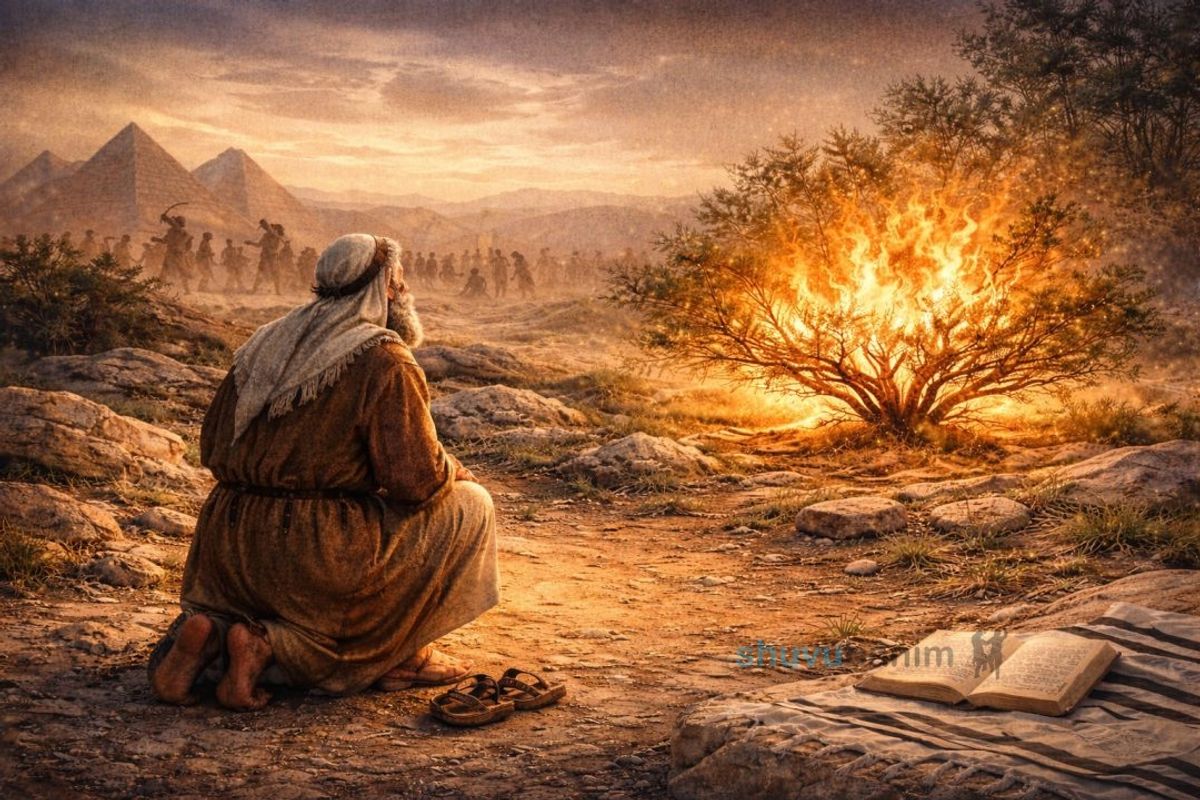
Parshat Shemot – What Did Moses See in the Burning Bush?
How wonderful is the trait of humility (anavah). And true humility, Rebbe Nachman teaches, is not a feeling of worthlessness and loss of value. On the contrary, it is the true value…
"And the children of Israel groaned because of the labor and they cried out, and their cry rose up to G-d."
Again and again, the Holy Torah hints to us about the power of prayer.
Sometimes it seems to us that there is no chance. We are immersed in desire or a bad trait so deeply that we think perhaps we will never be able to overcome it… and yet, we pray, we ask, we mention the object of our prayer at every free moment, until we feel the change. The prayer has worked.
Regarding the power of prayer, we are taught by the story of Rabbi Shimon, the student and attendant of Rebbe Nachman of Breslov zy"a (may his merit protect us):
It happened when Rabbi Shimon's child fell critically ill. He ran to his Rebbe in tears, asking him to pray for his child whose life was in danger, that Hashem (G-d) should grant him life and health. Rebbe Nachman listened to his weeping student but did not respond.
Night. Beside the sickbed sat his mother; she looked at him with eyes full of sorrow and grief, his condition was not good… The mother's sorrow reached the heavens: she wrung her hands, and from her mouth began to flow warm words, boiling words, from a torn and broken heart, words of the utmost simplicity: "My Father in Heaven! Please look at my great pain! See the suffering of my son, have mercy on him and send him a complete healing (refuah sheleimah)!…"
The next day at dawn, Rabbi Shimon knocked on the Tzaddik's doors with a repeated request that he pray for his son's recovery. When Rebbe Nachman saw Rabbi Shimon, he rushed toward him and exclaimed: "Look and see how great a simple prayer is and how great its power! The child's decree was already sealed, however, in the merit of (bizchut) his mother's warm prayers, in the merit of the sincere prayers that burst from a broken heart, the sick child merited a healing! Her simple words pierced the heavens and drew down the salvation! And if that weren't enough," the Tzaddik concluded, "the child's mother achieved through her prayer that long years of life were added to her son!"
This child recovered completely, and indeed merited an exceptionally long life – he lived for about a hundred years! And so it is written in the verse: "And the children of Israel groaned because of the labor and they cried out – and their cry rose up to G-d."
Humility – The Greatest of All!
"And he saw, and behold, the bush burned with fire, and the bush was not consumed." Why a bush (sneh)? How wonderful is the call of humility in the Gemara (Shabbat 67a): "O bush, O bush, it is not because you are taller than all the trees that Hashem rested His Shechinah (Divine Presence) upon you, but because you are lower than all the trees that Hashem rested His Shechinah upon you," for humility is one of the conditions for prophecy (Nedarim 38a) and the resting of the Shechinah (Sotah 5a).
Reb Noson, the student of Rebbe Nachman of Breslov, teaches us that only if we learn to completely subdue pride, only if we reach the ultimate nullification (bittul), then will we merit true humility (anavah).
Reb Noson succeeded, in the merit of (bizchut) his perfect humility and nullification, to transmit the light of the holy Rebbe Nachman to future generations without any blockage, and there is no other example like this in our history of such absolute nullification of a student to his Rebbe.
"When a person is told to be humble," Rebbe Nachman teaches, "he might err and fall into a low and bad mental state called 'mochin d'katnut' (constricted consciousness) and imagine in his soul that this is humility. But this is nothing but a false humility, the advice of the Yetzer (evil inclination), which tells a person that humility means worthlessness and wretchedness, smallness and lowliness, weakness and defeatism. If a person loses his value, if his mind is diminished and his wisdom is swallowed up, if he feels he has no power to act or that his deeds are not desired and have no value – can this be called humility?
"True humility, Rebbe Nachman teaches, is not a feeling of worthlessness and loss of value. On the contrary – true humility is the very value a person has, in that he is connected to his Creator and nullified to His will. Thus – his power is revealed with even greater strength, thus – his virtues shine with a precious light, thus – he merits elevation of spirit and great knowledge (da'at). From that same humility, he finds the strength to stand firm against all obstacles (monyim); he does not feel weak or poor" (Rabbi Erez Moshe Doron).
"For one must be humble to the ultimate degree of humility, to be literally nothing (ayin), without any error or ulterior motive (peniyah) at all, and nevertheless, he should be very strong and courageous, and not allow himself to be cast down by anything" (Likutey Halachot, Tefillin, Halacha 5).
Rebbe Nachman tells us (Likutey Moharan, Torah 4) that there is no such reality where a person hears a compliment and a thought of pride does not awaken within him. "For it is impossible that some greatness should not come to a person when he hears them recounting his praise." Therefore, one must be very careful, and when he hears his praise – he should say "Baruch Hashem" (Blessed be Hashem) and thus return the praise immediately to Hashem, for this is the truth – that everything is from Him, may He be blessed.
Humility – the greatest of all! The Gemara says (Avodah Zarah 20b), "And it is the father of the Torah and good traits, and according to its praise and goodness, so is its existence difficult, and a person must overcome his inclination, and with stratagems he shall wage war against his inclination which entices him to let his heart become haughty." The Gemara also tells us in another place (Niddah 30): "Even if the whole world says to you, 'You are a Tzaddik,' be in your own eyes like a wicked person."
How great is the humble person who does not 'hold of himself' (is not self-important) and does everything in secret, who is impressed by others even though in his own level he is greater than them.
"And he will see you and be glad in his heart"
Aaron is the elder brother. He sees how Moses, his younger brother, rises to greatness, yet he is not resentful. He is not jealous.
Hashem says to Moses: "And he will see you and be glad in his heart," and the holy Rashi explains: "Not as you think, that he will be resentful toward you because you are rising to greatness." And indeed, the greatness belongs to Aaron.
How difficult it is to rejoice with true joy in the joy of a friend when I myself am yearning and have not yet merited salvation. Regarding this, our holy Rebbe says that this is a very great level. "And he will see you and be glad in his heart" – for this is the essence of the rectification (tikkun) of the Redemption (Geulah), through the greatness of the peace that he will have with you and he will not be jealous of it at all; on the contrary – he will be glad in his heart. Also, Ephraim and Menashe merited that the blessing with which we bless our sons on the eve of the Holy Shabbat should be called by their names ("May G-d make you like Ephraim and Menashe, etc.") in the merit that this one was not jealous and that one did not become prideful.
"For this is the essence of vitality and existence, which is through joy and peace, and this is the aspect of 'And he will see you and be glad in his heart' mentioned above, through which the main redemption from Egypt occurred, because Aaron was not jealous of the greatness of Moses, his brother who was younger than him. For the essence of the Redemption (Geulah) is through joy as mentioned, the core of which is through the love of friends who are occupied with drawing close to Hashem in absolute truth, which is the aspect of 'And he will see you and be glad in his heart,' as mentioned" (Orach Chaim, Hoda'ah 6, 61).
To rejoice in the joy of a friend, to look with a good eye at every Jew – this is difficult work. It is the opposite of our nature, which is to see evil, to disqualify, and especially those who are different from us, to look to the sides and be jealous.
To rejoice in the joy of a friend, to love every Jew, to love Hashem – this is real life. "And this is the aspect of the vision that Moses saw in the bush, that he saw the bush burning with fire and the bush was not consumed. Therefore, Hashem showed this to Moses at the beginning of Israel's drawing near, for Hashem, may He be blessed, wanted to show Moses the greatness of the love for Israel, that He chooses them to bring them close to Him from all the seventy nations, and He hinted this to him in the bush; just as the bush burns with fire and is not consumed, so too Israel can cleave to Hashem even though He is a consuming fire, for of them it is said, 'And you who cleave to Hashem your G-d are all alive today'" (Orach Chaim, Chanukah, Halacha 4).
May it be His will that we merit the wonderful levels that arise from the Parsha – faith (emunah) in the power of prayer, humility (anavah) which is the greatest of all, true joy and rejoicing in the joy of a friend, and love and peace with all of Israel, Amen.
Subscribe to Our Newsletter
Receive Torah articles and inspiration directly in your inbox