
If We Don't Rebuke Another, the Person Will Arrive at the Truth on Their Own
The Daily Chizuk from the Gaon and Tzaddik, the Rav Rabbi Eliezer Berland shlit"a
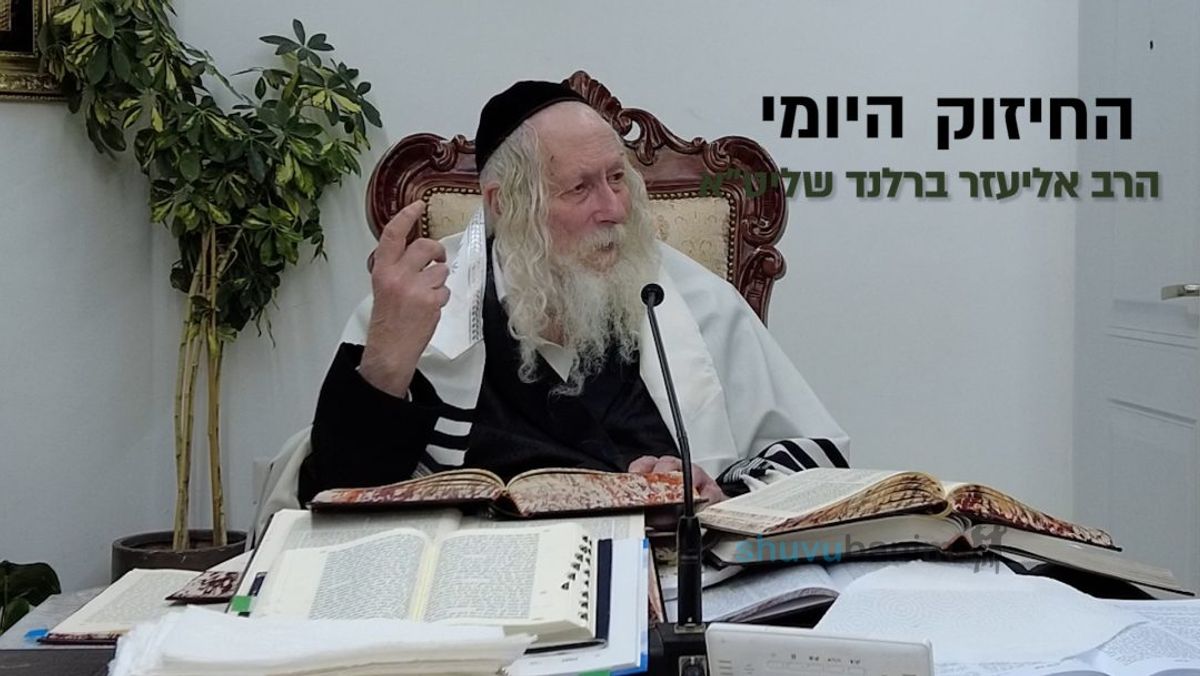
They heated the fiery furnace (Bereishis Rabbah 38:13), for after Nimrod told Abraham to prostrate himself before him, Abraham said to him, "You want me to bow to you? First, move the sun." Then Nimrod threw him into the fiery furnace, and then he confronted Nimrod.
Now, when Abraham was 140 years old, they were going to make a shidduch (marriage match) for his son Isaac. Eliezer, the servant of Abraham, was against the shidduch; anyone who has studied Rashi (Genesis 24:39) knows it is written there that Eliezer was against the shidduch.
The Daily Chizuk (strengthening) from the Gaon and Tzaddik, our teacher the Rav Rabbi Eliezer Berland shlit"a (may he live long and good days) – Friday, 22nd of Sivan, 5784
"And the man was wondering at her, remaining silent, to know whether Hashem had made his journey successful or not." The Rebbe [Rebbe Nachman] says (Likutey Moharan, Lesson 46, Part II) - if you have a kushya (difficulty/question) regarding the Tzaddik, or a kushya regarding anyone, go to the field and scream.
Kushya is an acronym for "Shema Hashem Koli Ekra" (Hear, Hashem, my voice when I call). If you have a kushya regarding Breslov, a kushya regarding Rebbe Nachman, scream about it to Hashem.
Abraham also saw that Esau would descend from Rebecca and Isaac. If Eliezer saw Esau, then Abraham certainly saw Esau. So why do you disqualify him [Eliezer]?
Lesson 46 (Part II of Likutey Moharan), kushya (difficulty/question) is an acronym for "Hear, Hashem, my voice when I call." It is written, "And the man was wondering at her, remaining silent" (Genesis 24:21). "Wondering" (mishta'eh) — what? After all, Eliezer didn't even ask who she was at all. Forgive me, but that's not how you make a shidduch (marriage match). You don't ask Rebecca who she is? You don't ask whose daughter she is? You immediately put a ring on her nose and bracelets on her hands? Back then, they wore nose rings. According to the commentary, Eliezer put the bracelets on her because he saw through Ruach HaKodesh (Divine Inspiration) that the Tablets were destined to be broken. He wanted to "join" (hatzmadah) the Tablets; he saw the Golden Calf that they were going to make, he saw the Tablets, and he wanted to cancel the shidduch.
At first, he put the bracelets on her; he didn't ask who she was at all. Later, when he told her family, he changed the story. How can you make a shidduch like that? How did you make the match? You didn't ask who she was at all—maybe she's the daughter of a criminal? The daughter of a thief? What?
He told the family, "No, I asked her whose daughter she is, and she told me, 'The daughter of Bethuel, son of Milcah, whom she bore to Nahor.' I investigated everything." A person loves to do the opposite of what they are told. If you tell him, "Come to the prayer service," he won't come—don't tell him, and he will come on his own.
Hashem said to Abraham, "Go for yourself from your land," and Abraham says, "Only to my land." Hashem says to Abraham, "And from your birthplace," and Abraham says, "Only to my birthplace." Hashem says to Abraham, "And from your father's house," and Abraham says, "Only to my father's house."
Everything is opposite, everything is opposite! Therefore, it is never worthwhile to tell another person anything—in the end, he will arrive at the truth on his own.
So we see that Abraham does the opposite of what he is told.
Subscribe to Our Newsletter
Receive Torah articles and inspiration directly in your inbox