If We Pray, the Shechinah Protects Us
The Daily Chizuk from the Gaon and Tzaddik, Rabbi Berland shlit"a
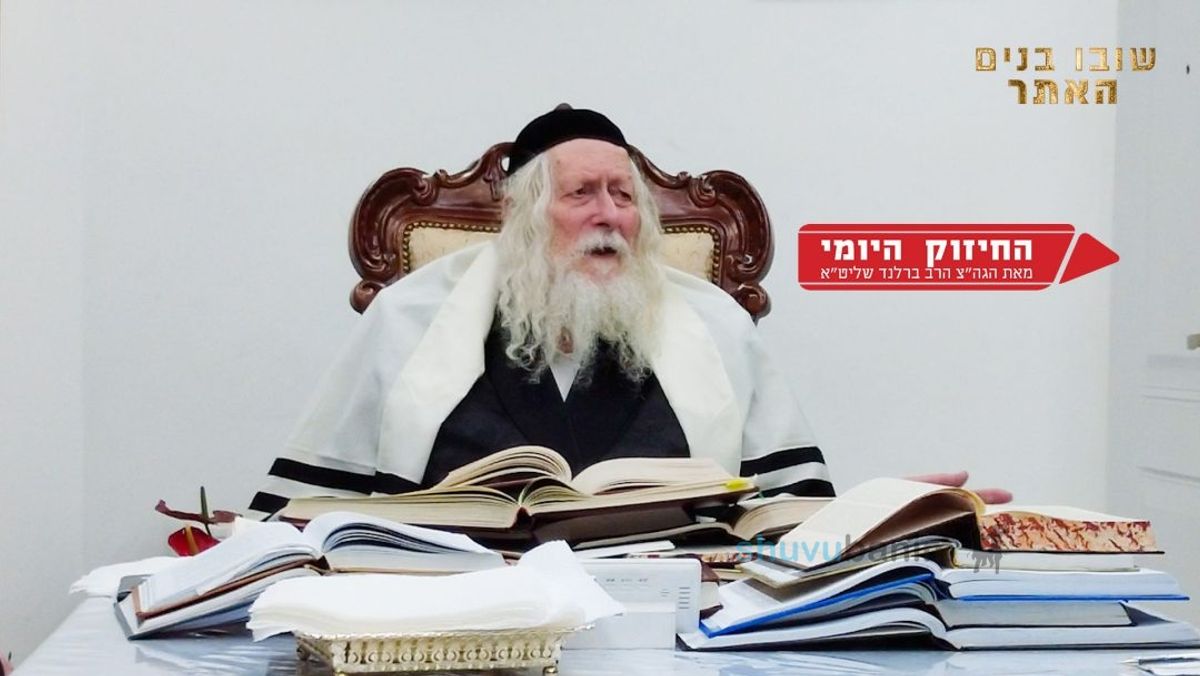
The Daily Chizuk from our teacher, the holy Gaon and Tzaddik, Rabbi Eliezer Berland shlit"a
Monday, 26th of Iyar, 5784
All the Tzaddikim (righteous ones) must enter into the fire, like Rabbi Ishmael the High Priest who was behind the Pargod (Heavenly Curtain).
They said to Rabbi Ishmael the High Priest, "With this you are trapped" (from the liturgical poem Eleh Ezkerah), because there are Ten Martyrs corresponding to the 10 drops [of wasted seed] that came out of Joseph (Sha'ar HaGilgulim, Introduction 26) - therefore, ten Tzaddikim had to die for Kiddush Hashem (sanctification of G-d's Name).
This refers to Rabbi Akiva, who corresponds to the Shechinah (Divine Presence), because the Shechinah was also under the ban during the sale of Joseph. The sale of Joseph is something impossible to understand; they sold Joseph for shoes.
What are shoes? Shoes are the "shoes of the Shechinah" that we sew for the Shechinah. Every moment, we sew shoes for the Shechinah through prayer, through the three prayers each day.
https://vimeo.com/952923391?share=copy
This was literally a "creation making shoes" (Asarah Ma'amarot, Ma'amar Em Kol Chai 3:22) with three corners (Sippurei Ma'asiyot, The Tale of the Sophisticate and the Simpleton).
The meaning of this is the three prayers that are prayed every day; these are the shoes of the Shechinah.
For Rebbe Nachman did not bring a story about a tailor, but rather about a shoemaker. A person needs to be a shoemaker; Chanoch (Enoch) son of Yered was a shoemaker, and with every single stitch, he would focus his intention and say, "Blessed be the Name of His glorious Kingdom forever and ever."
The Tzaddikim were all shoemakers. Rebbe Nachman told us in the Sippurei Ma'asiyot (Stories of Ancient Times) about the Simpleton who was a shoemaker; he didn't say he was a tailor or a carpenter. What does it matter if he was a tailor or a carpenter? What difference does it make?
No, specifically a stitcher of shoes! Because the shoes (with the three corners) are the three prayers, which are the shoes of the Shechinah.
Because through the three prayers, Hashem can walk here in the world.
We bring the Shechinah down below, and then we are protected by the prayer—but if one does not pray, then there is nothing to protect us.
If we pray the three prayers, then we make shoes for the Shechinah. In this way, the Shechinah can descend and protect us. Therefore, there are the Mincha (afternoon) and Maariv (evening) prayers, which are before the new day.
The Rebbe says: "He who turns his ear from hearing Torah, even his prayer is an abomination" (Proverbs 28:9) - it is impossible to pray without Torah study, "for through the Torah, all prayers and all requests are accepted" (Likutey Moharan, Torah 1).
It is impossible to pray without studying the entire Shas (Talmud). A person can pray for a day or two; a ba'al teshuvah (returnee to the faith) can pray for a month because he never prayed in his life, but after a month, he can no longer pray; he has already become accustomed to it, and he cannot say a word.
People come to prayer and cannot pray; so fine, at least listen, hum, buzz a little. The main thing is to participate in the prayers of everyone.
Whoever cannot pray, it doesn't matter—listen, pray, sway, move your lips. As it is written: "Deaf and mute" (Megillah 3a), just as Eldad and Medad would move their lips.
You cannot speak? Move your lips. They would move their lips even during the resurrection of the dead.
Subscribe to Our Newsletter
Receive Torah articles and inspiration directly in your inbox