Knishta Chada Newsletter – Issue Number 46
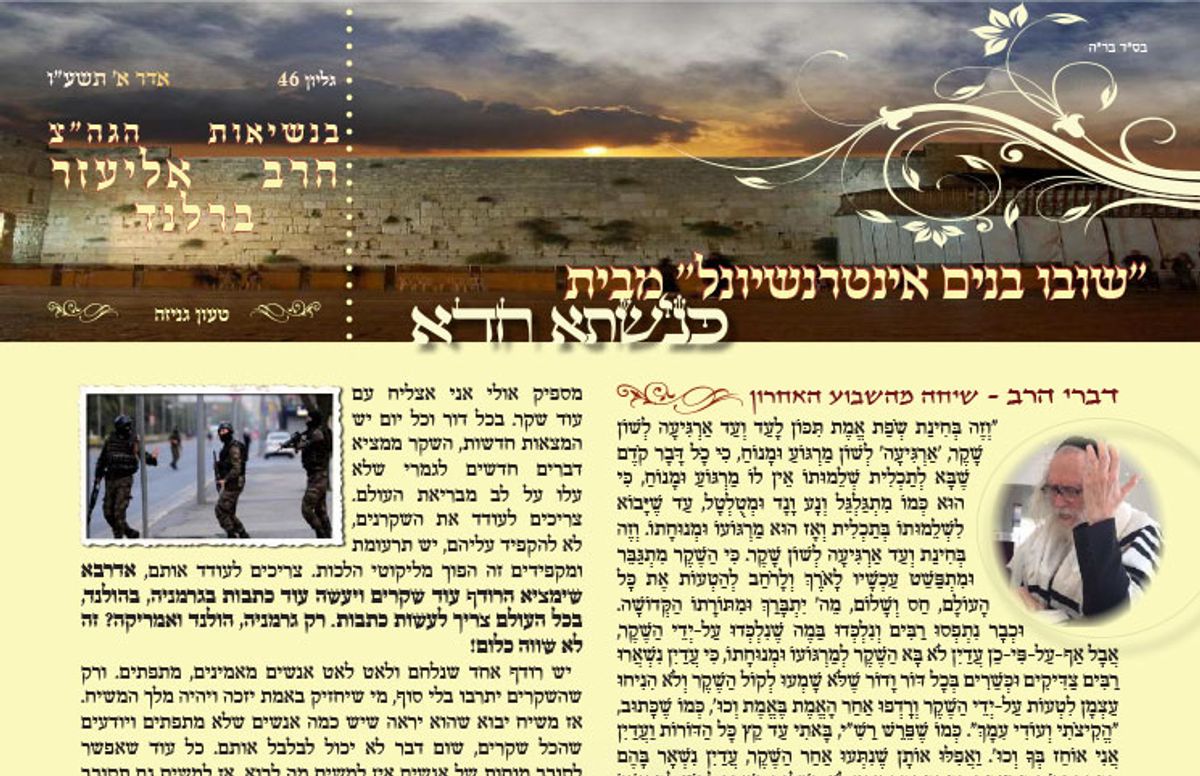
Knishta Chada Newsletter – Issue Number 46
בס"ד (With the Help of Heaven)
Likutey Halachos, Yoreh Deah, Laws of Signs of Pure Animals and Beasts, 4:34
And this is the aspect of "The lip of truth shall be established forever, but a lying tongue is but for a moment (ve'ad argi'ah)" (Proverbs 12:19). "Argi'ah" is an expression of margo'a (rest) and mano'ach (repose). For anything, before it reaches its ultimate perfection, has no rest or repose; it is like something rolling, moving, wandering, and tossed about until it reaches its ultimate perfection, and then it finds its rest and repose. And this is the aspect of "but a lying tongue is but for a moment (ve'ad argi'ah)." For falsehood overcomes and spreads now in length and breadth to mislead the entire world, Heaven forbid, away from Hashem (God) and His holy Torah. And many have already been caught and trapped in whatever they were trapped in through falsehood. But nevertheless, falsehood has not yet reached its rest and repose, for there still remain many tzaddikim (righteous ones) and kesherim (upright people) in every generation who did not listen to the voice of falsehood and did not allow themselves to be misled by falsehood, and they pursued the truth in truth, etc., as it is written, "I awake, and I am still with You" (Psalms 139:18). As Rashi (the classic commentator) explains: I have come to the end (ketz) of all generations, and I still hold onto You, etc. And even those who were misled after falsehood, there still remain within them several points of truth. Because of this, falsehood has not yet completed its arrival at its rest and repose, and it is always tunneling to capture everything, Heaven forbid, with its lies. Therefore, it overcomes and spreads each time with new lies and deceptions without limit, as we see that the sect of the heretics composes works at all times, large and small, with many types of seductions, incitements, and smooth words to mislead the children of Israel, Heaven forbid, with the schemes of their vanities, etc. (as explained elsewhere). But through the excessive spreading of falsehood, until it is close to its rest and repose, Heaven forbid—where almost everyone would be misled by its lies, Heaven forbid—then specifically "the lip of truth shall be established forever." For specifically through the great, great abundance of falsehood, the falsehood will turn into truth, as mentioned above. And now this verse is well understood: "The lip of truth shall be established forever, but a lying tongue is but for a moment (ve'ad argi'ah)." The expression "argi'ah" has no [other] explanation according to its plain meaning, for Rashi explained it as an expression of a moment (rega), but it does not sit well with the word "argi'ah" [which implies a verb of bringing to rest]. However, according to the above, it is explained well according to its plain meaning: that the Ruach HaKodesh (Divine Inspiration) prophesies that the main revelation of the truth will be in the end of days, when I give power to falsehood to spread in the world until almost "argi'ah (I give rest to) the lying tongue," that I will almost give it rest and repose in the world, Heaven forbid, as it wants to spread throughout the entire world, Heaven forbid, as mentioned above. Then specifically "the lip of truth shall be established forever," for through the great, great abundance of falsehood, the falsehood will turn into truth, as mentioned above. (For it is known that even the power of falsehood to mislead the world is grasped from Kedushah (Holiness), for without this, it would have no power to mislead the world. And as explained above regarding this matter, the power of falsehood comes from the truth, because in the beginning of everything, all things were in unity without distinction, etc., as mentioned above, and as the prophet said (Jeremiah 4:10), "Surely You have greatly deceived (hashé hishata) this people..." and it is written, "Why, O Hashem, do You make us err from Your ways..." (Isaiah 63:17) and many such verses. And through this itself comes the subduing of falsehood and its nullification, because in truth all its power is from the truth, from Hashem Himself, as it were, who gave us power for the sake of bechirah (free choice). And in the end of days, Hashem Himself will nullify it, for "from it and within it, the axe goes into the forest" (a Talmudic idiom meaning the tool of destruction comes from the thing itself), for specifically through the abundance of falsehood, it will turn to truth, as mentioned above. And therefore, the expression "argi'ah" (I will give rest) is very appropriate, as it is an expression of [Hashem] speaking for Himself, and understand this.)
The Words of the Rav
And the more lies there are, the more the truth will be revealed in a clearer way. The more the falsehood expands, with more lies to mislead everyone, then the truth is revealed in the end. They haven't told all the lies yet; this is only the beginning, "for there still remain many tzaddikim and kesherim in every generation who did not listen to the voice of falsehood and did not allow themselves to be misled by falsehood." But, in truth, this is not yet enough; there need to be even more lies. For if there are still tzaddikim, it is a sign that falsehood has not yet taken over so much, because people know it is a lie. Falsehood must win; until falsehood wins, the Geulah (Redemption) cannot happen. The moment falsehood wins and then people are clarified from within it, then from the greatness of the truth within them, only then will Mashiach arrive. Mashiach must be revealed from the peak of falsehood, and Mashiach and his people will not surrender to the lie. Falsehood wants to capture more; it says, "I haven't lied enough yet, maybe I will succeed with another lie." In every generation and every day there are new inventions; falsehood invents completely new things that never entered the mind since the creation of the world. But specifically through the spreading of falsehood—when falsehood wins completely and there is no longer any point of truth, only a few individuals hold onto the truth, and falsehood captures everyone, so that "almost everyone will be misled by its lies"—only then will the truth be revealed, and then Mashiach will come. Only through the abundance of falsehood...
So we need to encourage the liars, not to be resentful of them. There is grievance, and people are resentful... this is the opposite of Likutey Halachos. Likutey Halachos is always the "reversed intellect"—we need to encourage them! On the contrary! Let them invent more lies and more lies, and let them make more articles in Germany, in Holland; articles need to be made all over the world. Only Germany, Holland, and America? That's worth nothing! What is that? Everyone needs to—all the governments, all the countries... [they say] "How can we let such a person walk free? He is the most dangerous person to humanity, to all of humanity he is dangerous. He is dangerous in Germany, he is dangerous in Holland, in America he is dangerous." Look, the newspapers are warning everyone, warning everyone that there is some monster, such a monster that hasn't been created since the beginning of the world, and they need to warn, to alert—it's impossible to just move on. There is one pursuer who fights, and slowly people believe, they are seduced. And without this explanation, it is impossible to understand the verse "The lip of truth shall be established forever"—for it is a contradiction. What is the meaning of "The lip of truth shall be established forever—and a lying tongue is but for a moment (ve'ad argi'ah)"? Will the lying tongue reach rest? That even if the lying tongue reaches rest, in the end the truth will win? He [Rebbe Noson] says, "No—only when there is argi'ah (rest) for the lying tongue, only when the lies multiply without end, without measure, and without purpose, things that haven't happened since the creation of the world—then whoever holds onto the truth will merit to see the King Mashiach." So Mashiach will come when he sees that there are a few people who are not seduced and know that these are lies; nothing can confuse them. As long as it is possible to spin people's minds, Mashiach has no reason to come. For then you would spin Mashiach's head too; just as the pursuer can spin the heads of those people, he would spin the heads of these. No, everyone's head needs to be spun, and after everyone's head has been spun, if there remains some minyan (quorum), a few people, a "bi knishta chada" (in one gathering), whose heads are not spinning, then Mashiach will be able to be revealed. He will be revealed to them, and from them to the whole world. The main revelation of the truth will be in the end of days, when I give power to falsehood to spread in the world until almost "argi'ah (I give rest to) the lying tongue," that I will almost give it rest and repose in the world—there will no longer be room for a point of truth. When it wants to spread throughout the entire world, then specifically "the lip of truth shall be established forever," for through the great, great abundance of falsehood... the more lies there are... and it is forbidden to have resentment and forbidden to stop it. Should we put out an article against an article? Why should there be more articles? We don't need any article against an article.
For it is known that even the power of falsehood to mislead the world is grasped from Kedushah (Holiness). Ultimately, it comes from holiness. So why does Hashem really let this happen?! So that a person will truly burn with truth—not because they brainwashed him, not because he saw some handsome Rabbi, smiling nicely, wearing a nice tie.
Through the lies, one ascends to Atik (the highest level of Divinity). If he overcomes the lies, then he ascends to Atik, the Ra'ava d'Ra'avin (the Will of all Wills). Likutey Halachos, Laws of Things that Come from the Living, Law 4. Therefore, the Cave of Machpelah is double (kfulah)—four pairs, which is eight, corresponding to the eight elders, long life. The more lies there are, the more one can lengthen his days. "I am one hundred and twenty years old today" (Deuteronomy 31:1)—long life, for Moshe's eye was not dimmed nor his natural force abated. When they speak lies about a person, it heals his eyes. No old age jumped upon Moshe, because every time he was clarified anew. A person degenerates without feeling it, but if he has to fight the lies every time, then he is clarified anew. Moshe (משה) is the letters: Shin (ש) and Mah (מה) (Likutey Moharan I, Torah 4). Shin—300 jars from one spring, and Mah—that it is impossible to know what the Tzaddik is; he is the true infant who has not yet been born. He is very humble, "like a weaned child with his mother" (Psalms 131:2); he is always renewing himself with life. He is a Yanuka (youth) who is both old and young.
The Advice in Breslov...
"I am calling to tell you, the members of the 'Knishta Chada' newsletter, about the open miracles that happened to me," Yechia Kahalani begins his conversation with us. "For six years, files at the Execution Office (debt collection) weighed heavily on me. Although after two years I succeeded with Siyata d'Shmaya (Heavenly assistance) to close two files, a large debt remained to the Miris company. I tried with all my might to negotiate with them to remove this burden from my heart, and I even used the services of a professional lawyer. However, to my regret, nothing helped. The more I tried to solve the problem, the more they insisted on not reaching a settlement with us."
To our joy, we are accustomed to inquiries from various people who are eager to tell us about open miracles and revelations of Hashgacha (Divine Providence) related to the name of the Rav shlit"a. The heart is never satisfied with discovering how far the scope of the influence of the 'Faithful Messenger' reaches—to places beyond the intellectual understanding of a mortal. Nevertheless, from time to time, stories reach our ears that reveal other points, those that expose a small handbreadth while hiding dozens of others.
"I live in Kiryat Sefer and am married to a woman suffering from a difficult chronic illness," Yechia continues his unusual story. "After my portion of suffering increased, I decided to contact the Rav shlit"a, who at that time lived in Beitar. Right at the beginning of the contact, the occurrence was miraculous; when I began to tell the Rav shlit"a my name, the Rav finished the name himself, even though he supposedly did not know me before and it was not known to him who was speaking with him. My intention in the conversation with the Rav was solely to arouse mercy regarding the condition of my wife, may she live. 'Don't worry, she will be healthy,' the Rav shlit"a uttered toward me. 'I will go at two in the morning to the hospital, with Hashem's help, and bless the patient.' And indeed, there was a great improvement in her condition, and when my wife was discharged, we went together to thank the Rav. At that occasion, the Rav shlit"a said 'Kriat Shema' with us, and we both felt a great light illuminating our souls."
For people who know a bit about the Rav's activities, this story still sounds routine in his environment. However, from here on, even those who have heard many stories are surprised by the Rav's unique way. "My wife's condition deteriorated greatly, so I called the Rav to ask him to work salvations for us and to perform a Pidyon Nefesh (redemption of the soul) for our family. The Rav spoke with me for three minutes that were like Gan Eden (Paradise) on earth for me, but suddenly the Rav turned to me and asked if I knew what the advice in Breslov is. And without waiting for an answer, he continued and said: 'The advice in Breslov is to learn for eight hours and to dance for eight hours.' At first, I did not understand the Rav's intention; they seemed lofty to me, and the Rav, who understood this, said to me immediately, 'Fine, now we will sing with you and you will dance.'
At that time, I was at my work, and despite this, I sang and danced with the Rav for another twenty minutes, while in the background I heard all the people who were with the Rav singing together with us. On this occasion, I want to thank the Rav's gabbai (attendant), who truly exerted himself and tried for me to create contact with the Rav shlit"a, who was staying in Holland at that time. And also to Rabbi Rachamim Bracha, who connected me to the dedicated team of gabbaim," Yechia Kahalani adds as a side note.
"Almost immediately afterward, we obtained an excellent caregiver through Hashgacha Pratis (Divine Providence), who improved her condition drastically. This in itself returned joy to our lives, but along with it, another miracle occurred that we had hardly thought of. Suddenly my lawyer calls me and tells me about a 'strange' occurrence that happened with him. This is what he said: 'The lawyer for the Miris company contacted me and asked me for help with a certain matter. I told him there was no problem, but in return, I needed help as well. He agreed, and thus we immediately reached a settlement in your lawsuit. Do you know?' the lawyer asks me. 'Along with you, many others also merited a quick solution to their problem.'
"This was three days before Rosh Hashanah," Kahalani continues his story as if it weren't enough. "Following the removal of the restrictions, I merited to fly to the holy Kibbutz (gathering) in Uman, with miracles occurring to me one after another on the way. Great Siyata d'Shmaya in obtaining the ticket at such short notice and many others on the way to the Tzaddik..."
(Likutey Moharan 260, see there) The Name is the Soul
The name is the soul, "a living soul is his name" (Genesis 2). For there are the Ten Martyrs of the Monarchy who gave their lives for Kiddush Hashem (Sanctification of God's Name) for the sake of the unification of the Holy One, Blessed be He, and His Shechinah (Divine Presence), as it is known that the main unification is through Mesirus Nefesh (self-sacrifice). And they saw in those generations that it was impossible to rectify and perform unifications above except through their souls; therefore, they gave their lives for Kiddush Hashem. For when the souls ascend above through Mesirus Nefesh, then they return to the Shechinah, for from there they emerged, as Israel is literally a part of God from above, being literal parts of the Shechinah in the aspect of "those borne from the belly" (Isaiah 46). And when they return to the Shechinah, then the Shechinah boasts, "See with what a son I have come to You" (Zohar Vayikra 13), and then a supernal longing is awakened and a unification is made, as is known. And sometimes for this purpose comes killing, Heaven forbid, that many, many Jewish souls are killed, Heaven forbid, so that there will be a unification through their souls ascending above, for sometimes many souls are needed for the unification, Heaven forbid. Therefore killing comes, Heaven forbid. And likewise through the loss of the name, meaning the mefursam (famous person)—that is, there is one who is famous and not famous, meaning he is famous in everyone's mouth and everyone speaks of him, and yet he is not famous, for he is not important at all. And there is one who does not desire this, only that he lost the mefursam, meaning the loss of the name which is the soul—meaning even though it is not his will not to be famous, nevertheless he lost it. But there is one who does this with his will and his knowledge, who gives his life for Kiddush Hashem. And because of this, even though he is famous, nevertheless he is not famous at all, for on the contrary, it is the opposite, for everyone speaks against him and invents lies about him that never entered his mind, and he has literal bloodshed from this, and he does this intentionally, for it is a literal aspect of Mesirus Nefesh, for the name is the soul as mentioned above, and he also has bloodshed from this as mentioned above. And he saves Israel through this from what was fitting to come upon them, Heaven forbid, for the sake of the unification as mentioned above.
The Terrible Back Pain
"I mention my sins today" (Genesis 41:9), N. begins his story with a sheepish smile on his face. "A few years ago, I was attacked by strong back pains. At first, I hoped that maybe my back was just caught and the pain would soon pass, but unfortunately, the suffering continued." N. is a regular avrech (young married student) in the holy Yeshiva of the Rav shlit"a, and as he tells his story, it is evident that he is discharging an old debt. "After I tried all sorts of home treatments and it became clear to me that nothing was helping, I turned to an expert orthopedic doctor. After a thorough examination, to my regret, the doctor identified a 'herniated disc' in my back and even showed it to me on his computer screen." We will not lengthen it too much, but we will note that from that day on, N. underwent various and wearying treatments to try and reduce the level of pain, which was unbearable, since he did not want to undergo surgery.
"It was on the day of my son's upsherin (first haircut). As is the custom of Chassidim, we entered with honor into the residence of the Rav shlit"a, who was staying at that time in the city of Beitar, to merit that the Tzaddik would cut our son's hair. And indeed we merited, and the moving ceremony went as planned. And then, just a moment before we were leaving, I said to the Rav shlit"a, casually, that about a year ago I stood in the Amidah prayer for a long time and suddenly I was attacked by intense pains that refuse to stop until today. Indeed, I was ashamed that I, who consider myself a student of the Rav and who hears about so many miracles and wonders that occur in the Rav's vicinity, had not turned to the Rav shlit"a until now. But I gathered courage; after all, it is better to admit my mistake than to continue erring further."
From looking at N.'s face, it is clear that it is difficult for him to share his story and that the conversation for him is a kind of Vidui (confession) and closing of a circle. Thus he continues: "Immediately when I told the Rav about my pain, his face took on an expression of compassion. The Rav took a cup with a little water and sprinkled a few drops into it from a small bottle he had with him. He told me to say a blessing and drink, and also gave it to me while instructing me to continue taking from it for three more weeks.
From the holy residence of the Rav shlit"a, I left with a feeling of great joy, and indeed for the next day or two, I was careful to take the drops as the Rav said. But, to my regret, even this simple action did not go easily for me. At that time, I was studying in the Yeshiva in a chavrusa (study partnership) with one of the important avrechim, and when I told him about my meeting with the Rav shlit"a, we were strengthened together in the power of the Tzaddik. We looked together at the way the Rav hides his greatness and dresses it in trivial things like natural drops. We added that our holy Rebbe brings in Likutey Moharan (Torah 57) that from every word of the Holy One, Blessed be He, an angel is created (Chagigah 14), and every angel is appointed over something else in creation, even over trees and herbs. And this angel receives its vitality from the word, meaning from the Torah, and then influences the herbs. It follows that one who blemishes Emunas Chachamim (faith in the Sages) and breaks a fence, then there is no healing for his wound, because the angel has no power to receive or influence, and consequently the herb on which his healing depends has no power to heal. At that moment, 'wisdom' entered my heart and I thought to myself: 'Behold, I believe that the Rav shlit"a works the healing and he doesn't need anything physical at all; if so, certainly the Rav can heal me even without the drops.' And so I took the law into my own hands and stopped taking the drops. Just like the 'Sophisticate' in the story of 'The Sophisticate and the Simpleton' in the Sippurei Ma'asiyot (Stories of Rebbe Nachman)," N. adds sarcastically about himself.
"Time passed and the pains continued, until one day my wife, may she live, who saw that I continued to suffer, asked me if I was taking the drops. I answered her according to my 'great wisdom...', and she, of course, rebuked me to stop with the sophistication and act with simplicity as the Rav said. But the three weeks had already passed, I continued to be sophisticated, and she already got really angry, shouting at me, 'Continue immediately!' From that moment, I took it upon myself to take the drops for three weeks, with simplicity and exactly as the Rav said, and see what a wonder—not even a week passed and the pain was gone as if it never was."
"In fact, from the continuation of that same Torah (Likutey Moharan, ibid.), the exact opposite of my first 'attainment' is understood," N. concludes what became clear to him. "Like the literal language of our Rebbe: 'For the things that were not written in the Torah were handed over to the Sages, and we are commanded to listen to them, and there is one who disparages their words and does not believe their words because it seems to him that according to the Torah it is not so, and through this he becomes ill with a wound that has no healing and...'"
The avrech N. adds an interesting detail before summarizing his fascinating story. "After some time, I went for an examination with the expert doctor that had been scheduled for me back when I was suffering from intense pains. The doctor took X-rays again, only this time the 'herniated disc' was not found. I was not surprised by this, for I felt a marked change in my health; however, for the sake of publicizing the miracle, I entered into a conversation with the doctor and asked him his opinion regarding the reason for the matter. After all, the disappearance of a 'herniated disc' is no small thing. The doctor thought for a moment and, as if pulling it out of a hat, said that it could be that the disc returned on its own. I smiled at him and said decisively, 'On its own..?! Certainly not. There were miracles here from Hashem and His faithful messenger, Rabbi Eliezer Berland shlit"a.'"
Zohar Lech Lecha
Rabbi Abba said: Why did all this happen to Abraham, and why was it necessary (meaning the suffering in the descent to Egypt, etc.)? Rather, it was in order to magnify the names of Abraham and Sarah in the world, for even in Egypt, who are the sorcerers of the world and no man could be saved from them, Abraham was magnified and ascended upward. This is what is written, "And Abram went up from Egypt." To what place? "To the South" (meaning that specifically from the descent, his name was magnified) (Zohar Lech Lecha 83 – translated).
Tetzaveh – "And the wise shall shine as the brightness of the firmament" – A Story from the Rav
One must be careful not to throw boys [out of the Yeshivas] without crying rivers of tears before that. Like the story of the Apter Rav, the Ohev Yisrael (Rabbi Avraham Yehoshua Heshel of Apta), with Natan Tzvi, the father-in-law of Reb Noson. The Apter Rav was a great Maggid (preacher) and responsible for several towns, and the way in those days was that the Maggid was also responsible for the kashrus (kosher status) of the slaughtering. One day he arrived at a certain town to check the kashrus there, and when he reached the shochet (ritual slaughterer), he asked him for his knife so he could check it. A brief examination was enough for him to discover that the knife was blemished. Therefore, he decided to let the shochet check the knife himself. The shochet checked and said the knife was kosher. The Apter Rav did not understand what happened—after all, he saw that the knife was disqualified. Maybe the shochet didn't notice? The next day, after he checked the chalaf (sharp, smooth slaughtering knife) again and saw it was blemished, he asked the shochet to check the chalaf, and to his surprise, he again said it was kosher. The Apter Rav did not know what to do, because according to the Halacha (law), he had to fire the shochet, but on the other hand, he had a family with twelve children, and if he fired him, he would have no livelihood and they would have nothing to eat. It's not like today, where if someone is fired, he finds a better job. Therefore, he decided that tomorrow he would conduct one last test, and if he failed it, he would fire him.
That entire night, the Apter Rav did not stop crying over the fact that tomorrow he was going to fire the shochet, while shedding rivers of tears. And in the morning, when he came to check the chalaf, he discovered that the knife was kosher. The Apter Rav, who was surprised for the third time, asked him, "What happened? I checked the knife yesterday and saw it was blemished, and now I see it is kosher." The shochet answered him: "In order to say an opinion on my chalaf, one needs to cry for a whole night." For that shochet was a Tzaddik Nistar (hidden righteous man) from the thirty-six hidden tzaddikim, and after he saw that the Apter Rav cried a whole night to know what to do with his knife, he revealed it to him. Thus, every mashgiach (supervisor) before he wants to throw out a boy must be careful not to bury his soul. He needs to scream and cry so that he won't err in what he does.
The mashgiach should not feel that he is better than the boys, but rather that he is just a teacher in the class. Even if he is wise, he needs to feel that when the boys grow up, they will bypass him. And this is what Moshe thought. "And the man Moshe was very humble, more than any man on the face of the earth" (Numbers 12:3). For he thought in his heart that everything he learned for eighty years, he needed to pass on to the people of Israel in one year...
Sixty years ago, Yisrael Lippel was a boy in the 'Etz Chaim' Yeshiva and a member of the Etzel (Irgun). This was at the time when all the boys went to the Etzel to fight the British. In the Etzel, unlike the Haganah, they would not perform operations on Shabbat. However, on one of the Shabbats, they asked him to participate in some operation. He rejected it immediately and said he keeps Torah and mitzvot (commandments). But they did not give up and said to him: "Since you are a member of the organization, and moreover, the operation is not combat-related and without shooting, but rather something simple related to a sign that says—'Away with the British, away with the White Paper,' you must join." To tie the sign Lippel did not want, because that is a Torah prohibition; therefore, it was decided that he would stop the traffic on Agrippas Street so they could hang the large sign. And so Lippel stood with his shtreimel (fur hat) in the middle of the road and stopped the traffic. And the people who saw this began to shout, "A woman in labor! A woman in labor!" because they understood that if a Charedi man with a shtreimel stops traffic, it must be to bring some woman in labor.
The operation passed, but it caused a very big stir. Everyone spoke about how a boy stopped the road on Shabbat so that the Etzel could place a large sign. His mashgiach in the 'Etz Chaim' Yeshiva was Reb Aryeh Levin. What would a mashgiach do in such a severe case?! Yisrael Lippel entered the mashgiach's room with fear and trembling, but the mashgiach said to him only three words: "S'iz nisht" (It is not), intending to tell him that this way does not belong to us. Only three words—that was Reb Aryeh Levin, such gentleness he had.
Subscribe to Our Newsletter
Receive Torah articles and inspiration directly in your inbox