
"LIFT THE HEAD" • Parshat Naso from the Gaon and Tzaddik Rabbi Eliezer Berland
shlit"a
Chiddushim (Torah insights) and Pearls for the Weekly Torah Portion of Naso - The Gaon and Tzaddik Rabbi Eliezer Berland shlit"a (may he live long and good days)
"NASO ET ROSH" (LIFT THE HEAD)
"Naso et Rosh" (Numbers 4:2) — now is the time to lift the head. We ascend to the head of Adam Kadmon (the Primordial Man), we form the head of Rachel and the head of Leah. During the Melaveh Malkah (the meal escorting the Shabbat Queen), we create the head of Rachel and the head of Leah. The head of Rachel corresponds to the shoe of Leah, and the head of Leah comes from the Atteret Yesod of Ima (the crown of the foundation of the Supernal Mother). All of this is built during the Melaveh Malkah. The Melaveh Malkah is even greater than the three Shabbat meals, because now we effect everything; now we build the new week. The new week does not yet exist; according to how we pray now and how we sing now, so shall we merit the new week.
"AND THOSE THAT WERE NUMBERED OF THEM... WERE THREE THOUSAND AND TWO HUNDRED"
Elizaphan ben Uzziel merited to be the prince of the Kehathite tribe. "The families of the Gershonites shall encamp behind the Tabernacle westward," and after that we have here the Kehathites, 750, and after that we have their census. Everything is according to the word of Hashem, each man according to his service. He asks Moses, "For she did not know that I gave her the corn, and the wine, and the oil, and multiplied her silver and gold, which they prepared for Baal. Therefore will I return, and take away My corn in its time, and My wine in its season, and will recover My wool and My flax given to cover her nakedness. And now will I discover her lewdness in the sight of her lovers, and none shall deliver her out of My hand" (Hosea 2:10-12). "I will also cause all her mirth to cease, her feast days, her new moons, and her sabbaths, and all her solemn feasts. And I will destroy her vines and her fig trees, whereof she hath said, These are my rewards" — she said these are my rewards, but no. "I will also cause all her mirth to cease... and I will visit upon her the days of Baalim, wherein she burned incense to them, and she decked herself with her earrings and her jewels, and she went after her lovers, and forgot Me, saith Hashem. Therefore, behold, I will allure her, and bring her into the wilderness, and speak comfortably unto her. And I will give her her vineyards from thence, and the valley of Achor for a door of hope: and she shall sing there, as in the days of her youth, and as in the day when she came up out of the land of Egypt. And it shall be at that day, saith Hashem, that thou shalt call Me 'Ishi' (my Husband); and shalt call Me no more 'Baali' (my Master)."
"And I will take away the names of Baalim out of her mouth, and they shall no more be remembered by their name. And in that day will I make a covenant for them with the beasts of the field, and with the fowls of heaven, and with the creeping things of the ground: and I will break the bow and the sword and the battle out of the earth, and will make them to lie down safely. And I will betroth thee unto Me forever; yea, I will betroth thee unto Me in righteousness, and in judgment, and in lovingkindness, and in mercies. I will even betroth thee unto Me in faithfulness: and thou shalt know Hashem." This is the most important verse in the Torah: "And those that were numbered of them by their families, were three thousand and two hundred" (Numbers 4:44) — which is one hundred times the name E-L (numerical value 31). And all this is the tribe of Merari. "And those that were numbered of them... were eight thousand and five hundred and eighty" (ibid 4:48). This is the most critical number possible. "And the children of Israel did so, and put them out without the camp: as Hashem spoke unto Moses, so did the children of Israel" (ibid 5:4).
Therefore, what is written? "The families of the sons of Kehath shall encamp on the side of the Tabernacle southward (Teimanah)" (ibid 3:29). The side of Teimanah is the South. "And the prince of the father's house of the families of the Kehathites shall be Elizaphan the son of Uzziel" (ibid 3:30). This Elizaphan caused all the chaos; because of him, Korach was swallowed into the earth. He was to blame for the earth opening and Hashem creating a "mouth" for the land. "But if Hashem make a new thing, and the earth open her mouth, and swallow them up, with all that appertain unto them" (ibid 16:30). "Hear, I pray you, ye sons of Levi" (ibid 16:8). "And Moses sent to call Dathan and Abiram, the sons of Eliab: which said, We will not come up: Is it a small thing that thou hast brought us up out of a land that floweth with milk and honey, to kill us in the wilderness, except thou make thyself altogether a prince over us?" (ibid 16:12-13). We were in a land flowing with milk and honey! "Moreover thou hast not brought us into a land that floweth with milk and honey, or given us inheritance of fields and vineyards: wilt thou put out the eyes of these men?" — Do you want to gouge out the eyes of the people? "We will not come up."
"And Moses was very wroth" — here Moses our teacher is angry. "And he said unto Hashem, Respect not thou their offering: I have not taken one ass from them" — I didn't even take a donkey from them, as it is written, "And Moses took his wife and his sons, and set them upon an ass" — his own private donkey. "I have not taken one ass from them, neither have I hurt one of them. And Moses said unto Korach, Be thou and all thy company before Hashem, thou, and they, and Aaron, tomorrow." For Aaron is eternal; Aaron does not die. When Moses said he died, they did not want to believe him, until he showed them the bed hovering over the camp of Israel.
"And take every man his censer, and put incense in them, and bring ye before Hashem every man his censer" — how many? "Two hundred and fifty censers." The Megaleh Amukot (Ophan 181) says: Why 250? Corresponding to the men of Sodom — fifty, fifty, fifty, fifty, fifty. "And Hashem said, If I find in Sodom fifty righteous within the city, then I will spare all the place for their sakes" (Genesis 18:26). On the contrary, bring fifty righteous men! These fifty, fifty, fifty, fifty, fifty — they are from the men of Sodom. They decreed death upon Moses. They are the direct descendants of the men of Sodom, and they decreed death upon Eliezer, and they decreed death upon Abraham. "And they took all the goods of Sodom and Gomorrah, and all their victuals, and went their way" (ibid 14:11). "And they took every man his censer, and put fire in them, and laid incense thereon, and stood in the door of the tabernacle of the congregation with Moses and Aaron" (Numbers 16:18).
"ON THE DAY THAT MOSES HAD FINISHED"
Hashem wrote "Bereishis" (In the beginning); He should have written "Me-reishis" (From the beginning). Elijah the Prophet came and told Rabbi Shimon bar Yochai: Know that in the beginning it was written "Me-reishis," and Hashem split the letter 'Mem' and turned it into a 'Beis.' How the Torah was written, we do not know. It is written, "On the day that Moses had finished (Kallot)" (Numbers 7:1), and Rashi says "Kallot" is written without the letter 'Vav,' yet in our scrolls it is with a 'Vav.' Regarding Haran, Rashi says it is an inverted 'Nun.' It turns out that Rashi had a different orthography; there was Haran with an inverted 'Nun' and "Kallot" without a 'Vav.'
"On the day that Moses had finished (Kallot)" because the Luchos HaBritis (Tablets of the Covenant) are like a Chassan (groom) and Kallah (bride). Every groom and bride represents the union of the Tablets. A groom and bride is the union of the Tablets and not just the bodies. If it is just a union of bodies (meaning for the sake of desire), then they get divorced. Among the secular, after a week they are already getting divorced; after a week it's already over. Because until now it was just a show to get budgets and support and an apartment, but after a week they immediately divorce and have no reason to be together. The secular divorce after a week, and seventy percent do not even want to get married; in Tel Aviv, seventy percent do not marry.
"FROM BETWEEN THE TWO CHERUBIM... AND HE SPOKE UNTO HIM"
The Sifri (Midrash) asks in Parshat Emor that we should really make Sukkot during Passover because the Ananei HaKavod (Clouds of Glory) began on the 15th of Nissan (Passover). Sukkot is in this month, the seventh month. And I learned a Chiddush (new insight) that we need Mechilas Avonot (forgiveness of sins); a person must not have any sin. In order to enter the Sukkah, one must not have any sin. If a person wants to enter the Sukkah, there must be no sin, which is only after Yom Kippur. Therefore, we learn about the Sukkah from the wings of the Keruvim (Cherubim), because the entire Torah was given from between the wings of the Keruvim. "And when Moses was gone into the tabernacle of the congregation to speak with Him, then he heard the voice of one speaking unto him from off the mercy seat that was upon the ark of testimony, from between the two cherubim: and He spoke unto him" (Numbers 7:89). And Rabbi Avraham ben Rabbi Nachman says that the entire Torah was given from between the two Keruvim; there are two Keruvim in Heaven, and from there they received the Torah.
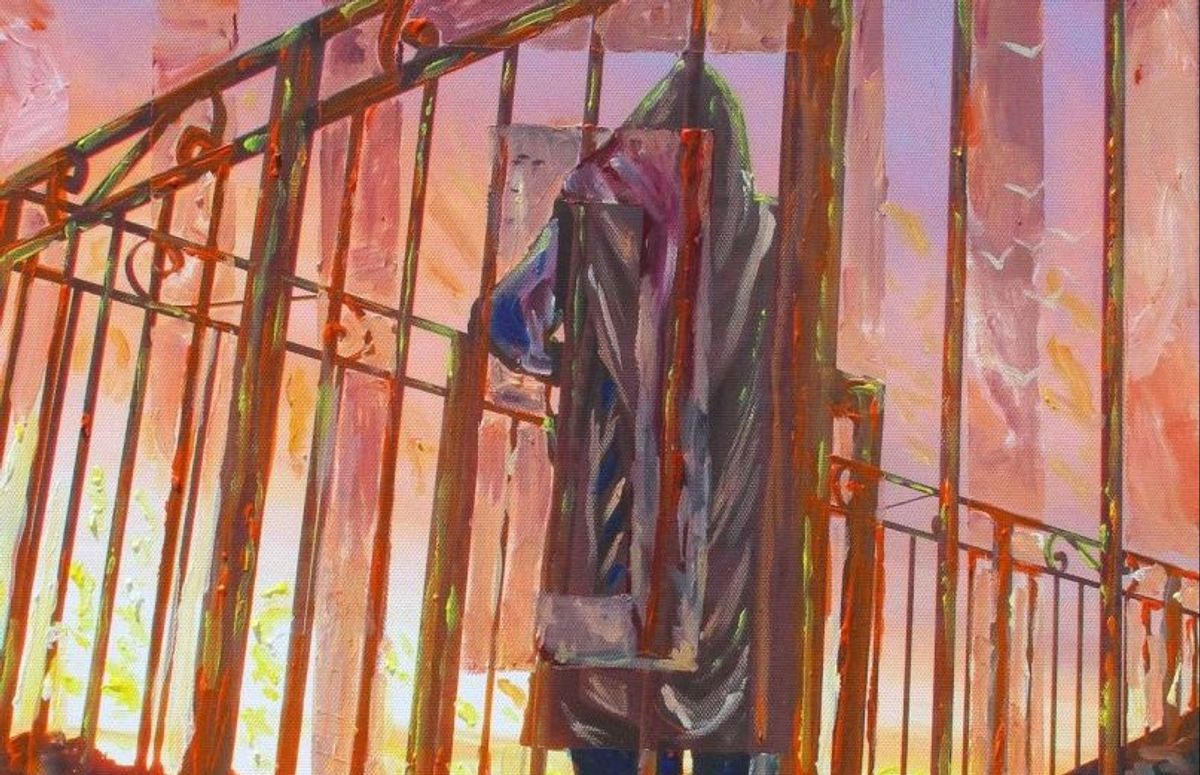
The lesson has undergone editing; if any error has occurred, G-d forbid, it should not be attributed to the Rav shlit"a, but to the writer—"and with us let our error lodge." Drawing courtesy of the artist Rabbi Yehoshua Wiseman. To purchase: www.yehoshuawiseman.com
The Shuvu Banim website team wishes you, the readers and followers,
A peaceful and blessed Shabbat!!!
Subscribe to Our Newsletter
Receive Torah articles and inspiration directly in your inbox