"My Soul Yearns and Pines" • The "Pe'er Bnei HaNeurim" Group in a Summer Term
Gathering at the Residence of the Gaon and Tzaddik Rabbi Eliezer Berland shlit"a
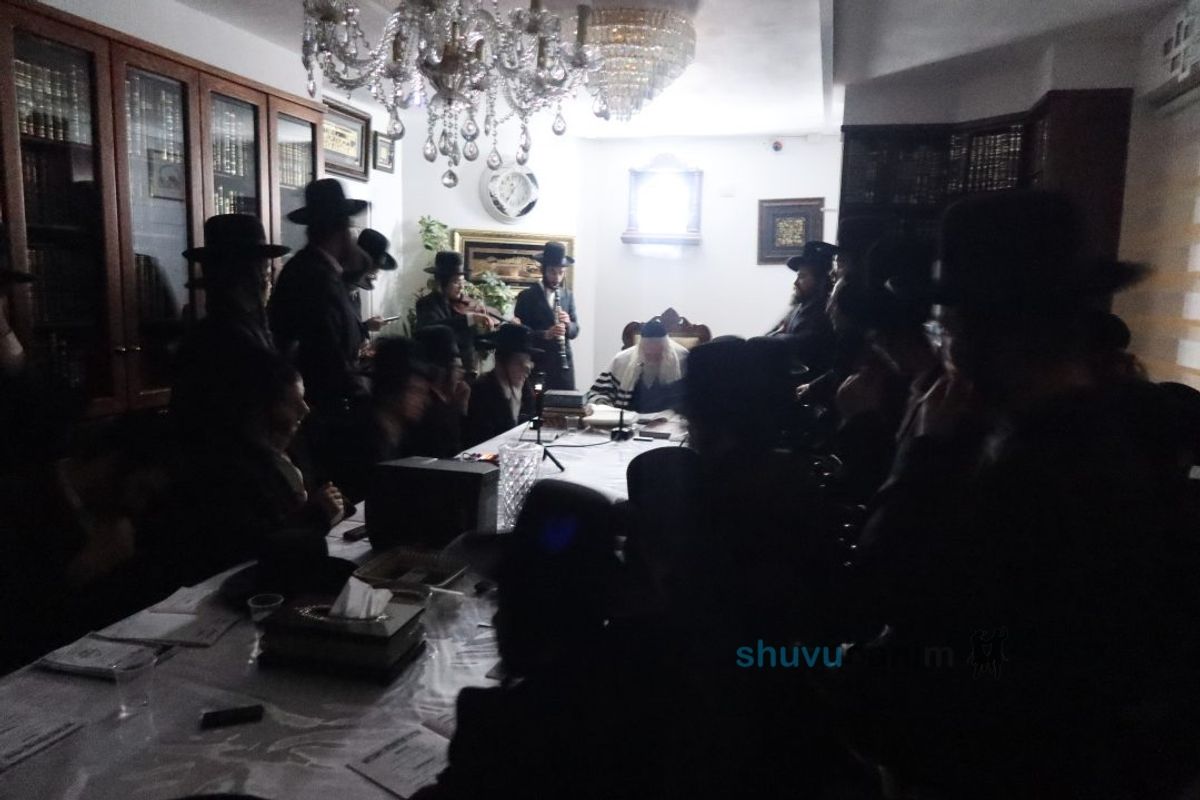
On Thursday night, the eve of the 6th of Tammuz, Parshas Chukas, the precious young men of the "Pe'er Bnei HaNeurim" group - Yeshiva Gedolah, merited to enter the residence of our teacher, the Rav, Rabbi Eliezer Berland shlit"a (may he live long and good days), for a special gathering—a meeting of chizuk (spiritual strengthening) towards the end of the summer term, with the pure participation of our teacher, the Rav shlit"a.
At 10:20 PM, our teacher, the Rav shlit"a, entered his holy residence, and dozens of precious young men welcomed him with songs of awakening, longing, and yearning for Hashem (God)... "Truly my soul waits silently for God; from Him comes my hope..." After this song, the awakening intensified with the singing of "Shir Naim" (Pleasant Song) found at the beginning of Likutey Moharan, written by our holy Rebbe (Rebbe Nachman). The stanzas, beginning with the words "My strong and wise soul," speak to the Jewish soul, strengthening and awakening it to remember its role and the magnitude of its power in the face of trials in the service of the Creator. Afterward, they continued with additional emotional songs, including: "Do the hands of Moses," "And Breslov burns a fire," "Reveal Yourself please," "For my entire aim," "For this our heart was faint," and "I believe." Upon concluding the heart-stirring singing of the acceptance of faith, they hurried to play the awesome request "Have mercy in Your kindness," in anticipation of the imminent Geulah (Redemption), speedily in our days, Amen.
At 10:40 PM, absolute silence fell. With immense devekus (attachment to God) and his pure eyes closed, and with a voice growing stronger and stronger, our teacher, the Rav shlit"a, began to deliver one of the lessons that will be etched for generations in the hearts of the young men. The Rav shlit"a began speaking from Torah 50 (in Likutey Moharan) about the greatness of melodies, through which prayer is accepted, and how the heart of stone must turn to water, which only happens through the true Tzaddik. He strongly encouraged the in-depth study of Torah, particularly ahead of the "Bein HaZmanim" (intersession) days, when instead of relaxing from Torah study, one can learn with great strength, even at night, since there are no formal yeshiva schedules. Afterward, he discussed the weekly Torah portion—Chukas—regarding the "Seraph" (fiery serpent) and said that the whole point is to lift one's eyes upward. He added that all of this was due to the sin of lashon hara (evil speech) and warned against it very severely. Subsequently, he spoke about the dispute of Korach and his assembly, mentioning that it is brought in holy books that during the dispute, not even a single minyan (quorum of ten) remained with Moses, and he said that in every generation, there is a "Korach."
Continuing, he explained the words of the Mishnah—"Light as an eagle" means that a person should not be confused by the matter of the Tzaddik; "Bold as a leopard" means rising early for prayer and running to pray with the Tzaddik. He returned to speaking about the upcoming Bein HaZmanim days and emphasized the need to utilize the nights for Torah study when there are no yeshiva schedules, citing the Rambam (Maimonides) that the main part of learning is at night, as mentioned in Torah 3 of Likutey Moharan. Later, he spoke about the Aggados (homiletic teachings) of the Shas (Talmud) and brought the story of Abba Tachna Chassida, for whom the sun stopped. He also added that the event of "Sun, stand still at Gibeon" with Joshua occurred on the 3rd of Tammuz. He then began to speak of the greatness of the day of the 3rd of Tammuz, which is the yahrtzeit (anniversary of passing) of the last Lubavitcher Rebbe, Rabbi Menachem Mendel Schneerson zy"a (may his merit protect us). He spoke of his greatness, describing how he would sit for fourteen hours a day and would not move his eyes from the Gemara (Talmud) for even a single second!
Towards the end of the lesson, he discussed the matter of a mother's crying, saying that a mother's tears are so great, even those of a non-Jewish mother, as seen with the mother of Sisera, of whom it is written "and she wailed," crying one hundred cries; therefore, we need one hundred blasts of the Shofar every year on Rosh Hashanah to nullify her cries. During his words, he strongly encouraged the study of Gemara and brought many sources from Likutey Moharan showing that our holy Rebbe's (Rebbe Nachman's) entire focus is solely to sit and study the Gemara of the Shas in depth. Afterward, he dealt with the matter of the seven maidens who were with Miriam the Prophetess when she went down to immerse with them and found Moses in the ark, and the secrets contained in that matter. At the conclusion of the lesson, he returned to the greatness of speech and song with which he began the lesson, weaving it into the weekly portion—Chukas—noting that Moses was supposed to bring water out of the rock through speech, which differed from "Take the staff" in Parshas Beshalach where the sea was split. For the main thing is speech and song.
After nearly half an hour of holy words of fire, our teacher, the Rav shlit"a, rose from his chair and exited to the sound of the singing of "Do the hands of Moses make war..." The dozens of precious young men, in whose hearts the majestic impressions of the words of the Living God were well-instilled, left feeling extremely strengthened towards the end of the summer term. They were particularly strengthened in their resolve, ready to utilize every minute and moment of the Bein HaZmanim days to the fullest for the study of the holy Torah, to do the will of their Creator by fulfilling the words of the Tzaddik, which were clearly explained in the fiery lesson they merited to hear.
Subscribe to Our Newsletter
Receive Torah articles and inspiration directly in your inbox