
Netzach shebeNetzach is the Greatest Sefirah of All the Sefiros • A Special
Lesson from the Gaon and Tzaddik Rabbi Eliezer Berland shlit"a on Netzach shebeNetzach
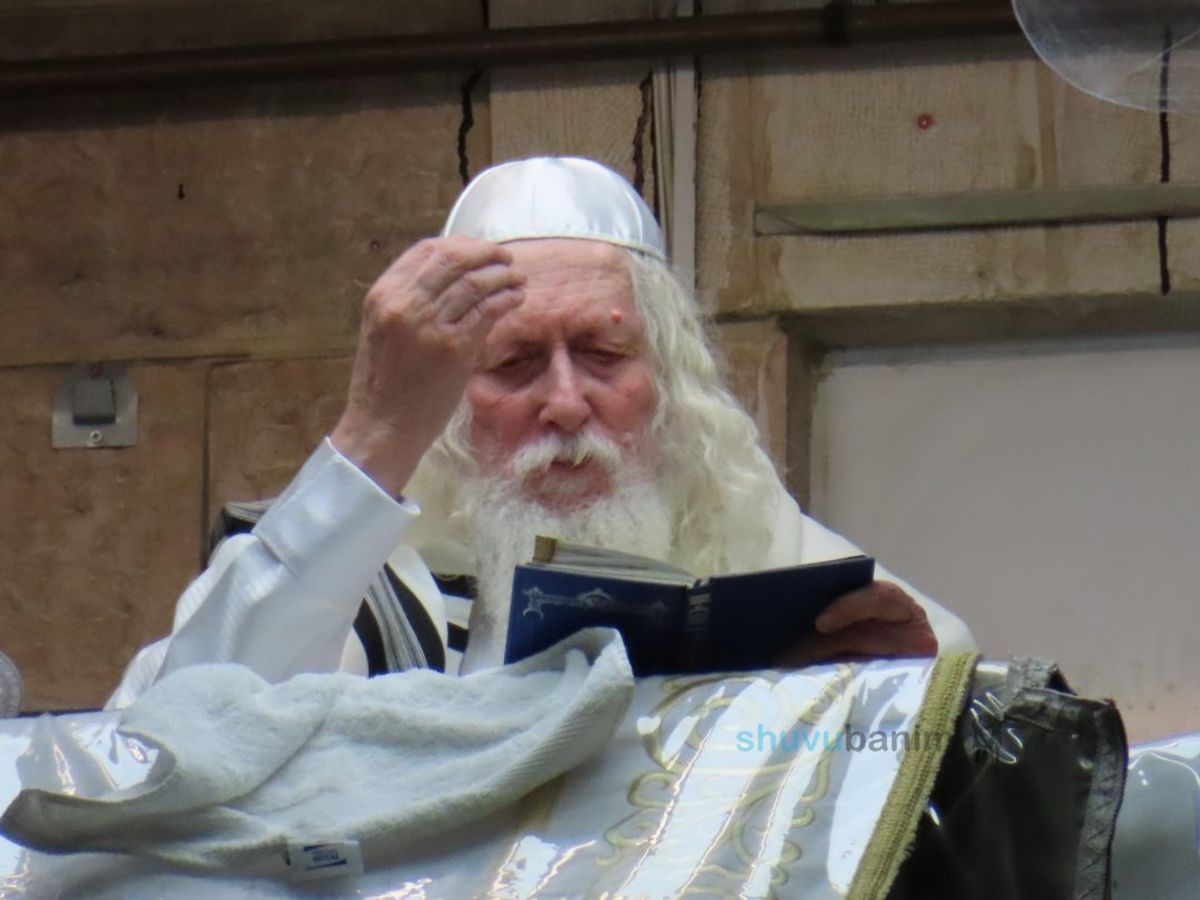
On the Holy Shabbat, twenty-five days of the Omer will be counted. Its sign is Netzach shebeNetzach (Endurance within Endurance). In honor of this lofty Sefirah (Divine emanation), which is the Sefirah of our Holy Rebbe [Nachman] who said, "I have triumphed and I will triumph," we present to you a lesson given by the Gaon and Tzaddik Rabbi Eliezer Berland shlit"a (may he live long and good days) on the Sefirah of Netzach shebeNetzach in the year 5780 (2020).
The Cleft of the Rock
Now is the time of Nikras HaTzur (the Cleft of the Rock), for Netzach shebeNetzach is even greater than Nikras HaTzur. The moment we enter Nikras HaTzur, where the Or HaGanuz (Hidden Light) resides—this is the subject of the entire Gemara in Megillah 19b—we see that a person comes into this world for the sake of Nikras HaTzur. This is why we read about it on Chol HaMoed (the intermediate days of) Pesach and on Chol HaMoed Sukkot; we read it twice. It is also found in the Torah portion itself, in Parshas Ki Tisa, in the verse "When you take (Ki Tisa) the sum of the heads of the children of Israel." Ki Tisa is the most important of all the portions. Ki Tisa contains the Thirteen Attributes of Mercy: "Hashem, Hashem, G-d, Merciful and Gracious..." All of this was revealed in Nikras HaTzur. A person is born for Nikras HaTzur; a person is created for Nikras HaTzur.
Utilizing the Days of Bein HaZmanim
Today, there is no yeshiva (Torah academy) and no Mashgiach (spiritual supervisor). There is nothing. Now, until Tisha B'Av (the ninth of Av), there will be no Mashgiachim; a person can learn ten times more, twenty times more. The Chazon Ish zt"l (of blessed memory) said that during Bein HaZmanim (the intercession period between yeshiva semesters), it is possible to learn twice as much—that is what the Chazon Ish said. When there is a Mashgiach, a person is subordinate to the Mashgiach. One can learn between the formal sessions, and if he is tired because he stayed awake all night—perhaps he said the entire book of Tehillim (Psalms) six times or managed to learn twenty pages of Gemara during the night—and then falls asleep in the morning, the Mashgiach screams at him and breaks him into pieces. But now, a person can stay awake at night and pray, saying the Shemoneh Esrei (the standing prayer) at ten to six in the morning, and manage to learn ten pages of Gemara. We must finish the entire Shas (Talmud).
Netzach shebeNetzach - The Hillula of All the Tzaddikim
Now is the yahrtzeit (anniversary of passing) of all the Tzaddikim: the Ba'er Heitev, the Pri Megadim, and the Rif (Rabbi Isaac Alfasi). The Rif was placed under a Cherem (excommunication), just as the Rambam (Maimonides) was placed under a Cherem. They wrote words of blasphemy on his gravestone in Tiberias. They called him "The Small Rabbi from Akko"—it was he who sent people to write those blasphemous words on the Rambam's grave. Then Rabbi David arrived; he was the Nagid (leader). In those days, there was no king, only a Nagid. Rabbi David was the son of Rabbi Abraham, the son of the Rambam; he was the grandson. He had to flee because of a false accusation. He fled and arrived in Tiberias, where he saw the blasphemous words. He sent a message to Damascus and then excommunicated the Rabbi of Akko. Rabbi David told him, "If you do not erase this, then I..." In every generation, the Tzaddikim were under excommunications, the Tzaddikim were in... people said that now that there is the Rif, people won't study the Gemara. It is exactly the opposite! The Rif summarizes the Gemara, stating what the Halacha (law) is and everything else. Because a person often doesn't know who the Halacha follows; one knows the Halacha follows Beis Hillel and not Beis Shammai because it was established that way. If there is a contrary logic, he should know it is Beis Shammai. The Rif summarizes everything; without the Rif, nothing is possible. A person must study the Rif; one can finish the entire Rif on a tractate in one hour. The entire Rif on Tractate Shabbat can be finished in one hour.
The Hillula of Eli HaKohen
And one must study the Tosefta on Shabbat. And about Rabbi Elazar ben Arach, who is Rabbi Nehorai, who says that the Sodomites were the most refined. For so he says, the Amorites were the most refined, the most moderate. Therefore, Lot went to live in Sodom because they were the most moderate people in the world, refined people. "Danke schön, bitte schön" (Thank you, please). As it is written that Agag walked "delicately" (ma'adanos). The more cruel a person is, the more "refined" he appears, because man has an Evil Inclination and there is a "shattering of the vessels," and since the sin of Adam HaRishon (the first man), he has not yet rectified the sin. Now is also the yahrtzeit of Eli HaKohen (the High Priest) in the days of Samuel the Prophet. He fell on his neck and passed away to rectify Aharon HaKohen, through whom the creation of the Golden Calf was brought about. For Aharon received no punishment, only that his two sons passed away, and even for this, he needed to atone. If a person's children pass away in his lifetime, he must also atone for that; a person must pray that his children live. Through prayer, he can always save his children, so they will do Teshuvah (repentance) and walk on the straight path. Jacob said, "If Joseph is gone, I am going to Gehinnom (Purgatory). It's over. I have a tradition that if any of my sons pass away in my lifetime, I will inherit Gehinnom." He felt all his spiritual work would be worthless. Therefore, when they told him Joseph was torn by a beast, it says: "And all his sons and all his daughters rose up to comfort him, but he refused to be comforted, and he said: 'For I will go down to the grave to my son mourning.' And his father wept for him."
Learning with the Children - Michnashta DeBei Darei
If a person's son passes away in his lifetime—meaning he does not follow the good path, Hashem have mercy—a person needs prayers. He needs to sit with the son, learn with him, and make the Torah beloved to him. Read the Parsha (Torah portion) with him, the Tehillim, and the Tikkun HaKlali. Now that there are no formal classes, one must learn with his son. A father should bring several children to his home and learn with them. Learn the Parsha with them, learn the chapter "Elu Metziot" (These are the found objects), learn about "scattered fruits." What are scattered fruits? "Michnashta DeBei Darei" (gathering in the threshing floor), where is this written? Michnashta DeBei Darei—maybe it's on Mars, or Jupiter, or Saturn? I don't know where this Michnashta DeBei Darei is; they say there is a star made entirely of platinum. We see the simple meaning of Michnashta DeBei Darei: a person travels from Beis Hilkia to Jerusalem with a thousand crates of oranges, and everything falls on the way, the railing broke. Now he arrives at Shuvu Banim and wants to give them away for free, but there isn't even one crate left. He goes back and there's no trace left. If these are scattered fruits in a way that suggests they fell, it is even more so Hephker (ownerless). But if it was placed there intentionally, even one or two items require the obligation of Hashavas Aveidah (returning lost objects). He placed it in a corner by the fence, in some hole in the fence—it is forbidden to take it if it was placed there intentionally. Rabbi Yitzchak said: "A Kav (a measure) within four cubits." Rabbi Ukva bar Chama said... there Rashi says that it is already Hephker, it is completely ownerless, we aren't even talking about a lost object. We are talking about him abandoning it; he has no strength left. At ten to six is the sunrise, by six he already finished the prayer, he went to the field to collect the oranges, to the orchard, or the stalks of grain. At around six in the evening, they told him it's time for Mincha (afternoon prayer), they are already shouting "Mincha!" Already Mincha, already Maariv (evening prayer), he no longer has the strength to collect them. Rather, what remains, remains—let them take it. We aren't talking about a loss, only about Hephker, that he makes it ownerless. All this must be explained beautifully to the child. Take a walk with him, maybe outside the city, maybe in some place—I don't know—take a spaceship and fly to Mars, and there are also the Tziyunim (gravesites) of holy Tzaddikim there.
The Lofty Status of Those Who Pass Away in Netzach shebeNetzach
Now is the yahrtzeit of the Rif, the Tolner Rebbe—all the Tziyunim of all the Tzaddikim who passed away in Netzach shebeNetzach. Whoever passes away in Netzach shebeNetzach enters Gan Eden (Paradise) immediately. The Rif, the Ba'er Heitev, Rabbi Shmuel of Kaminka—who didn't pass away then? All the Tzaddikim passed away in Netzach shebeNetzach because then one enters Gan Eden immediately, entering directly without any judgment. The Rif passed away, Rabbi David passed away. And the grandfather of the Chida (Rabbi Chaim Joseph David Azulai), he was traveling on a ship and remained with his Tefillin (phylacteries) in his hand; there was a miracle that he held the Tefillin in his hand, which is why there is the signature, the "Chesed L'Avraham." There is the signature of Abraham Azulai, a signature is...
The Miracle of Rabbi Shmuel Horowitz's Rescue in the Merit of Netzach shebeNetzach
The 10th of Iyar is the greatest miracle. Rabbi Shmuel Horowitz already has two thousand descendants; half the yeshiva is Rabbi Shmuel Horowitz. He was already facing the wall, in red clothes, facing the wall with a finger on the trigger—one more second and he would have been in Gan Eden. There was a Bris (circumcision). He had said that the Rebbe [Nachman] is greater than the Chofetz Chaim. That's how it started with Rabbi Shmuel Horowitz. A month after the wedding, they sat at a celebration and spoke there. A woman is a woman; a woman is like a ruler—she doesn't compromise. They spoke about the Chofetz Chaim and who is greater; he said the Rebbe is greater, and his wife said, "Get out of here!" At the Bris, he had to come in hiding. Then they gave the name Nachman, and so there were two names. They wouldn't let him take his Tefillin, they wouldn't let him. A person came to take his Tefillin for him. In the end, he said he would travel to Uman. Anyway, he hadn't seen his wife or the baby for a year. He had nothing to fear. He traveled to Uman—at most, we will die on the way to Uman. What could happen? Well, he goes to the British consul; the British consul was from his wife's family. There was the Ra'avad (head of the rabbinical court) named David. They went to the consul and said that Rabbi Shmuel Horowitz is a spy traveling to Russia to hand over secrets. Because England was at war with Russia—why is he traveling to Russia? In 1930, there was no Haifa port yet, only Jaffa. He walked along the shore, and a captain asked him, "What are you doing wandering here?" He said, "I want to travel to Poland." The captain said, "Fine, get on the ship, no problem." In those days, they didn't need visas or anything. He put him on the ship, he washed the dishes, washed the floors, and that was it—he arrived in Poland without documents. After that, he wanted to cross the border, he wanted to return. Then they decided and told him, "Go to the British consul," because we were under the British Mandate. The KGB was standing there. He sat in prison for seventy days there at the airfield—he had never had such a pleasure in his life. It was also Pesach. Then, on the way back in Odessa, they sentenced him to death. They took him on the train on Motzaei Shabbat (Saturday night) with two rifles aimed at him, standing over him, wanting to kill him at any moment. "If you make one move, we will shoot you." Then he uttered a few words in Russian, because he had already been to Uman twice for a year, so he already knew Russian. He had played as if he didn't know Russian. They said, "Ah! You know Russian? You must be a spy, for sure!" And now we will give you a death trial. The two soldiers came and said he spoke Russian on the train. It was the day they were supposed to execute him; they stood with bayoneted rifles toward him. One girl, eighteen years old, was like a prophetess; she said to him, "Next week you will be home, what are you worried about?" This was Sunday, just like now, Tiferes shebeNetzach. "In two weeks you will be home. By Lag B'Omer you will be home." Lag B'Omer is next week, just like now. Now is Netzach shebeNetzach; in a week it will be next Monday night. Ay! Two bayoneted rifles are on him, and she says, "You will be home by Hod shebeHod." On the way to the execution, he says, "No, there is Netzach shebeNetzach, what about our Rebbe?" And then, five minutes before they were to execute him, a telegram arrives from Moscow: "Immediately put him on the first ship sailing to Israel." This was still in Odessa, two minutes from the port. Exactly then, there was a ship standing ready to sail to Istanbul and from there to Jaffa. He immediately boarded the ship. He immediately boarded the ship and then arrived in Jaffa. This was exactly during Netzach shebeHod; it was on a Monday. Tuesday was already Netzach shebeHod. The telegram arrived from Moscow to release him because all the Rabbis had worked to prove he wasn't a spy, he just traveled to Uman. What did they say? That he traveled because of the riots—there were no riots then, it was just an imagination. It was a disgrace for all of England. The Russians published it in all the newspapers: that a man fled from the riots. He came to Russia—"Here we protect the Jews, here we guard the Jews, here Jews are protected." They claimed he fled from the British, he fled from the riots. The British had encouraged the riots in Hebron, where sixty-five people were killed. They cut them into pieces with axes. They were burned with Primus stoves... horror stories that cannot even be told. And when they reached Jaffa, they said to Rabbi Shmuel Horowitz, "You will not disembark here. You disgraced us by saying we kill, that we encourage the pogroms and the riots." But in the end, a miracle occurred, and he disembarked and managed to reach home by Lag B'Omer. Then his father-in-law received him with honor. His mother-in-law had been afraid that her daughter, his wife, would remain an Agunah (a woman anchored to a missing husband) all her life. Especially if a person travels to Russia—they didn't know if he went to Mars or the Moon. Even then there were "spaceships." They didn't know which spaceship they put him on. There was a fear he would never return. His father-in-law received him, gave him an apartment, supported him, gave him money, and said, "I am looking after you, come pray with me," and so on, and he brought him close. Before he had traveled to Uman, they had said exactly the opposite: "If he travels to Uman, there will certainly be a Get (divorce)." It was exactly the opposite! He traveled to Uman and there was Shalom Bayis (domestic peace)—Shalom Bayis with the father-in-law and the mother-in-law.
The Greatest Sefirah that Includes All the Sefiros of the Year
Netzach shebeNetzach is the greatest Sefirah of all the Sefiros. It includes all the Sefiros; it includes the entire year, all of Yom Kippur and Rosh Hashanah, it includes all the festivals, it includes Nikras HaTzur. We just read about Nikras HaTzur on Shabbat Chol HaMoed two weeks ago. One should read about Nikras HaTzur every day. Whoever merits to enter Nikras HaTzur enters Gan Eden with his physical body. In Netzach shebeNetzach, one merits to enter Nikras HaTzur with the body, straight into Gan Eden with the body. No one can stop us. A person needs to know that there are now twelve hours to prepare for Netzach shebeNetzach, during which it is forbidden to sleep, forbidden to eat—we must finish half of the Shas. There are no Mashgiachim; it is possible to finish half the Shas. No one can tell you what to learn and what not to learn. It is possible to learn all of Shabbat, all of Bava Batra, Bava Kamma, all of Bava Metzia, the entire Ketzos HaChoshen until Tisha B'Av—it is possible to manage everything, everything! To finish the entire Shas, everything. Until Tisha B'Av—it seems the Corona will not stop until Tisha B'Av. Today we are at the third of May; we still have May, June, July, until after Tisha B'Av. Tisha B'Av is on the 30th of July. On Tisha B'Av, we hope the Corona will stop, and until then there are ninety days in which one can finish ninety thousand pages—what, a thousand pages a day? Why not? If there are no Mashgiachim, one can finish half the Shas every day. Now everyone will learn; now it is only eight o'clock. From eight to eight, one can finish half the Shas, and everyone will learn now. No need to eat, no need to sleep, no need for anything. Everyone slept on Shabbat, everyone ate on Shabbat—now it is Netzach shebeNetzach. In this merit, may we merit the complete Geulah (Redemption) speedily in our days, Amen.
Subscribe to Our Newsletter
Receive Torah articles and inspiration directly in your inbox