
Opening Ceremony of the "Dorshei Yichudecha" Cheder Al Taharas HaKodesh in the
Shuvu Banim Community at the Residence of the Gaon and Tzaddik Rabbi Eliezer Berland shlit"a
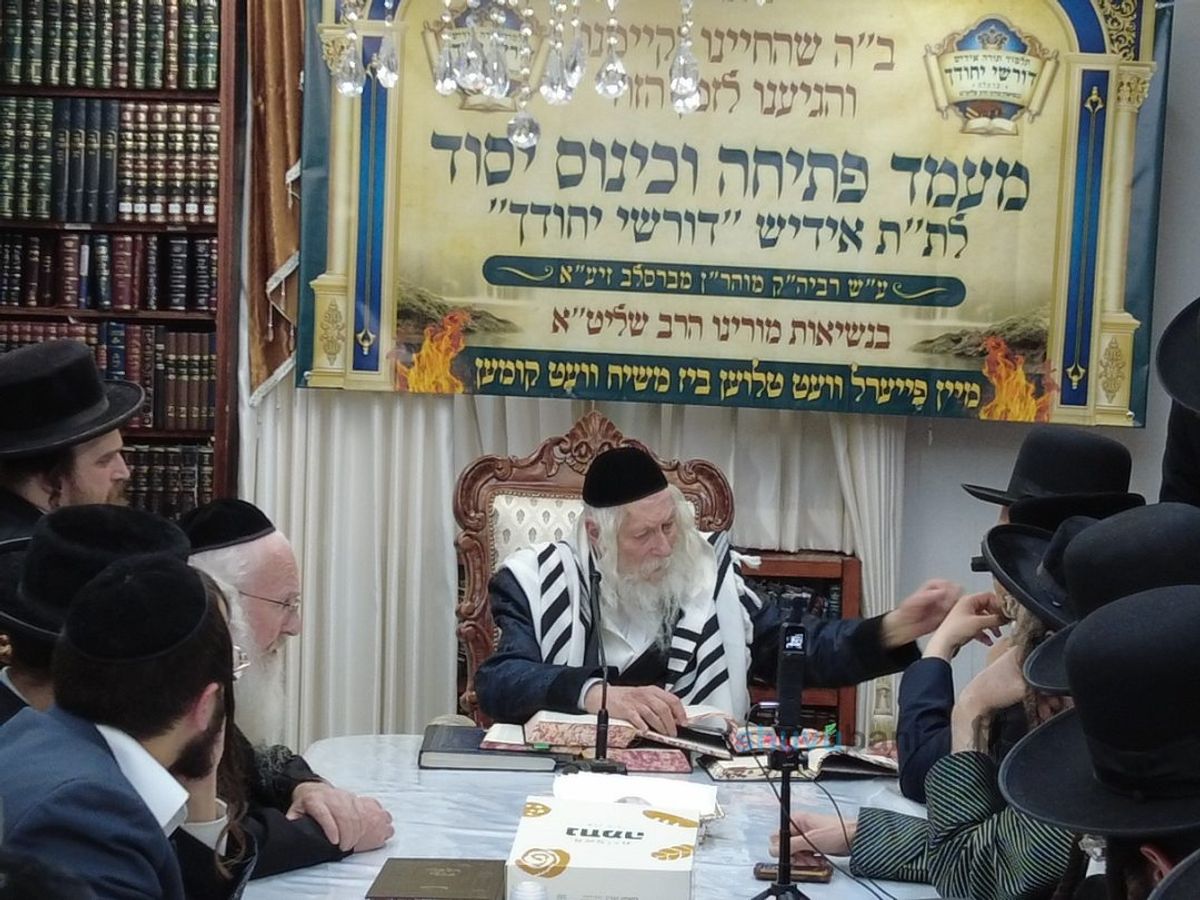
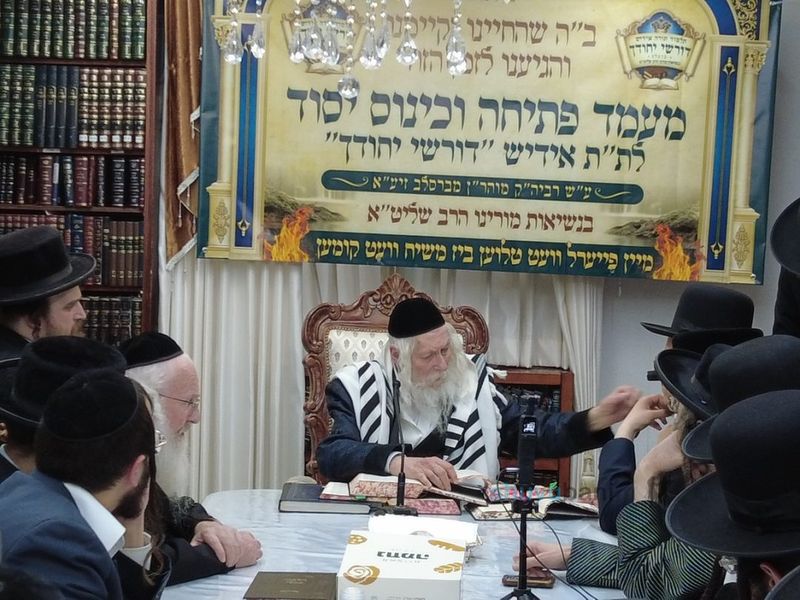
On Wednesday night, the eve of the 14th of Tammuz, Parshas Balak, the opening ceremony of the "Dorshei Yichudecha" Cheder (traditional Torah elementary school) for Yiddish speakers was held at the residence of the Gaon and Tzaddik Rabbi Eliezer Berland shlit"a (may he live long and good days). The Cheder is established Al Taharas HaKodesh (on the foundation of holy purity) within the Shuvu Banim community.
The ceremony was attended by the directors of the new Yiddish-speaking Cheder Al Taharas HaKodesh, as well as the Melamdim (teachers). During the event, The Rav delivered a lesson to the participants. Below is a summary of the topics from the lesson:
"How goodly are your tents, O Jacob" — now we are opening a new Yiddish-speaking Cheder. There is a question: why was Balak afraid of the Jewish people, given that the Torah says, "Do not provoke them in war..."? Rather, he knew that Ruth would descend from him, and from her would come David, who would eventually destroy Moab. Balaam was the son of Jethro; "fire went out from Heshbon." Balak and Balaam were such powerful sorcerers that they could draw down actual fire. Balaam possessed "Da'as Elyon" (Supernal Knowledge), having more knowledge than Moshe Rabbeinu (Moses our Teacher); he learned all his sorcery from his grandfather, Laban the Aramean. Amasa is mentioned once as the son of an Ishmaelite and another time as the son of an Israelite; the explanation is that he girded his sword like an Ishmaelite. Joab killed all of David's generals; Abner and Joab met and were discussing the law of how a woman with a severed hand receives her Get (divorce document), and then Joab stabbed him in the Chomesh (the fifth rib/upper abdomen). Every Jew has the potential to conquer the entire world; David wanted to conquer Rome, as it says, "Who will lead me to Edom..."
It is written that if a gentile converts, he is like a Kohen Gadol (High Priest) and is equivalent to the entire Jewish people because he has no [impure] roots. The Roman Emperor used to say to the Rabbi, "Step on me," but the Rabbi refused. The Emperor said to him, "May it be granted that I merit to be a footstool beneath you in the World to Come." What a person gives to Tzedakah (charity) is his only true money; that is what will truly remain with him. Abner could have stabbed Joab back but he desisted and did not kill him, because even if a person's "two signs" (the trachea and esophagus) were slaughtered, he can still perform legal acts of marriage and divorce and does not convey ritual impurity. Hashem (God) told David: You cannot conquer Rome, because if you do, they will not be able to serve idols and the Holy Temple will not be destroyed [at that time], and then Hashem would not be able to vent His anger upon wood and stones (sparing the people), Heaven forbid.
There is the story of Rabbi Yitzchak Delouya and the girl from the Sambatyon (the miraculous river that rests on Shabbos) who saved a Jew from Marrakesh. Rav Ashi once said, "Tomorrow we will speak of our colleague Manasseh." Manasseh appeared to him in a dream and said, "If you had lived in my time, you would have lifted the edges of your upper garment to run even faster to serve idols." Rehoboam was born when Abijah died; from Abijah the son of Jeroboam, Mashiach (the Messiah) will emerge because he removed all the blockades. For whoever used to go up to Jerusalem for the pilgrimage would be stabbed with a sword, so they used clever tactics to bring the Bikkurim (first fruits) and the wood for the altar. Now, on the 17th of Tammuz, one must decide whether he chooses the Golden Calf or the Tablets of the Covenant. On the 17th of Tammuz, Mashiach ben David (Messiah son of David) was born, for that was when Ruth the Moabitess was blessed with a child (conceived) from Boaz, who passed away that same day at the age of 400. When Saul asked Doeg, "Whose son is this lad?" he intended to ask whether he descended from Perez or Zerah; for if he came from Perez, he would merit the kingship.
Three people asked Hashem improperly, including Eliezer (the servant of Abraham), who asked improperly by setting conditions [for finding a wife for Isaac], for what if she had been a mamzer (illegitimate) or blind? Similarly, the daughter of Jephthah, which occurred during the period of Teves when it is forbidden to drink water. The Ketzos HaChoshen (a classic work of Jewish law) asks how David could betroth Merav [with the head of Goliath], since Goliath was not worth even a Perutah (a small coin), as it says, "Behold, the nations are like a drop from a bucket." The answer is that the blow itself with which he struck Goliath was indeed worth a Perutah. Eldad and Medad did not understand the prophecy; when they said "Moshe is dead," the intention was that he would die for only a second and then there would be the Resurrection of the Dead.
Now we are opening a Yiddish Cheder; this is the language of Rabbeinu (Rebbe Nachman), and this is what protects this generation from iPhones and all technology. There are enough children to fill this Cheder from all over the country, from all the Cheders of the various Chassidic groups. We are now before the trip to Uman; the first seal is "Zechor Bris" (Remember the Covenant). It is written that if even one Admor (Chassidic leader) had come to the Tziyun (holy gravesite) of Rabbeinu before the Holocaust, the Holocaust would not have happened. Eretz Yisrael (the Land of Israel) is the "Land of the Living"—here people do not die. Whoever sends his child to this Cheder will live until one hundred and twenty! And his children will know the entire Shas (Talmud) by the age of seven. We teach the children all these aforementioned stories about the daughter of Jephthah and the Zohar on Parshas Balak; these are all holy stories.
Subscribe to Our Newsletter
Receive Torah articles and inspiration directly in your inbox