Rabbi Levi Yitzchak is the True Legacy of Breslov • Pearls from the lessons of
the Gaon and Tzaddik Rabbi Eliezer Berland shlit"a for the Hillula (anniversary of passing) of the Elder of our community, the Chassid, our teacher Rabbi Levi Yitzchak Bender zy"a
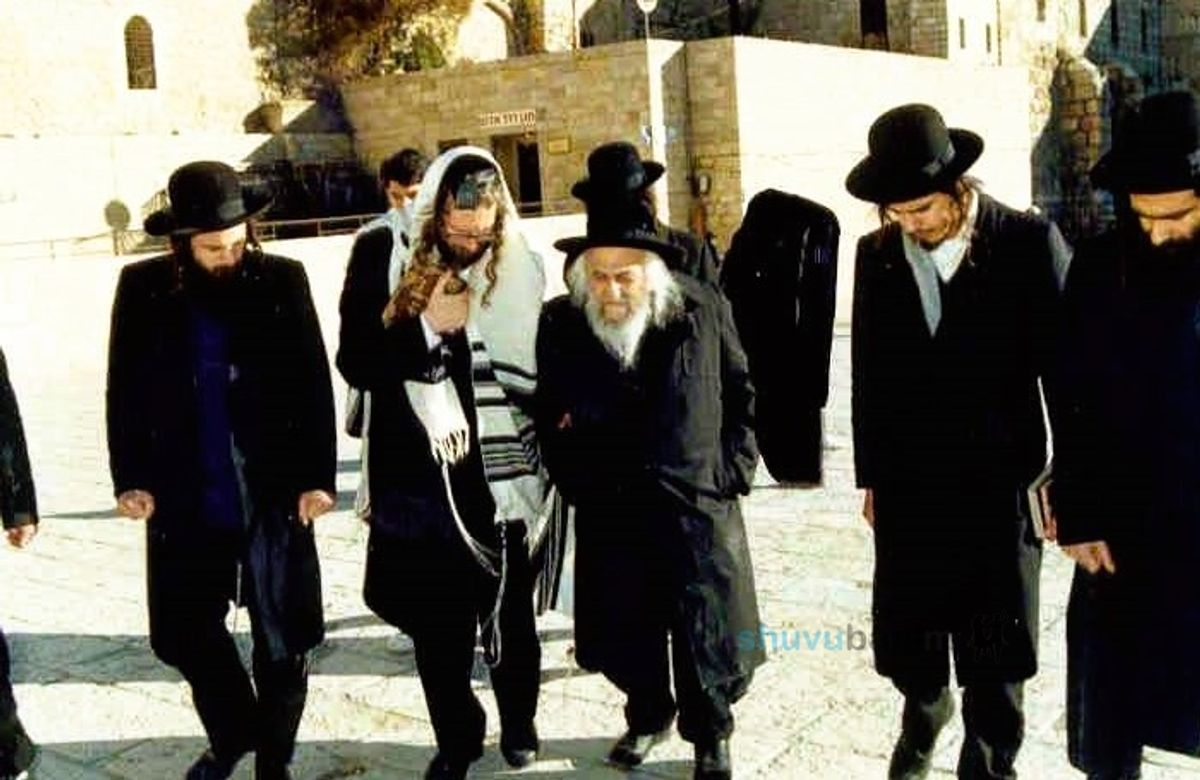
On the occasion of the 35th Yahrtzeit (anniversary of passing) of the Elder of our community and the glory of our heads, the transmitter of the tradition, the Chassid and Tzaddik, our teacher Rabbi Levi Yitzchak Bender zy"a (may his merit protect us), we bring before you pearls collected from the lessons of his prominent student and the successor of his path in the traditional way, the Gaon and Tzaddik Rabbi Eliezer Berland shlit"a (may he live long and good days).
There was Reb Levi Yitzchak, there was Reb Shmuel Shapira—it was a fulfillment of "And I will grant peace in the land." There were 40 years of quiet from 5709 (1949), when they returned from captivity, until 5749 (1989). There were forty years of "and the land was quiet for forty years." After Reb Shmuel Shapira returned from captivity, he sweetened all the judgments. We said, what is "Shul" (synagogue)? "Shul" is an acronym for Reb Shmuel Shapira, Reb Velvel Cheshin, and Reb Levi Yitzchak. Here in the corner sat Shmuel Shapira, there at the edge sat Reb Levi Yitzchak, and here sat Reb Hirsh Leib. There was Reb Shmuel Shapira, and there sat Reb Velvel Cheshin at that edge, and there sat Reb Eliyahu Chaim, the one who built the Shul. And there was Reb Velvel Cheshin. Exactly when they passed away, the Intifada began in 5749 (1989). They passed away, and the Intifada started. This was exactly forty years from 5709 when they returned from captivity and the ceasefire was made; until then, there were wars, and they had to go from house to house—a new creation. So there was Reb Velvel Cheshin, Reb Shmuel Shapira, and Reb Eliyahu Chaim who built the Shul. We are speaking here about how a new creation is being formed now. We are speaking about who built the Shul: Shmuel Shapira who sat in this corner, Reb Levi Yitzchak who sat in that corner, and Velvel Cheshin who sat in that corner—he was the first to start bringing people back in Teshuvah (repentance). This is the "Shul": Shmuel Shapira, Velvel Cheshin, Levi Yitzchak—these are the initials of SHUL, and they are alive and enduring.
Reb Levi Yitzchak would always repeat every two lessons: "Know that what you eat for breakfast, we didn't even have on Shabbos." I once asked Reb Levi Yitzchak, tell me, how was the seventh day of Pesach? We sat with Reb Levi Yitzchak for 20 years, we asked a million questions. Gavriel Grossman was present. We would come to eat breakfast, and Gavriel Grossman and I would sit and learn. Once I asked him questions—it was exactly before Pesach—how was the seventh day of Pesach here? The seventh day of Pesach, the festive meal, a story of the Rebbe... He said, what did they do on the seventh day of Pesach? He said that in Uman, on the seventh day of Pesach, there was barely a Minyan (quorum of ten). He said there was barely a Minyan in the Shul, in the Klaus (the Breslov synagogue in Uman); people were lying in their beds. He said there were seven days where there was no food. For seven days they ate nothing. On the first night, they ate the five 'kezayis' (olive-sized portions)—that was all the Matzah there was; there was no more Matzah. Reb Moshe would donate a few pennies to each family to buy Matzah, and they had to hide the Matzah from the children so that the children wouldn't eat the Matzah before the Seder night.
Through the power of Rebbe Nachman, it is possible to sweeten everything, so that truly the Jewish people will have a new year. Now we are creating a completely new year, without Qassam rockets, without missiles, without Katyushas, without Hezbollah, just as it was in the time of Reb Velvel Cheshin, Reb Shmuel Shapira, and Reb Levi Yitzchak. They are the "Shul"; they are the initials of SHUL. There were forty years from 5708 (1948) until 5748 (1988)—there were forty years of complete quiet. Until they passed away, then all the great disasters happened. We must draw down their lights, their simplicity, and their service of Hashem.
A person needs to know that one must pray in the Shul. Reb Nachman Tulshiner never missed a prayer in the Breslov Shul. Reb Levi Yitzchak would always say this: Reb Nachman Tulshiner never in his life missed a prayer. He was in Breslov in Uman for eighteen years, and before that, he was with Reb Noson in Breslov for eighteen years. Eighteen years in Breslov, eighteen years in Uman with Reb Noson, and after Reb Noson passed away, he moved to Uman for eighteen years. He said, "And never in my life did I miss a prayer in the Breslov synagogue. Once it was almost sunset, so I stood on the way in some other synagogue, but otherwise, all my life, except for that one time, I never missed a prayer." A person needs to know—we pray in the Breslov Shul; perhaps if a person falls, he will have a thought of Teshuvah (repentance), who knows.
A person must be careful not to say things he did not hear from Rebbe Nachman. Thus, we must truly continue the tradition, truly continue the real legacy of Rebbe Nachman. "Yechadeshu" (May He renew)—the melodies. Reb Levi Yitzchak renewed the melody of "Yechadeshu." It is forbidden to innovate melodies, so Reb Levi Yitzchak renewed "Yechadeshu" by taking the melody of "Yetzaveh Tzur Chasdo" and making "Yechadeshu" out of it. "Yechadeshu" itself is a melody of Reb Levi Yitzchak. In every generation, another melody. "Ga'al Yisrael" alone took a whole hour; "Tzur Yisrael" took a whole hour—such melodies! "Tzur Yisrael"—Reb Shmuel Shapira said it took us a whole hour to say "Tzur Yisrael." Reb Levi Yitzchak himself renewed several melodies and also renewed several things—we don't just add another melody, another song, another something, another song.
Truly, I wanted to say regarding "HaMelech HaKadosh" (The Holy King)—it is a terrible mistake, we do not clap hands. So during "HaMelech HaKadosh," we do not clap hands. We are sitting before the Throne of Judgment, sitting before the trial, sitting before the Judge, and one does not clap hands before the Judge. It's very simple. Reb Levi Yitzchak said that in Breslov they did not clap hands. Every year, Reb Levi Yitzchak would scream; he would scream in the middle of the prayer and tell them to stop clapping hands. We don't clap hands at all. We only clap hands during "Keser Melucha" (the Crown of Sovereignty), and even then, not too much. But in Breslov, they didn't clap hands at all. People need to know this, to say this. I hope I will say it again in the month of Elul so they remember once more—we said that we do not clap hands.
We are talking about Reb Levi Yitzchak, we are talking here about the path of Reb Levi Yitzchak—this is the true legacy of Breslov. So he says we don't clap hands during "HaMelech HaKadosh." There are infants and children, and every year they clap more, thinking it's already a Mitzvah and an obligation. They probably think Rebbe Nachman also clapped hands. It's very simple: we are sitting before the Throne of Judgment, the Throne of Trial. Now Chol HaMoed (the intermediate days of the festival) is coming, then we do dances—now that is the time for "Chasadim" (kindnesses).
(Regarding the holiness of the marital bond): Reb Levi Yitzchak once said, how can it be that the holiest thing is dragged down to the lowest depths? He didn't understand it. He told me this personally. I would eat breakfast with him, and he would say, "How can they degrade the holiest thing?"
The first thing is the Torah. Reb Levi Yitzchak said, why did Reb Noson put this Torah lesson at the beginning? Reb Noson did not hear this lesson from the Rebbe. This is Torah 1. Reb Noson didn't hear it from the Rebbe; he found it in the bundle of writings. He found it after the Rebbe's passing. Reb Levi Yitzchak told us that after the Rebbe's passing, he found this Torah. He didn't hear this Torah, and no one heard it; no student heard it. There was Torah 38 about shame that the Rebbe said and students recorded, but no one recorded this Torah. It was an interruption in hearing, "Ohr HaGanuz" (the Hidden Light)—everything is hidden. So the first Torah is this, and this Torah is truly the Hidden Light; no one knew about it. Reb Noson accidentally found it after the Rebbe's passing; he was rummaging through the writings and saw a Torah lesson. So Reb Levi Yitzchak said two reasons why he put it at the beginning: either because he wanted people to know that the advice of Breslov is the study of Torah—through the Torah one is accepted—to look at the "Sechel" (intellect/wisdom) in everything. The Torah is Sechel. The Rebbe is Sechel. The Rebbe said, "I wanted you to have such Sechel, such Sechel as has never been in the world." It is written in Chayei Moharan: "I believed that you would have such Sechel, such Sechel as has not been for several generations." Am I just bringing close "pipsqueaks" (insignificant people)? They brought someone, another one—did I bring them close?! Another pipsqueak, another crazy person, what?! The Rebbe wants scholars, geniuses who will be tested every day on 100 pages of Yoreh Deah and Choshen Mishpat—this is what the Rebbe wants. There are enough people to jump on tables. So the Rebbe says, they brought someone to him, and the Rebbe says, "What did you bring me? Did you bring me pipsqueaks?! You need to bring close a scholar, a wealthy man, a man of lineage, some great Rabbi." The main thing is to say more lessons, more lessons?! It is better to say one lesson that will bring close one person who will then bring close thousands. So Reb Noson, first of all, wanted—Reb Levi Yitzchak said—the foundation (the advice) of Breslov is the Sechel in everything, the wisdom and the Torah. So this Torah, Torah 1, is the Hidden Light. It is a Torah that says the first thing is Torah study. Reb Levi Yitzchak said this is the first discourse of the Rebbe on Rabbah Bar Bar Channah. This first discourse was not heard from the Rebbe. It is "Ehyeh Asher Ehyeh" (I Will Be What I Will Be), about those who went on a ship and a wave came to drown the ship and they were taken to prison. The Rebbe says that everything you do besides Torah study is "this wave that drowns the ship." Whatever Mitzvah a person does, even the greatest Mitzvah, if it is not Torah study, it is a wave that comes to drown the ship. The success of the Jewish people is only Torah study.
There were Tzaddikim who would sit all of Purim alone. Reb Levi Yitzchak would sit all of Purim alone. They would be in seclusion with Hashem, dancing with Mordechai HaTzaddik. Tzaddikim on Purim can perform rectifications even more than on Yom Kippur, as Reb Noson says, "For me, the service of Yom Kippur is [on Purim]," because one can accomplish such great things in these three days of Purim.
Reb Avraham ben Reb Nachman said it is forbidden to be in Uman for more than two weeks, because after that, one becomes "Heimish" (too familiar/casual). And Reb Eliyahu Chaim said that they saw many "psakim" (spiritual interruptions/difficulties) in people who traveled to Uman frequently. Reb Eliyahu Chaim said this in the lessons we would hear from him. He told us—we sat with him for 10 years in lessons every Thursday night; we would go to Reb Levi Yitzchak in the afternoon and stay for Thursday night in Jerusalem, going to him like that for 10 years. There are many tapes of him, and everything is full of stories. He said they saw many salvations and many "psakim," because if a person even slightly dozed off at the Tziyun (the Rebbe's gravesite), slightly feeling "Heimish," then it affected his children, it affected his wife.
From 5672 (1912) it is called "Ad" (until) 5678 (1918), when the British conquered the Land of Israel. So there were 6 years of "pruning your vineyard"—souls were pruned, souls were cut down, souls were crushed, and hundreds of thousands of Jews perished. Jews were killed just like that, as if for a post-meal snack, Heaven forbid. And after that, 5678, then was the time of Redemption. This is what the Zohar says, that Parshat Behar hints at the Redemption that comes after, after, after... and after all the souls that came with Yaakov were 66—add 6 years to that. "Six years you shall sow your field," which is 5672, and to this add another 6 years of "pruning your vineyard"—this is World War I. People perished. And Reb Levi Yitzchak told that they took everyone. Reb Levi Yitzchak was in World War I. Reb Levi Yitzchak was in Uman; he had just arrived in Uman exactly when the war broke out on Tisha B'Av. So he immediately fled to Uman; he didn't even enter his house. He immediately boarded a train without tickets, without anything. It was Ben Zion Apter who told them to get under the benches, and thus he merited to reach Uman without any tickets. Someone carried him; he reached the train station and there were ten thousand people on the platform—how would he get on? Then someone suddenly saw him standing there and said, "I will get you on." He was standing at the window: "Give me the suitcase, give me the suitcase!" He lifted him through the window. He didn't know if it was Eliyahu HaNavi; he doesn't know to this day who it was that lifted him onto the train. And so he began to travel and travel. He reached Lodz. The Breslovers there in Lodz said it is forbidden to travel, it is Pikuach Nefesh (a life-threatening situation), because they were killing Jews on the trains too. Soldiers would travel, see a Jew, and—boom—they'd shoot him, just out of sport. So they said it is Pikuach Nefesh. [He said], "I am traveling to the Rebbe. The Rebbe is the Tree of Life. I am traveling to the Tree of Life, I am traveling to Rebbe Nachman." And so he went from station to station, reached Reb Ben Zion Apter, and Yaakov (Dukto) arrived. He said, "Get under the bench." Today they also check under the bench, but until then they didn't know; the Russians were so simple, they didn't know people hid under the benches. And so he got under the benches and met one Reb Yudel whose half-earlock (payos) had been shorn off on the way—entire stories about Reb Levi Yitzchak's journey and how he arrived.
The Ten Martyrs (Asara Harugei Malchut)—now all the ten sons of Yaakov will have to come in every single generation and be killed. In every generation, ten are killed. In every generation, there are Ten Martyrs, just as there were Ten Martyrs in Uman. Reb Levi Yitzchak would always say that those who were killed in Uman were the Ten Martyrs. And in every generation, there are Ten Martyrs, and these are the sons of Yaakov and the tribes who come in every generation. Because until Mashiach comes, we have not yet atoned for the selling of Joseph, when they threw Joseph into Egypt; there they tortured him, "his feet were afflicted with fetters, his soul came into iron" for ten years.
The "Pele Yoetz"—this is no longer Shuvu Banim, this is no longer Breslov, this is the "Pele Yoetz" from about two hundred years ago. Two hundred years ago, this is how they educated boys and this is how they educated girls. He said, "When I arrived in Istanbul, there were souls there at the level of Tannaim (Sages of the Mishnah)." Reb Levi Yitzchak would say this about Yaakov Ze'ev Brzezinski. They published stories (Sichos), and no one knows the real stories. They published and wrote five pages but they don't know how to tell that he walked to Uman twice on foot. And they don't know how to tell that Reb Noson prophesied about him that he would be the tenth man to complete their Minyan—terrible things! People write and don't know the stories, they know nothing. They write and write about Reb Yaakov Brzezinski, but he is the one who completed the Minyan! He completed the Minyan that Reb Noson spoke of. He said that a day would come, Rosh Hashanah, without ten men. Nine arrived. There were pogroms, they slaughtered people in the streets. So in the year Reb Levi Yitzchak arrived, there were nine men. Nine men were there; they didn't know from where the tenth would come. The tenth arrived already after sunset. Suddenly he arrived from Poland, from Warsaw; he had walked on foot and managed to arrive. He was the tenth. All of this was Yaakov Ze'ev Brzezinski. No one knows this; it's not written at all. They wouldn't even know who Yaakov Ze'ev Brzezinski was. They don't know who they are writing about. They record stories... once, twenty years ago, we sat with Reb Levi Yitzchak, we slept at his place, we ate at his place, we heard endless stories. Today there are new people who don't know a single story, they even write about someone without any true story at all. The true story is that Reb Noson saw in his Ruach HaKodesh (Divine Inspiration) that he would complete the Minyan, he would be the tenth for the Minyan on Rosh Hashanah. And he was in a pit of the dead, and he knows it all depends on him. There were perhaps a hundred dead there; they threw him into the pit, they shot at him and threw him into the pit, but they missed the target. He made himself look like he fell into the pit, and after that it became dark and he continued walking. That is why he arrived after sunset. No one knows this; they don't write it at all. Both men and women—how the women walked! They walked through the pogroms, through the gunfire, through the fire, and every time they slaughtered Jews.
Reb Levi Yitzchak was stood up in front of the rifles as well. They told him to say Vidui (confession prayer). Suddenly a Bas Kol (Heavenly Voice) arrived and released him. So when he reached the nearby village, it turned out they had slaughtered the entire village. If he had arrived an hour earlier, they would have slaughtered him too. They asked that Hashem hold him back from ten until two, and he even saw the cloud of dust from the Russians who left the village—they didn't leave a single Jew alive. If he had come five minutes earlier, they would have slaughtered him too. And there are endless stories about all the elders of Anash (our community), how they walked through the fire, through the bullets, through the swords, through the spears—the main thing was to reach Uman, the main thing was to reach the Rebbe. Today they argue over two hundred dollars, fifty dollars less, fifty dollars more.
The Rebbe says that the main thing is Torah study. Without Torah study, no prayer is accepted. And this is the first Torah that Reb Noson put in Likutey Moharan. Reb Noson did not hear this Torah from the Holy Rebbe, but he put it as the first Torah. He put it from among the writings. Everything is in the name of Reb Levi Yitzchak. What we are talking about here—Reb Levi Yitzchak was once a Jew named Reb Levi Yitzchak, and he would sit and learn 18 hours a day. In fact, he didn't sleep; 18 hours a day, maybe even 19 or 20. He never slept, never... that was it. And he barely ate. He would only learn with the Choshen Mishpat, Shulchan Aruch, Gemara, and back again. And besides that, nothing. And as I knew him at age seventy—I knew him in 5720 (1960), in 5723 (1963) I knew him. He was born in 5657 (1897). In 5658 he was learning... in 5658 that's called 23... so he was 65 years old. From 5658 to 5723 is 65 years. He was born in 5657. He passed away at age 92. So he was born in 5657. So he was sixty-six years old when I first met him. That same Reb Levi Yitzchak, as he was at age 17, not a single movement changed in him. Just as at age 17 he sat and learned, and he was the most "mevuzah" (belittled/despised) person—the most belittled person in Breslov was Reb Levi Yitzchak. The more a person is belittled, the more he will eventually reach and continue the Rebbe's matter. He was the most belittled person in Breslov, and he always took upon himself the simple jobs, the ugly jobs, the despised jobs. He would sit with three or four people, no more, learning Gemara with them. Everyone else was a merchant, everyone was running to the fields, everyone was dancing on the tables. He was the only one who sat and learned simply. He sat and learned simply from Vasikin (sunrise prayer) until Maariv (evening prayer). At Maariv, he would go to sleep for maybe two or three hours, and wake up already for Chatzos (midnight lamentation). Abroad, Chatzos is already at ten-thirty; four-thirty is sunset. At ten-thirty he would already wake up and run to the Tziyun (the Rebbe's grave), say Tikkun Chatzos there, an hour of Hisbodedus (secluded prayer), and return to his studies. And so it went, back and forth. This was his order until the last day, until age ninety-two. This was his order, and besides Torah study, you saw nothing on him. Nothing besides Torah study. Besides Torah study. And he was the most belittled person in Breslov. Everyone despised him, everyone mocked him, and only he remained of all the elders of Breslov—only he continued the torch of the Rebbe.
On Motzaei Simchat Torah (the night after Simchat Torah), at the time when they do Hakafot Shniyot (second circuits with the Torah) and dance until morning—this was the custom in Uman, to dance until morning—he would fix the windows. The windows in Breslov, during the summer, they would be completely smashed. There were many servants of Hashem in Uman, many God-fearing people, many zealots, many Tzaddikim, and the first Mitzvah these Tzaddikim had was to smash the window. So in order that everyone could merit the Mitzvah, they arranged small windows in Breslov—tiny, tiny, tiny windows, so that every Jew could merit some Mitzvah. So it was maybe ten centimeters, twenty centimeters. Everyone sees the panes in the Klaus, but every Jew wanted to merit breaking some part. If there was one big, whole window, then only one Jew would merit the Mitzvah. So they wanted all the Jews of Uman to merit the Mitzvah, so they made tiny windows—meaning, they knew the first stone would break the whole window. This I am saying according to the Sod (secret/mystical meaning) and the Drush (homiletic meaning). According to the Pshat (simple meaning), it's simple—I hope the Pshat is understood—that if there is a very large window of ten meters, one stone breaks a ten-meter window. To ensure some remnant of the window remained until the end of the summer, they divided the window into thirty, forty, fifty, maybe a hundred parts, and in the meantime, every Jew merited the Mitzvah. It was with these iron strips, each window in the Klaus—there were 12 such large windows—divided into maybe a hundred pieces. And he would glue them. Now winter is coming. So everyone was dancing, and they gave him a giant ladder with these tiny panes to glue them into their frames. This took a whole night, maybe even several nights. And it starts right from Motzaei Simchat Torah. Everyone was dancing, and he was fixing the windows. And he said, "Master of the World, everyone is dancing, everyone is singing, everyone is serving Hashem, and to me they gave this despised work? To me they gave this despised work of fixing windows, of gluing the panes?" Then suddenly he shed a tear. Reb Mordechai Berenitzer saw this. Reb Mordechai Berenitzer was one of the great servants of Hashem, one of the leading Mashpi'im (spiritual influencers) in Uman. "Reb Mordechai Berenitzer, what is happening here? Always fixing the panes?" He said, "This will stand for you. The fact that you are fixing the panes, this will stand for you. You will live until ninety-two. You will survive the Holocaust, and you will continue the torch of the Rebbe, and you will continue the light of the Rebbe. This will stand for you, you will see that this will stand for you in the coming years. Specifically this simple work that you took upon yourself, to fix the panes so that people wouldn't freeze in the cold when the harsh winter begins—Simchat Torah it already starts to snow—so you took this thing. This will stand for you for generations, it will stand for you for your whole life, and you will be the successor of the Rebbe." The more a person is belittled, the more he is rejected... like Noah was inside the Ark with animals, with animals. Hashem could have arranged for him to be on Everest; He could have arranged to give him a boat and he'd travel on Everest and crocodiles would eat [the others].
Like Reb Levi Yitzchak—any city he arrived at, he saw that they were killing Jews. For example, Reb Levi Yitzchak arrived at some city, they caught him for four hours, from ten until two. He reaches the next city, a cloud of dust rises—now the murderers, the rioters, have slaughtered this city, and now not a single Jew remains alive there. Entire communities—that's a hundred thousand Jews. Entire communities of thousands of Jews, not a single Jew remained alive. There isn't even anyone to write about it, because no one remained alive now that they finished everything; there isn't even anyone to write. This was the period, in this period Reb Levi Yitzchak lived.
Subscribe to Our Newsletter
Receive Torah articles and inspiration directly in your inbox