Rabbi Shmuel Shapira Sustained the Entire Generation with His Guarding of the
Eyes! • For the 35th Yahrtzeit
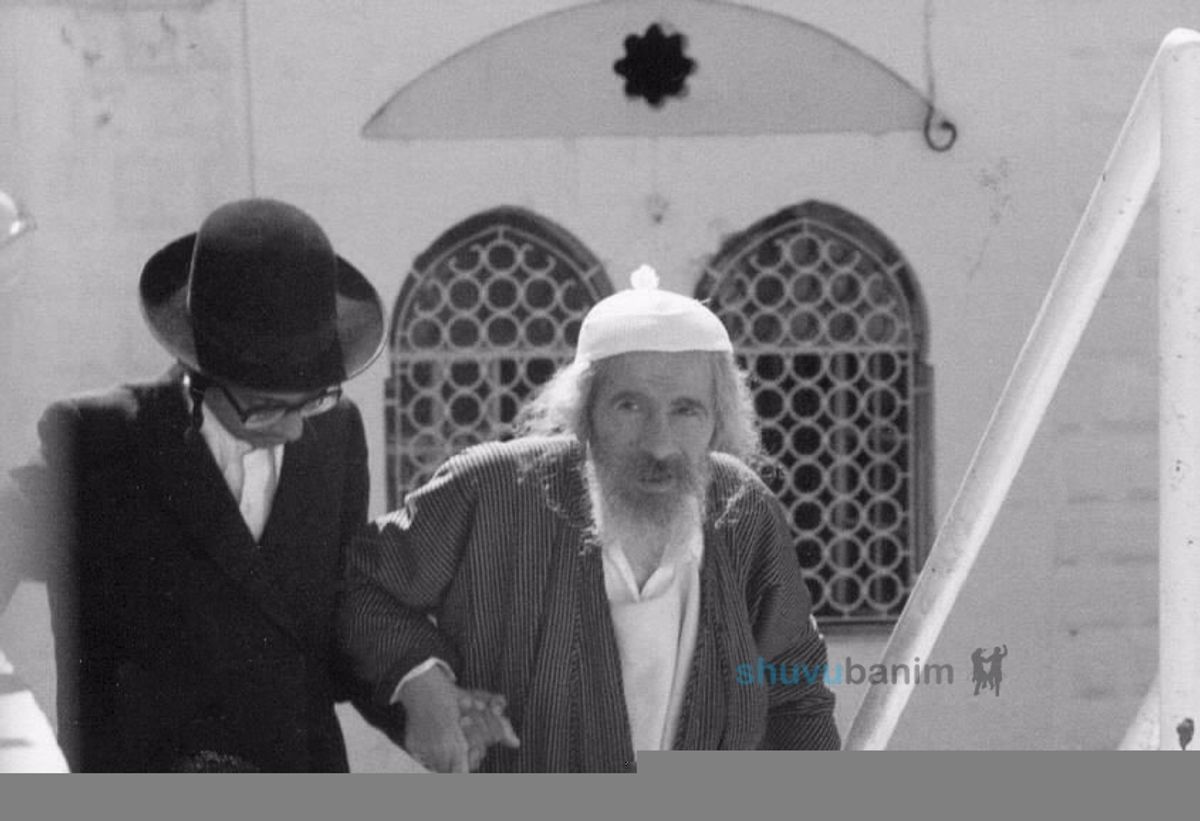
On the seventh day of Pesach, the yahrtzeit (anniversary of passing) of the holy tzaddik (righteous person), the leader of the Breslov Chassidim in the previous generation alongside our teacher, Rabbi Levi Yitzchak Bender zy"a (may his merit protect us), will occur. This is our teacher, Rabbi Shmuel Shapira zy"a, who passed away in the year 5749 (1989). The Gaon and Tzaddik, Rabbi Eliezer Berland shlit"a (may he live long and good days), merited to take shelter in his shadow and receive from his great light for many years. Before you are several stories from Rabbi Eliezer Berland shlit"a, a small glimpse into the awesome greatness of Rabbi Shmuel Shapira ○ For the day of the Hillula (celebration of passing):
Rabbi Shmuel Shapira makes the entire world accountable through his guarding of the eyes!
Now, thank Hashem (God), we saw Shmuel Shapira; we merited to see him. We saw a man who, from the moment he became a Breslover, closed his eyes. He closed his eyes. There was such a person, Rabbi Shmuel Shapira, who would scream from after Maariv (evening prayer) until the morning and would vomit blood. Thank Hashem, all his sons are holy and pure and guard their eyes. So this makes us accountable. It is written that Elazar ben Harsom makes the wealthy accountable, Hillel makes the poor accountable, and Yosef (Joseph) makes the wicked accountable. A person might say, "I have an Evil Inclination that reaches from here to the heavens." Yosef had an Evil Inclination that filled the entire world for twenty-two years until he became king. So Hashem have mercy, what trials he went through! As the Midrash describes, three times a day he had to withstand terrible trials. So do you have more of an Evil Inclination than Yosef? More trials than Yosef? Thus, Rabbi Shmuel Shapira makes the entire world accountable. He was such an awesome tzaddik. So a person—the Torah is the guarding of the eyes; this is the first foundation. If we don't fulfill this, then what have we accomplished?
In every place in the world, one must guard the eyes, even in the field in Meron!
"One who walks on the way and turns his heart to idleness..." The Gemara (Talmud) says, and then the Mishnah says, "One who interrupts his study and says, 'How beautiful is this tree, how beautiful is this plowed field...'" This isn't even talking about immodesty. We always know it's forbidden to look because one might stumble into immodesty. Rabbi Shmuel Shapira, in his life, was already in the field there in Meron in the Galilee—a desolate, lonely place. We are talking about 60-70 years ago when there was no settlement in the Galilee at all. So they said to him, "Rabbi Shmuel, open your eyes here; we are in a desolate, lonely place." [He replied,] "We don't know from where the Satan (accuser/adversary) jumps out. It's impossible to know. The Satan already knows that you are opening your eyes at this exact second, so he already prepares something for you. He already knows from before the creation of the world when you will not withstand the trial, when you will open your eye, and he is already planning for you."
Rabbi Shmuel Shapira held up all of the People of Israel without missiles for forty years!
The movements [of a tzaddik] are an awesome service. Every movement—how the movements of tzaddikim look! To see tzaddikim before one's eyes all the time, 24 hours a day to see tzaddikim before one's eyes. If a person hasn't seen tzaddikim, he hasn't seen anything. I still merited to see Shmuel Horowitz and Rabbi Shmuel Shapira. It’s a miracle that I still merited to catch them. If I had entered [Breslov] 10 years later, I wouldn't have seen them either. A person doesn't know what Breslov Chassidim are. A person doesn't know who Rabbi Shmuel Shapira was, or who Rabbi Shmuel Horowitz was. What holy people they were! What pure people! What people [dedicated to] holiness and modesty! And what devekus (attachment) to the Rebbe (Nachman), and what emunah (faith) in the Rebbe! They would walk with such devekus. Rabbi Shmuel Horowitz had a face that shone like the sun because he was always walking in devekus—always walking in devekus. Shmuel Horowitz—it was like this, he was always contracting his face like this... even if he had to walk from his house, which was 10 meters from the entrance to the synagogue, he would walk as if he were walking—I don't know where! Once, someone said to him, "Open your eyes, we are on the way to Meron, there is no one here." He said, "There is no such thing as 'no one.' Every opening of the eyes is a missile. As soon as it opens, there are missiles." He held up all of the People of Israel from 1948.
Shuvu Banim is the continuation of the path of Rabbi Shmuel Shapira
What is Shuvu Banim? It is to continue the path of Rabbi Shmuel Shapira and the path of Rabbi Mordechai Elazar Rubinstein—these two awesome tzaddikim who would pray at the tomb of Shimon HaTzaddik (Simeon the Just). For decades they prayed at Shimon HaTzaddik. They didn't go home at all; from after Havdalah (ceremony ending Shabbat) until the lighting of the [Shabbat] candles, they did not leave Shimon HaTzaddik. There they studied Gemara, there they studied Rishonim (early commentators), there they studied Acharonim (later commentators). Every prayer lasted six hours. They began the prayer at four in the morning—Shacharis (morning prayer)—and finished it at ten. "Tzur Yisrael" (Rock of Israel prayer) alone took half an hour. And that's it—to continue the path of these two awesome tzaddikim, who were Rabbi Shmuel Shapira, the Tzaddik and Gaon (brilliant scholar), and Rabbi Mordechai Elazar Rubinstein.
To nullify desire, they scream in Zedekiah's Cave all night long!
The Rebbe (Nachman) said, "Who has a [sinful] thought here?" The Rebbe screamed, "Whoever has a thought here, get out of here!" If a person does not have peace with his wife, he must have [sinful] thoughts. So a person needs, first of all—someone came to Rabbi Shmuel Shapira and said he doesn't have shalom bayis (marital harmony). He said, "Here is Breslov... in Breslov, one bows the head to the wife." This is what Shmuel Shapira said. I already heard this 30-40 years ago. Hirsh Leib told me—he regretted his whole life being a student of Rabbi Baruch Getz's, where they didn't know that a wife is necessary. They used to call the wife all kinds of names and everything to nullify this desire. So they would call her "kalbata" (female dog), and that's how you want to nullify the desire? Go to the field and scream until morning like Shmuel Shapira! He didn't call his wife "kalbata"; he went to the field and screamed. He went to Zedekiah's Cave (Mearat Tzidkiyahu). Today they have closed it because one can get lost there for three days and not come out. They used to enter with ropes, they used to enter with strings; they would tie them, they would buy strings like this and enter with a string so that a person would know how to return. So they would enter Zedekiah's Cave, pay five grush (small coins) to the guard, and scream from after Maariv until Vasikin (sunrise prayer). And in Uman, there were no clocks, so they would scream until a blue line appeared in the sky; then they knew they had to return. They would scream from after Maariv until a blue line appeared in the sky.
The mark on his bride's face disappeared in the merit of his extraordinary guarding of the eyes
The mother, Frieda—she had a red mark on her face. And Rabbi Shmuel Shapira, thank Hashem, even as a Litvak (Lithuanian Jew), he never looked [at women] in his life. From the day he reached maturity, he did not open his eyes. But the family is still family, and [they thought] this is not appropriate, it's not for the honor of the family. Fine, he was a Litvak, he still bowed his head for the family. After two years, he became a Breslover. He said, "Now give me this shidduch (marriage match)." They said, "But the family... it didn't help anymore... the match you offered me at first, I want that match!" "But she has a mark on her face! Half her face has a red mark!" "It doesn't matter to me at all. I must have this shidduch!" Krishevsky is their name. In short, he insisted, and there was no choice. The day after the engagement (erusin), she went out to the street and the mark had disappeared. The next day she went out—no mark, nothing. It's all imagination, it's all trials!.
Subscribe to Our Newsletter
Receive Torah articles and inspiration directly in your inbox