'Reb Leizer, Is It Enough Already?' ○ The Connection of the Gaon and Tzaddik
Rabbi Eliezer Berland shlit"a, to the Pious Tzaddik, Reb Mordechai Luzer Rubinstein zt"l
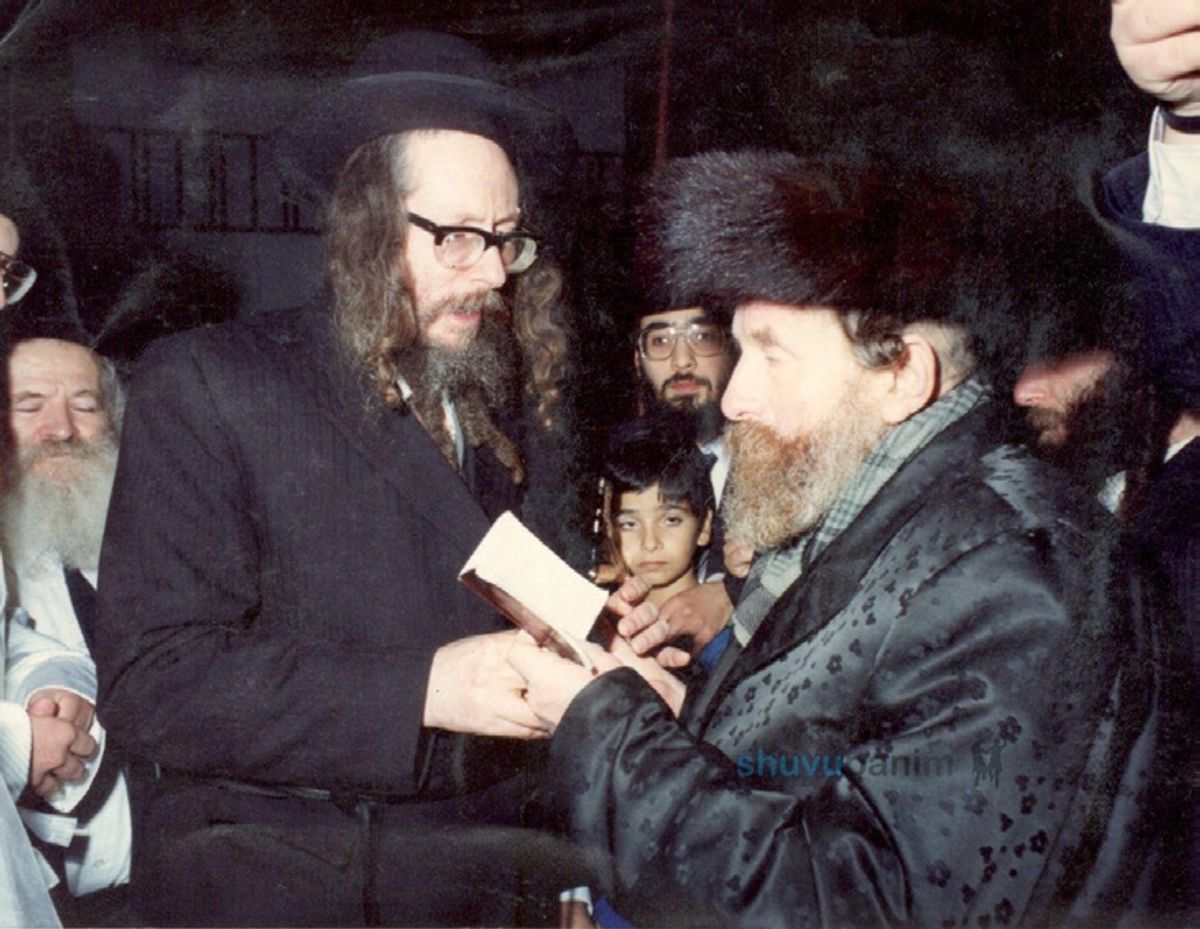
On Friday, the 23rd of Shevat, we marked thirty-one years since the passing of one of the greatest "Ovedim" (devout servants of Hashem) of Breslov in the previous generation, the Tzaddik Rabbi Elazar Mordechai Rubinstein, of righteous and holy memory (zt"l).
Before you is a rare documentation of the special connection that Reb Mordechai Luzer had with—may he be distinguished for a long and good life—our teacher, the Rav, Rabbi Eliezer Berland shlit"a. From an article published last year in the "Hischadshus" (Renewal) magazine in the month of Adar 5784:
Rabbi Mordechai Elazar Rubinstein held an immense appreciation for our teacher, the Rav shlit"a, for his extensive activities and his holy service. The uniqueness of this appreciation lies in the fact that, at first, it was actually not the case...
Those opponents who, from then until today, try to hide the light of our teacher, the Rav shlit"a, approached Reb Mordechai Luzer. Since he was a man who showed no favoritism to anyone, they initially succeeded in inciting him against the Rav shlit"a. The arguments and attempts of his son, Rabbi Yehoshua Dov shlit"a, did not help when he asked his father: "Why and for what reason are you opposing the Rav? Do you know him?! Have you investigated the matters?!" After all, our Sages of blessed memory already said: "It is a presumption that Lashon Hara (evil speech) will be accepted..."
Nevertheless, Rabbi Mordechai Elazar did not accept their words as the absolute truth. He told his son, Reb Yehoshua Dov, that when those people came to him with talk against our teacher, the Rav shlit"a, Reb Mordechai Luzer said to them: "If that is the case, come together with me and let us go scream at him." However, miraculously, those people immediately slipped away and disappeared... "From this, I understand that they are not truthful people," said Reb Mordechai Elazar. "If the truth is in your mouths, why do you not want to say the things to his face, and only try to send me for the matter?" he asked.
However, it did not take long before Reb Mordechai Luzer had the opportunity to witness our teacher, the Rav shlit"a, and his students from up close. Then, in his attribute of truth, not only was he greatly impressed by the Rav's conduct and holy works, and even asked for his forgiveness, but he now turned the arrows of his criticism toward those low and despicable opponents.
This occurred during the trip toward the Kibbutz (gathering) of Rosh Hashanah 5749 (1988), the first year in which a large Kibbutz of about two hundred and fifty of Anash (our community) took place near the Tziyun (holy gravesite) of Rebbe Nachman in Uman. The novelty of the fact that one could conduct themselves in Communist Russia as Jews in every respect and prostrate themselves on his holy Tziyun caused immense joy among Breslov Chassidim and hope that more good for all of Israel would grow from this.
However, this was not the only novelty of that Rosh Hashanah. Reb Yehoshua Dov recounts: "After Rosh Hashanah, Reb Yisrael Hirsch z"l approached me and said: 'This year Mashiach is coming!' I thought he meant to say that following the Kibbutz by our Rebbe, we would already merit the Geulah (Redemption), but he told me that was not his intention. He explained his words: 'I saw your father [Reb Mordechai Elazar], who on the first night of Rosh Hashanah, bent down to the floor, kissed Reb Leizer Berland's feet, and asked for his forgiveness.' I did not believe my ears, but an inquiry I conducted among other people who were present at the scene clarified to me that the things were true.
I did not know what caused this change in my father's position. And no, it wasn't that it was hard for me to believe such things about my father. Whatever he saw as right, he did without making any calculations, but how did his opinion suddenly change so much? To ask my father was a bit difficult, since he never spoke about himself, so I waited for an opportune moment.
During Succos, I found a suitable opportunity to ask my father about the reason for the change in his position. He told me that on the trip to Uman, he saw the students of our teacher, the Rav shlit"a, including the Baalei Teshuvah (those who returned to religious observance) among them, and behold, he saw righteous and simple people, exactly the opposite of what he had been told about them. 'When I needed help, no one came to my aid except for those Baalei Teshuvah, whom they had slandered so much. Likewise, I saw and observed Reb Leizer Berland, and I saw that I had shamed him for nothing. I saw that he is a Tzaddik and everything they told me about him was an absolute lie! Therefore, I asked for his forgiveness.'
His Connections Over the Years with Our Teacher, the Rav shlit"a
Rabbi Yehoshua Dov: "When I became related through marriage to our teacher, the Rav shlit"a, and my son Reb Nosson became the Rav's son-in-law, I informed my father that the Shabbat Aufruf (the Shabbat of being called to the Torah before a wedding) would be at 'Shuvu Banim' in the Old City. When my father asked when the prayer begins, I answered him that the prayer begins at three in the morning... For my father, there was no such concept as being late for prayer, and he arrived on time for a prayer that lasted 11 hours and even more! My father enjoyed it very much and was in the prayer from its beginning to its end.
Afterward, when we went for the occasion of the celebration to eat at the home of our teacher, the Rav shlit"a, the father of the bride, my father joined us. In the middle of the Seudah (festive meal), he turned to the Rav shlit"a with a question:
"Regarding you, I have no question how you can pray for such a long time, but I do not understand how you keep the entire public until such an hour with such a long prayer? Furthermore, Rebbe Nachman said that the eating of Shabbat is entirely holy, entirely spiritual—so what will be with the meals?"
Our teacher, the Rav shlit"a, gave him two answers to his questions. "First of all, I did not ask anyone to come pray with me, and certainly I do not force anyone. Whoever wants to can come, and whoever does not want to can also leave." Then our teacher, the Rav shlit"a, added to explain his conduct: "I myself do not need anyone. For my part, it would be better for me to sit for seventy years in a room with books and serve Hashem without people around me. But what can I do? Rebbe Nachman commanded us to 'water the trees' (nurture souls), and therefore I do this, but I do not force anyone to come pray with me."
"And regarding what you asked," the Rav added, "if Rebbe Nachman said that the eating of Shabbat is entirely holy, then the prayer of Shabbat is certainly even more holy. It is clear, then, that it is better to increase in prayer as much as possible." Reb Yehoshua Dov notes that his father, Reb Mordechai Elazar, was very impressed by the Rav's answers.
"When my son Meir brought his eldest son into the covenant of Avraham Avinu in the 'Shul' (synagogue), my father stood up and cried out from the depths of his heart against the Rav's opponents: 'Demons! Spirits! Liliths! What do you want from this Jew who is restoring the Avodah (Divine service) of Breslov? Hashem did us a kindness and sent him to us! People have already forgotten what Chatzos (midnight lamentation) is, what Hisbodedus (private prayer) is. Who today speaks of the fields? And here comes Reb Leizer and restores the service of Hashem that people had already begun to forget! What do you want from him?!' And so he continued in his words, not fearing anyone, to speak the clear truth (thanks to the joy of the Bris that took place then, these words of his were preserved in a recording available among Anash).
It was already mentioned in our magazine from the month of Tammuz 5776, the story that our teacher, the Rav shlit"a, told: how, after two days that no food had entered his mouth because he had no time to eat, as he was in the field all those days... Reb Mordechai Elazar noticed him and his face, where it was evident that no food had entered his mouth for a long time. In the middle of the prayer, he called the Rav to follow him and brought him to his home, where he prepared a hearty, soul-reviving meal for him. All this was without even knowing our teacher, the Rav shlit"a, only from the great attribute of Chesed (kindness) that was ingrained in him.
"And at Night His Song is With Me" – The Lessons in the Home of Rabbi Mordechai Elazar Rubinstein zt"l
Reb Yehoshua Dov: "Our teacher, the Rav, would make an effort to serve each and every one of the elders of Anash. He even came to my father in order to learn and receive more and more. Thus, the lesson was established in the last year of my father's life, when our teacher, the Rav shlit"a, would bring several other people with him to the lesson.
This wonderful and special lesson was on Wednesday night [the eve of Thursday], when our teacher, the Rav shlit"a, would speak together with Reb Mordechai Elazar and try to draw out more and more precious words from his mouth. Sometimes, after a certain period of time, Reb Mordechai Luzer would ask: 'Reb Leizer, shoyn genug?' (Is it enough already?) and our teacher, the Rav shlit"a, would answer him: 'Noch finf minut... noch tzen minut...' (Another five minutes... another ten minutes...). Thus we merited a series of six tapes, in which a significant portion of these precious conversations are brought, as well as recordings of the fiery melodies of Reb Mordechai Luzer.
"The joy of my grandfather, Rabbi Mordechai Elazar, when the Rav would arrive was immense," relates his grandson, Rabbi Nosson Rubinstein, the son-in-law of our teacher, the Rav shlit"a. "He had great vitality from the Rav, and they would sit calmly, speaking, asking, and singing. Often, we would be the ones speaking or asking questions.
"My grandmother, the wife of Reb Mordechai Luzer, also had great pleasure from these lessons, as she remembered the days of the service of the group of 'Ovedim' (devout servants) of the Breslov Chassidim in their youth." It is interesting to note that the wife of Rabbi Shmuel Shapira expressed herself similarly when students from the 'Shuvu Banim' Yeshiva came to her—that they reminded her of the group of servants of Hashem in Breslov, of which her husband was the first and foremost.
(The first part of those conversations has already been brought in the 'Hischadshus' magazines, and G-d willing, the rest of the conversations will be brought in the coming issues).
The article is courtesy of the "Hischadshus" magazine.
Have you still not fulfilled the instruction of our teacher, the Rav shlit"a, to join the magazine?
You can join now as a subscriber in a secure way by clicking here and receive every month a magnificent magazine full of Jewish and Breslov content according to the path and teachings of our teacher, Rabbi Eliezer Berland shlit"a, delivered to your home.
Subscribe to Our Newsletter
Receive Torah articles and inspiration directly in your inbox