Replacing the Body Before the Redemption
The Daily Chizuk from the Gaon and Tzaddik, Rabbi Eliezer Berland shlit"a
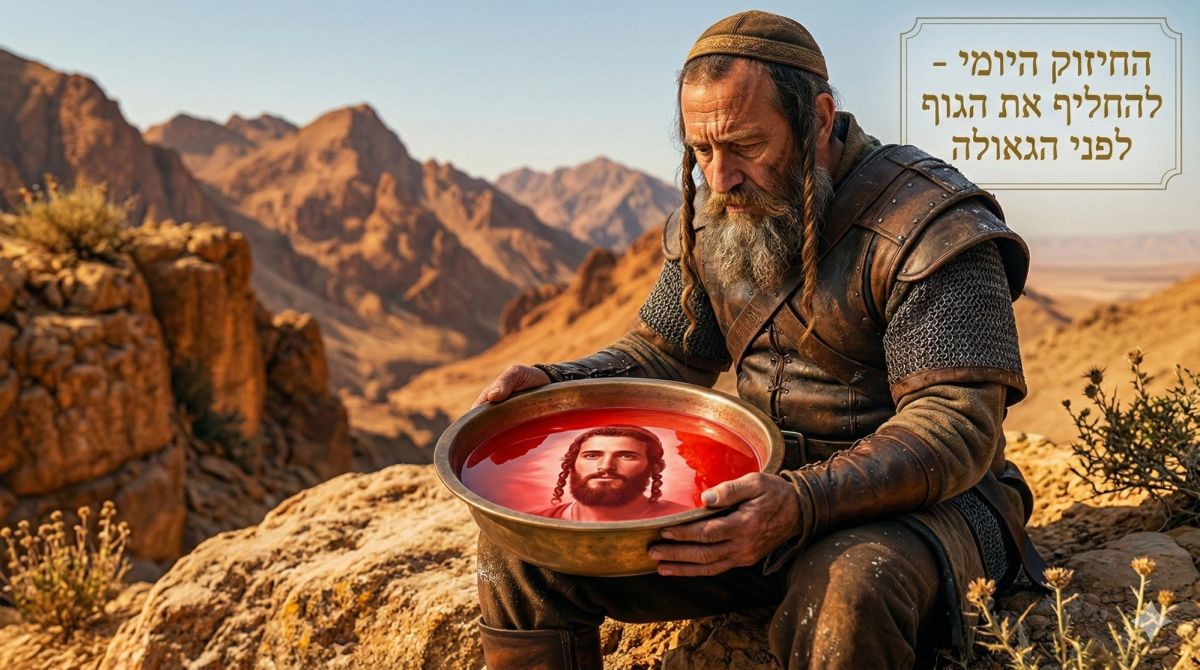
History holds deep layers of events and beliefs within it, weaving together to create a fascinating mosaic of culture and tradition. In the following chizuk (spiritual encouragement) from our teacher, the Gaon and Tzaddik, Rabbi Eliezer Berland shlit"a (may he live long and good days), a rich world of hidden meanings and foundational events that shaped the spiritual leadership of the Jewish people is revealed to us.The Conquest of Hebron and the Prohibition on Me'aras HaMachpelah (the Cave of the Patriarchs)The Mamluk Legacy in HebronThe Mamluks, who were originally slaves, conquered and seized power from the Turks, and as part of their expansion, they also conquered the city of Hebron. This event left a deep mark on Jewish history in the region.[VIDEO: https://vimeo.com/1169767673?share=copy&fl=sv&fe=ci]The Impact of the Conquest on the Jews of the RegionFollowing the conquest of Hebron by the Mamluks, Jews were forbidden from entering Me'aras HaMachpelah (the Cave of the Patriarchs), a prohibition that lasted 717 years, from the year 1250 until 1967. During this long period, Jews had no access to the holy site.Secrets of Me'aras HaMachpelah and the Meaning of the Resurrection of the DeadThe Seventh Step and the Entrance to the CaveThe Mekubalim (Kabbalists) noted that the place where people stand, at the seventh step, is the exact location, and there lie Abraham, Isaac, and Jacob. It is also said that this is the entrance to the cave.[IMAGE]The Connection to the Resurrection of the DeadThe belief is that Abraham, Isaac, and Jacob must return to their dust before Techiyas HaMeisim (the Resurrection of the Dead). When Eldad and Medad said that "Moses is dead," the intention was not his physical death, but a hint that the Resurrection of the Dead would occur now, for from this point onward, the body must be completely replaced.The Mystery of "Bas Nachash" and Spiritual PurificationThe Bodies and "Etiyo Shel Nachash" (the Counsel of the Serpent)All bodies contain within them something of the "etiyo shel nachash" (the counsel/taint of the primordial serpent), and therefore a change is required. In the scriptures, the name "Avigail Bas Nachash" (Avigail, daughter of the serpent) appears, an issue that raises questions regarding its meaning.The Symbolic Interpretation of "Bas Nachash"When a person comes for a proposal (shidduch/marriage match), they might not ask why the mother is called "Bas Nachash." The interpretation is that a woman needs to be a "Bas Nachash," meaning clean from all desire. Just as the serpent has no taste and "dust is its bread," so too was Zeruiah clean from all the desires of this world.The Heroism of the Sons of Zeruiah and the Rescue of King DavidSpecial Powers in the Family of ZeruiahAll the sons of Zeruiah would fly through the air. Avishai would fly through the air and Yoav would fly through the air. Yoav took a tree and thus flew through the air over the wall, and Avishai said the Shem HaMeforash (the Explicit Name of God) twice.Prophecy and RescueOnce, Avishai did not know where David was. He saw a hawk preying on a dove, and therefore said that David was in danger. He understood that the "dove" symbolized David. In the Batei Yisrael neighborhood, there was a vessel called a "shisselach" (a basin for washing). Sixty years ago, there weren't many showers; there were one or two for every thousand people. Everyone took a "shisselach," drew water from the mikvah (ritual bath), and poured it using the basin.The Shisselach as a Tool for PredictionThe Shisselach as a Tool for PredictionWhen we arrived in Jerusalem 70 years ago, there was only a "shisselach" and they would wash their heads in basins. And so it was with Yoav, who suddenly saw blood in the shisselach, and then said that David was in danger. He ran to look for David, but he was not found. Yoav called on the phone—surely a kosher phone—and asked: "David, where are you?". David answered: "I cannot speak, I am now a captive, I am among the captives."The Price of FreedomThe kidnappers demanded 10,000 terrorists in exchange for David. Yoav said: "I don't want 10,000 terrorists, I am releasing you without any compensation. I am arriving in a second." He also didn't know where David was—north, south, east, or west, perhaps in Tehran.
Subscribe to Our Newsletter
Receive Torah articles and inspiration directly in your inbox