The Amoraim and Tannaim Who Would Resurrect the Dead • The Daily Lesson from the
Gaon and Tzaddik Rabbi Eliezer Berland shlit"a
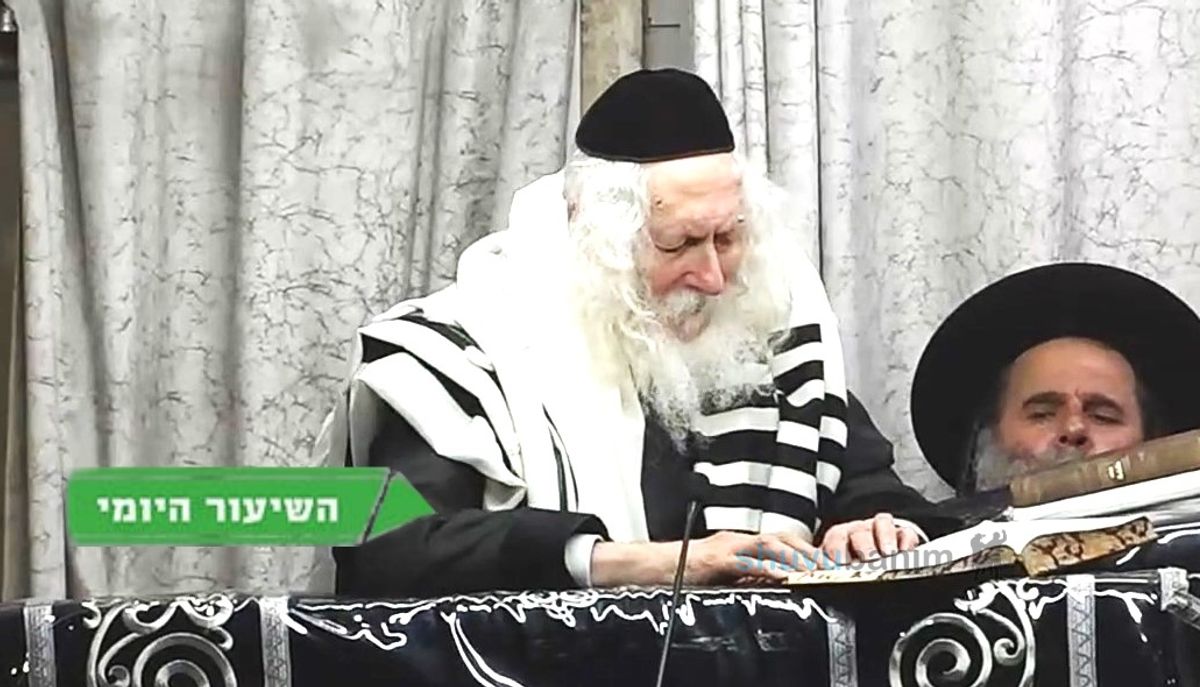
Before you is a summary of the daily lesson as delivered by our teacher, The Rav, Rabbi Eliezer Berland shlit"a (may he live long and good days) – yesterday after the Maariv (evening) prayer, Thursday night, the 7th of Adar, Parshas Tetzaveh:
In the Parsha (Torah portion) it is written: "Odem, Pitdah, and Barekes; Nofech, Sapir, and Yahalom; Leshem, Shevo, and Achlamah; Tarshish, Shoham, and Yashfeh" (the stones of the High Priest's breastplate). Tarshish corresponds to the tribe of Asher; Shoham is Joseph—a black stone; Shoham also corresponds to Moses, because Joseph is the soul of Moses; "Yashfeh" corresponds to Benjamin. However, the names of the tribes are missing certain letters; four letters were omitted: Ches, Tes, Tzadi, and Kuf. So how could the Kohen (Priest) answer questions through the Urim V'Tumim (the Divine breastplate)? Therefore, the letter Tes comes from the words "Shivtei Yeshurun" (the Tribes of Jeshurun), and the names Abraham, Isaac, and Jacob (which were also engraved on the stones). According to Reish Lakish (a Sage of the Gemara), the letters would join together to form the answers. So when Hannah arrived, she would not allow the Mishkan (Tabernacle) to be closed. Eli the Priest wanted to go home and close the Mishkan, but she wouldn't let him. He said to her, "Why do you act drunk?" and "Remove your wine from upon you." She would not finish her prayer; all the women would not finish their prayers... It is written that in the days of Samuel, we waited for the women to finish their prayers on the night of Pesach (Passover). There was the neighborhood of Nachalat Shiva; the Arabs said they should leave there. Later, Montefiore arrived and built Mishkenot Sha’ananim with a flour mill so that the avreichim (Torah students) would have money for parnassah (livelihood). Afterward, he built the structure over Kever Rachel (Rachel’s Tomb). When he arrived in Europe, they told him to erase the word "Zion." In Germany, they erased the words "Zion" and "Jerusalem" from the Siddurim (prayer books). They only spoke Yiddish and said there is no Eretz Yisrael (Land of Israel), and they didn't fast on Yom Kippur—these are the "progressives." They "progressed" in the end to Khan Yunis and Rafah. One can travel to the tomb of Rav Ashi. The girls need to know how to finish the entire Tehillim (Psalms) and study Mishlei (Proverbs), Iyov (Job), and also Jeremiah, Ezekiel, and Isaiah. The boys should finish twelve pages of Gemara (Talmud). They should learn about Rabbah who slaughtered Rabbi Zeira on Purim (and then resurrected him). Just like Rabbi Yochanan who came to take Rav Kahana out of the grave. Rav Kahana said to him, "I will not leave the grave; promise me that you won't kill me anymore." The entire Gemara is made of stories. Regarding Chanina bar Chama, there were two servants whom the Emperor killed. Before he killed them, he asked to bring them; one was already dead, and Rabbi Chanina said to him, "Arise, the Emperor is calling you." Everyone should learn the tractate of Avodah Zarah, page 10, side B. The girls should finish the Tehillim (Psalms) and the boys the aforementioned studies, and afterward page 117 of Bava Kamma regarding how Rav Kahana said to him, "Promise me that you won't kill me anymore," and he promised him. They asked him what was happening in Heaven. He told them, "You will die in a month," "You will die in a year"—people died on the spot from sheer fear. They said to Rabbi Yochanan, "What have you done? All the people are dying in the streets!" Rabbi Yochanan then said to Rav Kahana, "Return to Bavel (Babylon)."
Subscribe to Our Newsletter
Receive Torah articles and inspiration directly in your inbox