
The Bar Mitzvah Boy is Surrounded by Fire for Three Days! • Bar Mitzvah Shabbat
Discourse for the Great-Grandson of our Teacher, the Gaon and Tzaddik Rabbi Eliezer Berland shlit"a
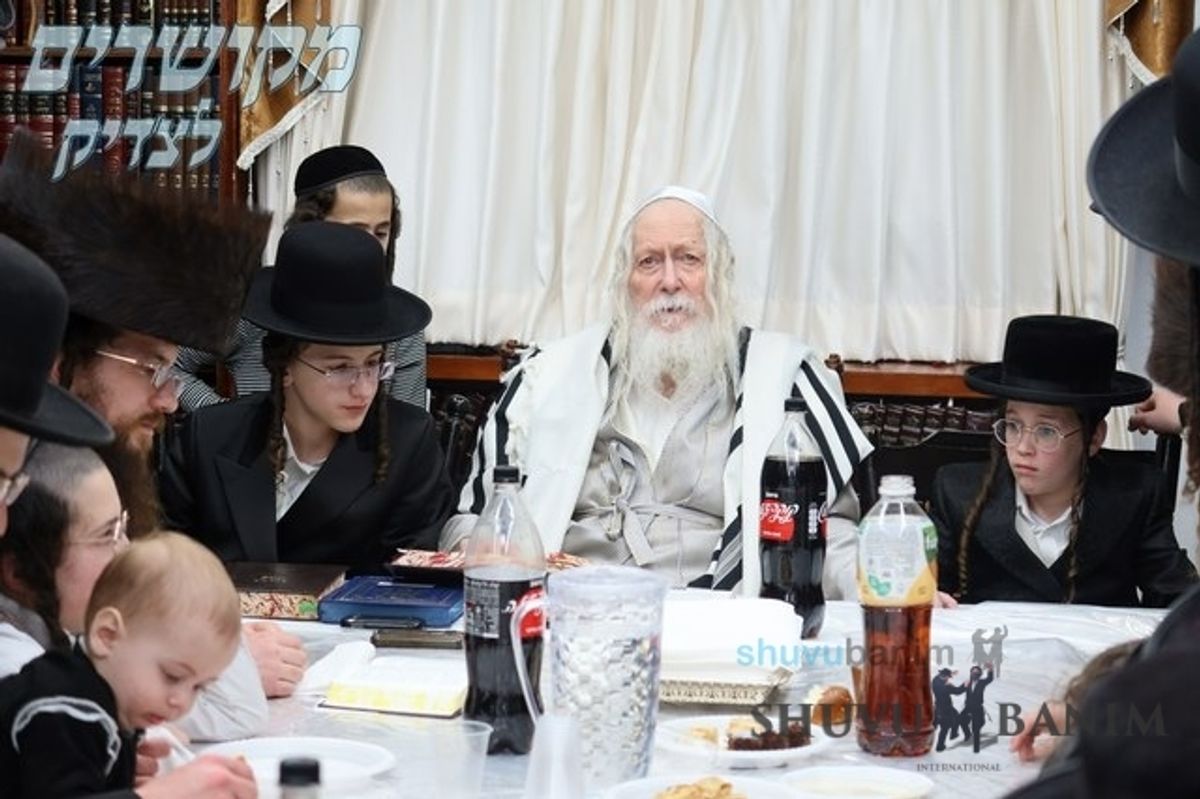
Last Shabbat—Parshas Vayechi—a Friday night seudah (festive meal) was held at the home of the Rav shlit"a, combined with the Bar Mitzvah celebration of the Rav’s great-grandson, the young man Mordechai Meir n”y, son of Rabbi Shmuel Isaac Zucker.
During the seudah, the Rav shlit"a delivered many words of Torah. We present to you the first publication of the Torah insights shared during the Friday night seudah of Parshas Vayechi 5785:
Someone asked: It is written in the Parsha, "The scepter shall not depart from Judah, nor a lawgiver (mechokek) from between his feet." Rashi says regarding "a lawgiver from between his feet" that these are the princes (Nesi'im) of Israel. So how did the Sages want to appoint Rabbi Elazar ben Azariah as the Nasi (Prince/President) if he was a Kohen (Priest)?
The Rav answered: They appointed him as the Av Beit Din (Head of the Rabbinical Court), not as the Nasi, or rather as the Deputy Nasi, which is considered a judge (Dayan), and there is no problem for a Kohen to be a judge. "The scepter shall not depart from Judah" refers to the monarchy, which must come from the tribe of Judah. The questioner asked: Then how was Saul appointed? The Rav answered: The prohibition only applied from David onwards; only then did the prohibition of "the scepter shall not depart from Judah" take effect. Indeed, the Ramban (Nachmanides) on that verse already says that this was the flaw of the Hasmoneans—that they took the monarchy even though they were not from the seed of David; they were Kohanim, and therefore they were all annihilated and killed because they transgressed this verse. The questioner asked: And what about all the kings of the Northern Kingdom of Israel? The Rav: Indeed, they transgressed this verse, but all of this was only from David onwards. When Samuel came to anoint David, Jesse had eight sons, but he only brought seven. They said about David that he was forbidden to enter the congregation (due to his Moabite ancestry); they did not want to accept him as king. They sent him to shepherd the sheep and did not accept him as king. The questioner: They didn't accept it from Samuel? Didn't Samuel anoint him? The Rav: No, they didn't accept it. They thought Samuel was mistaken. Even Samuel himself thought he was mistaken; he saw that David was ruddy (admoni), he saw he was a redhead—here, no one is a redhead—they said he is a Moabite. So Samuel thought perhaps it was Eliab, the eldest son. The questioner: But if he is a Moabite, then his brothers are also Moabites? The Rav: Yes, all the brothers were Moabites, but then Jesse separated from his wife because his sons were Moabites, and after that David was born. So they said he was a mamzer (illegitimate), that he was born from a "snake" (nachash). Jesse had no sin, as they called his daughter Abigail "the daughter of Nachash" because Jesse had no sin except for the sin of the Serpent (Nachash) at the Tree of Knowledge. But they thought, first of all, one must check in a shidduch (marriage match) if the mother is a "snake." In a few years you will already be married; now you are a Bar Mitzvah, soon a wedding—tell your father to check if she is a "daughter of Nachash." In any case, they then expounded "a Moabite [man] and not a Moabite [woman]." Then Doeg argued: If so, say also "an Egyptian [man] and not an Egyptian [woman]," "a mamzer [man] and not a mamzer [woman]"? The entire Sanhedrin (High Court) fell silent. Then came Yithra the Ishmaelite—later he was called the Israelite—and said: "Whoever says David is not fit to enter the congregation shall be pierced with a sword!" This is a wonder—is this how one decides Halacha (law)? Rather, he received this tradition from Samuel of Ramah: "An Ammonite [man] and not an Ammonite [woman], a Moabite [man] and not a Moabite [woman]." This is all in the Gemara in Yevamos. So they wanted to anoint Eliab, but Hashem said to anoint David.
One must study the entire Parsha with all the commentators, like Rabbi Chaim Kanievsky zt"l. People came to his father, the Steipler Gaon zt"l, after his wedding and told him they didn't know what happened to his son, Rav Chaim—he stopped coming to the Kollel, he left his studies. So he called him and asked why he wasn't going to the Kollel. He told him that now, for a whole year, he was studying the entire Parsha with all the commentators, all the explanations, the Ramban and everything, because one needs to know everything.
Now, we said this morning in the Selichos (penitential prayers) of the Tenth of Teves: "Seir and his father-in-law were consumed." Does the Bar Mitzvah boy know who "Seir and his father-in-law" are? Seir is Esau, and his father-in-law is Ishmael. For 850 years, they did not believe that Jerusalem would be conquered. "The kings of the earth and all the inhabitants of the world did not believe that an adversary and enemy would enter the gates of Jerusalem." For 850 years, they didn't believe such a thing could happen. The one who revealed Jerusalem was Samuel; it was the city of Jebus, as written regarding Araunah the Jebusite. Samuel revealed it to David. It is written that there is a "note" (pitka) where it is written who will dwell in Jerusalem. Whoever leaves Jerusalem is because he left the "note"; it is forbidden to leave Jerusalem. All the troubles came because they left Jerusalem. So they didn't believe it was possible to even come to Jerusalem. Therefore, regarding the destruction of the Second Holy Temple, we fast on the 17th of Tammuz, which is when they entered Jerusalem. In the First Temple, they entered on the 9th of Tammuz, but the fast was not established then. The fast was established for the day the gentiles arrived at Jerusalem, because no one believed it was possible to reach Jerusalem. For 850 years, no one could approach the gates of Jerusalem. And in the Second Temple, they established it on the 17th of Tammuz. The Yemenites arrived in Yemen after the destruction of the First Temple. People reached as far as Morocco and Yemen. Ezra the Scribe traveled around and asked everyone to ascend to Jerusalem. He reached Yemen and asked them to ascend because they were going to build the Second Temple, but they did not agree. They told him they knew it was destined to be destroyed. So he cursed them that they should be poor, and they also cursed him that he should not be buried in the Land of Israel. Therefore, he is indeed not buried in the Land; he is buried in Iraq on the banks of the Tigris River. There is a beautiful building there, a large structure over his grave. But he reached as far as Morocco to convince the Jews to ascend to the Land. Jews reached as far as Tunisia. Joab ben Zeruiah reached Tunisia; they found a stone there in Djerba signed by Joab ben Zeruiah. They brought it to the archives in Israel. Then we read the story of the lion in Chullin 59a, that the lion gave one roar and everyone fell from their chairs; he gave another roar and the walls fell; another roar and their heads turned backward; another roar and their teeth fell out; another roar and all the pregnant women miscarried. So the King (Caesar) said, "Fine, I give up on seeing the lion." We also told the story of Diocletian (Diclot). There was one named Diclot who was a pig herder, and the children threw stones at him. Later he grew up and became the Emperor of Rome. So he called the director of the Cheder (school)—today that would be Natan Hananya, but then it was Rabbi Yehuda Nesiah—and wanted to throw him into the fire because they had thrown stones at him. So he told him to come to him in Paneas on Motzaei Shabbat. When he arrived, he said to him, "I know that you Jews will be saved; even if I throw you into the fire, you will be saved. But why did you throw stones at me?" {Jerusalem Talmud, Terumos}
Now Trump said that if Hamas does not release the hostages, he will open the gates of hell for them. In 10 days he becomes president, on the yahrtzeit of the Rambam, the 20th of Teves. Every day explosives (metanim) are blowing up there and soldiers are being killed. "Metan" (explosive) is the letters of the 49 (MT) gates of understanding. "An" (the end of the word) is the gematria (numerical value) of 120, the gematria of Eliyahu HaNavi (Elijah the Prophet), because Eliyahu HaNavi is blowing up the explosives. Because they started to go with the attitude of "my strength and the power of my hand" on Simchas Torah. All the officers turned off their phones; they ignored the warnings that there were terrorists on the fence. They arrived with giant bulldozers and dismantled the fence, and the officers simply turned off their phones. They refused to send planes into the air. If they had sent a fighter jet, in a few seconds it would have blown up all the bulldozers on the fence; they wouldn't have been able to break through and enter Israel. Now there are also the Houthis; every night they send missiles here. They give us a wake-up call for Vatikin (sunrise prayer). Then they threw them at two in the morning so we would wake up for Chatzos (Midnight Lament). It's a distance of 2,000 km and it arrives within 7 minutes to the Land, or from Iran to the Land in 7 minutes.
Every day a person can say 600,000 letters. In a minute, 200 words. Each word is an average of 4 letters. So in an hour, 48,000. In 12 hours, 576,000. We are missing another 24,000, so how do we complete it? We add another half hour of study, then it is exactly 600,000 letters. With every letter, one can bring a Jew back in teshuvah (repentance). Through our learning "Lishmah" (for its own sake), we bring people back in teshuvah. And everything can be counted—the study, the prayer, everything together. Also Hisbodedus (secluded prayer) that one does is counted, and also what a person thinks in his thoughts is joined to this. A person does Hisbodedus for two hours—one hour of silence, one hour of talking. Only after an hour do the words come; that is also counted. Someone asked if one can do Hisbodedus during prayer with the melodies that the Rav sings during the prayer. The Rav said: Yes, we sing "Hoshia es Amecha" (Save Your People) for fifteen minutes, because through this one can do Hisbodedus and count it afterward toward the hour. But it is better to sing, as that is the highest level. And afterward there is time for Hisbodedus. Look, now on the yahrtzeit of Rabbi Nathan, we left the house at 10:45, and by 1:00 we were already finished. There is time left to go do Hisbodedus. One can go as far as Sanhedria to do Hisbodedus for two hours. One can go to the tomb of Samuel the Prophet—40 minutes there, 40 minutes back, 40 minutes there. It is the most beautiful place; there is a view from there as far as Latrun and the sea. It is the highest place in Jerusalem. The most beautiful place is called Ramah. Samuel lived in Ramah. The one who answered Samuel in Mitzpah—that is the lookout point. Someone asked: Was he buried in his house? No, the Crusaders write in their book that they moved him there afterward and they built the structure over his grave.
In the "Davar Be'Ito" calendar, on the date of the 17th of Iyar, the story from Lag BaOmer 5705 (1945) is brought. {The Rav searched for where the story was, and when he found it, he said:} I was looking on the 18th of Iyar, but it is on the 17th of Iyar. In the meantime, I already went over all the customs of Lag BaOmer from previous years. Rabbi Israel of Rizhin had already purchased the right of the lighting in Meron, and his grandsons, the Rebbes of Boyan, would light it. That year they were unable to reach Meron, so Rabbi Silberman from Safed, as an emissary of the Boyaner Rebbe, performed the lighting. Immediately after Ma'ariv (evening prayer), they told him to light, but he said he was waiting to see the moon. They didn't understand what he wanted—what does the moon have to do with it? He waited and waited until 9:50 PM. Then the telegram arrived that Hitler had committed suicide and the war had stopped. They waited until 9:50; the moon was already seen before because on the 18th the moon is seen earlier. He only waited to receive the telegram that Hitler had committed suicide and the war had stopped. Someone asked: Did the war stop immediately? The Rav answered: Yes, the second he died, the war ended. So on the 17th of Iyar 5705, Hitler committed suicide and at that same second the war stopped. The moment there was no leader, the war stopped. And if he hadn't committed suicide, he would have even won a Nobel Peace Prize, because that's how it goes—someone who murdered millions of people wins a Nobel Peace Prize because, after all, he just wanted to make peace; the Jews bothered him a bit, so they killed a few Jews. That's how it goes in the world. So the Nazis surrendered on Lag BaOmer, and the Japanese continued to fight because there was Togo, who wanted to continue the war. They were allies with the Germans because the first commandment—to fight the Jews—must be continued. They published a picture, a giant, giant poster of a Jew eating a Japanese baby. The Japanese didn't understand what a Jew was until they explained it to them regarding those Yeshiva students who were there, who fled from Europe to Shanghai. Not much time passed before they dropped the bomb on them. They dropped the atomic bomb on them. The first bomb was dropped on the 27th of Av, and the second three days later on the 30th of Av 5705. The first on August 6th and the second on August 9th. In the month of Av there are 30 days, so the first was on the 27th and three days later on the 30th of Av they dropped the second. And a third bomb was ready to be dropped on them if they hadn't surrendered. But then they surrendered. Why specifically in the month of Av? Perhaps because its zodiac sign is Leo (Aryeh). So they dropped the atom on them. Then Togo said he was going to consult with the sun, because they used to say that the entire royal family was born from the sun. So he went to consult with the sun, and then he said that it wasn't an atomic bomb—there's no such thing as an atom; it's impossible that the Americans have an atom and the Japanese don't, because the Japanese are smarter than the Americans. It's just that the Americans had Jews who invented and built the atom. So Togo said it's just some rotten tomato they threw, it's nothing. He said, so what if they killed 300,000 of us? We will kill 50 million Americans! He said he had a better method of killing; it's called Kamikaze, meaning suicides—suicide pilots who would explode on the American ships. Every suicide pilot can kill 10,000 people; 5,000 suicides is 50 million, because the entire Pacific Ocean was full of American ships. And they raised these suicide pilots; they went with faith from a young age that the purpose is to be included in the sun, therefore they were ready to commit suicide for the King. So he said he wasn't afraid of the atom and there's no such thing as an atom. So they threw another one at him after three days, and then he surrendered. Because Togo said to the Emperor of Japan, Hirohito, "What are you afraid of? We have suicide pilots!" And after that Hirohito surrendered. So 300,000 people were killed—70,000 on the spot in the first second, and another 140,000 in the three years that followed. But 70,000 evaporated on the spot. And also all the rescue teams and ambulances that arrived at the area to save people—they all died. And three years later people were still dying from the radiation that was in the place. Because every gram of uranium can destroy 90 million tons, because in every atomic nucleus there are protons and neutrons, and there are electrons spinning around the atom. That is how every atomic nucleus is built. But it spins around in a large volume; most of the nucleus is empty space. This means that if we compressed all the volume of the Eiffel Tower into just matter without the empty space, it would remain the size of a pin. From the entire Land of Israel, a tennis ball would remain, because most of it is empty space. So in an atomic bomb, they split the nucleus, but special tools are needed to explode the nucleus, to split it. Einstein invented the formula, and then the Russians didn't know about it until someone revealed the secret to them, and then they also started trying to invent an atomic bomb.
The Russians were much worse than the Nazis. Stalin murdered 80 million people. They were the Bolshevik party. Bolshevik means "the majority," the party of the majority, yet they were the minority. And there was the other side called the Mensheviks, which means "the minority." And the Bolsheviks took over the government. Bolshevik means the majority, but they were the minority. At first there was Trotsky, and he murdered masses of people. He already had a plan to deport all the Jews to Siberia; he had already prepared the trains to send everyone to Siberia. Yehudit, the mother-in-law of Nachman Berland, saw the trains in Kremenchuk. She was a girl of 17 and they were in a camp. It is told in the book of Rabbi Yitzchak Zilber, it's called "To Remain a Jew." And it was on Purim, and they were celebrating Purim there. A certain secular Zionist came and said to them, "What are you celebrating the miracle that Hashem saved you for? Soon they are sending all of you to Siberia!" and he showed them the trains that were already ready. Rabbi Zilber said, "Trouble shall not rise up twice." And then after a few hours, the news arrived that Stalin had died. They don't know if someone poisoned him—his advisor who was a Jew—or if he died of a stroke; he had a heart attack. But it was on Purim 5713 (1953). And then in all the kibbutzim in the Land, they mourned for him. They all mourned for him because here everyone was a Communist. The Communists learned the method of Communism from the kibbutzim here in the Land. The kibbutzim here were established before the Communists. We were in Degania; it is written there that the founding year was 1910 (5670), and the Communists only started in 1920 (5680). We saw that the kibbutz was established before the Communists started. So there was great mourning for him, the "Sun of the Nations." All the kibbutzim in the Land of Israel—Be'eri and all the kibbutzim—were established from the money of the Yemenites. The Yemenites would study; they have the clearest minds, they know the entire Tanakh, the Rambam, and Shulchan Aruch. And after studying, they were goldsmiths and diamond polishers. So when the Yemenites arrived in the Land, they took all their gold—crates of gold—and with that, they built all the kibbutzim. Now on Simchas Torah, all the kibbutzim were burned. There are also fires in California; for a whole week now everything has been burning there. At the beginning of the war, the Americans said, "What happened? So they burned a few houses for you." So now Hashem is burning whole dunams for them; all the luxury neighborhoods, everything is being burned for them. Even the stones are crumbling from the intense heat. In California they build with stone, and even the stones are crumbling from the heat of the fire. Here we have the Bar Mitzvah boy who is also surrounded by fire—a different fire. Now for three days he is surrounded by fire.
John Kennedy was murdered on November 22nd at 12:30 PM. He went out with the car for a campaign trip in Dallas; that is the capital of Texas. He had a completely open car without a roof and without walls, a Mercedes or Lincoln, a car without a roof. It was a campaign trip and he stood in the car, and the car turned from the main street onto the boulevard. So he said, "I have a feeling that in this building there is someone with a rifle who is going to shoot at me." There was a six-story building there. So he said, "In the six-story building, on the third floor, someone is standing over me with a rifle." Because a person has feelings that something is going to happen to him, that they are going to shoot at him; it's called intuition. So he said, "I have a feeling that in this building stands someone with a sniper rifle and wants to shoot at me." So they told him, "Then duck down on the floor." He said, "I will not duck; I am a leader." A brave leader, a leader does not surrender. And then at 12:30 the first bullet was fired. So they told him, "Now lie down! You saw they are shooting at you, lie down!" He continued to insist; he said a brave leader remains standing. If he had lied down, he would have been saved, like Queen Elizabeth—eight times they shot at her during various trips she took, on her birthday, on the day of her coronation. Eight times they shot at her; each time she lied down and was saved. Because it's impossible to aim perfectly with the first bullet; only an expert sniper hits with the first bullet. He sees where the aim is through the scope; with the second bullet he already gets closer to the target; with the third bullet he hits. There was also the murder of Abdullah, King of Jordan; that was in 5711, in July 1951. He was going down the stairs of the Temple Mount and they shot him. They also tried to assassinate Trump and shot him, and he was saved. So with Kennedy, the shooter fired the first shot. He had a non-automatic weapon, a rifle where you have to insert the bullet through the barrel each time. Who inserted the bullet for him? I don't know; I hope no one from here. So he fired the first shot and it didn't hit him. Only an expert sniper hits on the first shot; otherwise, one needs to aim up to three times. And it hit someone nearby, maybe a security guard, wounding him seriously. And then they told him, "Lie down! You see they are shooting at you!" He said, "I am not lying down." And then after 8 seconds they fired a second shot; it hit the driver perhaps. And after 8 seconds they fired a third bullet that hit him and murdered him. So that was on November 22, 1963, in Kislev 5724. This happened to him because exactly a month before there was a dispute over who the Jordan River belongs to, because the Syrians claimed it belongs to them since it comes from Syria. And a month before, Kennedy said it belongs to the Syrians because it comes from there, so the water belongs to them, and he went in favor of Syria. Therefore he was murdered. So it took 8 seconds between the first bullet and the second, and between the second and the third, because each time they insert the bullet from the barrel. I don't know who inserted the bullet for him. In the end, I confessed that I shot him. I had two cases, so during the interrogations I told them I was ready to confess to the murder of John Kennedy. They said to me, "Where are all the billions?" They came here to the house with sniffer dogs, they did a search, they opened the safe and found 10 shekels there. They searched for where all your billions are. In the end, they said I concealed a billion and I need to pay 138 million. In the end, Rotem managed to reduce the fine to 2 million in installments for 5 years, every month 50,000. Two years are left; Chaim Singer takes care of paying it, I don't know how.
Someone fell asleep. The Rav said: Sleeping is always good. A person who is sleeping does not commit sins. He sleeps for an hour, so he knows that for an hour he didn't commit sins.
When he came to perform Mayim Acharonim (final waters), he said: Mayim Acharonim must be washed until the end of the fingers, up to here, not just the tips of the fingers. This is explicitly written in the Mishnah Berurah in the laws of Mayim Acharonim. There are those who wash only the tips of the fingers; that is not Mayim Acharonim. Mayim Acharonim is all the fingers up to the palm, and afterward it is forbidden to speak.
They asked: What did Moharnat (Rabbi Nathan) see in Rebbe Nachman that he didn't see in other Tzaddikim? After all, Rabbi Nathan traveled among many Tzaddikim—the Berditchever and other Tzaddikim—so what caught him by Rebbe Nachman more than the other Tzaddikim?
The Rav answered: By Rebbe Nachman, he nullified himself completely. He arrived at Rebbe Nachman, he saw Rebbe Nachman singing "Azamer Bishvachin," and he was completely nullified in reality (Bittul B'Metzius) from the intensity of the light. By Rebbe Nachman, it was something else entirely. The Berditchever sang the same words, "Azamer Bishvachin," like Rebbe Nachman, but by Rebbe Nachman it was something else. Rebbe Nachman radiated such light that everyone was completely nullified. Rabbi Nathan was completely nullified; he saw Hashem eye to eye. He said to Hirsh Baer, the leader of the Maskilim (enlighteners) in Uman: "I will see Hashem—I saw Hashem!"
Joseph revealed himself to the brothers; it was truly a matter of life and death (Pikuach Nefesh). One more moment and Judah would have killed him. If he had delayed one more moment, Judah would have killed him. He would have drawn the sword and killed him. When we were children in Haifa, we learned fencing, it's like swords. Judah gave such a roar that their heads turned backward, like the story we told from the Gemara in Chullin with the lion that gave five roars.
Everyone is thirsty, waiting for people to come to their homes to bring in light, to bring in a little Torah. In the most anti-religious, most leftist places. There were several from the Yeshiva who would go from house to house speaking about Rebbe Nachman. They came to a certain house—maybe it was in Ramat Aviv in North Tel Aviv—they were told, "Don't enter this house; people who hate religion the most live here, extreme leftists." So they said, "We go through every house." They entered from the back side. The woman of the house opened for them and asked them, "Which Yeshiva are you from?" They said, "Breslov." So she said, "Breslov? I am studying the Sippurei Ma'asiyos (Rabbi Nachman's Stories)! Come in, I need you to explain to me what Rebbe Nachman is writing." And there was also a time they came to a certain kibbutz. They were told, "Don't approach this house; they won't donate anything to you." They came and knocked, and they opened for them. So they said, "We don't donate to Yeshivas. We are ready to donate to a cinema, to a disco, but not to Yeshivas," and they sent them away from the house. And then the father ran after them and said to them, "I do want to donate to Yeshivas! I want to return in teshuvah! It's just the family—they are not ready." Because truly everyone wants to hear Torah, to draw closer to Judaism; one just needs to bring it into their home, like Samuel the Prophet who would go from city to city and house to house to spread Torah and strengthen people. There was another story where Nachman Zucker was also there. They arrived at a certain city; they were told, "In this house they might pour hot water on you." They came and knocked, asked if they wanted to donate to the Yeshiva. They said no. So they asked them, "Don't you have a sick father or someone in the family who needs a healing (refuah)?" They said no, and "Get out of here." As they were leaving, they immediately saw them running after them and saying, "Come back! We want to donate!" Because their father really was sick, and as they left, they felt the whole house shaking—there was a real tremor—and they were afraid the whole house would collapse on them. And there was already a story with the Chafetz Chaim, that a certain very wealthy man came to the Chafetz Chaim and said he wanted to support the Yeshiva entirely, to donate everything to the Yeshiva. The Chafetz Chaim did not agree to this. He said he wanted all of the Jewish people to donate to the Yeshiva, that people should go around and collect donations. This way people see that there is such a thing as Yeshivas, there is Torah among the Jewish people. People come to the homes and Jews are strengthened by it. So he told him he could donate, but not support the Yeshiva entirely.
Subscribe to Our Newsletter
Receive Torah articles and inspiration directly in your inbox