
The "Bnei HaNeurim" Youth Gathering with the Participation of the Gaon and
Tzaddik Rabbi Eliezer Berland shlit"a for the Young Men of Bnei Brak
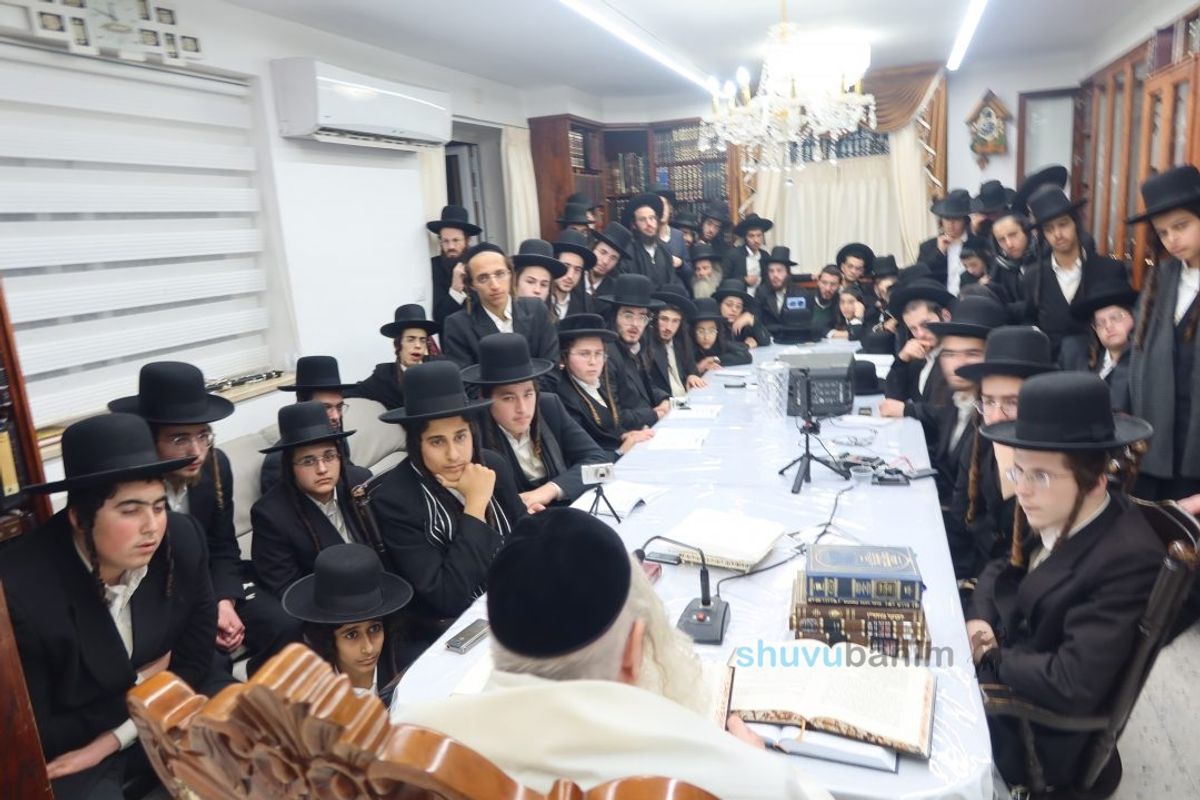
The "Bnei HaNeurim" Youth Gathering in Bnei Brak ○ The Gathering Inside the Holy Chamber ○ A Summary of the Lesson from our Teacher, the Rav, Rabbi Eliezer Berland shlit"a
The "Bnei HaNeurim" (Youth) chaburah (spiritual gathering) for the service of Hashem has many branches throughout the country. Besides the center of fire in Jerusalem with hundreds of precious young men, there are also branches in Beit Shemesh, Modi'in Illit, and other cities. One of the central locations where the chaburah takes place is in the city of Torah, Bnei Brak. The chaburah meets every Tuesday evening in one of the synagogues in the center of the city of Torah, and about forty young men participate each week. Among the young men, one can even find Litvish (Lithuanian-style) students coming from the most elite yeshivas (Torah academies) in the Torah world.
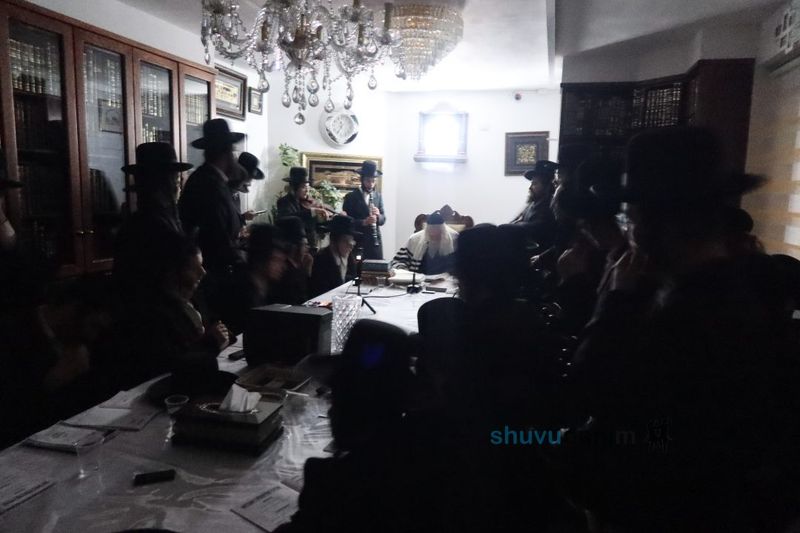
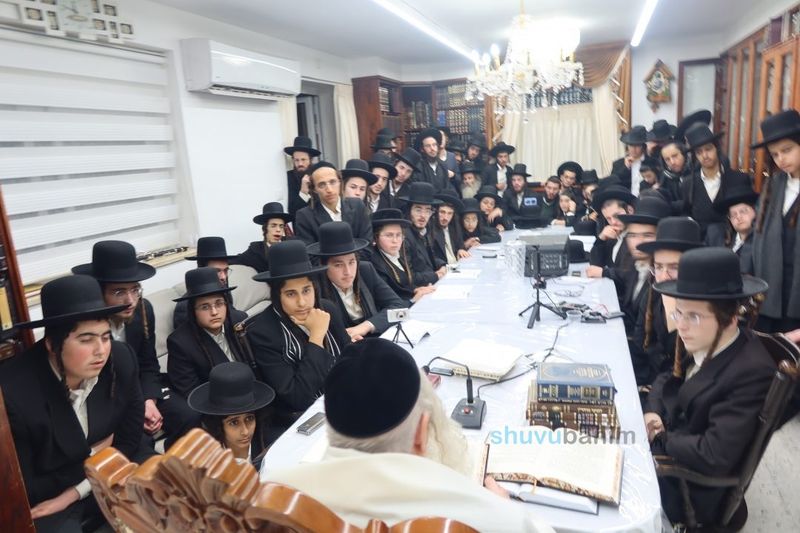
Last Thursday night, Parshas Shemos (the Torah portion of Shemos), the young men gathered for a special chaburah, this time in the home of our teacher, the Rav, Rabbi Eliezer Berland shlit"a (may he live long and good days). The precious young men sang soul-stirring songs with great awakening for a full half-hour. During the melodies, the Rav shlit"a entered his room and joined the pure young men in the moving singing. Afterward, the Rav shlit"a began a fiery lesson for about thirty-five minutes. Here is a summary of the lesson's progression: The Rav shlit"a began the lesson with the weekly Torah portion—Shemos—where Moshe (Moses) said to Hashem, "Please send by the hand of whom You will send." He asked why Moshe insisted, given that the halacha (Jewish law) states that a prayer leader who is asked a third time must step forward. In this context, he cited the Gemara (Talmud) in Menachos, which describes how when Moshe ascended to the Heavens to receive the Torah, he saw Rabbi Akiva and asked, "Why are You giving the Torah through me if there is someone as great as Rabbi Akiva?" Hashem replied, "Be silent, for such was the thought before Me." He also mentioned the continuation of the story, where Moshe saw the end of Rabbi Akiva—that his flesh was being combed with iron combs—and received the same answer: "Be silent, for such..." etc. He then brought Lesson 64 from Likutey Moharan, where Rebbe Nachman speaks about this matter. Afterward, he discussed Lesson 46, Part II, regarding the questions Eliezer had about Avraham (Abraham) when he saw that Esav (Esau) would descend from Rivka (Rebecca), as hinted in the words "and her pitcher was on her shoulder" (ve-chadah al shichmah)—the first letters of which spell "Esav." He cited Rebbe Nachman's words that if a person has a difficulty (kushya) regarding the Tzaddik, he should go to the field and scream, because the first letters of "Kushya" (difficulty) are "Shema Hashem Koli Ekra" (Hear, Hashem, my voice when I call). He further brought the matter of Rivka's shidduch (marriage match) and the miracles that occurred there, such as the pitcher jumping up on its own to water the camels because Rivka practiced mesirus nefesh (self-sacrifice) to water them, as it was evening and they were not allowed to be out after dark. He also cited the verse, "And from Hashem comes a wise wife," explaining that if the mother is wise, the child will also be wise. He spoke at length about how the mother is the one who influences the children to become holy and wise. After that, he returned to Eliezer's question, saying that when a person sees something, he doesn't understand what he sees; only the Tzaddik truly knows how many children you will have and what kind of children. He cited what the "Imrei Noam" writes on this matter: that in the merit of Eliezer being "machrish" (silent), he merited to see Yaakov (Jacob) as well, and then he understood that Esav is only the klipah (husk/evil shell) of Yaakov, because "machrish" has the same gematria (numerical value) as "Yaakov Esav." Indeed, Yaakov and Esav were buried on the same day. He spoke about how Chushim ben Dan, who was deaf, did not understand why they were waiting and killed Esav on the day of Yaakov's burial, which is what Rivka hinted at: "Why should I be bereaved of both of you in one day?" From one topic to another, he transitioned to the idea that even a deaf and mute person can know the entire Torah, as brought in the Gemara in Chagigah, where Rebbe (Rabbi Yehuda HaNasi) had two deaf-mute students who attended all the lessons. Rebbe prayed for mercy for them, they were healed, and it was revealed that they knew the entire Torah. Regarding this, he mentioned the gilgulim (reincarnations) of souls—that these students were Eldad and Medad who returned in reincarnation. From there, he spoke about their prophecy that "Moshe will die and Yehoshua (Joshua) will lead [the people into the Land]." He said they erred because if a prophecy does not say "lemor" (to say/to tell), it is forbidden to publicize it. Regarding the spies (meraglim), they intended for the good by not wanting to enter the Land because they didn't want to leave Moshe. Nevertheless, the Rav said they should have listened to Moshe, because if the Tzaddik says to enter, then one enters. Truly, if they had entered, Moshe would have died for five minutes, there would have been the Resurrection of the Dead, and the Geulah (Redemption) would have arrived. He linked these matters to Eliezer, who nullified himself to Avraham Avinu (our forefather Abraham) despite having a terrible difficulty (kushya)—for Hashem told Avraham, "Go from your land," yet here he tells Eliezer, "For to my land and my birthplace you shall go." In the merit of this bitul (nullification) to the Tzaddik, he merited to transition from "cursed" to "blessed" and to enter Gan Eden (Paradise) while still in his physical body. He added to this and brought another difficulty Eliezer had: if he had already moved from cursed to blessed, why didn't Avraham take his daughter? This is why the word "Ulai" (perhaps) is written without the letter 'vav,' meaning "Elai" (to me)—that the shidduch should be made with Eliezer's daughter. He spoke of the greatness of Rivka and all the Matriarchs, whose candle never went out. From one topic to another, he asked why, if miracles involving candles were performed for Tzaddikim in every generation—like with the daughter of Rav Chisda whose candle burned from vinegar, and the holy Matriarchs—why was a holiday established for the miracle of Chanukah? He answered, concluding the lesson, that for private individuals there were miracles, but for the entirety of Israel, it was a miracle above nature. He finished by saying that if a person follows the Tzaddik, his candle will never go out, forever and ever! After the lesson, our teacher the Rav shlit"a instructed the young men to sign a commitment document to abstain from technological devices. The precious young men passed one after another and signed the commitment document together with the Rav shlit"a.
Subscribe to Our Newsletter
Receive Torah articles and inspiration directly in your inbox