
The Chilling Lesson of Rabbi Eliyahu Meirav zt"l at the Home of the Gaon and
Tzaddik Rabbi Eliezer Berland shlit"a
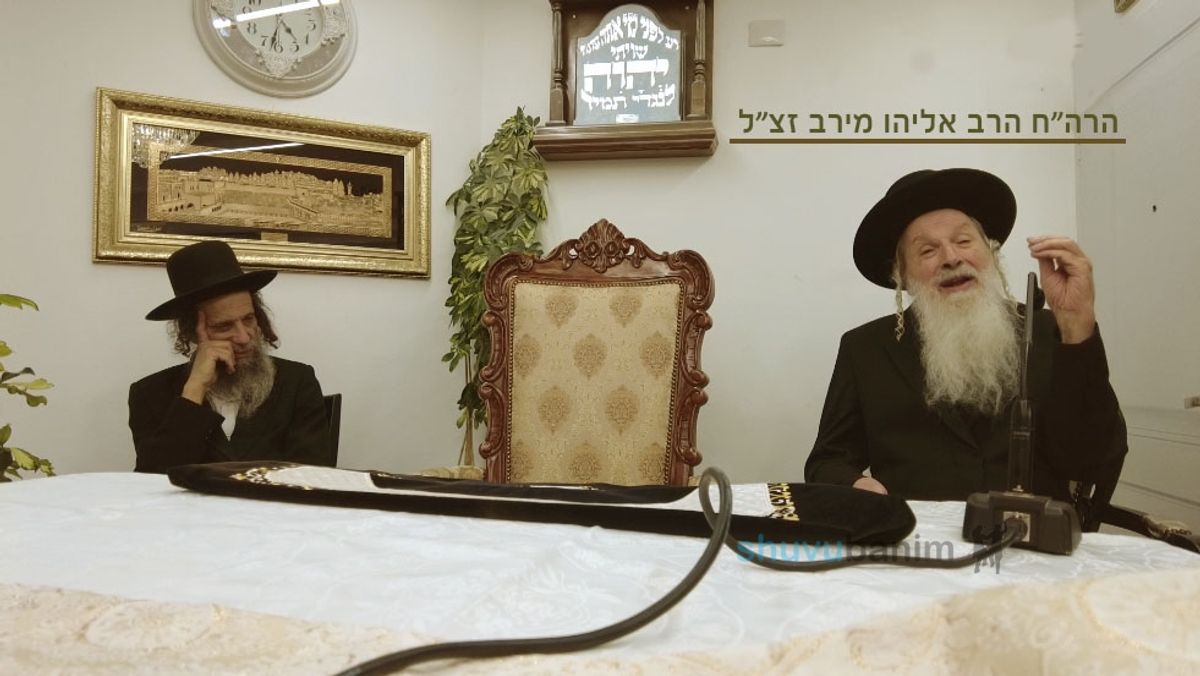
The Chassid and Sage Rabbi Eliyahu Meirav zt"l (of blessed memory) in chilling holy words which he delivered on Rosh Chodesh Iyar 5784, in the holy home of our teacher, the holy Gaon and Tzaddik Rabbi Eliezer Berland shlit"a (may he live long and good days).
In his holy words, Rabbi Eliyahu Meirav zt"l speaks about the process of his drawing closer to Breslov Chassidus and particularly to his teacher and rabbi whom he loved and esteemed, our teacher Rabbi Berland shlit"a. From his words, one sees how deeply he delved into the holy paths and Emunah (faith), with great self-sacrifice for the vital foundation of Emunas Chachamim (faith in the Sages).
These are his holy words, zt"l:
There is a concept of people like you—where did we grow up? We grew up among the communists (in the kibbutz). Suddenly I began to understand that there are people who look like us, but they are something else entirely. Later, when I began to study Torah and saw the Midrash Rabbah that says Moshe Rabbeinu was the "man of G-d." The Midrash there asks, what is a "man of G-d"? From his waist up, he is G-dly; from his waist down, he is a human being. You begin to understand.
I merited to serve the Baba Sali (Rabbi Yisrael Abuhatzeira zt"l) a bit, and I saw how he read my thoughts and did wonderful things. I had a personal and specific education to understand that truly, Emunas Chachamim (faith in the Sages) is the hardest thing in the Torah. We know that a person can believe in everything, and certainly in Tzaddikim (righteous ones) who have passed away, but to believe that in our generation—this dark generation with the disputes, problems, hatreds, crazy permissiveness, and everything happening—to believe there are still people who are, I don't know how to define them, who are truly connected to the Creator of the world.
https://vimeo.com/1033714122?share=copy
Everyone believes in the Creator of the world, even the gentiles, but there are people whom Hashem merited in every generation. There is a famous Baal HaTurim on Parshas Ki Savo who explains: "Ki" (כי) is the numerical value (Gematria) of 30, "Tavo" (תבוא) contains the letters of "Avos" (אבות - Patriarchs), "to the land" (אל ארץ)—this is how the portion begins. The Baal HaTurim says this comes to teach you that there is no generation in the Land of Israel that does not have Tzaddikim who are like the Holy Patriarchs—Avos (Patriarchs) - Tavo (will come)—Abraham, Isaac, and Jacob. Such a Baal HaTurim.
You didn't find them? You are stuck where you are stuck? You think everyone is a fraud and a fool like me? Fine, you have a problem, but know that such a thing exists. Start searching, start searching.
I remember the first time, a dear friend took me many years ago to a lesson the Rav gave in the Pomerantz home. For me, it was a new Revelation at Sinai. Thank Hashem we returned in Teshuvah (repentance) and merited to be among the Litvaks (Lithuanian-style Haredim). My first Rebbe was Rabbi Chaim Greineman o.b.m., a holy and wonderful Jew. I was a "Chazon Ish'nik" type; I was enthusiastic about the precision in Mitzvos (commandments), about Rashbam Street, and diligence in Torah study. Thank Hashem that I merited to be a Litvak first; thank Hashem for the matter of Torah, Torah, Bitul Torah (wasting time from Torah study)—everything. To this day, I remember once they asked me for a lecture, and I had a good friend named Adler. I told him, "I should leave my book? No way!"
He said to me, "No, it's very important, they are opening Yeshivas." I told him, "I don't know." He said, "I will ask a Gadol HaDor (great leader of the generation)."
I asked him, "Whom can you ask?"
He said, "I am close to Rabbi Chaim Shmuelevitz, who was the Mashgiach (spiritual supervisor) in the Mir Yeshiva, a very great man for anyone who has read his books."
Fine, ask him. If he tells me to leave the books and go, fine, I will do it, because I need to hear from the Tzaddikim of the generation. That dear friend Adler was close to him. He told him, "Listen, there is this Ba'al Teshuvah (returnee to faith), and he's like this, and he tells his story and it brings people closer. But he says he doesn't want to leave his book. He only returned in Teshuvah two and a half days ago, and suddenly he's become such a diligent student—what is this? But they need him, and it's a merit for the public."
Aryeh relates that Rabbi Chaim Greineman said, "Take him away from his book?! There is nothing in the world that should take him away!!" Aryeh came to me and said, "You were right, forget it."
This power of learning and learning—that's why the Rav always says, "Praiseworthy is he who merited to be a Litvak first." Even though I say, I wish I had come straight from the Yom Kippur War to the Rav. That was 1974—where was the Rav then? What was happening, I don't know, but perhaps what happened to me wouldn't have happened. Similar to what the holy Rabbi Avraham son of Rabbi Nachman writes in Kochvei Or; he says, "If I had listened to my father and known his greatness—for he told him, 'Go to the Land of Israel, you are not meant for the Diaspora'—if I had merited to listen to my father and go straight to the Land of Israel, what happened to me in body and soul, as a terrible sufferer of afflictions, would not have happened."
In retrospect, we see that everything is precise and there are no mistakes; we only need to know and ask for mercy regarding this. To know is to know that the Land of Israel, the World to Come, and the Torah are acquired through suffering. There's nothing to be done; that is the currency, to the point that the giants of the world would say, "Come, my brothers and friends—the afflictions." Everyone knows the famous Gemaras about Rabbi Elazar the son of Rabbi Shimon. Even our holy Rebbe has this power; suffering is the greatest gift, except that the Gemara says, "We possess neither the suffering of the Tzaddikim nor the tranquility of the wicked" in this final generation.
But one thing I can tell you: "From my flesh, I behold G-d" (Job 19:26), for everyone has gone through what they've gone through. The Rav always tells how once the Maggid of Mezeritch sat with his student, the Baal HaTanya (Rabbi Shneur Zalman of Liadi), and they studied the whole night. In the morning, he asked his holy and awesome student, "How many sins did you commit tonight?" He didn't ask if he committed sins; he asked how many sins he committed tonight.
And he, with his massive intellect, thinks and thinks and says, "Two." The Rav tells that the Maggid said to him, "What, you only did two? I already did 400." Two such heavenly angels sitting all night and studying Torah, and one says "I did 400" and the other says "I did 2." What did they do that night? That night, certainly the Shechinah (Divine Presence) was there, and all the angels; they studied Torah, they studied Etz Chaim all night, they studied what they studied! This is to teach you that our reality—as the Rav always says—is the very fact of us being inside a body, especially in this body. You are, thank Hashem, the second generation, the third generation. What can we say? Praiseworthy are we that we merited; "Good sons are a good healing for the fathers," Rebbe Nachman says. So you, thank Hashem... someone came to cry years ago...
He said, "I saw some 'Yedioth Ahronoth' (newspaper)—what are they doing? I saw some headline in Yedioth Ahronoth?" A boy who was then 16 in the Yeshiva—those are the sins. But what your parents and grandparents went through—such a Gehenna (hell) that they endured. Ostensibly, it's complete despair; who can rectify this? Especially one who knows a bit of Zohar and knows what sins are. But Rebbe Nachman says a wonderful thing—Torah 31 (L"A), you surely saw it: "A sin extinguishes a Mitzvah, but a sin does not extinguish Torah." And a sin does not extinguish Torah.
Thank Hashem, in all the years I merited to be an emissary of the Rav throughout the whole world, more will be told of what we saw and how we acted. Truly, these are entire books, what we merited to see, to see what this is. All the stories you read in Shivchei HaBaal Shem Tov, Shivchei HaAri z"l, Shivchei Rebbe Nachman—we saw it all with our own eyes and much more than that, much more than that. I don't know how we merited; truly, this is the only question one can ask—how did I merit?
I don't know how I merited, I don't know how my sons merited, I don't know how you merited. This is a question that is still permitted to ask, but we merited; in practice, we merited. It is clear to me that if we were not "close"—let's say that in double and triple quotation marks—but done with simplicity, belonging to this holy community. To brag that we are close? With Hashem's help, maybe yes, I hope, we pray for it, we long for it, we act for it. It is clear to me that I would not have survived the recent years, what we went through spiritually and physically—I would not have survived. But every time we come here, every time we see these holy faces, and every time we hear the speech, especially the new books that have come out.
The new book 'HaNechemadim MiZahav U'Paz Rav' (More Desirable than Gold and Much Fine Gold) literally does not move from my table. Every word is truly refined, and every word is life-giving, every word illuminates, and every word screams: "You are not alone, Hashem is with you, do not be confused by anything." You go through what you go through; it is nothing compared to what still awaits you. It will yet be good, it will yet be wonderful, we will yet merit. These afflictions are very, very great gifts, and I know myself—it happened to me personally—many times the Rav would call me on various occasions, thank Hashem we merited. Even today we merit in all sorts of impossible situations; suddenly we find a ray of light we hadn't thought of, literally like the Splitting of the Red Sea in every place, and Hashem helps.
I will conclude with one word from the Sfas Emes (Rabbi Yehudah Aryeh Leib Alter of Ger); it is a word that is very illuminating that we heard from the Rav years ago. The verse says in the book of Devarim (8:5): "For just as a man chastises (Yeyaser) his son, so Hashem your G-d chastises you." And he asks a difficulty there: why the term "Yeyaser" (יְיַסֵּר) in the future tense? It should have written "as he chastises" in the present tense—I am your father, "a man his son," and I am chastising you like a father chastises his son. The Sfas Emes says that this is the simple meaning of the verse.
The Rav said a wonderful thing in the name of the Sfas Emes, of course: Know, the Holy One Blessed Be He says, "I chastise you 'as a man will chastise (Yeyaser) his son.'" That is to say, this father has not yet been born—"will chastise" one day (in the future) when there will be this perfect father who will know how to chastise his son; that is how I chastise you. The afflictions I bring upon you are "as he will chastise"—there is no such father in reality, but perhaps one day such a wonderful father will be born who will know how to chastise his sons in the most correct way, the most precise way, the way that will not make them fall, the way that will not break them, the way that will give them life, the way that they will remain after the afflictions imbued with Emunah (faith), Bitachon (trust), and Simcha (joy) after everything they go through.
And this is the point: "Just as a man will chastise his son"—our holy Rebbe, our holy teacher the Rav, he chastises us. We cannot say that we do not go through afflictions, we won't say that, but the sweetenings (Hamtakos) compared to what was deserved... How does Rebbe Nachman say: "And you shall love your neighbor as yourself" (V'ahavta l'reacha kamocha)—do not say "to your neighbor" (l'reacha) but "to your evil" (l'ra'acha), for "as yourself, I am Hashem." Just as was deserved, the Tikkunim (rectifications) that were necessary—everyone knows for themselves what they went through, and how it was, and what is needed. Once, a person would have had to reincarnate a million times to reach rectification, but we reach our holy Rebbe, so we finish everything.
Why am I saying this? Because every single conduct, every single request—and again I want to say, at the beginning of my drawing closer many years ago, the Rav told me this. The Rav himself told me, and it helped me very, very much all my life. I repeat it many times because it is a foundation in drawing closer. He told me: "Know, I hate robots! And even when I tell you to do something, contemplate it! If I tell you, for example, to jump off the roof, then don't jump off the roof of the... towers, I don't know, find a low roof! Do what I tell you, but do it with intelligence, don't be a robot!"
For the words of the Tzaddikim are deeper than the sea, and I have encountered over the years things the Rav said to people and they didn't grasp them. He guides the person; in the end, if someone holds on with simplicity, he eventually reaches the most wonderful things. Only sometimes people fall along the way; my best friends fell along the way. Everything that happened in Shuvu Banim in recent years—my best friends, truly dear friends, good friends, but they didn't hold on. It's not simple; it is fire.
Rebbe Nachman says in Torah 31 (L"A) that drawing close to a Tzaddik is like entering the Pardes (the Orchard/Hidden Wisdom); one dies, one goes mad, one becomes an apostate, and one enters in peace. When I saw Torah 31 years ago, thank Hashem, under the Rav's guidance, I went to do 6 hours of Hisbodedus (secluded prayer). Immediately there were screams: "What, how will I draw close now? What, I am a Litvak, it's good for me there, I study Torah, everything is fine and dandy, I am a Kollel student, and now I will enter a place where one can die, where one can go mad or become an apostate? Am I crazy?"
Go pray that you merit, in the merit of Rabbi Akiva, to enter in peace and leave in peace. Perhaps by the power of this prayer, we merited to remain here and we will merit to remain here, of course, everything in the merit of the Rav, with Hashem's help, until 120 and beyond—in this world and the next, this is all our hope.
With Hashem's help, I believe with complete faith that certainly—as the Rav says, every day he says that today is like this, and every day is the highest day of the year, every day the Geulah (Redemption) must come. Because it's truly true; what can be done that we do not merit, but the Tzaddik sees. Now, with a small "arousal from below" (Asaruta D'l'sata), one can reach what can be reached, with simplicity and sincerity.
To truly merit to study and pray, to be kosher Jews, to guard one's eyes, to guard holiness, and to do everything correctly by the power of the True Tzaddik—and "not taking credit for oneself" is one of the conditions for entering the World to Come.
"Humble when entering and humble when leaving" [bending and entering, bending and exiting], "and constantly studying Torah" [and learning Torah regularly], but mainly "and not taking credit for himself" [claiming goodness for himself] (Sanhedrin 88b), which is the greatest Satan (adversary). Know that everything is by the power of the Tzaddik; do not take any credit for yourself, even for the most wonderful things—know that everything is by the power of the Tzaddik who influences us and gives to us.
And may it be His will that we merit.
Subscribe to Our Newsletter
Receive Torah articles and inspiration directly in your inbox