"The Izhbitza was a Breslover; He Studied Likutey Moharan" • Profiles of the
Izhbitza Rebbe, Author of 'Mei HaShiloach', for His Yahrtzeit
In recent days, the students of our teacher, the Gaon and Tzaddik Rabbi Eliezer Berland shlit"a (may he live long and good days), have repeatedly heard the name of the Izhbitza Rebbe during many lessons delivered by the Rav shlit"a. He spoke about the greatness of the Izhbitza and added that it is important to travel to his grave.
So, who was the Izhbitza Rebbe? Before you are profiles of the leader of the Izhbitza Chassidus and author of the widely-circulated Chassidic book 'Mei HaShiloach'. For his yahrtzeit (anniversary of passing) which begins today, the 7th of Teves.
Rabbi Mordechai Yosef Leiner was born in the year 5560 (1800) to his father Rabbi Yaakov Leiner, who was a student of the Chozeh (Seer) of Lublin. From his early childhood in the city of Tomashov, he became a student of Rabbi Pinchas Bunim of Peshischa zy"a (may his merit protect us). When he reached young adulthood, he moved to live in Peshischa and would practice great self-mortification in order to remain close to his holy Rebbe. Upon the passing of Rabbi Pinchas Bunim of Peshischa in the year 5587 (1827), he accepted the leadership of Rabbi Menachem Mendel of Kotzk, whom he had known since childhood in the city of Tomashov. Rabbi Menachem Mendel, seeing that Rav Mordechai Yosef had drawn close to him, began sending many Chassidim to him for advice and wisdom, due to the lack of time available to the Kotzker Rebbe. As the Kotzker Rebbe became more reclusive, more and more Chassidim gathered around Rav Mordechai Yosef, until on Simchas Torah 5600 (1839), Rav Mordechai Yosef began to conduct himself as a Rebbe due to differences of opinion with his teacher, the Kotzker Rebbe, and instructed his Chassidim to perform Hakafos (festive circuits with the Torah) separately from the main Kotzk minyan (prayer quorum). After Simchas Torah, the Rebbe Rav Mordechai Yosef moved with his Chassidim to his childhood city of Tomashov, and years later settled in the town of Izhbitza near the city of Lublin. There, he delivered many words of Torah.
The Rav, Rabbi Eliezer Berland shlit"a, related in recent days that Rav Mordechai Yosef—the Izhbitza Rebbe—was the only one among the Rebbes of that era who studied and taught Likutey Moharan and Breslov teachings. The Rav shlit"a expressed that he was a "Breslover."
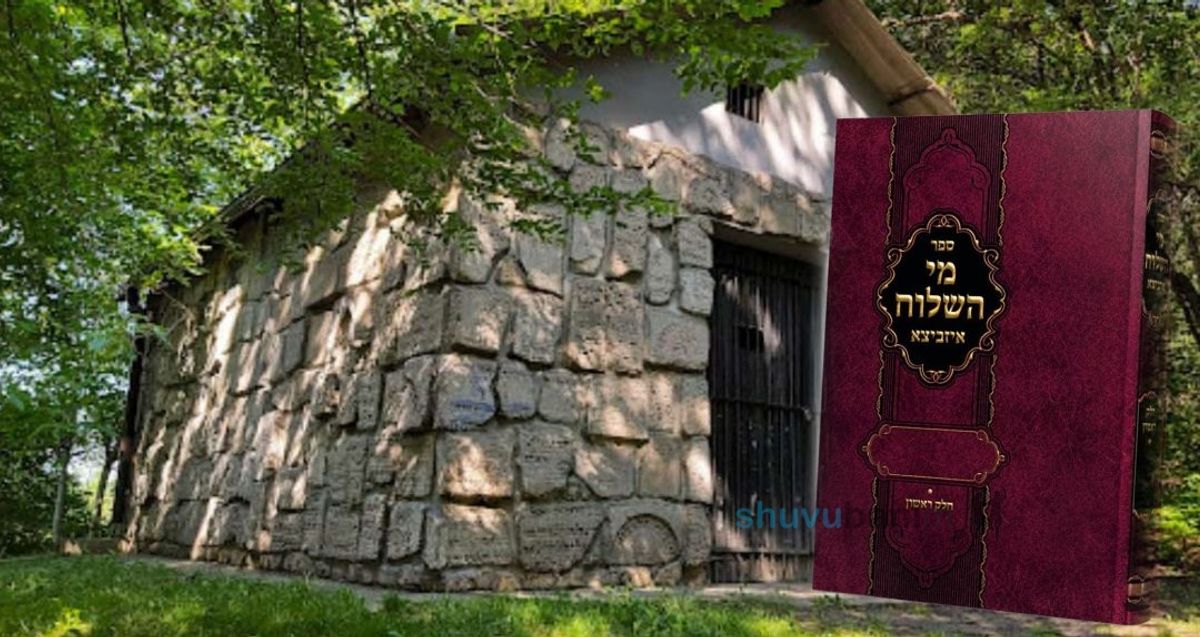
About six years after his passing, his grandson, the third Rebbe of the Izhbitza dynasty, Rabbi Gershon Henoch Henich Leiner, published his Torah teachings in the book "Mei HaShiloach." The book was named after a rare expression by Rabbi Pinchas Bunim of Peshischa regarding Rabbi Mordechai Yosef, saying that "his Torah is like the waters of Shiloach—its waters are few, but they are deep and penetrate the abyss." Additionally, the name of the book hints at the initials of his name, Mordechai Yosef (Mei).
Rabbi Mordechai Yosef Leiner, the first Izhbitza Rebbe and author of the book "Mei HaShiloach," passed away on the Holy Shabbat of Parshas Vayigash—the 7th of Teves, in the year 5614 (1854), 171 years ago. The Izhbitza Rebbe was buried in the cemetery on the outskirts of the town. During the years of the Holocaust, the Germans desecrated the cemetery, but his holy grave was preserved; it was later renovated, and an Ohel (tomb structure) was built over it. The outer walls of the Ohel are covered with tombstones from the Jewish cemetery. To reach his grave in the town of Izbica, Poland, click here.
Subscribe to Our Newsletter
Receive Torah articles and inspiration directly in your inbox