
The Lender Broke the Staff and the Hundred Dinars Rolled Onto the Ground with a
Great Sound • A Lesson at the Kiddusha Rabba of Shabbat Bamidbar from the Gaon and Tzaddik Rabbi Eliezer Berland shlit"a
Before you is the full lesson delivered on the Holy Shabbat, Parshat Bamidbar 5785 (2025), during the Kiddusha Rabba (Sabbath morning meal) after the conclusion of the Musaf prayer:
The lesson was written according to the listener's understanding; if there is an error, it should be attributed to the writer and not, G-d forbid, to our teacher, the Rav (Rabbi Berland) shlit"a.
Now it will be Shavuot. Tomorrow is already Shavuot. And now there are ten hours from nine until seven-fifteen; the men will finish ten pages of Gemara (Talmud). They will finish the second chapter, "Dayanei Gezirot," in Tractate Ketubot from page 100 to 113, and also study the Daf Yomi (daily page of Talmud) in Tractate Shevuot.
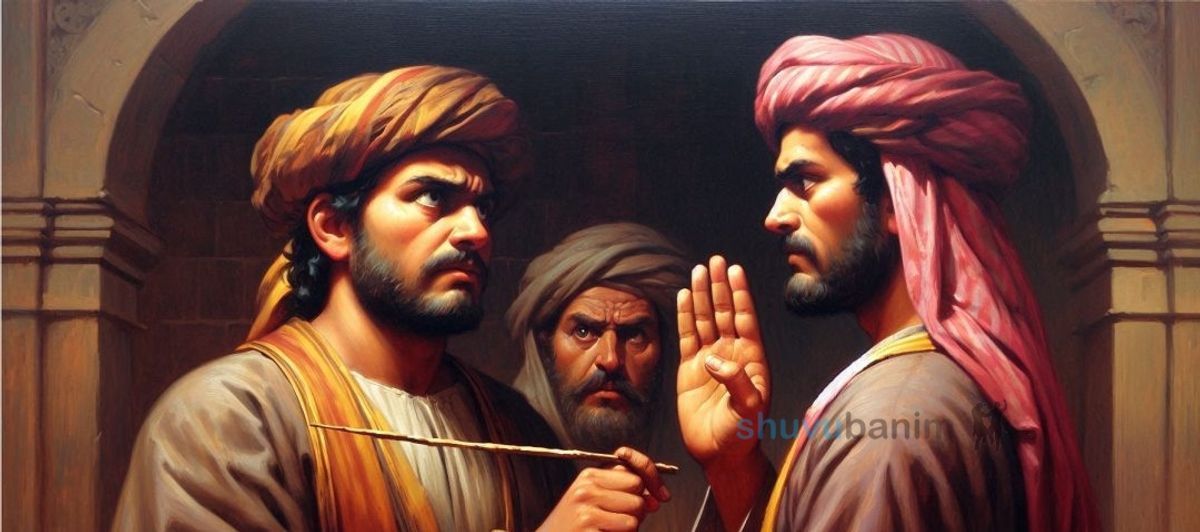
The Gemara tells of "Kanya deRava" (Rava's cane). There was a special staff, a magic staff—can you get it? Here, he will bring it to us. This is a special staff that has diamonds and pearls in it. This is found in the Gemara in Nedarim (25a). The Gemara tells that there was a lender who sued his friend who owed him money. Rava told him, "Pay him." He said, "I already paid." Rava said to him, "If so, swear on a Sefer Torah (Torah scroll)." He said, "It is very serious to swear, I don't want to, but there is no choice." So he filled the cane with all the money and gave it to the lender to hold while he swore on the Sefer Torah. He swore that he had paid, and it was actually true because he had given him the staff with all the money, but the lender was very angry because he believed he hadn't been paid. It is forbidden to be angry, so he threw the staff in anger on the floor, and the staff broke, and all the money and diamonds poured out. This is a staff that contains all the silver and gold. The Gemara says there are three types of oaths: a vain oath (shevuat shav), an oath of expression (shevuat bituy), and an oath of testimony (shevuat ha'edut). An "oath of expression" is when one says "I will eat" or "I will not eat." If he ate the bread, he transgressed "I will not eat," and if he didn't eat, he transgressed "I will eat." A "vain oath" is when one says about a stone that it is gold [the Rav says to his grandson] or they say about you that you are gold or platinum. Platinum is more expensive than gold. You are made of platinum. Or if one says, "I saw a camel flying in the air." The Gemara says maybe it was a large bird he saw. Today there are UAVs (drones), so we understand, but in the past, there weren't. Or if one says, "I saw a snake like the beam of an olive press," and the Gemara tells that there was a giant snake that ate 13 stables of straw, and that's how they killed it.
There are another 20 pages until the end of the tractate. And in Ketubot, there is material here about Eretz Yisrael (the Land of Israel) [on page 111]. The Gemara tells of a Yevamah (widow awaiting levirate marriage) where someone had to perform Yibbum (levirate marriage) for his sister-in-law [the Rav turns to a young man]: "Soon you will have a sister-in-law, you are the first who will get married." So there was a case in Bei Chuza'e, and he asked Rabbi Chanina whether to leave Eretz Yisrael to perform Yibbum. He said, "Blessed is Hashem that he [the brother] passed away; G-d forbid to leave the Land." And afterward, the Gemara tells of one who left Pumbedita for Astunia—that is Latvia—and he passed away. And afterward, it is written about a cabbage stalk that they needed a ladder to climb up to it. Bring me a ladder! And afterward, it is written that a single grape will be of such a size that they will load one donkey with just one grape. "And the blood of the grape you shall drink as wine." They will load one leaf on a donkey. And once, Rabbi Chiya bar Abba did not come to the Yeshiva (Torah academy) for three days. Resh Lakish asked him, "Where were you?" He said to him, "I have a vineyard, and on the first day I harvested 300 clusters like a million liters, and each cluster was a Seah (a measure of volume), and on the second day, two clusters were a Seah, and on the third day, three clusters were a Seah." Every day it decreased because he didn't come to the Yeshiva. And Rami bar Ezekiel arrived in Bnei Brak [turns to someone]: "That's it, the first thing is to live in Bnei Brak, it's final that you will live there. I lived in Bnei Brak from 5719 to 5742 for 23 years." So he saw goats eating figs, and honey dripped from the figs and milk from the goats. Rabbi Yaakov ben Dostai said: from Lod to Ono—Kiryat Ono—is 3 miles, and he walked up to his ankles in honey. And Rabbah bar Chana said that he once saw the "land flowing with milk and honey," and it was 22 parasangs (ancient unit of distance) long, about 80 kilometers, and 6 parasangs wide. Like half of Eretz Yisrael. And once they arrived at a place and they brought them a peach, and they ate a third, declared a third ownerless, and placed a third before the animal. And afterward, the Gemara tells about Rabbi Joshua ben Levi. He was very unconventional; he studied in Shatilim. I spoke with Shimon Treisman that they should accept him, and they didn't accept him. Rabbi Joshua ben Levi had holy chutzpah (boldness); he jumped into Gan Eden (Paradise). We will tell this story in the next lesson on Shavuot. So he arrived in Gavla—that is in Transjordan—and saw oxen in the vineyard. So he started shouting, "There are oxen there, remove them from there, let them fly out of there!" [Turns to his grandson]: "Go down and remove them." [The grandson started to go down]. "That's it, enough, you have already fulfilled your obligation." So they told him, "Those are not oxen, those are clusters of grapes that were the size of oxen." And a year later, Rabbi Chiya arrived there and saw goats in the vineyards. Goats are more dangerous than oxen. So he said, "There are goats in the vineyards, remove them from there." So they told him, "Get out of here, so that you don't cause them to become even smaller!" Once they were the size of oxen, and now they are only like goats; in the end, they will be like a raisin, like a mouse. This is all because of the sins. And you have no rocky ground in all of Eretz Yisrael more than Hebron; it is built on the side of a mountain. And anyone who merits to live in Eretz Yisrael, about him it is said, "And His land will atone for His people."
Subscribe to Our Newsletter
Receive Torah articles and inspiration directly in your inbox