
The Piercing Argument Between Balaam the Wicked and Moses Our Teacher • The
Daily Lesson from the Gaon and Tzaddik Rabbi Eliezer Berland shlit"a
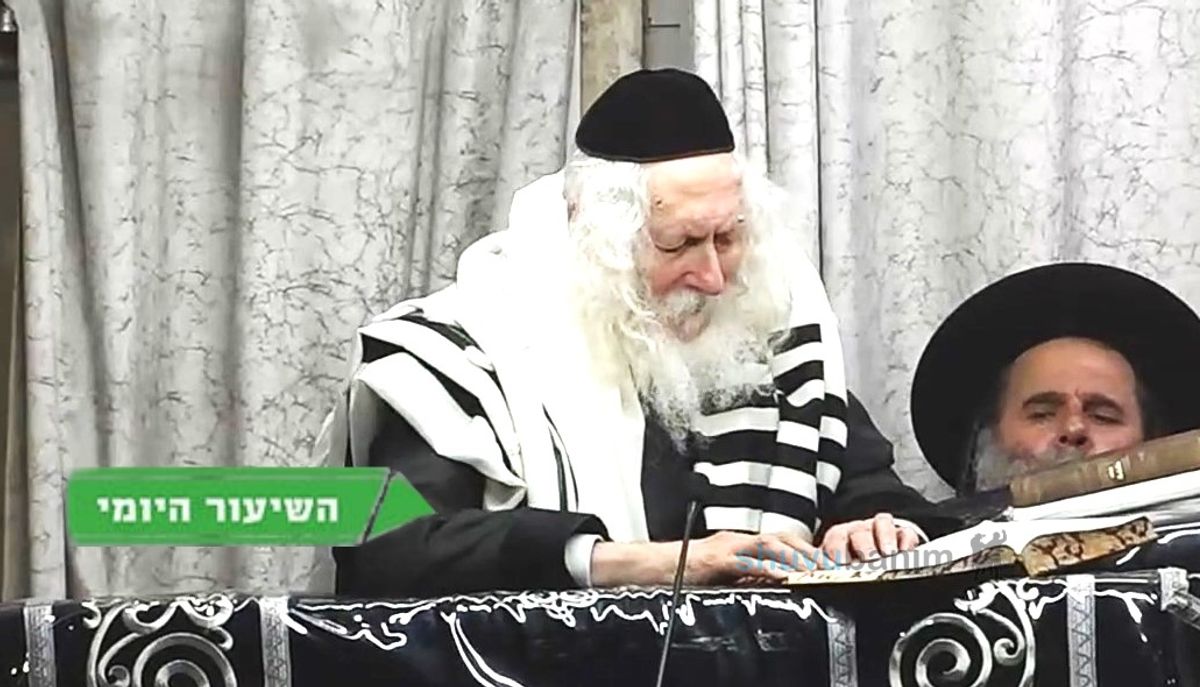
Before you is the full daily lesson as delivered by our teacher, the Rav, Rabbi Eliezer Berland shlit"a (may he live long and good days) — yesterday after the Maariv (evening) prayer, Sunday night, the 16th of Tammuz, Parshas Pinchas:
"Now they have expanded the hall downstairs. Everyone is obligated—even Shimi is obligated—to say ninety Amens, four Kedushas (sanctification prayers), ten Kaddishim (sanctification prayers), and one hundred blessings, which corresponds to the numerical value of Tzaddik (righteous person). Everyone without exception; there is no favoritism, no privileges, no discounts for anyone. You also need to say them, and also [-] who just arrived now, he also needs to say every day ninety Amens and four Kedushas. This includes 'Holy, Holy' along with 'U'va L'Tzion' (a prayer), which makes four; on Saturday night, it is five. And after that, we have ten Kaddishim and one hundred Amens.
Because Moses and Balaam had a very piercing argument. An argument—Moses claimed, 'I am Balaam,' and Balaam claimed, 'I am Moses.' I tried to mediate, I brought in professionals, but Moses remained in his position; he did not give in—'I am Balaam.' 'And G-d happened (Vayikar) upon Balaam'—I am 'Vayikar' (meaning a chance encounter), I don't want to write the Aleph [which would make it 'Vayikra' - and He called, a term of endearment], I am just 'Vayikar.' And Balaam claims, 'I am Moses,' 'He who knows the knowledge of the Supreme' (Numbers 24:16), the Reisha D'lo Ityada (the unknowable head/crown), he merited to reach Atik (the highest level of emanation). He saw until the end of the world. He saw how Samuel kills Agag. 'Oy, mi yichyeh mishumo El' (Woe, who shall live when G-d does this) — these are the letters of Shmuel (Samuel).
'And his king shall be higher than Agag, and his kingdom shall be exalted' (Numbers 24:7), but today Nasrallah rules. We see that all of Balaam's blessings turned into curses, except for 'How goodly are your tents, O Jacob, your dwellings, O Israel' (Numbers 24:5). The entire Galilee is destroyed, everyone is fleeing their homes. The State of Israel has no power to control anything. From the most glorious army, it has become the most idle army. You see that every secular person is a great idler. Now they reached the Houthis in Yemen; exactly now the Yemenites are a bit confused, they don't know what to do. But Smotrich didn't want to sign [on the attack on Shabbat], nor [Ben] Gvir; they said it's an optical illusion, it's a fata morgana (mirage). It's nothing, it's just to calm people down.
In any case, David was among the hostages—King David. I was at Kaplan at the protest, to free David. They want ten thousand terrorists for him. Bibi compromised on five thousand, Biden lowered it to seven thousand, but the protests continue. It won't help until David is released, because Ishbi caught him—Ishbi, the brother of Goliath. He threw him to a height of one hundred meters. One hundred meters is twelve seconds [from the ground]. Every 9.81 [meters is a second squared]. Every child needs to know how to calculate. Every girl at the age of thirteen—they learn this in physics, we learned this. 9.81 [meters per second squared] is the acceleration. So one hundred meters is twelve seconds. 98 meters is exactly ten seconds, we have another eleven meters left which is one second. In those eleven seconds, there was time for Abishai to run to the Sanhedrin (High Court) to ask what to do, David is missing. He saw a hawk preying on a dove; he saw blood in a basin. In the past, there was no water in bathtubs, no sinks, and no water in taps; they would take basins. They would take water out of the mikvah (ritual bath)—like in Beit Yisrael, we would pour water on our heads from the mikvah. So there was a basin full of blood, and he ran quickly to the Sanhedrin—what should be done? I can't find David, I want to take the mule. They told him the mule is fine. But where will he go? North, South? Maybe he fled to Afghanistan, maybe he fled to Thailand, maybe he is in Thailand. Have you ever been to Thailand? I was there for three years, the most interesting place in the world. Afterward, I went to Guatemala, even more interesting. You see the Pacific and Atlantic Oceans together. So David was also in Guatemala, and he was also in Thailand. So maybe he is in Thailand, who knows where he fled. But the mule knows the way on its own. He said the Shem HaMeforash (Explicit Name of G-d), and he reaches David—all this in eleven seconds. In eleven seconds, he needs to get from Jerusalem to Gaza. Maybe to Khan Yunis, I don't know where. Maybe in Rafah, we need to clarify this. And David is still among the hostages.
The Rebbe [Rebbe Nachman] was also among the hostages. The ship sailed—instead of going to Jaffa, it sailed to Rhodes. It was the Rebbe who led the ship. Because in Rhodes, there are the biggest billionaires, even today. That's where all the colors come from, from Rhodes; I have all the fish with all the colors. Snails from which they make techeiles (blue wool for tzitzit), everything is there. The richest place in the world is Rhodes; whoever lives there, for a few pennies he takes the Arabs to take out the pearls, the shells, the conchs from the sea. And they sell them afterward for millions of dollars. That's how they became the richest. And the captain didn't want to let the Rebbe get off; finally, he let the shamash (attendant) get off. The shamash reached the market. They see a Jew—where did you come from? Jew, where did you land from, the moon? From Mars? No, I am here with Rebbe Nachman. Have you heard of Rebbe Nachman? Of course we've heard. He is in captivity, he is a hostage; they want ten thousand terrorists for him. No problem, we are already buying the whole ship. They bought the whole ship with the captain, with the sailors. Only the sailor asked that they leave him some popsicles and ice pops to buy for the sailors. The sailors are waiting for some bonus, for some tip. Since they have been holding the Rebbe here since Shabbat Zachor (the Sabbath before Purim)—it's already the eve of Passover, thirty days. They want some tips.
Like Yoav would distribute cans—without bechiyos (crying). Because the Arabs call them bechiyos, we call them pachiyot (cans). And after that, he distributes popsicles and ice pops to them, to all the children of Jerusalem. So he merited that his blessings are a billion trillion times the blessings of Moses. Because we do what Rashi says—every girl needs to know the Rashi, every girl has an IQ a million times more than a boy. Every girl needs to know the whole Rashi, (Judges) 24:3: 'Like these and like these a hundred times.' So we need to know: how much is a hundred times two? Two hundred. That's your craziness, you don't know. It's a thousand billion trillion, thirty zeros. You do two times two [four—times two], that's eight, and after that sixteen, thirty-two, sixty-four, one hundred twenty-eight, two hundred fifty-six—within a second we reached one thousand twenty-four. Another two seconds and it's a million, another thirty seconds and it's a billion, after that a thousand billion, a million billion. After sixty, it's already a trillion—sixty seconds—in six seconds we reached a trillion. After that seventy, after that another second—seven [seconds], then we reach a thousand trillion, a billion trillion. Ninety is already a billion trillion, a hundred is already a thousand, that's a thousand billion trillion. One hundred twenty is a trillion trillion, thirty-six zeros, and if we do one hundred eighty then three times trillion, trillion times trillion, fifty-four zeros, and after one hundred eighty then we have one hundred ninety which is a thousand trillion, a thousand times trillion, and after that twenty, it's exactly twenty which is called two hundred. Because Rebecca's jug was twenty-four—if there were ten jugs, there would be no remnant of Esau; the more you multiply it. By distributing ice pops and popsicles and cans to infants on Shabbat, one merits to double everything until reaching two hundred, then it's already a million trillion trillion trillion, and after that at two hundred ten it's already a billion trillion trillion trillion, two hundred twenty is a thousand billion trillion trillion trillion, and after that we reach two hundred forty, we reach four times trillion: trillion times trillion times trillion times trillion times trillion—that's already seventy-two zeros immediately after that.
So this is Rebecca's jug, that Rebecca could have completely cut off Esau, because Rebecca's candle never went out. Once, every woman was a prophetess; sixty myriad (600,000) prophetesses in every generation. On the verse 'Your lips, O bride, drop honey' (Song of Songs 4:11)—'drop honey,' the Midrash says on page 27b in Song of Songs: that in every generation there were sixty myriad prophetesses. They spoke prophecies of everything that would happen. Like Hannah said, 'The bows of the mighty' (1 Samuel 2:4)—Hannah lived seven hundred years before Hanukkah, and she says, 'I already see what will happen in another seven hundred years, "The bows of the mighty are broken."' Because it is written in the Gemara (Talmud), Avodah Zarah 9a: that Greece ruled the world for one hundred and eighty years. Persia for thirty-four, Greece for one hundred and eighty—that's two hundred and fourteen, plus twice one hundred and three. From the Hasmoneans until Herod was one hundred and three. Two hundred and six together is two hundred and twenty, the Second Temple. The First Temple was four hundred and ten. And Hannah sees all of this. Therefore, Reb Noson says on page 39 in Matanah 5, section 61, that the entire Hanukkah is in the merit of Hannah. Hannah prayed one hundred and eighty years earlier—'The bows of the mighty are broken' refers to the Greeks, 'and those who stumbled' refers to the Maccabees, 'are girded with strength.' And after that, 'Those who were full have hired themselves out for bread' refers to the sons of Haman—seventy sons. After that, 'and those who were hungry ceased' refers to Mordechai and Esther. Hannah saw everything that would happen until the end of generations.
And also Balaam, 'who knows the knowledge of the Supreme,' he says no remnant will remain, 'and he shall smite the corners of Moab' (Numbers 24:17). For what is Balak afraid of? 'Do not distress Moab, and do not contend with them in war' (Deuteronomy 2:9). Balaam told him that no remnant would remain of Moab, no remnant! Know that the moment the Holy Temple is built—and in another four hundred and forty years the Holy Temple will be built. Because from Balaam until the [building of] the Holy Temple is four hundred and forty years. No remnant will remain of Moab, 'and he shall smite the corners of Moab.' And who will do this? Your granddaughter (Balak's). You will have a rebellious and wayward granddaughter, like Shimi, rebellious and wayward; she will bring David into the world and he will cut off all of Moab, and that will be your granddaughter. Balak lost his mind. What, my granddaughter will destroy Moab? She will finish Moab? I won't allow it! What should be done? [Balaam said to him:] You know what to do—take a barrel of these snakes. Cut off the heads of a thousand snakes, fill a barrel with a thousand heads, and put it in the place of the Temple. Balaam knew exactly where the Holy Temple would be built. The Holy of Holies, the threshing floor of Araunah the Jebusite—put the barrel with the snakes there. When the Temple is built, it will immediately collapse; there will be an earthquake and it will collapse. But David knew this from Ruth. Ruth was David's grandmother, and she knew—she was the granddaughter of Balak, and Eglon—Eglon was a grandson of Balak. So she knew all of Balak's secrets. So she [Ruth] said [to David], 'Know that there is a barrel here; you cannot build the Holy Temple until you remove this barrel.' Therefore it is written, 'Upon Edom I will cast my shoe, Moab is my washpot' (Psalms 60:10)—he removed the barrel and threw away all the snakes. In this merit, may the Holy Temple be built speedily in our days, Amen, in the blink of an eye, Amen, Netzach Sela (forever)!".
Subscribe to Our Newsletter
Receive Torah articles and inspiration directly in your inbox