
The Secret of Dedication to Torah: From the Power of Righteous Women to Supernal Attainments
Lesson No. 67 | Thursday, Parashas Nitzavim, 21 Elul 5756 - A lesson for the general public at the Breslov Yeshiva Nechamas Tzion, the Old City of Jerusalem, may it be rebuilt and established (continued in 68)
A fascinating article from the lesson of Rabbi Eliezer Berland shlit"a deals with the power of self-sacrifice for the Torah and the virtue of righteous women. The article describes how Rabbi Akiva and Rabbi Eliezer merited tremendous attainments thanks to their toil and tears. Furthermore, it explains the secret of Devorah the Prophetess and the Shunammite woman, who merited spiritual revelations in the merit of their pure intention for the sake of Heaven.
The evil inclination is like a spider's web; it is absolute nothingness and mere imagination. When Rabban Yochanan ben Zakkai wanted Rabbi Eliezer to begin giving a discourse, he stepped outside so that Rabbi Eliezer would not be embarrassed in his presence. The moment Rabbi Eliezer opened his mouth, awesome novel Torah insights began to pour forth.
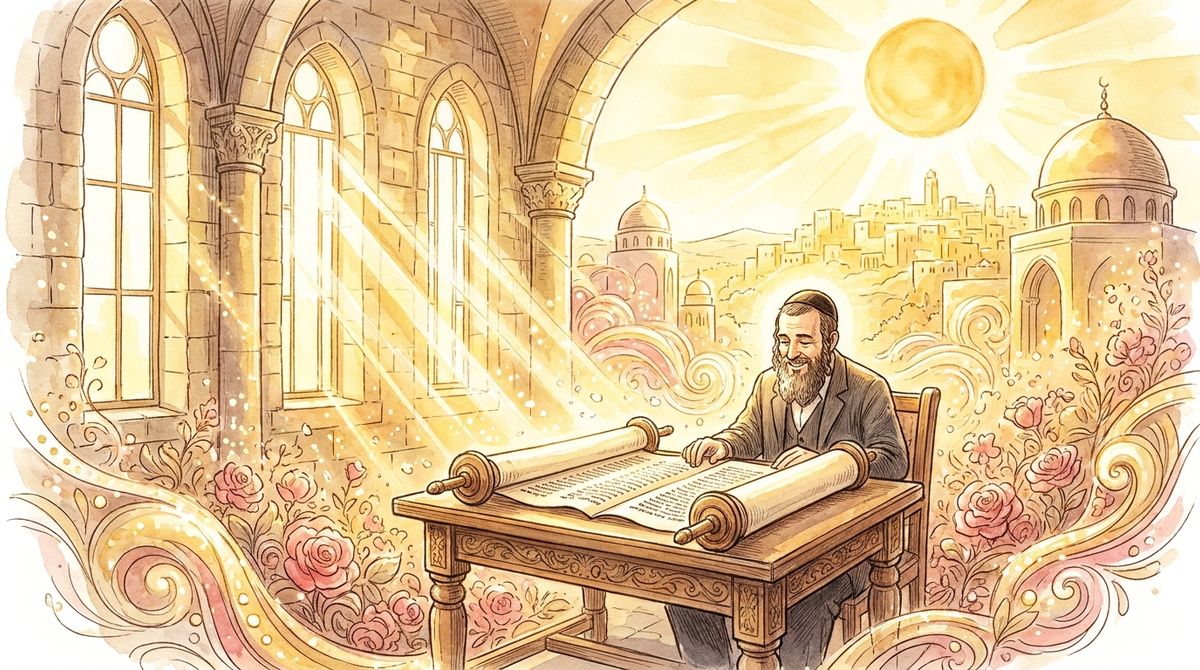
"And Rabbi Eliezer sat and expounded, and his face shone like the light of the sun, and rays of light emanated from him like the rays of Moshe."
His face shone so brightly that people did not know if it was day or night. In those days, there was no electricity, yet the light that burst forth from him was stronger than the midday sun. His father, Hyrcanus, had come to disinherit him from his properties, but when he saw his son expounding with a radiant face, he initially did not recognize him. Rabban Yochanan ben Zakkai said to him, "Fortunate are you, Avraham, Yitzchak, and Yaakov, that this one has emerged from your loins." Hyrcanus asked who they were talking about, and when they told him it was his son Eliezer, he replied, "He should not have said it that way; rather, he should have said, 'Fortunate am I that this one has emerged from my loins.'"
When Hyrcanus realized the spiritual level his son had reached, he wanted to give him all his properties as a gift and disinherit the other brothers. However, Rabbi Eliezer firmly refused and said: "If I had asked Hashem for silver and gold, He would have given it to me, for the earth and its fullness belong to Hashem. But I asked Hashem for nothing other than Torah alone."
Water Wears Away Stone: The Beginning of Rabbi Akiva's Path
Rabbi Akiva's path was different. He had to start from the very aleph-beis (alphabet), toiling intensely and shedding tears like water for years upon years. Until the age of forty, he had learned nothing. Once, he stood by a well and saw a hollowed-out stone. He asked, "Who carved this stone?" They told him, "The water that constantly falls upon it every day."
Immediately, Rabbi Akiva made a logical deduction regarding himself: "If water, which is soft, carved the stone, then the words of Torah, which are as hard as iron—how much more so will they carve my heart, which is flesh and blood."
He went with his three-year-old son, and the two of them sat with the teachers of young children. He learned letter after letter, halachah (Jewish law) after halachah, until he completed the entire Shas (Talmud). Rabbi Akiva poured out rivers of tears to attain the Torah. Regarding this, Rabbi Tarfon said to him:
"He dams up the streams from flowing [a play on the Hebrew word for weeping], and brings hidden things to light."
Through the sheer volume of tears he wept, he merited that things hidden from ordinary people were revealed to him. The Midrash states that things were revealed to Rabbi Akiva and his colleagues that were not revealed even to Moshe Rabbeinu. How is it possible for a person to see more than Moshe Rabbeinu? The explanation is that the soul of Moshe Rabbeinu became impregnated (ibbur) within Rabbi Akiva, and it continued to attain higher and higher supernal attainments.
The Power of Pure Intention: The Secret of Devorah and Barak
The power of perseverance and dedication to Torah is also revealed in Barak ben Avinoam, the husband of Devorah the Prophetess. Initially, he was a complete ignoramus who did not know how to read or write. His wife said to him, "The time has come for you to go learn Torah. I will sit at home alone, and you will go to the yeshiva until you know how to learn."
Devorah would prepare sacks with thick wicks and good candles for him so that he could learn at night. From this, he was called "Lappidos" (Torches). His real name was Michael, but he was called "Barak" (Lightning) because his face resembled lightning from the immense light of the Shechinah (Divine Presence) that rested upon him, and "Lappidos" after the candles that he and his wife would make.
Many people donate candles to study halls, but not everyone merits to become prophets and saviors of Israel. What was the special virtue of Devorah and Barak? Hashem examines the hearts and minds. He knew that Devorah and Barak did not do this to receive honor or recognition. They did not wait for any "yasher koach" (expression of gratitude) or encouragement. They did it as a pure, refined, and unadulterated mitzvah for its own sake, solely so that they could learn Torah at night with an expanded mind.
Therefore, Hashem revealed Himself to Devorah and said to her, "You directed your intentions for the sake of Heaven and made thick wicks so that their light would be abundant in the study hall—I, too, will multiply you in Israel and in Judah."
The Great Woman: Recognizing the Scent of the Garden of Eden
Regarding righteous women like Devorah, it is said:
"The wisest of women builds her house."
A righteous woman who does not seek any honor and does everything for the sake of Heaven merits bringing salvation to the Jewish people. We find this as well with the Shunammite woman, who hosted Elisha the Prophet. The holy Zohar asks why she is called a "great woman." The answer is that she was great in her deeds, and she was the mainstay of the home. She was the one who recognized Elisha's holiness, whereas her husband did not notice it and assumed he was just a simple traveler.
She said to her husband:
"Behold now, I know that he is a holy man of God."
How did she know this? The Zohar explains that when a person sleeps, their thoughts influence their surroundings. In Elisha's case, the bed was filled with the fragrances of the Garden of Eden, because during his sleep, his soul ascended and roamed through the upper worlds.
The Pri Tzaddik asks: How did the Shunammite woman know how to identify the fragrance of the Garden of Eden? This proves that she herself also merited an ascent of the soul to the Garden of Eden every night in the merit of her earnestness and righteousness, and therefore she was able to recognize the holiness of the Prophet.
Part 1 of 2 — Lesson No. 67
All parts: Part 1 (current) | Part 2
Subscribe to Our Newsletter
Receive Torah articles and inspiration directly in your inbox