The Sukkah is a Hug from Hashem
The Festival of Sukkot by Rabbi Menachem Azulai shlit"a
You have not yet attempted this: to scream all day long, "Master of the World, let me taste the flavor of the Sukkah!" What a taste you would have tasted afterward in the holiness of the Sukkah (Rebbe Nosson)
Just One Word – Ashreinu (Fortunate Are We)!
Joy in our Judaism is the root of all joy. The Creator of the World had compassion on me and did not make me a gentile—is there anything more joyful than this? The Sukkah is a hug with which Hashem embraces us, as it is written, "And His right hand embraces me," and the Arizal says that this refers to the Sukkah.
Hashem had mercy on us and gave us the mitzvah of Sukkah, to keep us within holiness even after the holy days have ended.
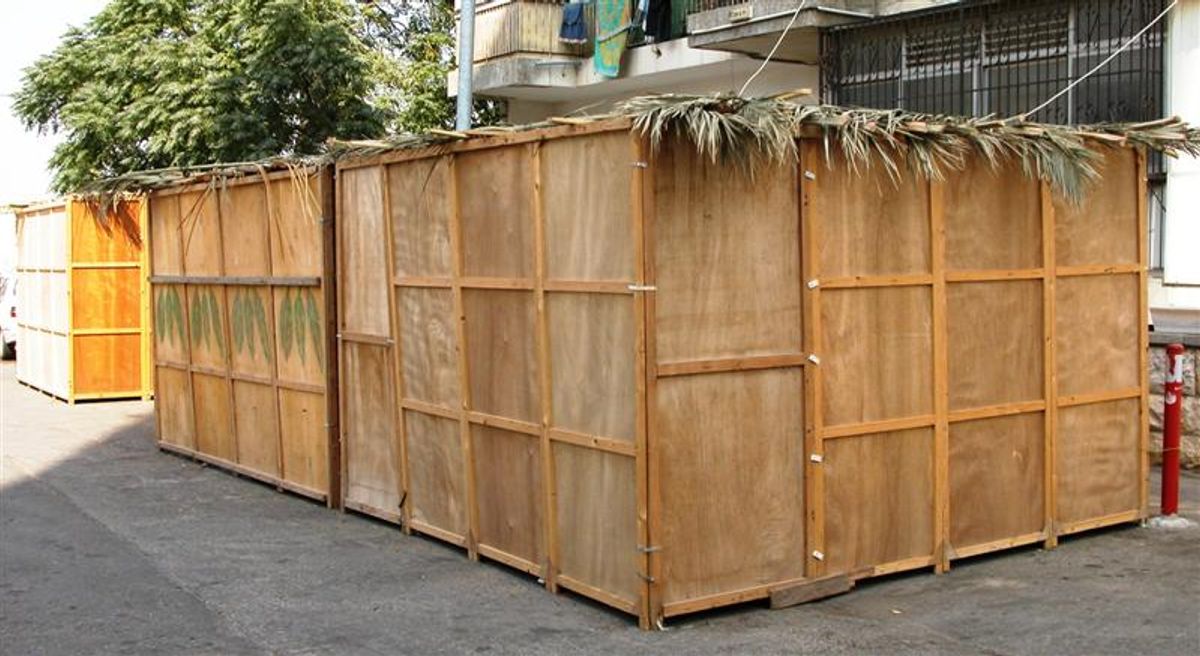
The light of the Sukkah is so immense that even when one builds a Sukkah in the street—which is the public domain, a place far from holiness all year round—during Sukkot, even such a place becomes sanctified.
The Sukkah is a piece of the World to Come within this world. There, I am closest to Hashem. Sitting in it elevates the soul and lifts us to high peaks, more than a handbreadth above the ground.
"But as for me, the nearness of God is my good." If I am close to Hashem, then it is good for me; and if I am not close to Hashem, it is not good for me. It does not matter at all what I have or what is given to me—if I am not close to Hashem, it is worth nothing to me.
Sukkot is the perfection of joy. We rejoice with Hashem not only when blowing the shofar and praying, but also when eating, drinking, and dancing. This is the very essence of what this festival comes to say: that the connection with Hashem is total, in all situations and at all times.
When the Holy Temple existed, they would not stop dancing and singing for all seven days. They did not sleep in a bed due to the great light and joy, because when a person is happy, he hardly needs to sleep.
"And you shall rejoice before Hashem your God for seven days"—this is a commandment from the Torah. It is not said regarding Pesach or Shavuot, only regarding the festival of Sukkot. The Torah commands us to rejoice and dance without ceasing for all seven days.
The Kingship of Hashem is not only in the higher worlds where we were at the beginning of the month. We reach the peak of our connection with Hashem specifically now. Through all these things that might seem like external actions, the Divine light is revealed not only in the synagogue during prayers and shofar blowing; the Divine light descends to us into the Sukkah, as we eat, drink, and rejoice.
Hashem has forgiven us for all our transgressions, so should we not rejoice?! After all, what is the schach (roofing) made of? From the waste of the threshing floor and winepress. This waste represents all our sins, but for Hashem, the waste is fine flour. From it, we make the holiest part of the Sukkah, the holy schach.
"Fortunate are you, O Israel! Who is like you, a people saved by Hashem?" (V'Zot HaBerachah 33:29). Ashreinu, how good is our portion, how pleasant is our lot, and how beautiful is our inheritance, that we have such a great Father to whom everything belongs, and out of His great love for us, He wants to give us everything.
More than anything else, a Jew wants to feel close to Hashem. And this is felt most strongly now. The special closeness felt inside the Sukkah hints to us that we can search for many other "Sukkahs" prepared for us during the rest of the year. Every word of prayer is a Sukkah, every lifting of the head [to Heaven], every minute of Hisbodedus, it is all Sukkahs. One can feel Hashem in all situations and at all times. We can draw the light of the Sukkah into many other moments in life. If only we leave behind all our nonsense, everything that belongs to physicality. Therefore, we read Kohelet (Ecclesiastes) on Sukkot: "Vanity of vanities," said Kohelet, "all is vanity." To turn the vanities of the world—which are "me, me, and me"—into a holy breath of the mouth that praises, lauds, and thanks Hashem. Because if it is "me" all the time, then there is no room for the Holy One, Blessed be He. Everything is blocked. The opposite of what King David said: "My heart is hollow within me"—for me, it is not blocked; for me, there is plenty of room in the heart for the Holy One, Blessed be He.
The joy of Sukkot is a joy of Emunah (faith) in Hashem and absolute trust in His salvation. Just as when we left Egypt, the Clouds of Glory protected us and paved the way for us, so too now, we are in the Sukkah, taking refuge in the shadow of the Creator. We take the Lulav and wave it in all directions, a hint that the Holy One, Blessed be He, rules everywhere. "He leads and brings for the One to whom the four winds belong; He raises and lowers for the One to whom the heavens and earth belong" (Sukkah 37b).
A Jew must deepen his faith throughout his life that everything he goes through and everything that happens to him is all from Hashem, until he reaches the state of "Just as one blesses for the good, so one blesses for the bad," which is a very high level of faith.
Like a (true) story about a family that built their Sukkah in the plaza next to their apartment building after the balcony Sukkah could no longer contain the family members, alongside many other Sukkahs built by neighbors. And behold, after many hours of strenuous work by the father and his six sons, the Sukkah stood in its place to everyone's joy. Except for one neighbor, who decided that it was out of the question for the neighbors' Sukkah to take up his regular parking spot. In a rage, he went up to the family's apartment and demanded the Sukkah be dismantled immediately, unwilling to hear another word on the matter. Pure wickedness, heartlessness with no parallel—after all, the car could be parked a little further away, and it is only for a week. To demand they dismantle a Sukkah that was already built? The father bowed his head and gave in, to the heartbreak of his children. He wanted a Sukkah of peace, not a Sukkah of war. They all dismantled and moved the Sukkah to a nearby field of thorns. On the first night of Sukkot, the family was getting ready to sleep in the Sukkah when suddenly a terrible BOOM shook the whole neighborhood. The stone fence of a balcony in one of the apartments facing the plaza suddenly collapsed and landed on the neighbor's car, crushing it completely... And six frightened children with their father tried to imagine what would have happened if, Heaven forbid, their Sukkah had continued to stand there, in that corner of the plaza next to the building... Everything is from Hashem and everything is for the best...
Sukkot is a holiday loaded with mitzvos, and mitzvos comes from the language of tzavta (connection) and bonding; they connect us to Hashem. When? When we perform them with joy. Because connection with the Creator of the World is possible only through joy. This is essentially the inner dimension of the mitzvos—that we rejoice in them. The more you rejoice in a mitzvah, the more it connects you with the Creator of the World. The Arizal already said that all the spiritual attainments he reached were through joy in the mitzvos.
A person who instills an atmosphere of joy in his home—nothing will be lacking for the members of the household, because when one is happy, one feels closest to Hashem, and when one is close to Hashem, nothing is missing anymore.
When a father loves the mitzvos and performs them with enthusiasm, the child sees the sparkling eyes, feels the father's excitement, and learns from this that this is the most joyful thing in life. The opposite is true when the father performs the mitzvos because "what can one do, one must..."
A person who rejoices in a mitzvah shows that he does it out of love, doing it with all his heart. But when he does not rejoice in it, it is no longer out of love; perhaps out of fear, perhaps out of habit, perhaps he wants to show off to others.
Joy is perhaps the most important commodity in our world. Rebbe Nachman says:
"All illnesses, spiritual and physical, come from a corruption of joy. Therefore, one must overcome with great strength to be only happy always, for human nature is to be drawn toward melancholy and sadness due to the injuries and accidents of time, and every person is full of suffering. Therefore, one must force oneself with great power to be in a state of joy always and to gladden oneself in any way possible" (Likutey Moharan II, 24).
People are willing to do anything to achieve a little joy, willing to spend a fortune in usually futile efforts to achieve imaginary joy.
For a Jew, it is different. A Jew who rejoices in his Judaism is the happiest creature on earth. A Jew draws his joy and vitality from the knowledge that he works for the honor of a High and Exalted King, the King of Kings, and from the faith that everything he goes through—it is all from the King and all for the best.
The Rav [Rabbi Berland shlit"a]: ["Joy does not come just like that. Joy is the hardest of all things; the greatest obstacles are on joy. All the Satan fights against is only joy. This is what he fights—the whole war is that you should not be happy. It is the work of the Satan that you should not be in joy, that you should not dance, and not rejoice. Everyone goes through insults and humiliations, adventures in body and soul. There are many reasons to be sad, and it is human nature to be sad, but with joy, everything can be arranged. If a person dances and sings to Hashem, then all the abundance comes to him. With joy, one merits to turn the descent into an ascent, to sweeten all judgments, to attain all salvations. Through joy, one can heal all the illnesses in the world. A person sees that he failed, that the body overcame him, Amalek overcame him and wants to cast him into sadness and melancholy—nevertheless, he must not fall in his mind. He must immediately look for friends, dance and rejoice with them, say Psalms, look for all kinds of advice on how to be happy. People do not like to dance because dancing is a humiliation; it is not dignified to dance, it is good for children... it is good for young men... The moment one jumps their legs, they cancel all the decrees and judgments. There is a decree of debts upon you, you have no shidduch (match), they are going to take your apartment—jump your legs, dance with force, rejoice with force, break the judgment, sweeten the judgment. When a person dances and whirls, everyone laughs at him, and when everyone laughs, all judgments are sweetened. Because the moment they start laughing at the person down on earth, and say about him, 'Look at this fool,' then in Heaven they also laugh; all the accusers laugh at him and consider him a fool, and therefore they do not judge him. And through this, the sweetening of judgments occurs."]
Why is it so important to serve Hashem with joy? How is it that the most terrible curses mentioned in the Torah are all "Because you did not serve Hashem your God with joy and a good heart"? Because all blessing in life comes only from connection with Hashem, and all connection is only through the joy of mitzvos. True, Hashem Yitbarach rejoices in every mitzvah one does, even if it is without joy, but when one does the mitzvah with joy, it is something else entirely. When a person is not happy, he cannot overcome his inclinations, he cannot nullify his desires because he still needs a little vitality. But when he is happy from every mitzvah he performs, then he no longer needs the desires, for he already has true vitality! Vitality from Hashem! Joy from Hashem! When a Jew rejoices in the Torah and mitzvos, he can do Hisbodedus day by day until, with his prayers, he nullifies the desires. Because desires are a curse; they disconnect him from Hashem. Master of the World, help me that all my vitality will be from holiness, from the Torah and mitzvos, not from desires, Heaven forbid.
Simchat Torah is the joy of everyone. Of every single Jew. A joy that unites everyone, from the greatest scholar to the simplest of the simple. On Simchat Torah, we see how artificial the barriers are. Crowds fill the synagogues, and soon we will see them dancing with excitement with the Torah scrolls.
On Simchat Torah, one can see how a pure and clear Divine soul beats in the heart of every Jew, full of love for Hashem and His Torah. Without knowing why, masses of Jews find themselves coming—people who all year round have no special connection to Torah and mitzvos—but today they come, as if to declare: We are also Jews. This sight of masses of Jews filling the synagogues and afterwards the city squares in the Hakafot Shniyot is a moving sight. Dancing without pause, until they are washed in the sweat of a mitzvah.
In these dances, a person shows his love for Hashem. In these dances, all judgments are sweetened. Like the story told about a Jew who received a dismissal letter on the very eve of Sukkot. It was hard for him to truly rejoice, as he was seized with worries about how he would support his household after being a teacher for many years and loving his work very much. To overcome the worries, he forced himself to join the circle of dancers on Simchat Torah. Just then, the orchestra began to play a melody that spoke to him deeply: "In You our fathers trusted; they trusted, and You delivered them." "To You they cried out and escaped; in You they trusted and were not ashamed." There is a God in Heaven from whom everything comes, and one must accept everything with love and know that Hashem treats him only for the good. Hashem will not abandon him nor forsake him.
And so he danced and sang until he felt how good it is to lean on the Creator of the World; he would cast his burden upon Hashem, and Hashem would sustain him. He suddenly felt like a baby leaning on his father's arms, so safe and protected there. Then he felt a tap on the shoulder; someone was calling him to leave the circle for a moment. That person had heard about his dismissal and offered him a job teaching fourth grade in his "Cheder" because "your good name as a teacher spreads far and wide." And so he returned to the circle, and by then they had changed the tune. And what were they playing now? "Let them give thanks to Hashem for His kindness, and for His wonders to the children of men"... (Peninei Beit Levi).
The more a person learns, the more desire and will for Torah is added to him; his soul yearns for the courtyards of holiness, and he has no more interest in the desires of this world.
"A Jew who learns Torah is like a fish in water. That is his true vitality. He is so attached to the sea of Torah that he cannot leave the water. Like a fish. When it leaves the water, it feels that it is dying. Only there is it good for him. There he feels wonderful. There is Godliness, there is the Infinite, that is purity, that is refinement; whoever needs to be purified is purified in water. That is purity. That is clarity. It is a completely different world. Quiet. Wonderful. Far removed from this world of dry land. Something completely different. A Jew who learns Torah is like a fish inside the water. Now tell him to leave the water—a fish that leaves the water will die. A Jew cannot leave the water."
A Jew must remember every day that Hashem watches over him, protects him, walks with him, and screens him exactly like the holy Sukkah. A person needs to draw the light of the Sukkah into his entire life. To believe in Hashem. To trust in Hashem. To know that if he lives with the Holy One, Blessed be He, no one can harm him.
Words of Rabbi Menachem Azulai
Subscribe to Our Newsletter
Receive Torah articles and inspiration directly in your inbox