
The Tzaddik Said "Vayisau" So There Is No Sea • The Daily Lesson from the Gaon
and Tzaddik Rabbi Eliezer Berland shlit"a
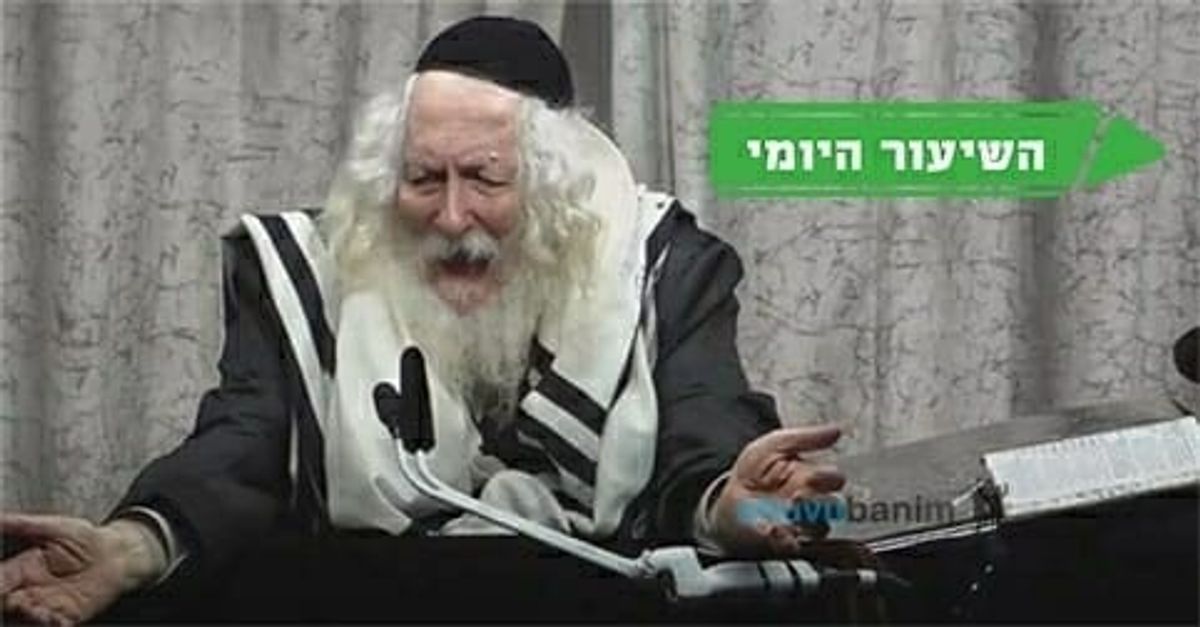
Before you is the full daily lesson as delivered by our teacher, the Rav, Rabbi Eliezer Berland shlit"a (may he live long and good days) — yesterday after the Maariv (evening) prayer, Tuesday night, the 27th of Iyar, in the desert:
"Next week is the Ten Commandments; everyone will merit the Giving of the Torah. Hashem called the women a day earlier and asked if they wanted to receive the Torah. To 'I am Hashem your G-d,' they said yes. To 'You shall have no other gods before Me,' they said no. According to Rabbi Akiva, they said 'Yes'—meaning 'we have heard.' After that, 'Do not murder,' 'Do not commit adultery,' 'Do not steal'—to everything they said no. According to Rabbi Akiva, they said yes. After that, 'Do not bear false witness.' After that, 'Do not covet your neighbor's house'—it is forbidden to covet anything.
After Shavuos—after the Ten Commandments—we read the portion of the Princes (Nesi'im), where there was a real struggle. Shavuos is on Shabbos; after Shavuos, Moshe wrote it. The prince of the children of Reuven was Elitzur ben Shedeur; the prince of the children of Shimon was Shelumiel ben Zurishaddai; the prince of the children of Gad was Eliasaph ben Deuel; the prince of the children of Ephraim was Elishama ben Ammihud; the prince of the children of Manasseh was Gamaliel ben Pedahzur; the prince of the children of Benjamin was Abidan—who sacrificed himself and jumped into the sea—Abidan ben Gideoni. The prince of the children of Dan was Ahiezer ben Ammishaddai; the prince of the children of Asher was Pagiel ben Ochran; the prince of the children of Naphtali was Ahira ben Enan.
When he wanted to write 'Prince' for the children of Judah—Nachshon—Nachshon screamed, 'Absolutely not!' He began to scream terrible screams, frightening screams that were heard all the way to Uman. Such terrible screams: 'You will not write "Prince"!' He said, 'What is this favoritism, what is this privilege? Do you think favoritism should be shown to me? Everyone else was called "Prince," so we will write "Prince" for you too.' He said, 'No. For me, you will not write it.' Moshe told him, 'This is pride! Know that this is pride! You want to be different from everyone else—know that this is pride.' He replied, 'I don't care about pride or no pride, you are not writing the word "Prince"!' A lethal struggle began, just like over the 'small Aleph' (in the word Vayikra), where Hashem told Moshe to write a Vav, he wrote a Vav; write a Yud, he wrote a Yud; write a Kuf, he wrote a Kuf; a Reish, he wrote a Reish. Suddenly He said, 'Write an Aleph,' and he [Moshe] said, 'This, no. This, absolutely not.' There was a struggle there, blood was shed. 'I am not writing the Aleph, it won't help You.' Hashem said to him, 'Write the Aleph,' and he said, 'No!' The Baal HaTurim says [Moshe said], 'I am like Balaam.' It is written, 'And G-d happened (Vayikar) upon Balaam' (Numbers 23:4)—to him too, You speak with me as You speak with Balaam. The entire dispute between Moshe and Balaam was that Moshe claimed he was like Balaam, and Balaam claimed he was like Moshe. This was a very serious dispute that they couldn't resolve, with Balaam shouting that he is Moshe, 'He who knows the knowledge of the Most High, who sees the vision of the Almighty, falling down with eyes revealed' (Numbers 24:16).
'I see him, but not now; I behold him, but not nigh; a star shall step forth from Jacob, and a scepter shall rise out of Israel, and shall smite the corners of Moab' (Numbers 24:17)—no memory shall remain of Moab! Balak did not forgive this. Because Biden said not to enter Rafah, not to enter Moab. Who wrote the verse 'Do not distress Moab' (Deuteronomy 2:9)? Biden. It is forbidden to enter Moab, forbidden to enter Ammon. He said absolutely not. Moshe listened to the voice of Biden; he wrote it in the Torah: 'Do not distress Moab, and do not contend with them in battle.' So what is Balak afraid of? We aren't entering Rafah, and we aren't entering Moab or Ammon. Why does he bring Balaam? Rather, he says, 'For he is too mighty for me' (Numbers 22:6). The Zohar says: I see that my grandson, my great-grandson, my son—for Eglon was the grandson of Balak, and Ruth was the daughter of Eglon—and her grandson, her great-grandson [King David], wiped out Moab. 'And he measured them with two lines, to put to death, and with one full line to keep alive' (II Samuel 8:2). They killed his father and mother; he had entrusted them when he fled from Saul, he entrusted them with... he said, 'The King of Moab is my cousin.' He is a cousin of Orpah, a cousin of Ruth. So he said two lines to put to death, and one to keep alive. 'And he shall smite the corners of Moab.'
And now we are approaching Parshas Naso; we read the portion of the Princes on the first of Nisan, we read it on Chanukah, and now we will read it in ten days, immediately after Shavuos. Parshas Naso will arrive. And this is 'May my prayer be accepted like the sacrifice of Nachshon,' because Nachshon jumped into the sea; Nachshon didn't care about anything! The Tzaddik said 'Vayisau' (and they shall journey) (Exodus 14:15)—the Tzaddik said to travel, so he says there is no sea. If the People of Israel say 'Vayisau,' then there is no sea. Everyone was afraid. Rabbi Meir says everyone was afraid to jump into the sea, only the tribe of Benjamin jumped into the sea—after Nachshon. Everyone said, 'How can we jump? We will drown, with the babies! We'll take the babies on our shoulders maybe, but...'
Because there were four groups: one group said 'Let's make war,' one group said 'Let's flee to...', [another group said] 'Let's surrender.' So what will happen if we surrender? Then they will hang Moshe and Aaron, the 'heads of the terrorists'—a few bandits, a few terrorists who fled from Egypt. Who are the heads of the terrorists? Moshe and Aaron. They will hang them; if we return to Egypt, they will hang them. They said, 'Let's go back, it's over, we are lost.' Six hundred thousand [men], six hundred tanks. Some said to war, some said to surrender, some said to jump into the sea to swim or make ropes. Some said 'Let's flee to the desert,' but they said there are wild animals there. Moshe said, 'Stand still and see the salvation of Hashem' (Exodus 14:13), 'Hashem will fight for you, and you shall remain silent' (ibid 14). Not this and not that—not war, not surrender, not the desert, and not the sea. Stand, and then 'Hashem will fight for you, and you shall remain silent.'
And then they saw 'And the waters were split' (ibid 21). 'And with the blast of Your nostrils the waters were piled up' (Exodus 15:8)—the Kedushas Levi brings regarding 'And with the blast of Your nostrils the waters were piled up' that the waters, on their own, without Hashem telling them, piled up on their own; they climbed on top of each other on their own. 'The flowing waters stood upright like a wall.' 'And the waters were a wall to them on their right and on their left' (Exodus 14:22)—it is written twice, twice 'wall' (Chomah). Once for Moshe and the Children of Israel, and once for [Dathan and Abiram]; even though they were wicked, they received blows [for the sake of] the People of Israel. And all their skin was split, all their skin peeled off. The sea was split for them."
Subscribe to Our Newsletter
Receive Torah articles and inspiration directly in your inbox