
There is Nothing That Cannot Be Accomplished with Reb Shayala ben Reb Moshe!! •
For the Hiloula of the Rebbe of Kerestir
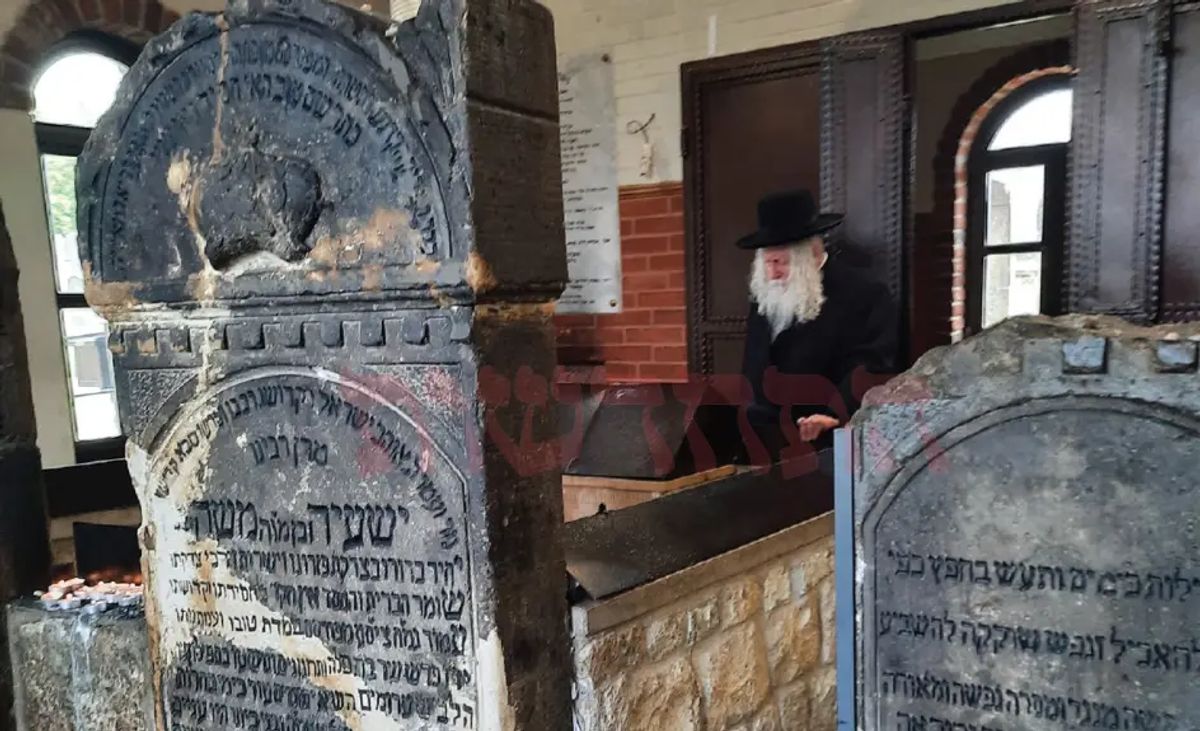
Today, the 3rd of Iyar, is the day of the Hiloula (anniversary of passing) of the Tzaddik (holy person) who works salvations, Reb Yeshaya ben Reb Moshe of Kerestir. Before you is a collection of sayings and stories regarding the greatness of Reb Shayala and the miracles he performed, from the Gaon and Tzaddik Rabbi Berland shlit"a (may he live long and good days):
The Salvations Accomplished at His Grave
If Reb Shayala ben Reb Moshe were alive, there would have been no Holocaust! During his lifetime, he was never seen holding a book—not the Rambam (Maimonides), not the Gemara (Talmud), and not Likutey Halachos (the primary work of Reb Noson of Breslov). Once, a great Rabbi was asked, "Why are you traveling to him?" He replied, "This man knows the answer to every question you ask him, every difficulty found in the Shas (the entire Talmud)." He would only hold a book when no one was looking, late at night when everyone had gone to sleep. His main occupation was feeding people; day and night, he fed people. There were always full pots. Once, a crowd of people arrived and there were no pots, so he said, "No matter how much you take out, there will always be fish cholent (Sabbath stew)." No matter how much they took, everything remained full—they saw open miracles. This was Reb Shayala ben Reb Moshe, through whom everything can be accomplished! Whatever a person wants—children! healings! cancers! There is nothing that cannot be accomplished there!!
Reb Shayala's Greatness During His Lifetime

Regarding Reb Shayala—because in his lifetime he was never seen studying, he was only distributing food to people. Whoever came, he would force them to eat. Once, a man with an intestinal illness came; he couldn't even get down from the carriage. It was a horse-drawn carriage, yes, there were no Mercedes yet. We are talking about thirty years before the World War—the year 5670 (1910). He [Reb Shayala] said then that there was going to be a World War. So let's say this story happened in 5650 (1890): a man with an intestinal illness came and couldn't get down from the carriage. Reb Shayala approached him and said, "You must get down from the carriage," and he brought him cholent (Sabbath stew) from Shabbat. It was already Sunday, apparently, but it was the kind of cholent that people usually die from [if they have such an illness]; whoever eats such cholent could say the blessing for the "Resurrection of the Dead" afterward... The man said, "How can I? I have an intestinal illness!" Reb Shayala said, "I am telling you to eat—eat!" He was immediately healed. He ate from the cholent and was healed. He began to walk on his own, whereas otherwise they would have had to carry him down; Reb Shayala himself helped him down from the carriage, he took him down from the carriage.
Reb Shayala Draws Down Healing for a Dying Child from Afar
Now we will read the story of a grandmother whose grandson was deathly ill. There was a childhood epidemic in Kerestir—this story apparently took place in 5650 (1890), thirty years before he passed away. She cried all night; the grandson could no longer speak, he was already paralyzed, but she continued to pray. In the morning, when the sun was already shining by the window, she dozed off and saw Reb Shayala of Kerestir in a dream. She was a simple woman living in Kerestir. She dreamed that Reb Shayala came to her in the dream and said, "I am sending you the greatest professor in the world," in the dream. She was in Kerestir, a village where all the houses were half-buried in the ground, houses from two thousand years ago. He says it was the poorest village possible, where they barely had water, drawing it from wells. Suddenly, she sees Reb Shayala of Kerestir; she sees him. She is sitting at the head of her grandson's deathbed. And she dreams there is someone speaking to her: "Listen to me, I am sending you the greatest professor in the world, I am sending him to you." She doesn't understand; she wakes up, the candles are already burning, the roosters are already crowing "cock-a-doodle-doo." The bush is rustling, a horse screams in the stable wanting food, the dog barks twice. She turns her head right and left—who is this man? Who was it that shouted to her, "I am sending you the greatest professor"? She looks for who it was. She sees ["the only movement visible to the eye was the flickering flame of a small oil lamp at the top of the mast of] one of the ships in the river." [The grandmother closed the window quietly and whispered:] "It was an angel of [G-d," she raised her arms toward the heavens and threw her head back, her eyes fixed on the ceiling. "G-d,] please fulfill my dream..." Suddenly, Mr. Friedman arrives, apparently her husband. He asks, "How is the boy?" She says, "He is already about to die." "—He is still breathing." She says, "Yes, I dreamed a dream that Reb Shayala of Kerestir is sending me the greatest professor in the world." "Fine," he says, "you must be hallucinating from the great grief over the grandson, you are already hallucinating. What professor? We are here in some remote village, what do we have to do with professors? If only there were a normal doctor in this village." The church bells are ringing; she goes to draw water at eight in the morning. She sees a royal carriage parked by the well, entirely plated in gold, with two white horses, and the coachman is watering the white horses. She peeks inside and sees a man of dignified appearance, wearing a tie that was almost entirely gold, and he has a James Bond briefcase, but one for ministers, for kings. A royal carriage, and even the coachman—even the driver of the carriage—is dressed with shining gold buttons, gold embroidery, gold stripes, and also... either it was pure gold or it was gold-plated. And white horses, the likes of which she had never seen in her life; only the king has such horses, royal horses, white horses. Everyone stands around the carriage and they see someone sitting there on a padded seat—it was a royal carriage, more padded than a Mercedes. Everyone looks at the passenger, at the one inside—at the professor. "[He (the professor) did not have gold buttons, and he was bald]" like all professors—completely bald. And a very prestigious leather bag, surely worth a hundred or two hundred dollars, like a doctor's bag. Then she understood that this was a professor, a doctor, and she shouts to him: "I have a sick child here—a sick grandson, maybe you can jump out to see him for a second, just a second, a second!" As soon as she says it to him, he jumps from the carriage and runs with all his might, he runs at a sprint. The house was right across, and he is wrapped in golden clothes, a famous professor, unique in his generation. She wants to fall to her knees, but a gentile... gentile women bow to professors, kiss their feet, but she is a Jewish woman, she cannot. It's enough that we bow on Yom Kippur. "Professor, professor, run to my grandson, he is right here across." As soon as she says the words "he is right here across," he immediately jumps from the carriage, runs to the baby, gives him a small bottle: "Drink a drop, a drop every hour, five drops every hour day and night, for five days." The baby already opens his eyes, he is already recovering. She says, "I want to give you [payment]," she opens her purse there, takes out a few Euros, a few Crowns, a few Krona—this is Hungary, so a few Krona. He said, "I won't take a penny." "Why not?" He tells her, "I dreamed a dream in the night, I dreamed a dream in the night that a woman would come and tell me, 'Come heal the grandson,' and I must immediately heal the grandson and not take anything from her." He says, "I had a dream that was a command from Heaven, and from Heaven they will repay me, and I won't take a penny." So the professor also dreamed a dream. All of these are the miracles that exist with the Kerestirer.

Prayer for the Day of the Yahrtzeit:
https://www.shuvubanimint.com/58227/
Subscribe to Our Newsletter
Receive Torah articles and inspiration directly in your inbox