Traveling to Rashbi to Draw the Holy Spirit • Fiery Words from the Gaon and
Tzaddik Rabbi Eliezer Berland shlit"a for the Hillula of the Divine Tanna
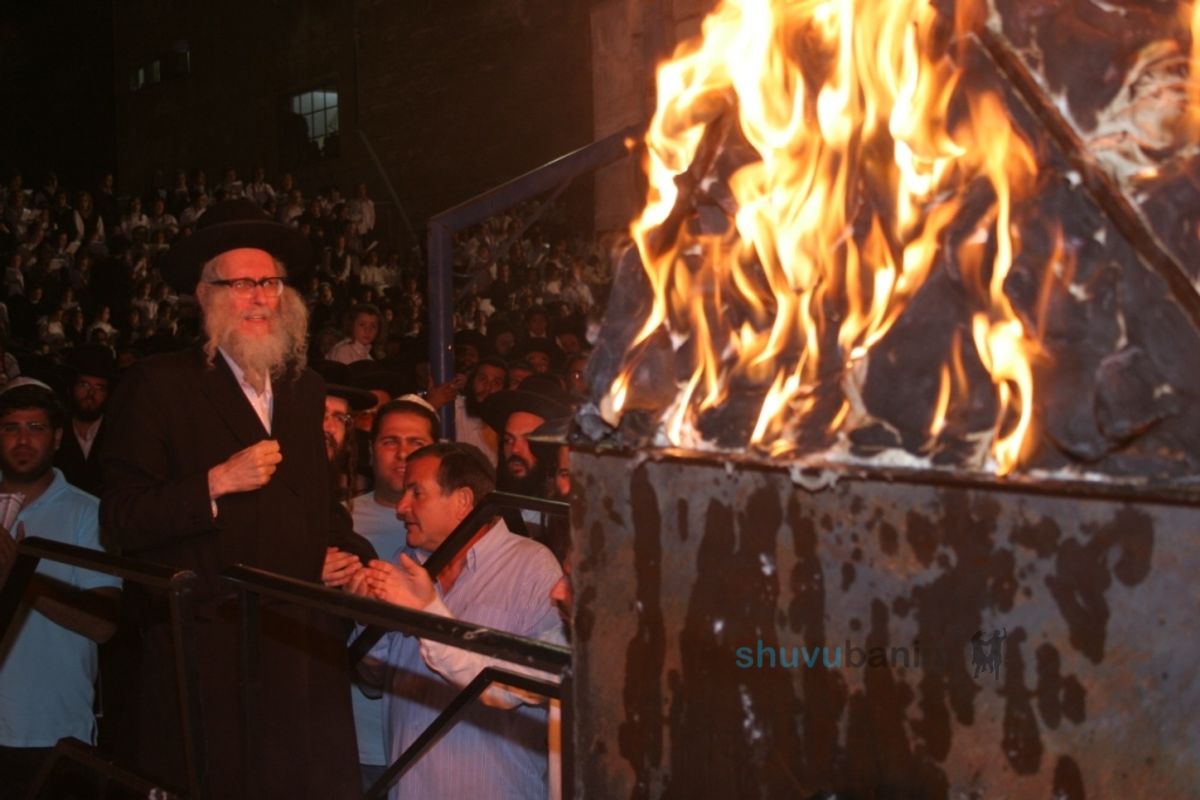
What does a person merit who travels to Rabbi Shimon bar Yochai on the holy Hillula (anniversary of passing)? How does one merit to receive the spirit of Rashbi? And what gifts are distributed on Lag BaOmer in Meron?
Sparks of light from the "Fiery Flame" lessons of the Gaon and Tzaddik Rabbi Eliezer Berland shlit"a for the awesome day of the Hillula, Lag BaOmer, in honor of the Divine Tanna (Mishnaic Sage), Rabbi Shimon bar Yochai zy"a (may his merit protect us):
The Soul of Rashbi
The soul of Moshe Rabbeinu could ascend with the body to heaven, simply by leaving the body here. He is buried on Mount Nebo, and "no man knows his burial place"; he is included in the concept of "lo yada" (did not know). For the entire work of a person is only to reach the level of "lo yada" (not knowing) and "ad d'la yieda" (until one does not know). But Rabbi Shimon bar Yochai said: "Moshe did not know, but I know (ana yadana)" — what was a state of "not knowing" for Moshe Rabbeinu was a state of "knowing" for Rashbi. Rashbi merited to reach such a level that through his joy, he could sweeten all the dinim (harsh judgments). This was the work of Rashbi. Through his joy, Rashbi merited to sweeten all the judgments in the world. Similarly, it was said of Rabbi Elazar the son of Rabbi Shimon that no person died before their time during his life.
Rashbi the True Matchmaker
Rashbi opens the path in the sea. A person travels to Meron, travels three hours to Meron, is pushed there among tens of thousands of people, and then all his sins are sweetened, all his blemishes of the Brit (covenant of purity), everything he sinned throughout his life — everything is sweetened for him; so that he can truly find his zivug (soulmate). Rebbe Nachman says: all the terrible blemishes are sweetened for him, and his partner comes, the soul he was created with before the creation of the world, who is actually right next to him — he simply reveals her. Lag BaOmer is the time when a person can reveal his match. A person comes to Rashbi — Rashbi is the true matchmaker. "For the lips of the Kohen (priest) shall guard knowledge, and they shall seek Torah from his mouth" (the Hebrew initials of this verse spell "Shidduch" - Likutey Moharan 9). Rashbi is the true Kohen, Rashbi is the true matchmaker, he is the power of the Zohar, he is the soul of Moshe Rabbeinu that descended anew to the world. As the holy Ari says: "M'ah S'hehayah H'u" (That which was is that which will be), for the unique individuals of the generations are Moshe Rabbeinu himself, and they are the Ra'aya Meheimna (Faithful Shepherd) himself. Traveling to Rashbi is traveling to Moshe Rabbeinu himself, to the Ra'aya Meheimna himself! All shidduchim (marriage matches) are with Moshe Rabbeinu, all shidduchim are with Rashbi.
How to Approach the Holy Books
Rabbi Chaim Elazar of Munkatch said that one should not dare to touch Likutey Moharan before first going to immerse in the Mikvah (ritual bath). The same applies to the holy Zohar; when going to study, one must first immerse in the Mikvah. [When asked to lend the book, he replied]: "I certainly will not leave Likutey Moharan with you, for I need to look at it every second." This is what Rabbi Chaim Elazar of Munkatch said. "What I am willing to do is give you the Sippurei Maasiot (Rabbi Nachman's Stories), and even then, you must not look at the book of Sippurei Maasiot without immersing in the Mikvah. Sippurei Maasiot should be read all day and night without ceasing, and every single word in this holy book contains great and lofty secrets. If the world would begin to study Sippurei Maasiot with deep analysis — Mashiach would come." Rabbi Chaim Elazar of Munkatch said this. If they would start to study Sippurei Maasiot with depth, not just saying it like Tehillim (Psalms).
Rashbi Lives and Endures
There is no passing away for the Tzaddikim. When traveling to Rashbi or to Rabbi Elazar the son of Rabbi Shimon — the Tzaddikim have not died. Tzaddikim do not die. A Tzaddik is a joy for all of Israel. Half a million people already come to Rashbi, and soon all of Israel will come. Meron is the way to the capital of the world; all of Israel will come. The Tzaddik's day is a wedding, and the Tzaddik gives gifts to everyone who comes to him; he distributes gifts to everyone who comes to his wedding. Because then [at that time] is the time to distribute gifts.
A Trip to Meron is Not a Vacation
In Likutey Tefillot (Collected Prayers), one must pay attention to every word! A person reads and doesn't notice so much. "And may I merit to draw (lish'ov) the spirit of the Tzaddik." To draw! Not just like that. You are a Breslover, you are traveling now to Meron — draw the spirit of Rashbi. You come to Meron, draw the spirit of Rashbi, draw! If not, you are turned upside down. You travel to Meron to draw, you don't travel for "fun"; taking the wife and going on a trip (tiyul). That is not Rashbi, that is not the graves of Tzaddikim. It is written in Orchos Tzaddikim: there is a lust for trips, and people dress it up as visiting the graves of Tzaddikim, but it is just a lust for trips. Rebbe Natan says: to draw the Ruach HaKodesh (Holy Spirit).
You come to Rashbi to draw the spirit of Rashbi. You travel to Rabbi Yochanan HaSandlar, Hillel, Shammai — to draw. This is what is written here: "And may I merit to draw into my heart the Ruach HaKodesh of the true Tzaddikim." And then I will be able to dance and sing and feel the Tzaddik. A person is a Breslover, but in what way are you a Breslover? The light of the Tzaddik is darkened for him, he doesn't know what Breslov is. Why on earth do we travel to Tzaddikim? Why do we travel to Uman? (Rebbe Natan reveals to us): For the spirit in the heart! When we start to dance, the spirit in the heart comes, the spirit of the Tzaddik comes. We start to dance, we start to sing, to clap hands — the spirit in the heart comes through the Tzaddik. The Tzaddik is the spirit in the heart.
We come to Rashbi to draw the spirit of the Tzaddik, we come to Rabbi Akiva to draw the spirit of the Tzaddik, we come to the Rambam to draw the spirit of the Rambam, so that we can study Rambam. And then we start to dance and sing, and we go from the side of death to the side of life. Through dancing and clapping hands, the sweetening of judgments (hamtakas hadinim) is achieved, and then there are no judgments. Why are there judgments? Because there was a terrible accusation. People traveled for nothing, for "hafles" (parties), to go on trips, to make barbecues. Hashem have mercy! Hashem have mercy, where have we reached? Where have we reached? We travel to the Tzaddik to cry! Once, they traveled to Tzaddikim and cried there; there was no food, there was spotted bread, bread with mold. Rabbi Shmuel Shapira ate moldy bread in Meron for an entire year. When Rabbi Shmuel Shapira arrived, it was still an Arab village there, and every moment there was danger that the Arabs would kill the Jews. It was a life-threatening danger, and yet they traveled in order to cry with a broken heart. Every time the Arabs hit them, beat them — that was the sweetening of judgments. In the book "Yimei Shmuel," he describes it all. There is a lust for trips, so people travel to Meron... One should travel to Meron with a broken heart, to receive the spirit of Rashbi, some spark from Rashbi!!!
Subscribe to Our Newsletter
Receive Torah articles and inspiration directly in your inbox