
We Must Know That Our Rebbe is Alive and Enduring!! • The lesson of the Gaon and
Tzaddik Rabbi Eliezer Berland shlit"a on the Hiloula of our Holy Rebbe, from the new book 'Ma'alos HaTzaddikim'
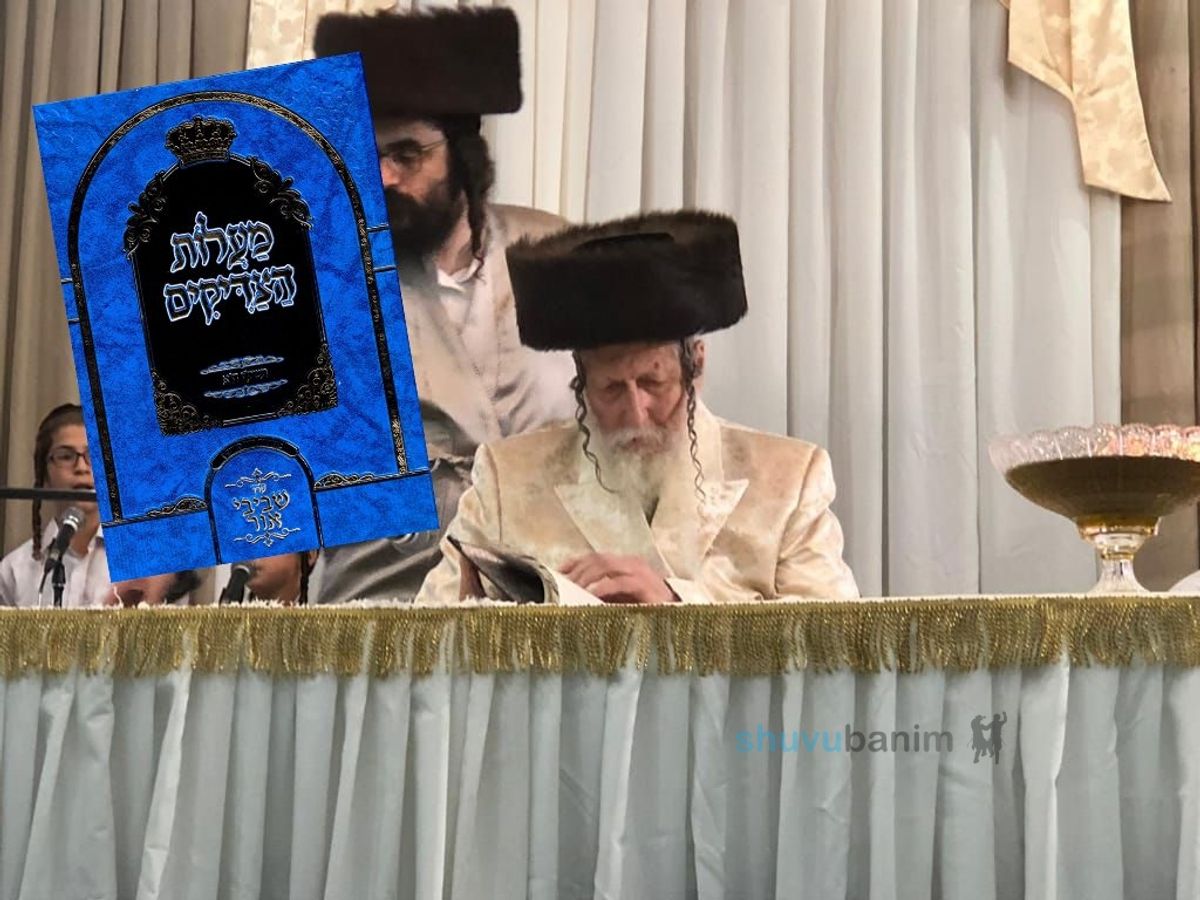
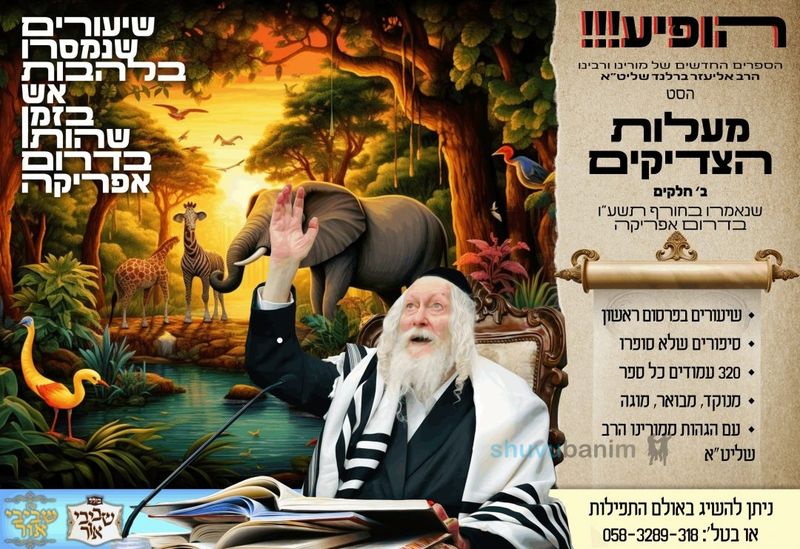
In recent days, the new book 'Ma'alos HaTzaddikim' (The Levels of the Tzaddikim) has appeared to the world, featuring the lessons of our teacher Rabbi Eliezer Berland shlit"a delivered during his stay in Johannesburg, South Africa, in the winter of 5776 (2016).
Before you is a taste from the new book—a lesson delivered on the Hiloula (anniversary of passing) of our Holy Rebbe in the year 5776:
"Or HaOros" (The Light of Lights)
Emunah (faith) ❁ Holiness and Purity ❁ Renewal ❁ Prayer with Intention ❁ and many more stories
A lesson delivered on Thursday, 18th of Tishrei 5776, the 3rd day of Chol HaMoed Succos, on the great Yahrtzeit (anniversary of passing) of our Holy and Awesome Rebbe.
With Hashem's help, now is the greatest miracle, today is the greatest day, greater than Rosh Hashanah, greater than Yom Kippur, today is the greatest day of the year, greater than the Day of Atonement, greater than Pesach (Passover), than the Seder night. This day includes the entire year, includes the Seder night, includes everything. This moment is the moment of Geulah (Redemption), from this moment... I hereby bind myself to Rebbe Nachman ben Simcha ben Faiga. Now Rebbe Nachman is here with us, and we must know that our Rebbe is alive and enduring. The Rebbe is not just a segulah (spiritual remedy), [1] the whole world wants to reach Rebbe Nachman—gentiles, Jews, everyone wants to reach Rebbe Nachman.
The Rebbe is Alive and Enduring
We must know that this is the greatest day of the year, greater than Yom Kippur, greater than Rosh Hashanah, greater than any intellect in the world. On this day, the Rebbe removes all the 'chitzim' (arrows)[2]. 'Chitzim' (arrows) has the gematria (numerical value) of 'Nachman'. 'Chetz' (arrow) is 98, plus the 'yud' and 'mem' (of the plural 'chitzim') which is 50, totaling 148 (the value of Nachman). It is written, "Until an arrow pierces his liver" (Proverbs 7:23). All the arrows that a person has swallowed, the Rebbe is the one who shoots these arrows. The Rebbe only wants shiflus (humility), only for us to be 'Ayin' (nothingness). The Rebbe knows that it is impossible to make us into 'Ayin' except by shooting arrows at us; one cannot reach 'Ayin' except through the arrows.
Holiness
For the Rebbe, no blemish of the Bris (covenantal purity) is relevant. The Sfas Emes zt"l had a student whom he sent to the grocery store. The student said to him, [How can I go to the grocery store, for] it is forbidden to enter the grocery store [lest I stumble in forbidden sights]. The Sfas Emes said to him: You cannot be my student if you are afraid to enter the grocery store. [Meaning, as long as he does not break this 'ruach shtus' (spirit of folly) of this trial, he cannot be his student]. So a person must know that this spirit of folly is removed on this day—the spirit of folly that entices a person toward forbidden sights and forbidden thoughts—it is all a spirit of folly.
Yosef HaTzaddik
[It is said in the Prophet regarding the brothers' sale of Yosef:] "For three transgressions of Israel, and for four, I will not revoke it: because they sold the righteous for silver, and the needy for a pair of shoes" (Amos 2:6). Did they not have shoes, [that they had to sell their brother to buy footwear]? {The Rav asks someone: Do you have shoes? Two pairs? Can you lend them to Yosef's brothers?} They were ten brothers, poor things, they didn't have shoes? They didn't have money to buy shoes? Were they poor? Why, each one had a hundred thousand sheep, and they didn't have money for shoes? Rather, until then they would walk without shoes because it is written in Psalms, "The King's Sanctuary," for the entire Land of Israel was the Beis HaMikdash (Holy Temple). It is written in 'Pelach HaRimon' that the entire Land of Israel was holy with the holiness of the Temple Mount, the holiness of the Courtyard, and the holiness of the Kodesh HaKodashim (Holy of Holies). [Therefore they walked barefoot and did not feel the thorns and briars at all. But once they sold Yosef, they fell from this level and no longer felt the holiness as before, and thus they needed shoes to protect their feet].
Now that we are here at this point, this is the Kodesh HaKodashim. Here we are in the Holy of Holies. The moment we speak of Rebbe Nachman, this place becomes the Holy of Holies. This is the place where the soul of Rebbe Nachman is drawn down now. And at the moment the Kohen Gadol (High Priest) enters the Holy of Holies, Rabbi Nosson says in Hilchos Gviyas Chov, Halacha 4, that from all the sins of the entire year, in that merit he enters the Holy of Holies[3]. In the merit of all the sins people stumbled in, people were turned into 'Ayin' (nothingness), because the moment a person does teshuvah (repentance), he turns into 'Ayin'. And through a person turning into 'Ayin', the Kohen Gadol can enter the Holy of Holies and draw down new perceptions, for on this day, new perceptions are drawn down that have never existed before.
Iron Combs
On this day, Hashem draws down new perceptions, as they said: "Things that were not revealed to Moshe Rabbeinu were revealed to Rabbi Akiva" (Midrash Rabbah Chukat 19)[4]. Meaning, in every generation, the tzaddikim are greater than the previous generation—things that were not revealed to Moshe Rabbeinu. Regarding Rabbi Akiva it is said, "He binds the streams from weeping, and the hidden thing he brings to light" (Job 28:11) [Avos D'Rabbi Nosson, Chapter 6]. So things not revealed to Moshe were revealed to Rabbi Akiva. (Megaleh Amukos, Ofen 72 and 173). The Megaleh Amukos explains[5] that Rabbi Akiva attained the 'Shin' of the Tefillin. It is written by a student of the Rashba in 'Minchat Yehuda' that everything Moshe attained is called 'Achurayim' (the Back), even the 'face to face' of Moshe is called 'Achurayim'. Only Rabbi Akiva attained 'face to face' in truth. Only Rabbi Akiva, who cried out 'Hashem Echad' (Hashem is One), merited to attain 'face to face' in truth. He saw Hashem face to face; he is within 'Hashem Echad'. He did not feel at all that they were combing his flesh with iron combs. Until a person is combed with iron combs, it is not called that he has attained Hashem.
Humility
All the lusts that a person falls into are only to lower a person's pride. But a person has infinite pride; a person is born with pride, and all his life he lives from pride, thinking he is the most important. The tzaddik nullifies his pride[6]. This is the entire work of the tzaddik, as Rebbe Nachman said, "I brought you a gift—machlokes (controversy/dispute)"[7]. The entire matter of the tzaddik is to nullify pride. The tzaddik nullifies the pride, and that is what this day is—the 18th of Tishrei—which is the true day of the creation of the world. This is the true day of the creation of the world, the 18th of Tishrei, for today is Chesed of Netzach (Kindness within Eternity).
For until now it was "His left hand is under my head"[8]. From Rosh Hashanah until the Ne'ilah prayer on Yom Kippur, it is "His left hand is under my head"—it is only Gevuros (judgments/severities). It is only the rectification of Rachel; for Rachel, the Gevuros are rectified. The woman is entirely Gevuros, and we must now draw down the Chasadim (kindnesses). So from the conclusion of Yom Kippur, we draw down the Chasadim. The 11th of Tishrei is Chesed of Hod, the 12th is Chesed of Netzach, the 13th is Chesed of Tiferet, the 14th was Chesed of Gevurah—and these are all internal lights. For until now [during the Ten Days of Repentance] we built Rachel but without lights, just building the skeleton, the stature. Now, in these four days from the 11th to the 14th, we drew down internal lights, so that one merits to feel Hashem internally. But the surrounding lights (Oros Makifim) are even greater. So internal lights for Rachel, and on the night of Succos when we entered the Succah, we drew down the internal Chesed of Chesed, and the surrounding Chesed of Chesed, for the Succah represents the surrounding lights.
A person must be entirely in 'lights', entirely surrounded by the light of Netzach (Eternity). Rebbe Nachman is Netzach, and one must be surrounded by the light of Netzach, to be surrounded every day by the lights of Rebbe Nachman. Rebbe Nachman can only enter when we are in shiflus (lowliness) and humility. Only when a person is pursued and humbled can the Divine light be drawn to him. Only when a person is pursued and everyone speaks against him. For the Rebbe says, "I brought you a gift—machlokes (controversy)." About me [they must dispute] from 'prizve' to 'prizve'[9]. The Rebbe said: They dispute about me from step to step, from bench to bench. A 'prizve' refers to the ledges or boundaries that separate the public domain from the courtyards. So the Rebbe says: from fence to fence, from prizve to prizve. The Rebbe brought the gift of controversy. The Rebbe said the greatest gift for a person is controversy. Reb Chaikel asked the Rebbe, "Rebbe, why do you bring controversy upon yourself?" Why?
Rabbi Chaikel
The Rebbe said to Reb Chaikel: You could be a Chazzan (cantor) such as has never existed[10], not since the creation of the world. The Rebbe wanted Reb Chaikel to be such a Chazzan, more than Sirota, more than all of them. Sirota went to sanctify Hashem's name in the end; he was in Uman, he was everywhere, he was the greatest world-class Chazzan. The Rebbe wanted Reb Chaikel to be the greatest Chazzan in the world. He had the power of melody (neginah)[11]. And when Rabbi Nosson visited him after Rebbe Nachman's passing, it was exactly during Chanukah. Reb Chaikel said: If I had listened to the Rebbe, I would now be going to collect donations, for the Chazzanim used to collect donations on Chanukah and Purim. They would go from house to house and be given a piece of cake and a cup of tea, and this one would give him two hundred rubles, that one two hundred grivnas. That was the work of the Chazzanim; the community didn't have money to support them. So on Chanukah and Purim they would go from house to house, and in every house they would give them a few coins. So Reb Chaikel said to Reb Nosson: If I had listened to the Rebbe, I would now have to go with a 'lantern' (a wind-lantern that protects the candle from being extinguished by the wind). Even today they call it a lantern. A wind-lantern is a lamp where you light a candle [and from the light of the candle it becomes a lantern]. So I would be walking with a lantern in the mud, in the rain, in the snow. Then Reb Nosson said to him: Until when will you lack emunah (faith) in the Rebbe? Even now [after the Rebbe's passing] you have no emunah in the Rebbe. The Rebbe wanted to make you the greatest Chazzan in the world, the greatest master of melody in the world.
Every single person who stands in the trial of holding fast to Rebbe Nachman—the Rebbe turns him into something that has not existed since the creation of the world. Everyone who holds fast to Rebbe Nachman through all the trials, the Rebbe slowly turns him into something that has not existed since the creation of the world, such a thing that has never been since the creation of the world.
For every soul is a completely new thing. It is a completely new thing. Every soul is a completely new thing that has not been since the creation of the world. [And even regarding the matter of reincarnations, it is not that this person descended again, but every person is completely new, rather it is a 'level' of the reincarnated soul, etc. (The Rav in his lessons)]. Only the Tzaddik can reveal this. No one can reveal the treasures hidden in every soul except the Tzaddik.
Iyov (Job)
Even of Iyov it is written, "A man pure and upright, G-d-fearing and shunning evil" (Job 1:1). It does not say 'Tzaddik', it says: "A man pure and upright, G-d-fearing and shunning evil." And 'G-d-fearing' is written [by our Sages] as being even more than Avraham Avinu[12]. He merited to reach levels higher than Avraham Avinu, but he did not know how to use it. "And I am dust and ashes"—he wants to be dust and ashes.
For seven sons and three daughters of Iyov passed away. What was his sin? This is a terrible and awesome thing! If, G-d forbid, one child passes away, it is already impossible to recover from it. But seven children at once?! One day the whole house falls in an earthquake, a storm wind knocks down the whole house, seven sons and three daughters [died on him]. What is happening here? Rather, he does not know what his tikkun (rectification) is. Iyov was the greatest in his generation, 'G-d-fearing and shunning evil'.
Moshe Rabbeinu says to the spies: You are going to the Land of Israel, see "if there is a tree (etz) in it or not" (Numbers 13:20). But did Hashem not tell Moshe it is a land flowing with milk and honey? One explanation is that they uprooted the trees. But in fact, there were trees all the time—a land flowing with milk and honey. [Rather] the meaning of 'tree' (etz) is Iyov. [And Moshe told them to check if Iyov was alive, for his merit would protect the gentiles so that the Children of Israel could not conquer them, and if Iyov was not alive, the Children of Israel could go up and conquer the land][13].
Now we are before the month of Cheshvan, the combination (tzeruf) of which is from the verse: "Look down from Your holy habitation, from heaven, and bless Your people Israel and the ground which You have given us, as You swore to our fathers, a land flowing with milk and honey (u'devash). This (ha'yom) day (ha'zeh) Hashem (Hashem)" (Deuteronomy 26:15-16). 'U'devash HaYom HaZeh Hashem' is the combination for the month of Cheshvan.
Now we are in Succos. We offer ninety-eight sheep sacrifices, fourteen every day. On the second day, we brought twelve bulls, and a person must believe that he brought twelve bulls, and yesterday thirteen, today eleven. On the Yahrtzeit of Rebbe Nachman, it is ten, corresponding to the Ten Commandments. Rebbe Nachman is ten times. Every day we reduce one bull, totaling seventy bulls[14], [corresponding to the seventy nations][15], because we pray for the whole world.
Praying for the Whole World
It is forbidden for any gentile to die. Here in Africa, there are 55 million blacks; there should have been a hundred million blacks here. If there were a hundred million, everything would already be different. We pray that no gentile should die. We say, "Remember us for life, King who desires life, and write us in the Book of Life for Your sake, Living G-d." And after that, we ask, "Who is like You, Father of Mercy, who remembers His creatures for life in mercy." It is forbidden for any gentile to die. Amaziah threw ten thousand Edomite gentiles off a cliff[16], so Hashem said: Now you shall go into exile[17]. You have no permission to kill any gentile, nor to pray for any gentile to die[18].
In the time of Avraham Avinu, no ship sank in the sea[19], no airplane fell |[20]|, no gentile died, no ship sank—"And in you shall all the families of the earth be blessed." A person in his prayers must pray for the entire world. Therefore, the second request [added during the Ten Days of Repentance in the Shemoneh Esrei is:] "Who is like You, Father of Mercy, who remembers His creatures for life in mercy." One must pray for all the gentiles, for all the nations of the world. Beloved is man, for he was created in the Divine image. Every gentile has some Divine spark; we must know how to reveal that spark. But this is only through the Tzaddik. A person by himself cannot reveal the spark that exists in all creatures. There are seven billion gentiles; if there were 14 billion, then a flight to Uman would cost 50 dollars |[21]|. So we must pray for the entire world, we pray for the entire world, we pray for all the gentiles.
The Study of Gemara Surpasses Everything
And now that we reach the Yahrtzeit of Rebbe Nachman, for Rebbe Nachman is alive and enduring. We do not travel to Uman for a 'segulah' (remedy). The Rebbe says: I am standing in the next room and hearing you; I am like a person who moved from one room to another[22]. The Rebbe is alive and enduring. The Rebbe said that if a person does not study Gemara (Talmud), he cannot attain any perception. If a person does not study Gemara, he can travel to Uman a million times and nothing will move for him. The Rebbe says [in Torah 8, Part II] that being saved from evil thoughts is only through the study of Gemara[23]. A person has a brain, called the 'skull of the mind', and a person needs to fill the three chambers of the brain with Torah, to fill them with fear of Heaven.
The Rebbe says in Torah 12 that from studying Chumash (Pentateuch) alone, a person does not become a scholar[24]. Likutey Moharan is like studying Chumash, for in Likutey Moharan, every letter contains awesome secrets[25]. But how does one reach these secrets? Only if a person studies Gemara. A person cannot understand the secrets in Likutey Moharan like Torah 21 |[26]|. The Rebbe says that the Succah is the lighting of the Menorah. The Rebbe says that the seven days of Succos, which are the seven handbreadths, correspond to the seven branches of the Menorah—this is the Divine flow (shefa). The Kohen Gadol draws down the Divine flow for us[27].
According to the Rambam, the Menorah is lit twice. Everyone disputes the Rambam[28], but the Halacha (law) in the future will be like the Rambam. Mashiach will rule like the Rambam. The Menorah is lit twice. In the Menorah there are seven branches. On Chanukah, they lit fifty-six candles, the numerical value of 'Yom' (Day). 56 candles. According to the Rambam that they light twice, twice fifty-six is one hundred and twelve, the gematria of 'Baki' (expert) and 'Yabbok' (the river). For when traveling to Uman, one must pass through Kiev. Why? Because it contains the letters of 'Yabbok'. So the agents must arrange it specifically through Kiev since it is the number of 'Yabbok', the letters of 'Yabbok'.
Renewal
The Rebbe says that the entire work of a person is not to fall from any fall[29]. The entire work of a person is to always start anew, to always start completely anew.
And Iyov did not know what his tikkun was. Iyov could have been the greatest in his generation, as it is written, "Is there a tree (etz) in it or not" (Numbers 13:20). Moshe says to them: If Iyov is alive, it is impossible to conquer the Land of Israel (as mentioned above). It is impossible to understand this. Moshe walks with the Clouds of Glory, with seven Clouds of Glory, Manna from heaven, the Well of Miriam, and he says we cannot conquer the Land of Israel if Iyov is alive. "There was a man in the land of Uz, whose name was Job; and that man was pure and upright, and one that feared G-d, and shunned evil" (Job 1:1). Greater than Avraham Avinu[30]—he is not greater than Avraham Avinu, but things are written about him that are not written about Avraham Avinu.
Do Not Complain
For Iyov was Terah[31]. Why? Because the Pesikta (47) says that if Iyov had not complained about his suffering, they would say: "The G-d of Avraham, the G-d of Yitzchak, the G-d of Yaakov, and the G-d of Iyov"[32]. If a person does not complain about the suffering he has—"Why should a living man complain" (Lamentations 3:39). On the day he is alive... people can live forty days without food. If there is water in the taps, a person can live even a whole year. There was one who lived a whole year only on potato soup |[33]|.
So we know that the Rebbe reveals our tikkun to us. For a person can be like Iyov, 'a man pure and upright, G-d-fearing and shunning evil', and he does not know what his tikkun is. [Even though his merit is so great that] he protects the Land of Israel, he protects the gentiles, protects the nations of the world. But regarding the Jews, he said to destroy them. In the Gemara it is written that he remained silent during Pharaoh's counsel[34], but the Zohar says he did not remain silent[35]. He said: It is permitted to enslave the Jews and they can be made to do backbreaking labor, while Bilaam said they must be eliminated and destroyed. So Iyov said no, not to destroy [only to enslave]. Yitro [who was also Pharaoh's advisor] fled. Yitro said it is forbidden to touch the Jews, and they wanted to kill him, so he fled. Bilaam said to destroy the Jews. They (Iyov, Yitro, and Bilaam) were the three advisors.
According to the Gemara that says Bilaam was Pharaoh's advisor, this does not align with the Midrash of "Men of blood and deceit shall not live out half their days." [That Bilaam lived less than 35 years][36], for the decrees [and the enslavement of the People of Israel]
in Egypt, as explained at the beginning of the Book of Exodus, began eighty-three years before the Exodus from Egypt. [And since Bilaam died at the end of the forty years that the Children of Israel were in the desert, according to the opinion that he lived 35 years, he certainly did not live 123 years earlier and advise Pharaoh to enslave the Children of Israel. But according to the opinion that he was Pharaoh's advisor, he certainly lived more than 123 years].
Three and a third years before Moshe was born, when Miriam was three years old, the decrees began [in Egypt]. Therefore they called her Miriam after the 'bitterness' (merirut)[37], for Amram saw that there were going to be terrible decrees. But Amram could have nullified the decrees. Miriam said to him: Father, you can nullify the decrees.
Miriam [at that time] was a five-year-old girl, and when Moshe was born she was six, and when Moshe passed away she was one hundred and twenty-six. And Yocheved was still alive. Yocheved saw three children (Miriam, Aaron, and Moshe) pass away in one year—Miriam on the tenth of Nisan, and after that Aaron on the first of Av[38].
Only for Aaron is the Yahrtzeit written in the Torah. Not for Moshe Rabbeinu—we know [he passed on] the 7th of Adar, some say the 7th of Shevat[39], we say the 7th of Adar. But no Yahrtzeit is written in the Torah. In the entire Tanakh (Bible), there is no Yahrtzeit, not even for King David which is Shavuos, only for Aaron. Why? Because Aaron went from house to house. Aaron went from house to house to make peace and to teach the children. He saw children not learning, and he learned with them. Aaron sacrificed himself to go from house to house, from tent to tent—there were no houses, there were tents, it was in the desert. And also before that, when they were still in Egypt, he went from house to house to teach children |[40]|.
There is No Advice Except the Study of Gemara
Without the study of Gemara, all that we speak of, all that we perceive—there are no vessels for the lights. A person cannot fight against evil thoughts except through the study of Gemara. Even if he travels to the Tziyun (the grave in Uman) a million times, it will not help him. The Rebbe said[41] that only through the study of Gemara can a person fight against bad thoughts. To fight against bad thoughts is only through the study of Gemara, to fill the mind with the study of Gemara, with Ktzos HaChoshen, Nesivos HaMishpat, Tokpo Kohen—a person must study Gemara.
A woman [to purify her mind] needs to study the Halachos (laws) and the Midrashim. She is exempt from Gemara, but she needs to study the stories in the Gemara. 'Menoras HaMaor' collects stories, 'Tze'enah Ure'enah' collects all the stories—this is a work from four hundred years ago. Tze'enah Ure'enah contains all the stories from the Gemaras and Midrashim. They wrote it in Yiddish, but now it has been translated into Hebrew. A woman needs to know all the Midrashim, all the stories.
How they entered the Land of Israel, when Moshe said that in the Land of Israel there would be no Clouds of Glory. Moshe Rabbeinu informed everyone immediately upon leaving Egypt that here there would be no Clouds of Glory. There would be no Clouds of Glory in the Land of Israel, so everyone was terrified. The spies said: We are not entering. The spies went on strike. I remember that I was one of the spies. They said: Moshe, without Clouds of Glory we do not agree to enter, we are striking, we are not entering. But they did not know that "From heaven the stars fought, from their courses they fought" (Judges 5:20).
Stars descended at the moment Devorah the Prophetess was there. Devorah was just a woman, she was not a man. How do we listen to a woman? "If your wife is short, bend down and whisper to her." But for the entire People of Israel to follow a woman? We never heard of such a thing. So she said: Zevulun and Naphtali are simple/pure. [And she told them Hashem's command to fight Sisera, and they listened to her and went out to a war that naturally they could not win, and the stars of heaven descended and helped them and they defeated Sisera's entire army].
Insights and Comments:
[1] (Everyone is staying here, that's it, we are staying here now for three years, from here we will manage everything. We will set up a travel agency here and every day we will fly a million people to Uman. There are seven billion people in the world, so we need seven thousand planes, seven thousand trips, every week a million people. We are now opening 'Cosmos Shuvu Banim'. Before it was 'International Shuvu Banim', now it will be 'Cosmos Shuvu Banim' Space—Shuvu Banim in space. With Hashem's help, from now on we are flying a million people, a million people flying now, every day a million people.)
[2] Sippurei Ma'asiyot (Rebbe Nachman's Stories) - Story 13.
On the sixth day they were also happy. And they were longing: How do we take that one who was without hands? And behold he came and said, "Here I am!" ... For once we sat together, some men. And each one was boasting of the power in his hands: this one boasted he had this strength in his hands, and that one boasted he had that strength in his hands. And so each one boasted of the strength he had in his hands. (That is) for one boasted he had such power and strength in his hands that when he shoots an arrow he can turn and pull it back to him. For he has such power in his hands that even though he already shot the arrow, he can still return it and pull it back to him. And I asked him: Which arrow can you return? For there are ten kinds of arrows, because there are ten kinds of potions. That is, when they want to shoot an arrow they smear it with some potion. And there are ten kinds of potions. When smeared with this potion it harms thus, and when smeared with a second potion it harms more, and so there are ten kinds of potions, each one worse than the last. (Meaning it harms more). And this itself is the ten kinds of arrows. For the arrows are of one kind, only because of the change in the potions they are smeared with, which are ten kinds as mentioned, therefore they are called ten kinds of arrows. And therefore he asked him which kind of arrow he can return. He also asked him if before the arrow reached the one it was shot at he could return it, and if even after the arrow reached him he could still return it. To this he replied: Even when the arrow has reached, he can still return it. But which kind of arrow he can return etc. as mentioned, he replied: Such and such a kind of arrow he can return. I said to him: (That is, the one without hands who tells all this, said to the one who boasted about the arrow as mentioned) If so, you cannot heal the King's daughter, since you cannot return and pull back except for one kind of arrow. Therefore you cannot heal the King's daughter.
[3] Likutey Halachos, Choshen Mishpat, Hilchos Gviyas Chov Mi'Yetomim, Halacha 4.
And this is the essence of the length of this bitter and long exile, and the Geulah (Redemption) depends only on teshuvah, which is Vidui (confession) before the Torah scholar, which is the essence of teshuvah. Through this, the Malchut (Kingship) is raised to its root, and then the Kingship will return to the House of David and our righteous Mashiach will rule over us, which is the Kingship of Holiness. And therefore the wicked kingdom of Greece intensified then to nullify the Torah from Israel, G-d forbid, in order to strengthen the power of their wicked kingdom as mentioned. And Hashem in His abundant mercy stood by us in all our troubles and performed a great and awesome miracle for us, and a few men from the Hasmonean house stood up and defeated them and subdued and toppled the wicked kingdom and strengthened the Kingship of Holiness. And therefore the rectification of the miracle was through a flask of oil they found sealed with the seal of the Kohen Gadol etc., for the Greeks, who are the wicked kingdom, defiled all the oils—the aspect of the holy anointing oil which is the Da'at (knowledge/intellect). And then it is impossible to be included and nullified in the light of the Infinite (Ein Sof), for any stranger or impure person cannot enter and be included there. And the miracle was through the jug of oil of the Kohen Gadol. This is the aspect that the essence of the miracle and salvation of Chanukah was that they subdued the wicked kingdom and toppled them with a great fall until it is drawn upon us every year that we too should have the power to subdue them and humble them and topple them.
The essence of the strength of this miracle is performed every year by the true Tzaddikim of the generation who bring people closer to Hashem and instill in them thoughts of teshuvah until they confess with Vidui before them. And through them, a great and awesome light is drawn to all of Israel until they all know Hashem from the small to the great. Just as He did for our fathers in those days at this time, a wondrous and awesome miracle through the little oil of the Kohen Gadol that was sealed with his seal. That is, for the Kohen Gadol is the aspect of the great true Tzaddik who has the power to raise all the Vidui of Israel and to ascend and enter and be included through this in the place where he enters and is included, namely in the Holy of Holies where the point of the Foundation Stone (Even Shetiyah) is, upon which the Ark and the Cherubim stood, and there he is included in the Infinite, in the 'Will of Wills' (Ra'ava d'Ra'avin) as mentioned. But the Kohen Gadol did not have the power or permission to enter there except once a year on Yom Kippur through the power of the Vidui he confessed first for all of Israel over the bull and the scapegoat, and 'with this shall Aaron come into the Sanctuary'. For it is impossible to enter there to the Holy of Holies to the aspect of Ra'ava d'Ra'avin where the light of the Infinite opens, as it is written, "And I will meet there with the Children of Israel etc." except through the Vidui he confessed first three times, as explained in the portion there. For all of Israel also confessed then on Yom Kippur, for then it is a commandment from the Torah to confess with a full mouth, and especially at the time the Kohen Gadol confessed and mentioned the Honored and Awesome Name, when they would bow etc. and then they would confess, as explained in the words of our Sages of blessed memory. And the Kohen Gadol in his great strength had the power through the confessions he made to lift and raise all the confessions of Israel so that it would be considered as if they confessed before the Torah scholar and similar to what our master and teacher (Rebbe Nachman) of blessed memory wrote on what our Sages said: Who caused Reuben to confess? Judah etc. for because Moshe mentioned the confession it was considered as if he confessed before him, see there. It follows that the power of the Kohen Gadol to enter the innermost sanctum to the aspect of Ra'ava d'Ra'avin was through Vidui, for through this specifically he is included in the Infinite in the aspect of Ra'ava d'Ra'avin as mentioned.
[4] Midrash Rabbah Numbers - Parsha 19, Section 6.
[5] Megaleh Amukos on the Torah - Parshat Vayikra.
[6] Likutey Moharan Part I, Torah 10, Section 5.
And the advice given to nullify pride, which is idolatry, as it is written (Proverbs 16): "Every proud heart is an abomination to Hashem" (as our Sages expounded in Sotah 4b), the essence is through drawing close to the Tzaddikim...
[7] Siach Sarfei Kodesh - Part VI, 27.
As is known, immediately upon Rebbe Nachman's return from the Land of Israel and his settling in Zlatipoli, a great controversy arose against him and our people... and Rebbe Nachman then said wittily to our people: I brought you a gift (from my journey)—the controversy.
[8] Sha'ar HaKavanos - Rosh Hashanah, Drush 1.
[9] Siach Sarfei Kodesh Part II, 141.
Once Reb Chaikel turned to Rebbe Nachman and said: Rebbe, I would like to ask you a question, but I am afraid to ask. Rebbe Nachman asked him: "What are you afraid of?" Reb Chaikel replied: "I am afraid that perhaps the Rebbe will say: Chaikel, die, and I will die..." Rebbe Nachman said to him: "Ask, ask!" And he asked Rebbe Nachman: "Why do you cause controversy for yourself? In Zlatipoli you entered to live in the city without asking permission as is customary, and because of that the controversy arose against you there, and in Breslov you caused controversy for yourself with the Holy Rav Rabbi Baruch of Mezhibuzh." Rebbe Nachman answered him: "It is good that you were careful... To carry out my matter is not only from one city to another city, but even from one 'prizve' (ledge/boundary) to another, as long as I carry out my matter."
[10] Siach Sarfei Kodesh - Part II, 222.
As is known, Rebbe Nachman wanted Reb Chaikel to leave all his business and accept a position as a Chazzan (cantor)... and when Rebbe Nachman told him this, he said to him: "If you travel with me to Breslov, you will be a 'chiddush' (novelty) in your matter, namely in Chazzanut, just as I am a 'chiddush' in my matter."
[11] Siach Sarfei Kodesh - Part V, 68.
[12] Bava Batra 15b.
Rabbi Yochanan said: Greater is that which is said of Job than what is said of Abraham, for of Abraham it is written: "For now I know that you are a G-d-fearing man," but of Job it is written: "A man pure and upright, G-d-fearing [and shunning evil]."
[13] Bava Batra 15a.
Rava said: Job was in the days of the spies... Moshe said to Israel: Is that man still there, whose years are long like a tree (etz) and who protects his generation like a tree?
[14] First day of Succos 13, 1st day of Chol HaMoed 12, 2nd day of Chol HaMoed 11, 3rd day of Chol HaMoed – Rebbe's Yahrtzeit 10, 4th day of Chol HaMoed 9, 5th day of Chol HaMoed 8, Hoshana Rabbah 7 = 70.
[15] Succah 55b.
Rabbi Elazar said: These seventy bulls, corresponding to whom? Corresponding to the seventy nations.
[16] II Chronicles Chapter 25.
[17] Midrash Rabbah Lamentations - Introduction, Section 14.
[18] And so we find in Berachos 7a.
A certain Sadducee who lived in the neighborhood of Rabbi Joshua ben Levi used to trouble him much with verses. One day he took a rooster and placed it between the legs of the bed and watched it. He thought: When that moment comes, I will curse him. When that moment came, he fell asleep. He said: Learn from this that it is not proper to do so, for "His mercies are over all His works" is written, and it is written "To punish the righteous is also not good."
[19] Yalkut Shimoni, Parshat Lech Lecha, Remez 65.
[20] Here dozens of airplanes fall a day, only when a jumbo of four hundred people falls do they publicize it, but every day dozens of airplanes fall. In the time of Avraham Avinu no ship sank.
[21] I don't know if one can profit from this... it would be possible to travel for 50 dollars to Vinnitsa, the agents just suck the blood of the people, just dragging money... but for this there needs to be not 7 billion but 14, it's a simple calculation, one could transport a billion people...
[22] Sichot HaRan (Rebbe Nachman's Wisdom) Section 156.
He said then: But by the Tzaddik one does not need to fear that perhaps he is not there. For the death of the Tzaddik is only like one who goes from one room to another room. And he then gave a parable to his daughter about himself: Just as I am now in this room and afterwards I go out of this room and enter the second room and close the door behind me. If you come to the door and cry "My father, my father" etc. will I not hear your words?! Words like these were heard from his holy mouth several times, hinting to each and every one how great is the level of one who merits to come to his holy and awesome grave. For he will certainly hear his words and help and save him in whatever is possible.
[23] Likutey Moharan Part II, Torah 8.
And to come to this, to separate and distinguish and nullify the evil from the good, is through Torah and prayer. And the study of Torah should be to 'dwell in the depth of the Halacha', namely to study the Poskim (codifiers). For in the Torah there is a grasp of good and evil... and as long as he does not clarify the Halacha, he mixes good and evil... until he investigates and clarifies the Halachic ruling and clarifies the forbidden and permitted etc., namely through the study of Poskim, then he separates the good from the evil.
[24] Likutey Moharan Torah 12.
What we see, that for the most part the 'scholars' dispute the Tzaddikim and speak against the Tzaddik with pride and contempt, this is a great intention from Hashem... and it is known that one is not called a Torah scholar except through the Oral Torah, for he who knows how to study Chumash is not called a Torah scholar, but rather he who is expert in Gemara and Poskim. And when he studies without Da'at (knowledge/holy intent), he is called 'Lavan' (the Aramean), after the cunning that enters him, and he hates and pursues the Tzaddikim...
[25] Chayei Moharan Section 348.
(9) He said: In my Torah there is depth. And see what was recorded elsewhere that what was written in his language one must be precise with it as with the Scripture. For he repeats his words every time which seemingly looks like extra language, but it is with great intention. And one must be very precise with it etc.
[26] I studied Torah 21 with the Rebbetzin, then I began to understand a little something.
[27] Likutey Moharan - First Edition, Section 21.
[28] Siach Sarfei Kodesh Part II, 56.
Rebbe Nachman said: "Even though in the future, when they need to know some Halacha, they will open and look in the Rambam, nevertheless in the book 'Guide for the Perplexed' and the philosophy he composed, it is forbidden to look."
[29] Cited many times, among them Likutey Moharan Torah 155.
And this is the aspect of 'Arich Apayim' (patience), namely that he is not afraid of anything, and does not pay attention to any nullification or confusion in his service, but just does his part, this is the aspect of Arich Apayim. That nothing can confuse him, for he doesn't care about anything, just does his part in his service of Hashem.
[30] Bava Batra 15b.
[31] Sha'ar HaGilgulim, Introduction 36.
The root of Terah the father of Abraham: Terah, Job, Avidan in the days of Rabbi Yehuda HaNasi, Ibbu from the side of the Nefesh. Avimi from the side of the Ruach, Nachum Ish Gam Zu from the side of the Neshamah.
[32] Pesikta Rabbati Parsha 47.
[33] There was one who saved from Social Security in the US thirty years ago... they wanted to deposit it and asked if he had other income, he said no, I only eat potato soup, I buy potatoes and make soup and that's what I eat. The Rebbe said "Bread with cucumber is also good" [Meaning to live on these foods is also good, and one needs no more than them to exist]. "And borscht (beet juice) with cucumbers," so this is the healthiest food in the world, a person can be healthy just from borscht, just from an omelet, it takes away the cholesterol and heals all the diseases in the world. Here there are no beets, but if there are beets one can heal all the diseases in the world.
[34] Sotah 11a.
Rabbi Hiyya bar Abba said in the name of Rabbi Simai: Three were in that counsel: Bilaam, Job, and Yitro. Bilaam who advised was killed; Job who remained silent was judged with suffering; Yitro who fled merited that his descendants sat in the Hewn Chamber (Sanhedrin).
[35] Zohar Part II, 33a.
And everything came with judgment. As he judged, so he was judged. Because Job was among Pharaoh's close advisors, and when Pharaoh rose against Israel, he wanted to kill them. Job said to him: No, rather take their money and rule over their bodies with hard labor, and do not kill them. Hashem said to him: By your life, by that very judgment you shall be judged. What is written? (Job 2) "But put forth Your hand now, and touch his bone and his flesh etc." As he judged, so he was judged. And even though in all else he feared Hashem.
[36] Sanhedrin 106b.
A certain heretic said to Rabbi Hanina: Have you heard how old Bilaam was? He said to him: It is not written, but since it is written "Men of blood and deceit shall not live out half their days," he was thirty-three or thirty-four years old. He said to him: You have said well, for I saw Bilaam's notebook and it was written in it: Bilaam the lame was thirty-three years old when Phinehas the robber killed him.
[37] Yalkut Shimoni Exodus Chapter 2, Remez 165.
[38] Ramban Genesis Chapter 46, Verse 15.
[39] Yalkut Shimoni Exodus Chapter 16, Remez 261.
[40] They arrive here, ninety percent have a 'black visa' but slowly we will see maybe we will cancel it, so ninety percent don't merit to arrive at all, but whoever manages to arrive then he needs to see to learn with the children, with the boys. Now on Shabbat 5:45 is sunrise and 6:10 is sunset, so it's almost twelve and a half hours of day, one can finish twelve pages of Gemara every day, take the children and learn pages of Gemara with them.
[41] Likutey Moharan Part II, Torah 8.
(2) ...And from this comes, G-d forbid, the lust for adultery, for the mind is a partition spread before this lust, for 'a person does not commit a transgression unless a spirit of folly enters him' (Sotah 3), but when the mind and knowledge are complete, it protects against this lust.
Before you are the words of our teacher Rabbi Eliezer Berland shlit"a written in the introduction to the book:
INTRODUCTION TO MA'ALOS HATZADDIKIM — 5776
It is an obligation for every Jew to purchase the book 'Ma'alos HaTzaddikim 5776', which contains words of Torah that have never been heard before, in the aspect of a 'new garment'. Such innovations have not been heard since Moshe Rabbeinu received the Torah at Mount Sinai. Therefore, it is an obligation for each and every one to purchase this book and to meditate on this book day and night = 177, until all the words of Torah in this book are ingrained within him and in his mind, and he shall not lack any word or any letter from the words of this holy and awesome book. For all its words are the words of the Living G-d, and it is forbidden to omit any word, any term, or any letter.
And in the merit that every person will meditate on this book day and night, all the judgments in the world from all reincarnations will be sweetened for him, and he will merit to see the consolation of Zion and Jerusalem, and the building of the Third Holy Temple which will be a Temple of Fire, and the building of Jerusalem the Holy City and the consolation of Zion. And he will merit to see Mashiach ben David in all his glory and honor. And in this merit—in the merit of reading this book—we shall merit the complete Geulah (Redemption) speedily in our days, Amen, Netzach, Sela, Va'ed.
With the blessing of the Torah and with great love,
Eliezer Berland
Subscribe to Our Newsletter
Receive Torah articles and inspiration directly in your inbox