When You Overcome, the Whole World Overcomes With You | The Daily Chizuk from
the Gaon and Tzaddik, Rabbi Eliezer Berland shlit"a
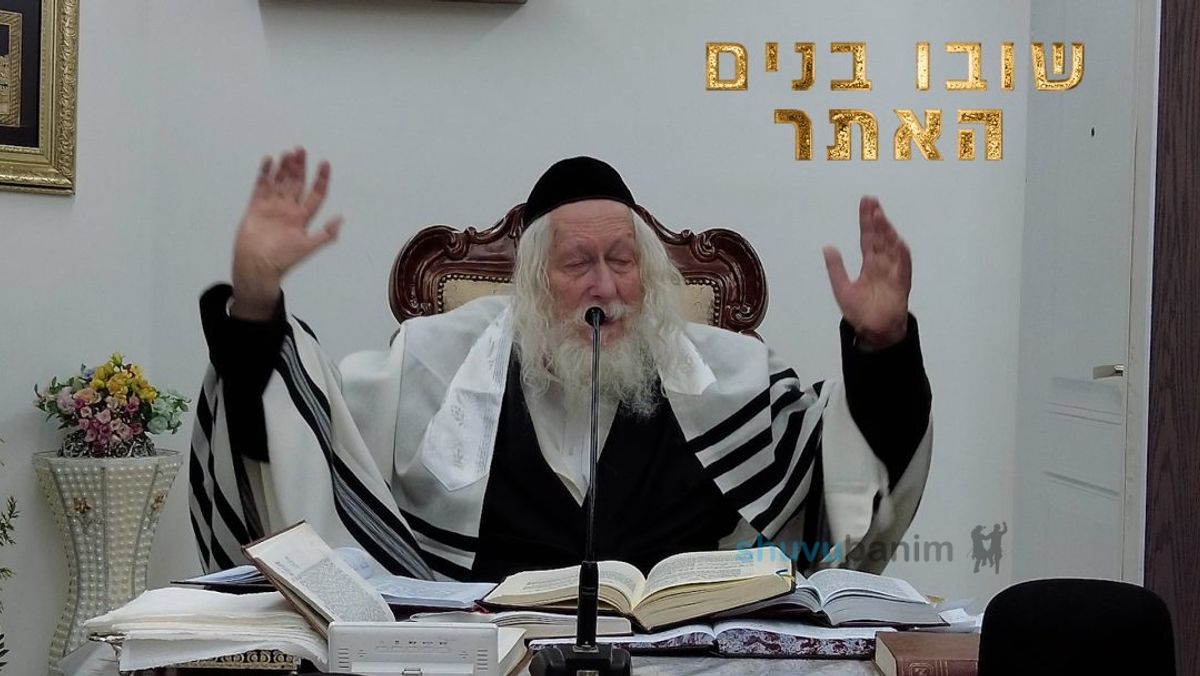
The Daily Chizuk (strengthening) from our teacher, the holy Gaon and Tzaddik, Rabbi Eliezer Berland shlit"a (may he live long and good days) – "Even if Hashem tells you that a stone will give birth, believe that a child will emerge from the wall"
Why Didn't Sarah Want to Return to Age 12?
Tuesday, 30th of Kislev 5785 – "The entire purpose after the sin of the Tree of Knowledge is to break this desire"
These are his holy words:
In Parshas Vayera (the Torah portion of Vayera), there are a million difficulties; this is the hardest of all the portions. There are endless questions here—why is Sarah laughing here?
Abraham says to her, "You know, Sarah, Hashem (God) revealed Himself to me and told me that from today your name will be Sarah. This is a true prophecy, I’m telling you, a very, very true prophecy."
Sarah: "What? Explain to me why?"
"Because you will have a son!"
"A son? Mazel Tov (congratulations), Mazel Tov!" She dances, she jumps—a woman of 89, 90 years old. After three days, three men (the angels) arrive and say to Sarah, "You will have a son." Sarah started to laugh. What?
https://vimeo.com/1043029284?share=copy
At first, she thought it was just an imagination, but now after all this, all these promises and prophecies, Sarah already understands that this is a prophecy of truth. So what is there to laugh about? Why is Sarah laughing at all? What is there to mock? After all, it is written: even if a gentile tells you that your prayer will be accepted, say "Amen." You travel with a gentile taxi driver to the Kotel (Western Wall) to pray, and he says to you, "May the prayer be accepted," say "Amen." What does it matter? It is written that it doesn't matter if a gentile or an Amalekite blesses you—if he says your prayer will be accepted, say "Amen."
Why does Sarah have anything to laugh about? Even if she didn't know she would have a son, she should believe that Hashem can do anything, but all the more so when they tell her she will have a son!
The Ha'amek Davar (Torah commentary) says: even if Hashem tells you that a stone will give birth, believe that a child will come out of the wall. So what is Sarah laughing at? "Is anything too hard for Hashem?" (Genesis 18:14).
In truth, Sarah laughs because she is becoming a young girl, and she will have "ednah" (rejuvenation), and only then will she give birth. When Sarah understood that the birth would be through natural means, she was amazed that she saw no change in Abraham's face.
"And she laughed"—what is she laughing about? The Meor Vashemesh (Chassidic work) says: she is laughing completely, saying, "Why did Hashem make me a young girl? I want to give birth at age 90!"
And the Heichal HaBracha (Komarno Rebbe) explains this: Sarah did not laugh at the news of the son; she already knew about that two days prior. She already knows she will have a son—it's clear she will have a son. Rather, suddenly her "dam niddah" (menstrual cycle) returned, and she returned to the days of her youth. She said, "Master of the World, why are You doing this to me? I don't understand this. I am already 90 years old; I have already moved past these follies—from this ta'avah (physical desire). This is the most terrible of all desires. Because of this desire, children are born with defects, and one has to go to the hospital with them, because a person is immersed in this desire."
It is written in Shivchei HaRan (Praises of Rebbe Nachman) that it is impossible to pull people out of this desire. People are immersed in desire; they wait from age 3 to get married, thinking everything is permitted, not understanding that then children are born with defects and weak, half-blind and half-deaf, and they don't understand why. A person is composed of a trillion parts, and it's enough for one small part not to work—Sarah laughed at this: "Why is Hashem making me a young girl of 12?"
It is written in Shivchei HaRan that it is impossible to pull people out of this desire. We try to explain to them: behave with kedushah (holiness), behave with tzniut (modesty). What? They don't grasp what you are saying to them! This is their whole purpose! They think this is why they were born! This is why Hashem created them!
Rabbeinu (Rebbe Nachman) said in Shivchei HaRan that it is impossible to speak of this with people, because people are immersed in these things from age 3 and have become coarse, waiting for this moment. They think, "Now if I am already married, then everything is permitted," and they don't understand why afterwards children are born with defects—it is written that there is no difference between before the wedding and after the wedding; one must feel the pain of the Bris Milah (circumcision) during the time of yichud (intimacy). They don't know at all that it is possible to despise this, to nullify it. The secular are immersed in this 24 hours a day, but in truth, even the gentiles can get out of it. In Korea, there are 5 million couples who do not touch each other; that is the condition of the marriage. Because the "Chacham HaEmet" (True Sage) knows how to despise this desire with the ultimate loathing—that which for a person is the ultimate desire, the ultimate pleasure, the ultimate life.
So the Rebbe says that this is the ultimate loathing; the Rebbe says to despise this desire with the ultimate loathing. The Rebbe spoke about this very, very much; it is impossible to explain how much the Rebbe spoke about how to despise this, to despise it with the ultimate loathing. For the True Sage, this is not considered a trial at all—everyone should read Shivchei HaRan (sections 16, 17) every day with his wife. The Rebbe had trials and he stood up to all of them.
This is what the Heichal HaBracha explains—that this was Sarah's laughter: suddenly she becomes a young girl. "What, I'm becoming a young girl? I already got out of this, and You are bringing me back to it?"
On this, the Kedushas Yom Tov (Rebbe of Sighet) says that Hashem has enough angels—Hashem has billions of angels—but the whole point after the sin of the Tree of Knowledge is to break this desire; that is the whole purpose of a human being. Angels don't need to fight this desire; they have no desire. But a human being, after Adam HaRishon (the first man) sinned with the Tree of Knowledge—and he sinned with the Tree of Knowledge specifically to come to a "birur" (clarification/refinement).
Hashem has enough angels. The Rambam (Maimonides) writes that a "Chassid" (pious person) is only one who has no desires at all. On this, it is written "Tzaddik Elyon" (Upper Tzaddik) and "Tzaddik Tachton" (Lower Tzaddik). Because we finish the Shas (Talmud) with 310 worlds, and we finish Tractate Bava Metzia also with 310 worlds. Rabbi Naftali Katz zt"l, whose yahrtzeit (anniversary of passing) will be on the 24th of Teves, says there is a Tzaddik Elyon and a Tzaddik Tachton, while in the middle there is "Yereq" (greenery). "Yereq" (numerical value 310) is the 310 worlds. How does one merit the 310 worlds? How does one pluck the "Yereq"?
Rabbi Meir says that the "Yereq" belongs to the "Elyon" (Upper). What is "Elyon"?
There is a Tzaddik who has no desires; he has already left them—a Tzaddik like Rabbeinu who nullified everything. But there is a Tzaddik who struggles for all 120 years—shmiras einayim (guarding the eyes) and not looking, and every time his Yetzer Hara (evil inclination) awakens anew—he is called a "Tzaddik Tachton" (Lower Tzaddik).
Rabbi Meir comes and says that the "Yereq," the 310 worlds, will be merited only by a Tzaddik Elyon. But who can be a Tzaddik Elyon? That is only Rabbeinu! The Tzaddik before whom everyone passes on Rosh Hashanah night—everyone passes—this is a Tzaddik in the aspect of Leah; this is a Tzaddik who has no desires, he nullified the desires. Rabbeinu said, "I had trials and I had desires, but I nullified everything." I nullified everything with the ultimate, ultimate loathing; with the ultimate loathing I nullified it. The Rebbe never sat with his wife, except once on the Seder night. Reb Noson says, "I was just passing by and I managed to see the Rebbe, how he was glowing and flaming; his face was shining like the sun."
So the Rebbe nullified it completely; therefore the Rebbe is called a Tzaddik Elyon. But Rabbi Naftali Katz says that a Tzaddik Tachton is a Tzaddik who struggles all day, practicing shmiras einayim and not looking in the street. A certain Tzaddik would walk with open eyes; he said, "I don't see anything." The person with him said, "Guard your eyes." He answered, "I don't see!" A person can walk with open eyes and see nothing; he doesn't need to see—if his mind is busy with Torah, with prayer, he sees nothing. To be without a Yetzer Hara is for angels; angels are without a Yetzer Hara. The Rambam says that a true Chassid is one who has no inclination for evil at all, but what is the greatness in that?
We need to break the Yetzer Hara; our whole work is to fight with this Yetzer Hara, to teach the woman to fight it, and the woman also wants to fight it. In Tractate Avodah Zarah, the Rambam brings that the true Chassid is one who has no desire at all; this is called a Tzaddik Elyon.
In the Eight Chapters of the Rambam, Chapter Seven, the Rambam speaks about what a Chassid is. He says that a Chassid is a Tzaddik Elyon, but there is a Chassid called "one who conquers his inclination." "Who is a hero? He who conquers his inclination!" (Pirkei Avos 4:1). A person has a Yetzer Hara and for all 120 years he must struggle. Fine, he struggles all day, he belongs to the "strugglers," but he is not a Chassid, he is not a Tzaddik. Every time he has pain anew; he has to wake up in the morning, he has to break his sleep.
The Rambam says, and with the agreement of the philosophers—these are the Greeks—that a Chassid is a person who has no desires. He broke the desires, eradicated them, and this person is more important than one who conquers his inclination; he is like a Chassid, but he is not a Chassid. A Chassid is only Rabbeinu who eradicated the desires to the end. Every time [a regular person] has a new desire; he sees a woman and an "hirhur" (improper thought) comes to him. The Tzaddik no longer has an "hirhur." Someone said to the Sfas Emes that he is afraid to go to the store. He answered him, "Then don't be my Chassid; you cannot be my shamash (attendant)." He sent him to buy something there and he said, "Rebbe, I am afraid to go to the store, I am practicing shmiras einayim, I am afraid." "You are afraid? Then get out of here! I thought you were already completely clean!"
Now the question is, who is more important: the perfect Chassid or the one who struggles?
The Rambam says that in truth, more important is the one who struggles all day. This is what Hashem says to Sarah. Sarah says, "I don't want to be a young woman, I don't want to be a girl, I already left these things. Give me a child like this—what do You care how You give me a child? But You are bringing me back to the desires, to be a 12-year-old girl with the trials, with the confusion—I don't want this." On this she laughs; she doesn't laugh at the fact that she has a child, she laughs at the point: "After I have grown old, shall I have rejuvenation?" (Genesis 18:12). On this she laughs—after I am already 90 years old, You are bringing me back to "ednah" (rejuvenation), You are bringing me back to "dam niddah" (menstrual cycle), You are bringing me back to the youth of age 12? What, is this my reward?
Sarah says, "The main thing is to leave the desire, not how to return to the desire!" The Kedushas Yom Tov explains that this is the highest level—that a person needs to struggle every moment anew. Because every moment that a person closes his eyes, the whole world closes its eyes with him; it's not just you alone. There was one who was a fisherman; he had a boat in Ashkelon or Ashdod. He would come on Shabbos; every Shabbos he would arrive, strengthen himself, and then return to secularism. After half a year, I said, "What is going on here? He comes on Shabbos, he walks me home, I talk to him, and he returns to secularism."
I said to him, "Know this, you think that if you do teshuvah (repentance), what is my teshuvah even worth?" This is what a person thinks: "What does it matter if I did teshuvah or didn't do teshuvah? What does it matter to the Almighty if I do teshuvah? I come, I love the Rav, I hear a class, they give out a little kugel after the prayer, some cans [of soda] in the morning, so it's worth coming." But know this, if you do teshuvah, another 10,000 people do teshuvah with you.
He said to me, "If so, now you have convinced me." A person needs to know that every moment he closes his eyes, another million people close their eyes. The whole world knows that one needs to guard the eyes; the Arabs boast of this: "We are the righteous ones, we go with veils, we go covered." Rabbi Levi Yitzchak (Bender) said that this is a "katrug" (prosecution/accusation) against the People of Israel. He told a story: "I was in Tashkent, everyone was covered; you didn't see a finger or a thumb, everyone was covered. The Jews go exposed, barely with a rag on their body." And the Arabs go completely covered, and therefore they want to conquer the world; they say, "We are the righteous ones, we are the messengers of Hashem. You go with 'pritzus' (immodesty), come on, get out of here." This is the main claim of the Arabs against us: "You are apikorsim (heretics), you are 'prutzim' (immodest)," they scream this at them day and night.
The Rambam explains that in truth, the great level is the one who struggles, who must break his Yetzer Hara every moment. Then another million people break their Yetzer Hara with him and guard their eyes. He covers himself, the girl covers her sleeve, then another million girls cover their sleeves. Every movement a person makes, the whole world depends on it. The whole work is to turn the Yetzer Hara into good, to break the Yetzer Hara. Abraham taught Sarah to break the Yetzer Hara; when Isaac was born, Hashem returned the Yetzer Hara to Sarah so that she would break the Yetzer Hara of the whole world.
Because in every "yichud" (union), a soul descends even if a person doesn't see a child; suddenly in the kibbutzim, people return in teshuvah. Sarah didn't know this; she didn't know that one needs to return to the Yetzer Hara, and on this she laughed. This is what the Heichal HaBracha says: Sarah laughed at the "ednah"—"After I have grown old, shall I have rejuvenation?" After 90 years of working, You are bringing me back to my rejuvenation? I don't want this!
Sarah asks: "And my lord is old?" (Genesis 18:12). Abraham remains old and me they make 12 years old? Let it be the opposite: I will be old and he will be young.
"And Hashem said to Abraham, why did Sarah laugh?" There are 3 lines here in the Torah scroll. What are these lines?
This hints to the fact that in truth Sarah did not laugh; these lines show that she did not laugh—it is not literal. It is not written that Sarah lied; it is written "And Sarah denied" (Genesis 18:15), "I did not laugh." If she had said it to me (says our teacher the Rav shlit"a), I would have said to her, "Sarah, why did you laugh?" She would have told me "I didn't laugh." But Hashem is speaking with her and she says, "I didn't laugh at all"—"I cried," she says.
This is crying; there is laughter that is crying. Sarah's laughter was crying; it wasn't laughter at all. "I am crying," "for she was afraid"—what is "afraid"? Not that she was afraid of Hashem because He caught her red-handed laughing, but rather she was afraid of descending from her level!
Therefore there is another line here. "And Sarah denied" is one line; "she was afraid" is a second line—it's not fear, "I didn't laugh, I cried. I don't want to be a 12-year-old girl, I'm not ready for this, all my work went to waste." Therefore there is another line here.
Now the third line begins: "And He said, No, for you did laugh"—also regarding this: you need to have the Yetzer Hara and break it, and then the whole world will leave the Yetzer Hara.
And may we merit the complete Geulah (Redemption)
Speedily in our days, Amen.
Subscribe to Our Newsletter
Receive Torah articles and inspiration directly in your inbox