Why Didn't Pharaoh Kill Moshe Rabbeinu? • A Lesson at the Kiddusha Rabba of
Parshat Shemos
Before you is the full lesson delivered on the Holy Shabbat of Parshat Shemos 5786 by the Gaon and Tzaddik Rabbi Eliezer Berland shlit"a (may he live long and good days), at the Kiddusha Rabba (festive Shabbat morning meal) following the conclusion of the Musaf prayer:
The lesson was written according to the listener's understanding; if there is an error, it should be attributed to the writer and not, Heaven forbid, to our teacher the Rav shlit"a.
The word "holchos" (walking), Rashi explains, means "to die." Why to die? It is written, "And the officers of the Children of Israel were beaten," so they merited that afterwards they became the Elders. Those who were beaten merited to be the Elders of Israel. However, Dathan and Abiram also took beatings, but they thought that because they were beaten, they were tzaddikim (righteous ones)—they thought they were even more righteous than Moshe Rabbeinu—so they were swallowed by the earth. For if a person is beaten, he should think that he is being beaten because he is wicked. The Elders thought they were wicked and that is why they were receiving beatings, so they later became the Elders. But Dathan and Abiram thought that because they were being beaten they were tzaddikim, so they were swallowed by the earth. And it is written that there was a smell there, a terrible smell; so it is written. They said, "You have made our smell stink," because the skin peeled off the flesh from the beatings they took, and there was a foul odor.
Rashi says: "Holchos" refers to the handmaidens of Bithiah, the daughter of Pharaoh. Rashi says they were "walking"—meaning they were going to their deaths [for protesting her saving Moshe]—and then Bithiah took him. But he did not want to nurse from the Egyptian women, so she knew he was a Jew. This is like the daughter of the Shach (Rabbi Shabbatai HaKohen zt"l) who fell away and disappeared, and she did not want to hear the songs of the gentiles; she was not willing. Everyone else listened to the music but she did not want to hear it, so they knew she was Jewish. They then asked the Shach—the Shach was already forty years old and she was twenty. The Shach said to check if she had a mark on her shoulder, and she had a mark on her shoulder, so they knew she was his daughter.
Now, they asked me: How did Pharaoh not kill Moshe? After all, he saw that he was circumcised. He also saw that he took the crown, so he saw that the dream he had was being fulfilled—the dream that one star arrived and swallowed all seven stars {later the Rav said 70 stars}. He saw that this was exactly the dream, so how did he not kill him?
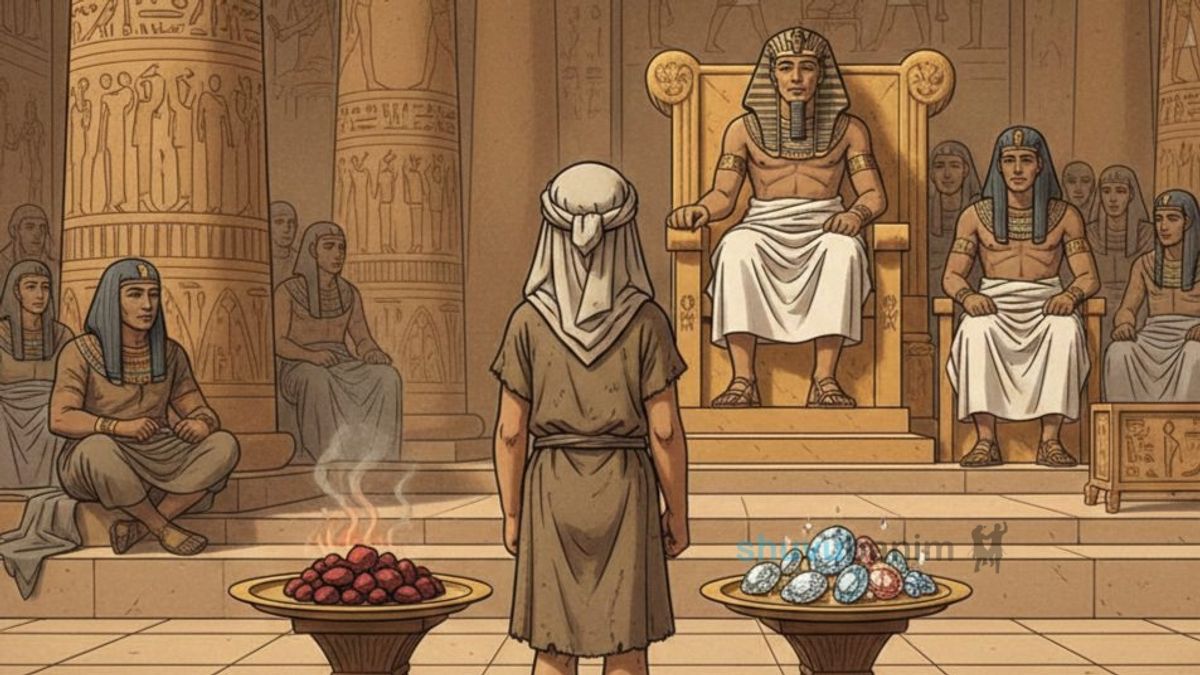
So they said to test Moshe Rabbeinu. They placed two "shislach" (bowls), two bowls—one of gold coins and one of coals. But Moshe wanted to take the coins because he was a merchant; he knew what was worth taking. Then an angel arrived and pushed his hand into the coals, and then he took a coal and put it in his mouth, and thus he became "heavy of mouth" (speech impaired) until the Giving of the Torah, at which time everyone was healed from all their illnesses.
But why didn't Pharaoh kill Moshe, given that he saw he was circumcised? Rather, when Moshe was born, it was eighty years before the Geulah (Redemption), which means it was three hundred and twenty years after the birth of Isaac. Ishmael had already circumcised himself a year before that [Isaac's birth], which means that people had already been circumcising for three hundred and twenty years. For three hundred and twenty years people had been circumcising themselves, so half the world was already circumcised. Therefore, they said, "This is not a Jew, this is a Muslim (Ishmaelite) child," and for that reason, Pharaoh did not kill him.
Subscribe to Our Newsletter
Receive Torah articles and inspiration directly in your inbox