Why is Haman Called "A Thorn, Son of a Thorn"? • Shabbos Parashas Terumah Class
A holy Shabbos Parashas Terumah class delivered at the Kiddusha Rabba (Great Kiddush) by the Gaon and Tzaddik, Rabbi Eliezer Berland shlit"a.
In this class, Rabbi Berland shlit"a explains the phrase "a thorn, son of a thorn" from the Yotzros (liturgical poems) for Shabbos Zachor. He discusses the self-nullification of the tzaddikim to the True Tzaddik, the reason we celebrate the holiday of Sukkos in Tishrei, the prayer of Chana the Prophetess for the victory of Mordechai and Esther hundreds of years before Purim, and the mesirus nefesh (self-sacrifice) of Yiftach's daughter.
Here is the full class:
Haman Kept Mitzvos Like a Canaanite Slave
"A thorn, son of a thorn" - why do we call Haman a thorn, son of a thorn? Poor guy, what did he do? Why is he a thorn? Why not a fig, a pomegranate, a vine, or a date? Dates from Morocco. Why a thorn? All in all, he was a good person, with a generous heart. Yes, a person with a wide heart - today they call that being "large" (generous). He was a good person. He even kept Shabbos! He didn't put on tefillin, because he was obligated in mitzvos like a woman [as a Canaanite slave]. Mordechai bought him as a slave - Rashi says this both in the Megillah (5:13) and in Tractate Megillah 15a. Yes, he was a good person, because they were two Chiefs of Staff - both Haman and Mordechai. Mordechai was a Chief of Staff, just like Rabbi Elazar [ben Shimon] was a Police Commissioner. They were two Chiefs of Staff. He had a million soldiers, and overall, he was a guy with a good heart. He gave them a bottle of champagne every day, and for thirty days - that's thirty million bottles of champagne. Then he ran out of money, and he needed money to provide food for his soldiers, so he came to ask Mordechai. Mordechai didn't know where he got it from - he had it from the Caribbean (Islands) - and he bought him as a slave. Poor guy.
A Thorn, Son of a Thorn
Why is he called a thorn? A thorn, son of a thorn. We say this in the Yotzros (liturgical poems) of Shabbos Zachor: "The cutter [Haman] hastened among the cutters to cut down the cut-off ones [the Jews], with explosive speech to crush the crushed ones." So why do we call him a thorn? Why do we call him a cutter? Because he changed the letter Dalet to a Reish, turning Echad (One - referring to Hashem) into Acher (Another - referring to idolatry). He turned to idolatry. Our entire spiritual work is to change the Reish back to a Dalet - from Acher to Echad. Rabbi Elazar ben Arach changed the Dalet to a Reish [when he forgot his learning]. We need to change the Reish to a Dalet. That is why they hanged Haman on a tree fifty cubits high.
When Did They Hang Haman?
When did they hang him - in Adar or in Nissan? In Nissan. So when do we celebrate Purim? In Adar. We should really celebrate Purim in Nissan - everything is upside down here, in Shuvu Banim.
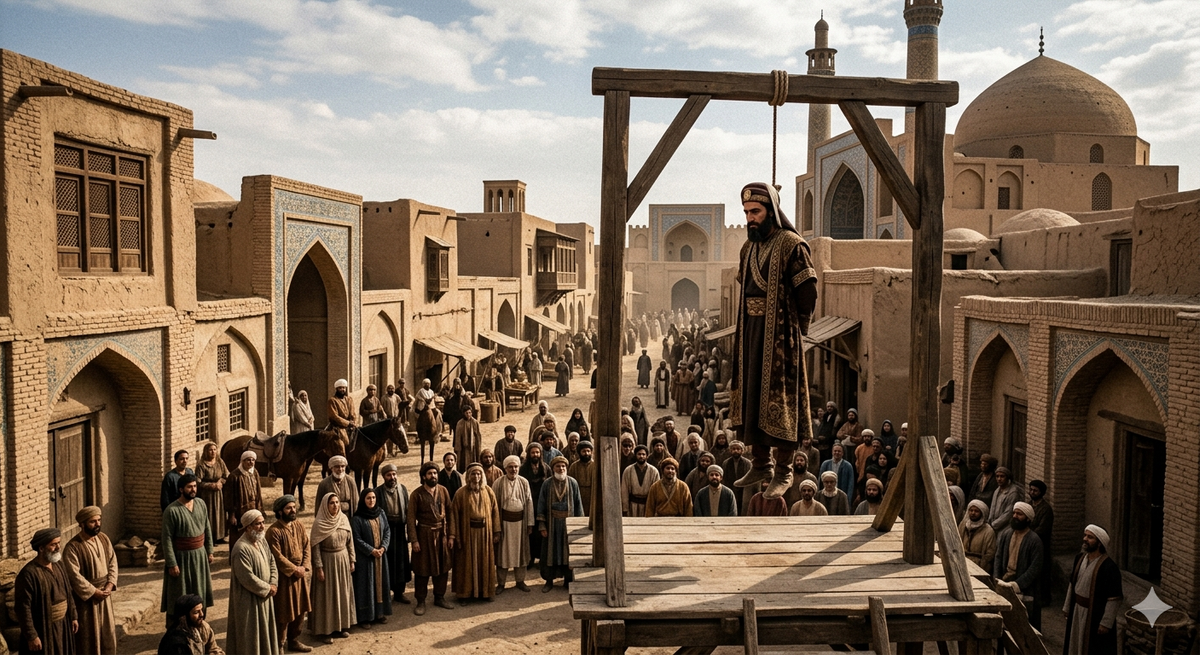
The tree was fifty cubits high. Fifty cubits - how much does that come out to? There is a dispute between the Chazon Ish and Rav Chaim Naeh. What was the height of the tree? According to the Chazon Ish, every cubit is sixty centimeters. That comes out to thirty meters. And according to Rav Chaim Naeh, who says every cubit is forty-eight centimeters, it comes out to twenty-four meters.
So how did they hang them? Each person was three cubits tall, and there were eleven souls on the tree - Haman and his ten sons. So each one takes up three cubits, plus one cubit of space between each person. That comes out to forty-four cubits, plus three clear cubits at the bottom and three clear cubits at the top - that makes fifty cubits.
According to the Chazon Ish - that's thirty meters, and they fit. But according to Rav Chaim Naeh - how did they fit into twenty-four meters? The answer is that Vaizasa was a dwarf. He was short, a little guy. And that is why there is an elongated letter Vav in the name "Vaizasa" [in the Megillah scroll], because they stretched him out to fill the empty space on the tree.
When did they hang them? In Nissan. It was within three days of the decree. Such a miracle never was and never will be again, that within three days of the evil decree everything flipped, and they already hanged him on the tree.
Just like now - Khamenei. They say that by Shabbos there will already be a war. So he said he will throw missiles. I am asking you to catch missiles for me. You, and you too - catch a missile for me. Everyone. You can't? Then I will catch it for you. And I ask that you do not return it to him, even if he says it's stolen property - we are not giving it back to him.
Why Do We Celebrate Sukkos in Tishrei?
But when was the miracle? In Nissan. So why do we celebrate Purim in Adar? Shuvu Banim does everything upside down. Sukkos too - when do we celebrate Sukkos? In Tishrei. When did the Clouds of Glory begin? In Nissan. So why do we celebrate Sukkos in Tishrei? Sukkos and Matzos are supposed to go together: either Matzos in Tishrei or Sukkos in Nissan. But it happened together. This is asked by both the Sifrei and the Mishneh LeMelech in Chapter 6. Why do we celebrate Sukkos in Tishrei? The answer is that only after we are clean from sins, only then can we enter the sukkah. Only after Yom Kippur, when we are all clean, is it possible to enter the sukkah.
The Test of Yeravam and the Great Tzaddikim
Yeravam ben Nevat wanted to make a holiday in Cheshvan. The Gemara says that he was like a "new garment" - that he would expound such novel Torah insights (chiddushim) that no ear had ever heard. Like a new garment, which has no flaw in it. Yeravam was like a new garment - he had no flaw in him. But his test was that he needed to nullify himself to the tzaddik, and this he could not do. He did not nullify himself to the tzaddik, even though he was completely flawless and would say such novel Torah insights that no ear had ever heard. But he did not nullify himself to the tzaddik. The same was true of Achitofel.
Chana Prayed for Purim and Chanukah Hundreds of Years Earlier
Reb Noson says in Likutey Halachos, in Hilchos Milah 4, letter 24: This is the pitcher of Rivkah, that every woman is a spark of Queen Esther. Chana already prayed for the miracle of Purim almost seven hundred years before it happened. Chana already prayed for it. Chana prayed: "Those who were full of bread have hired themselves out" (Shmuel I 2:5). Who are "those who were full of bread have hired themselves out"? These are the sons of Haman. They were full - they ate a lot. They arrived full. So "those who were full of bread have hired themselves out" - this refers to the sons of Haman.
"The bows of the mighty are broken, and the stumbling are girded with strength" (Shmuel I 2:4). This refers to Chanukah, because she prayed for Chanukah as well.
How many years before this did she pray for Purim? She prayed the Prayer of Chana when Shmuel was small, about two years old. That is when she prayed the Prayer of Chana. And Shmuel lived for fifty-two years. So that's fifty years, plus another fifty-two years until the First Temple, until they built the Beis HaMikdash - that's 102 years. The Temple stood for 410 years, plus 70 years of the exile, because the Purim story happened at the end of the seventy years. That comes out to 480 plus 102 - which is 582. So five hundred and eighty-two years before it happened, Chana already prayed that there would be a miracle, that they would be saved from Haman.
For Chanukah, it was another 210 years. That comes out to 700 years before it happened that she prayed for it, because Chanukah was two hundred and ten years after the First Temple. The mnemonic is: "Because it does not chew the cud (gerah lo yigar), and the pig you shall not eat." The pig - this represents Greece. Yigar (will chew) - has the gematria (numerical value) of 213, meaning that after two hundred and thirteen years the miracle of the Hasmoneans took place. So Chana already prayed for this seven hundred years beforehand.
Yiftach's Daughter Wanted to Die Al Kiddush Hashem
Yiftach's daughter. What did Yiftach want? All in all - he just wanted to live with her. He had an only daughter. Yiftach - he only had one daughter. And what did he want? All in all - he just wanted to live with her. So he wanted to annul his vow. But she was so stubborn, so rebellious - she absolutely refused to let him annul the vow. Women are stubborn. Learn the whole story of Yiftach's daughter in the Book of Judges with your wife. She stubbornly insisted that he slaughter her. And when he took the slaughtering knife, one drop of blood dripped, and it entered all the waters in the world.
And therefore the Abudarham says, on the last page of the Abudarham - the Abudarham says that this is why it is forbidden to drink water during the Tekufah (the turning of the solar season), at the exact time of the Tekufah. The time of the Tekufah is just one second. We are stringent for half an hour before and half an hour after, but the actual time of the Tekufah is only one second. And in the Land of Israel, this is not practiced. The Ibn Ezra says that this is an old wives' tale. In any case, that is why we do not drink water at the time of the Tekufah. So when he took the slaughtering knife to slaughter her, a Heavenly Voice (Bas Kol) came forth and said: "Do not stretch out your hand against the lad" (Bereishis 22:12).
Minchah will be in another eight hours. Everyone should learn with his wife Hilchos Milah 4, letter 24, that every kosher woman is a spark of Queen Esther. And Sanhedrin 102a about Yeravam ben Nevat.
Subscribe to Our Newsletter
Receive Torah articles and inspiration directly in your inbox