
Captions: The Gaon Rabbi Shimon Baadani shlit"a in a Moving Visit with the Holy
Tzaddik Rabbi Eliezer Berland shlit"a
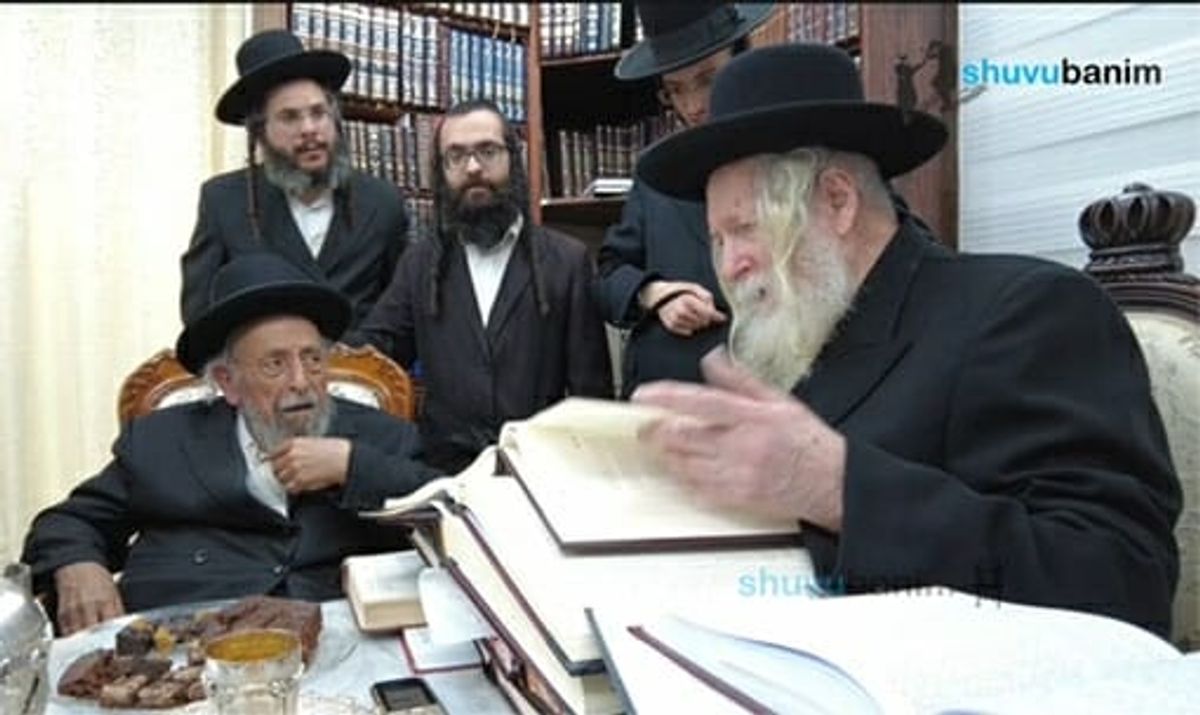
The Gaon Rabbi Shimon Baadani shlit"a, Rosh Kollel Torah V'Chaim in Bnei Brak and member of the Council of Torah Sages, came to visit our teacher, the holy Tzaddik Rav Eliezer Berland shlit"a, at his holy residence on HaChoma HaShlishit Street in Jerusalem - Shushan Purim Katan 5782.
The visit is truly a moving document of a holy conversation between two tzaddikim, Torah scholars whose entire occupation is only in the holy Torah. In the visit, one hears Rabbi Baadani shlit"a telling our teacher Rav Berland about a chiddush (novel Torah insight) he had; the Rav shlit"a answers him with sources, and the conversation elevates to an examination of the matters of Purim and Tractate Chullin - "its sharpness precedes its clarification."
Not to be missed
Rabbi Baadani asks our teacher Rav Berland shlit"a: "I just heard a new chiddush... I am looking for something, I remember seeing it once, it is so wonderful. Hashem says to Avraham Avinu: 'Know for certain that your offspring will be strangers in a land that is not theirs.'"
"Why? What happened?... There is a very simple pshat (literal explanation); in the Torah it is written: 'But Hashem has taken you and brought you out of the iron furnace, from Egypt'... what is the iron furnace?"
"The Zohar says that until Mount Sinai, their filth did not cease. And how did their filth cease? By performing backbreaking labor, all those impurities and all that filth were removed from them, so at Mount Sinai, all the filth ceased. I do not remember where I saw this, but Hashem says He wants His children to receive the Torah, but how will they receive it with all the filth within them? The filth of the serpent... upon Chava. Therefore: 'Know for certain that your offspring will be strangers in a land that is not theirs,' rather you and your children will perform backbreaking labor, and through this, they will be cleansed of the serpent's filth, then they will be able to receive the Torah... If so, for a convert who did not undergo this cleansing, he has the serpent's filth because he was not at Mount Sinai, but Hashem knows the hidden things and saw that the soul of the convert was destined to convert and took it to Mount Sinai so its filth would depart."
Our teacher Rav Berland shlit"a answered: "'For those who are here with us standing today before Hashem our God, and for those who are not here with us today.' This is the verse from which we learn this."
Rabbi Baadani shlit"a: "Yes, that is the verse I was looking for."
Our teacher Rav Berland: "The root of everyone is a Jewish root. All the nations have a root, 'All the inhabitants of the world will recognize and know'..."
And our teacher the Rav shlit"a continues, "They said to Hagar, 'You will have a child, a wild man.' How is it possible to bless a person, to bring them such news... and furthermore, a poor woman like Hagar whom Avraham is banishing... He says that because Avraham banished her, therefore 'When he sends you away, he will surely drive you out from here.' Pharaoh drove the people of Israel out of Egypt, and they did not leave with settled minds. The Rambam brings this, and also the Ba'al HaTurim: 'And she said to Avraham, "Drive out this slave woman and her son, for the son of this slave woman shall not inherit with my son, with Yitzchak."'
"It is written in the Zohar (Shemot, page 32) that Yishmael asked why He gave his brother the Land of Israel, because he is circumcised? I am also circumcised. And the answer is because Yishmael is circumcised without periah (uncovering)... For 400 years he was a prosecutor, because the Yishmaelim ruled the land for exactly 400 years. 400 years from when the Turks conquered the Land of Israel, it is exactly 400 years from 1517 to 1917; these were Ottoman Yishmaelim, may Hashem help."
"Today is Purim Katan, there is an elevation for all souls, two days of Purim Katan. In the Gemara Megillah, Rabbi Eliezer bar Rabbi Yossi says... The Chatam Sofer says that one does not pass over mitzvot; we must fulfill all the mitzvot on Purim Katan, one does not pass over mitzvot. The Chatam Sofer says that by Torah law, one must eat something in honor of the holiday... one must make joy, and also give mishloach manot... which is by Torah law to make a remembrance, from death to life. The miracle of Purim is greater than the miracle of Egypt, because in Egypt there was backbreaking labor, but here there was a decree to kill, destroy, and annihilate, so the miracle from death to life is literally by Torah law... The remembrance is by Torah law, but the lighting of the Chanukah candles is by Rabbinic law."
"Why did the Sages institute Purim in Adar II? After all, one must connect one Redemption to another... The mitzvah of the Megillah is not by Torah law, it is Rabbinic, so it is possible to postpone it to Adar II, but the joy and the remembrance through eating something good must be established on the chosen day, Redemption to Redemption, therefore by Torah law, one must do something as a remembrance in Adar I."
Rabbi Baadani shlit"a: "Is your honor preparing this for Purim?"
Our teacher Rav Berland shlit"a: "Yes! As it is brought in Chullin..."
Rabbi Baadani: "Does your honor agree with what I said from my own mind regarding the exile of Egypt? That the exile came to purify from the serpent's filth?"
Our teacher the Rav shlit"a: "Certainly, this is a completely new chiddush... Rabbah asked Rabbi Zeira, the Ba'al HaHafla'ah brings that Rabbi Zeira says that 'its sharpness precedes its clarification,' that if a person slaughters with a knife, the Rema disagrees with this, but we rule like the Shulchan Aruch, like the Rambam, that its sharpness precedes its clarification even in the blink of an eye; one must do it very, very quickly."
"This is the dispute between Rabbah and Rabbi Zeira... Rabbi Zeira rules in Chullin that its sharpness precedes its clarification. All of this is a statement of Rabbi Zeira; here Rabbah also 'slaughters' Rabbi Zeira. They wanted to see if sharpness precedes... how it works exactly. Rabbah took a white-hot knife... This is the chiddush of the Hafla'ah who said this as a witticism... why specifically 'he slaughtered him'... The Shulchan Aruch brings in Yoreh De'ah, Siman 9, that one must do it quickly...?"
"Rabbah stood up and slaughtered Rabbi Zeira... Why on Purim? Because he knew that then he could revive him... that first they heated the knife and after that they slaughtered... And the Ba'al HaHafla'ah says that even though it was said as a joke, we will learn it literally."
"The Ba'al HaHafla'ah, Rabbi Pinchas of Frankfurt, who was the brother of Rabbi Shmuel Shmelke Horowitz of Nikolsburg, said this as a joke for the joy of Purim... The word 'chiduda' (sharpness), 'chiduda' is one who learns much Gemara; 'libuna' (clarification) is when one becomes enthusiastic in the service of Hashem. When a person becomes Breslov, he already jumps on tables, dances in the streets - a person must be 'chiduda'; 'libuna' is the enthusiasm, the fire. 'Hashem brought out a coin of fire from under the Throne of Glory and showed it to Moshe.' What is a coin of fire?"
"One must show the moon, because one does not know what size the moon is, it changes every moment, but a coin, one takes a 10-shekel coin, must one specifically show him one of fire?"
"Rather, this comes to atone for idol worship and the sale of Yosef, and it hints that every Jew is fire. Every Jew can be brought to teshuvah. If we were worthy, we would bring all of the people of Israel to teshuvah. Every Jew wants to return to teshuvah, only they confuse him all day, saying that the rabbis are thieves, here the rabbis are this way, presenting it as if in Meah Shearim they throw stones 24 hours a day."
"Rabbah knew that Rabbi Zeira would die and live; he revived him the next day, and this is also a question - how does he leave him dead for a whole day? If a person passes away, one buries him immediately. Rebbe Nachman says that one should not take a person to the cemetery at all, one should bury them immediately. It is written that the deceased is distressed that he is dead; he sees everything, he feels, he cannot bear the shame that he is dead and everyone else is still alive. He wants them to bury him on the spot, that they should dig under the bed and bury him."
"The Maharsha asks that if so, Rabbah should have buried Rabbi Zeira, but this was on the 14th of Adar and he knew that the next day, on the 15th, he would revive him. He waited for the 15th because then one can revive the dead. On Purim Katan, one can also revive the dead. Now one can revive the dead and bring all the people to teshuvah; now this is a sanctuary of fire, that every Jew is fire..."
"The Rambam (Hilchot Taharah) brings that even if they slaughter two signs for a person... it makes a difference regarding Kohanim, if the Kohen needs to leave if someone dies. There is here the book Da'at Emunah on purity by Rabbi Chaim Kanievsky; a person does not die immediately... The Kohen can meanwhile raise his hands, go up to the Torah; it will take him another quarter of an hour until he dies, but one must not move. A person needs to have a settled mind and immediately attach the signs."
"There was a story that a soldier was shot and his two signs were cut, and they immediately attached them; they managed to attach them within two minutes. Someone saw that they were slaughtering a dove and it continued to fly because someone attached the signs for it..."
Rabbi Baadani shlit"a: "The Halacha obligates the slaughterer to check the signs before he throws the chicken..."
Our teacher Rav Berland: "Correct, the Ketzot HaChoshen in 250 says from when he is called a goses (dying person). Even if they slaughtered two signs, it is nothing; he can still give an inheritance, he is still clear-headed, it is not like a goses..."
Rabbi Baadani shlit"a: "Now the Rav must continue the activity of bringing the people of Israel to teshuvah... The Rambam says that Israel is only redeemed through teshuvah. There is a rabbi who brings many to teshuvah and they started to speak against him. I was angry at them and held a meeting; I told them the words of the Rambam, 'What do you want, that Mashiach should not come?'... I said that they do not listen to this."
Rabbi Baadani: "They do not appreciate what it is when a person returns to teshuvah. The Gemara says that he annuls all the decrees."
Our teacher Rav Berland shlit"a: "The Gemara in Bava Metzia says that whoever brings to teshuvah annuls all the decrees..."
Subscribe to Our Newsletter
Receive Torah articles and inspiration directly in your inbox