
Subtitles: A Moving Visit at Joseph’s Tomb
the holy tzaddik Rabbi Eliezer Berland shlit"a
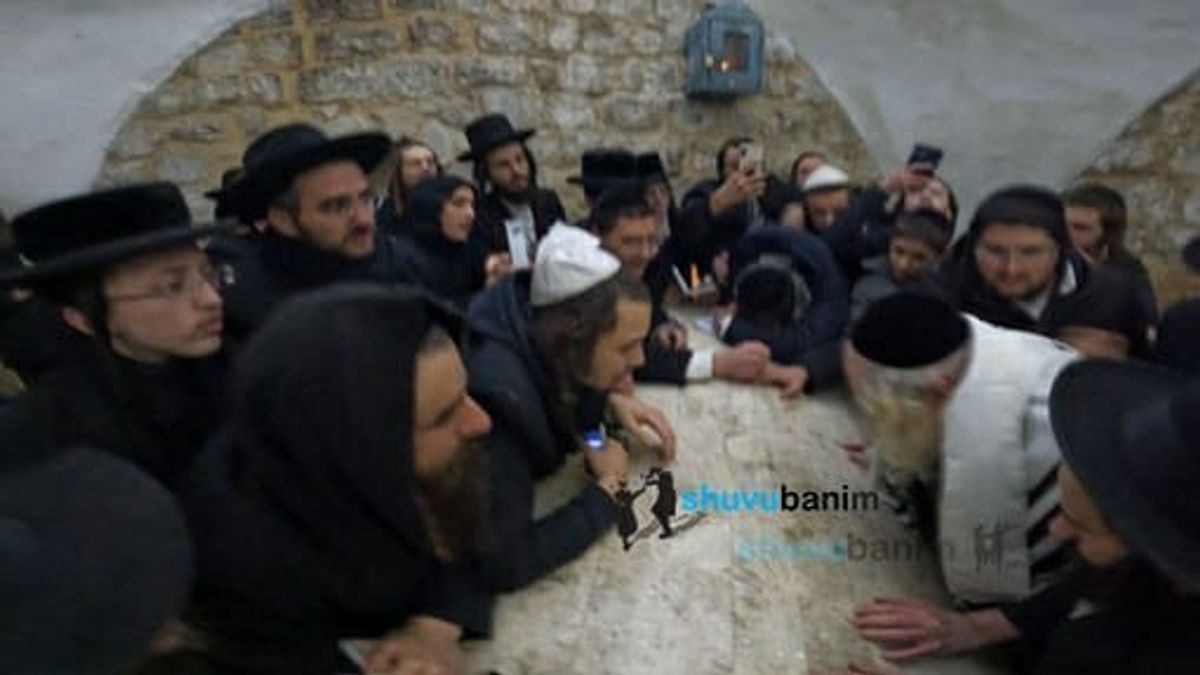
Our teacher, the Gaon and Tzaddik, Rav Eliezer Berland shlit"a, arrived at the holy gravesite of Joseph the Tzaddik in Shechem - 1st of Adar I, 5782.
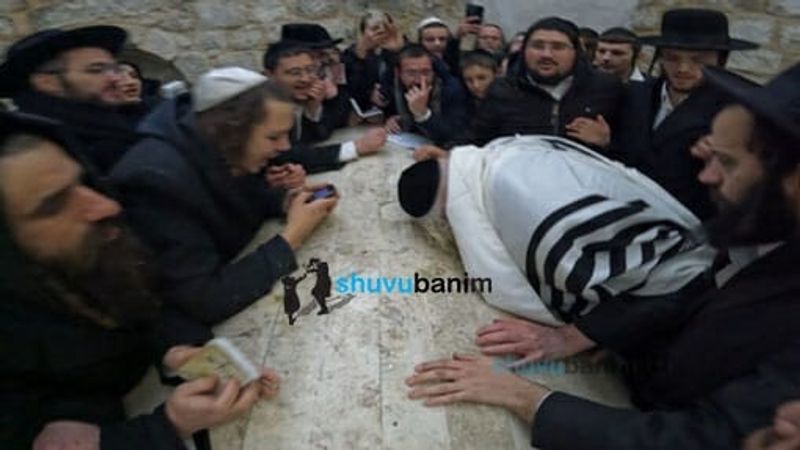
The atmosphere at the holy gravesite upon the arrival of our teacher, Rav Berland shlit"a, was fervent. Our teacher, the Rav shlit"a, recited the Tikkun HaKlali with the public with great enthusiasm and melody, and afterwards, he delivered words of Torah to the public.
A lesson delivered by our teacher, Rav Berland shlit"a, at the Tomb of Joseph after the Tikkun HaKlali, Wednesday night, the second day of Rosh Chodesh Adar I, Parshat Terumah 5782. These are his holy words:
"Now it is the 1st of Adar II, the sign of Pisces. The fish are the Leviathan, Amram and Yocheved, who reached the fiftieth gate, and in the merit of this, they merited to draw down the soul of Moshe Rabbeinu. (In one of the Rav's prayers, this matter is mentioned somewhat. This is the language of the prayer: 'Master of the World, the month of Adar, whose sign is Pisces, the secret of the Leviathan and his mate, for Hashem killed the female and castrated the male, because in the month of Adar, this desire is completely nullified and has no place, for all the disasters that befall a person are solely because of this desire, which is his undoing and awakens all the judgments against him.')"
"The Leviathan is the fiftieth gate; the sign of Pisces is the fiftieth gate. Haman was at the fiftieth gate of impurity, and Mordechai was at the forty-ninth gate of holiness. Haman was one gate higher than Mordechai, and in this lay his plan to overcome Mordechai. But our Rebbe says in Likutey Moharan, Part I, Torah 8 (The Rebbe's language in the Torah: 'This is: "I saw, and behold, a golden menorah"—this is the Torah, which is "more desirable than gold." "And its bowl is on its head"—Rashi explains: "a spring," this is the spring that issues from the House of Hashem, which is prayer. "And its seven lamps"—these are the souls that were raised in the Garden, divided into seven groups. "Seven and seven pipes"—these are the 49 lights, which is the hidden light for the future (as Rashi explains there), the aspect of Eden, "no eye has seen," which is the aspect of prayer as mentioned above. "And two olive trees upon it"—Rashi explains: "two trees," meaning the Tree of Life and the Tree of Death, meaning good and evil as mentioned above. And this is: "one on the right and one on the left" as mentioned above. "And from there it separates"—that the evil is separated from the good, this to the right and this to the left.) that the gate of prayer is the fiftieth gate, and in the merit that Mordechai prayed, he ascended to the fiftieth gate, and through this, he overcame Haman. The fiftieth gate is also in the Torah, in Yoreh De'ah and in Choshen Mishpat."
"Now it is the Yahrtzeit of the Shach. The Shach went over the entire Choshen Mishpat one hundred times before he began his commentary on the Choshen Mishpat. At the age of thirty-one, he had already finished his work. He did not take his head out of the book from the day he was born; from the age of three, he did not take his head out of the book. And this is Joseph the Tzaddik, who did not take his head out of the book; he did not open his eyes; in his life, he saw nothing. 'The blessings of your father have prevailed above the blessings of my progenitors unto the utmost bound of the everlasting hills; they shall be on the head of Joseph, and on the crown of the head of him that was separate from his brethren' (Genesis 49:26). Joseph is the head."
"'Besamim Rosh' (Head of Spices)—Mordechai is Besamim Rosh; he is the head of all the Tzaddikim, all the spices. 'Mara Dachya' (Pure Master) is Mordechai; the Targum says Mara Dachya is the head, Myrrh, he is the head of the spices, and Esther is the head."
"Esther is Hadassah (myrtle). I saw a chiddush (novel insight) yesterday: 'Instead of the thorn shall come up the cypress, and instead of the brier shall come up the myrtle' (Isaiah 55:13). How do we turn the brier into a myrtle? We extract the 'par' (bull) of judgments. Vashti is the 'par' of judgments. There is a 'par' of judgments; 'Man-Tzaph-Chach' (the final letters) is 280, which is the gematria of 'par'. So we extract the judgments from Vashti."
"Vashti is the Satan himself; it is all our sins, and all the judgments we receive from Vashti. We extract the 'par' of judgments from Vashti, then we will become a myrtle. The brier (sirpad) is the letters Heh, Dalet, Samech, and we only need to extract the 'par'. Through the Tikkun HaKlali and by coming to Joseph the Tzaddik, we extract the 'par' of judgments from Vashti and from Ahasuerus, for Vashti, Ahasuerus, and Haman are one thing; it is one body, one reality."
"Ahasuerus is the gematria of Rebbe Nachman ben Simcha, exactly, without the 'kolel' (adding one for the word itself). So, Rebbe Nachman ben Simcha is 821, which is exactly Ahasuerus with two Vavs, meaning as it is written in the Megillah, and not as people usually write it, 'Achashverosh' with three Vavs. Only the Rebbe can defeat Ahasuerus, only the Rebbe. This is such a kelipah (shell) that there has not been since the creation of the world, and there will not be such a kelipah, so only the Rebbe. And this begins already today, on the 1st of Adar I; we begin to defeat all the Ahasueruses, all the Knesset, and all the members of Knesset. None of them will remain, not a trace, and they will all be like dust and chaff."
"Joseph did not take his head out of the book. From today, we do not take our head out of the book. 'Joseph is a fruitful vine, a fruitful vine by a spring' (Genesis 49:22). Why 'porat' (fruitful)? Because he was a shoemaker and had a shoe shop. Joseph is a reincarnation of Enoch the shoemaker. Through the Tikkun HaKlali, we make shoes for the Shechinah. Save me from the kelipah of Haman-Amalek, save me from the kelipah of Haman-Amalek."
Subscribe to Our Newsletter
Receive Torah articles and inspiration directly in your inbox