A Lesson for the Residents of the 'Har Homa' Neighborhood in Jerusalem at the
Holy Residence of the Gaon and Tzaddik Rabbi Eliezer Berland shlit"a
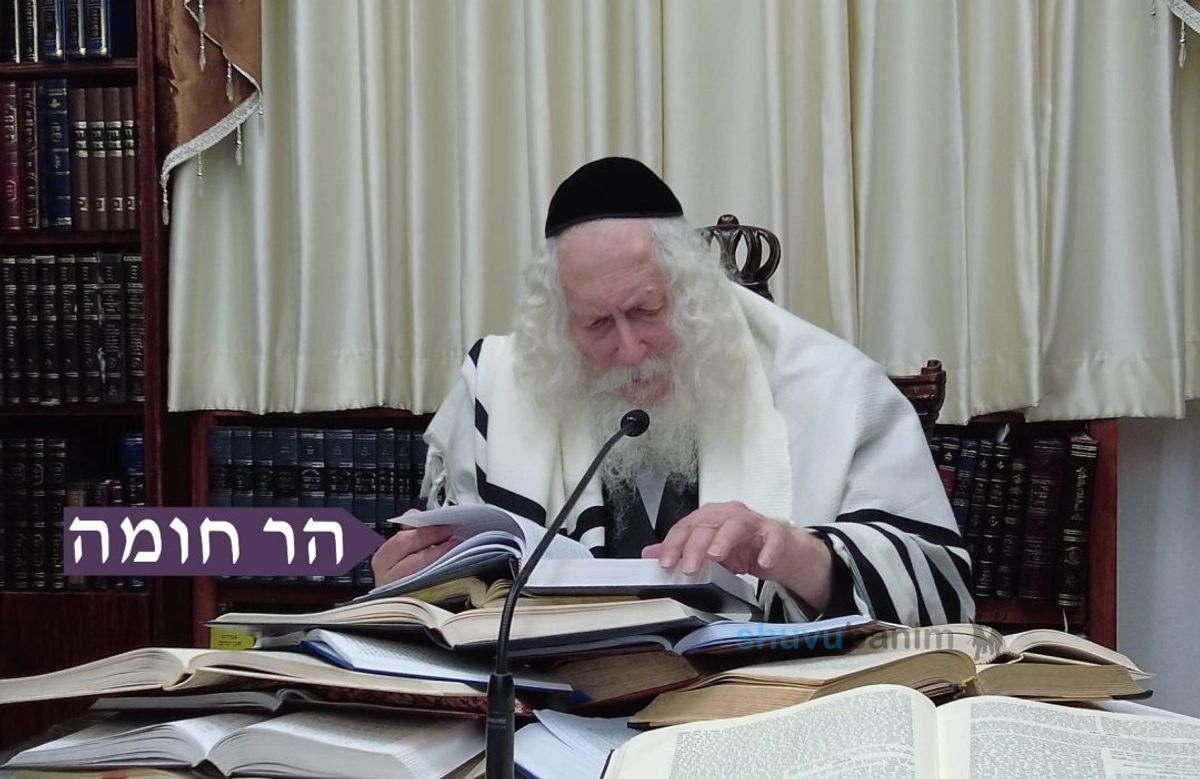
Yesterday, Monday, the night of the 11th of Adar I, Parshas Tetzaveh, before the Maariv (evening) prayer, our fellow followers from the Har Homa neighborhood entered the residence of our teacher, the Rav, Rabbi Eliezer Berland shlit"a.
Our teacher, the Rav shlit"a, delivered a lesson to them for about an hour. Before you is a summary and the words spoken during the lesson:
The Rav shlit"a began the lesson with the story of Megillat Esther and brought down that Charvona was actually Eliyahu HaNavi (Elijah the Prophet). He further added a novel insight in the name of Rebbe Noson of Breslov that the miracle was that Haman made the gallows 50 cubits high, so that Achashverosh could see the gallows from his palace window. Afterward, he spoke about the matter of "Or Bahirus HaDerech" (the light of the clarity of the way) of our holy Rebbe Nachman, saying that the reason travel has become difficult in recent years—requiring flights to countries neighboring Ukraine, etc.—was because people did not uphold the greatness of "Or Bahirus HaDerech."
Further, the Rav brought an interesting question in the lesson: why did Moshe name Gershom before Eliezer? After all, he should have first given thanks for being saved from Pharaoh's sword. He explained that as long as he had not been informed of the Geulah (Redemption), he still felt like a "stranger in a foreign land (Ger)..." However, after the news of the Geulah, he could name his son Eliezer, for "the G-d of my father was my help (be'ezri)." Likewise, during the lesson, the Rav several times strengthened the importance of rising for Chatzos (the midnight prayer), saying that if a person rises for Chatzos, he can conquer the entire world. He also spoke in the lesson about the act of Shimon and Levi who killed those in Shechem. Amidst these words of the "Living G-d," the Rav strengthened the study of Torah, saying that all the wisdoms in the world are found in the Torah and there is nothing to seek in external wisdoms.
Continuing the lesson, he brought the Midrash speaking of how King David wanted to conquer Rome and subdue the klipah (evil shell) of the dog, which would have brought the Geulah (Redemption). However, Hashem did not agree, because otherwise, the lowly souls, especially those of the final generation, would have had no hope. From one topic to another, he cited the Ben Ish Chai on what is written in Tractate Megillah, that Mordechai the Jew was "crowned with his manners/customs," and Rebbe Yosef Chaim zt"l explains that Mordechai had thick and coarse peyos (sidelocks), and this is what angered Haman. Our teacher, the Rav, even brought the Aggadah (Talmudic legend) mentioned in the Gemara that Mordechai and Haman were heads of army divisions; Haman ran out of food and sold himself as a slave to Mordechai the Jew. In his holy way, he moved from topic to topic to other legends brought in the Gemara, including one about a person who did not perform Netilat Yadayim (ritual hand washing), and they served him "something else" (pig/non-kosher) because they thought he was not Jewish since he didn't wash his hands, Heaven protect us. He strengthened the importance of Netilat Yadayim. Afterward, he returned to the matter of the greatness of a Jewish man's peyos (sidelocks) and cited the book "Mayim Adirim," which writes that the verse "He shall smite the corners (pe'as) of Moab and break down all the sons of Seth" refers to the matter of peyos. The Rav said that a person can subdue all of Moab through peyos, and added that if a person who has peyos enters Gaza, he crushes all his enemies.
Afterward, he dealt with the matter of song and melodies, especially before prayer—the morning Zemiros (praises)—saying that melodies are what open the gates of prayer, and therefore one should sing before every prayer. The Rav also brought the words of the Baal HaTurim on the word "Va'eschanan," noting it has the same gematria (numerical value) as "Shirah" (song) and also "Tefillah" (prayer), and spoke extensively about the connection each has to the other.
In the second part of the lesson, our teacher, the Rav, referred to Torah 85 in the second part of Likutey Moharan, which speaks of the secret of the Luz (the indestructible bone), which is the matter of "and on the crown of the head of him who was separate (nazir) from his brothers."
Towards the end of the lesson, our teacher, the Rav shlit"a, spoke extensively about the virtue and the obligation of dwelling in the Holy City of Jerusalem. He brought the words of the Chasam Sofer zt"l in full, stating that the terrible earthquake that occurred in Safed was because people did not come to live in the Holy City. He further spoke about how even in this time when the Beis HaMikdash (Holy Temple) does not stand, the law brought in Tractate Ketubot remains: "All may be compelled to go up to Jerusalem."
Subscribe to Our Newsletter
Receive Torah articles and inspiration directly in your inbox