A Moving Interview with Rabbi Shlomo Elmaliah
Author of the Magnificent Commentary on the Etz Chaim
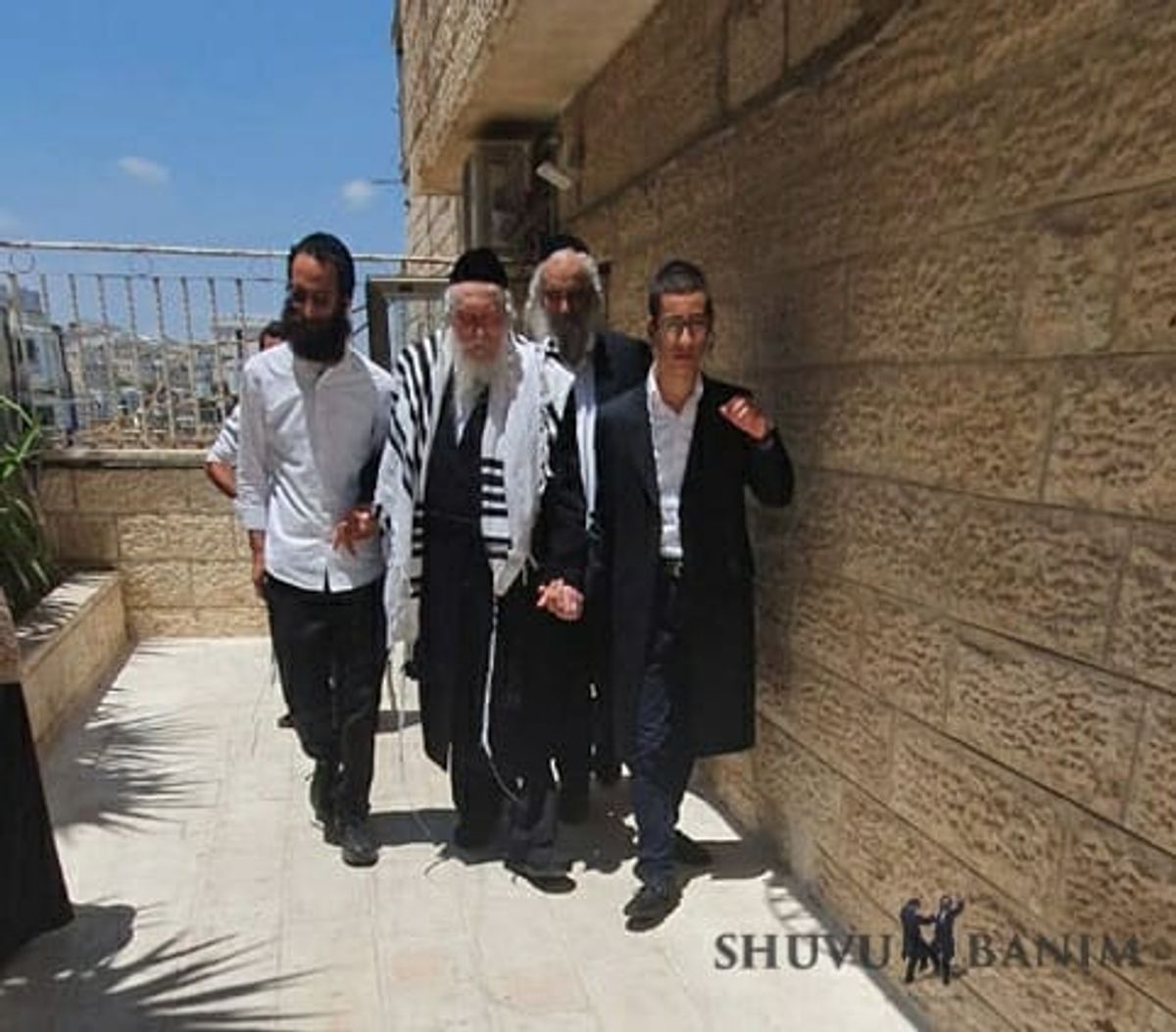
Ateret Shlomo (The Crown of Solomon)
Mighty ones of knowledge, giants in both the revealed and hidden Torah, have graced Moroccan Jewry for hundreds of years. You will now read about one of the most unique among them, who chose to remain hidden even after his death, demonstrating how "tzaddikim (righteous ones) in their death are called living," even decades later. In an interview with his grandson, one of the prominent students of the Rav, who continues the family's glory, he tells the story of his drawing close to Rabbi Berland shlit"a, and simultaneously reveals another layer of the greatness of our teacher, the Rav.
It was over a decade ago. The Jewish beis hachayim (cemetery) in the city of El-Kela in Morocco was in immediate danger. By order of the city governor, who decided to turn the site into a market, the Arabs began the destruction and clearing of the Jewish cemetery. There was no one to protest; after all, Jews no longer lived there, and who would prevent them from doing as they pleased? At least, that is what they thought.
But in truth, they forgot that buried there—or perhaps more accurately, residing there—is a holy man of G-d who would not let them do as they wished. This was the holy Gaon and Kabbalist, Rabbi Yehuda Elmaliah zt"l (of blessed memory), who only seventy-two years ago still served as the city's Rabbi and led his community with strength.
Amazing tales of wonders circulate about this tzaddik, and there are still Jews among us who remember his wondrous holy conducts. To this day, Moroccan Jews ascend to his tziyun (grave site), and on the day of his hillula (anniversary of passing), hundreds of Jews from all over Morocco gather in his honor.
The tractors moved onto the site, and to our great sorrow, began destroying the graves. Suddenly, the engine died, and the digging equipment was disabled. The workers tried unsuccessfully to repair the machine, but they saw no visible fault. Their attempts to move the machine forward yielded the same result, but when they tried to drive in reverse, the tractor drove without any trouble. They tried again to move forward toward the grave in front of them, but again the machine would not work. After trying several times, they realized there was something deeper going on and stopped the excavation. These were the graves of Rabbi Yehuda Elmaliah and his holy student, Rabbi Yitzchak HaKohen, where the tractors stopped, unable to continue.
That night, Rabbi Yehuda appeared in a dream to one of his descendants, informing him of the danger his grave was in, and commanded him to travel urgently to Morocco to meet with the King. "The King will help preserve the site, and I command you to move our graves to the edge of the cemetery, and adjacent to it, build a large building for hachnasas orchim (hospitality). An elderly Arab living nearby will be appointed over the tziyun. Tell him that I appointed him to guard the place and care for those who come to the grave. Additionally, surround the entire cemetery with a strong fence so that its honor and holiness are preserved."
The descendant, who did not understand how he could carry out all this in a foreign land, received an answer in the dream from his grandfather: "When you wake up in the morning, you will find a letter from me to the King of Morocco in your coat pocket. Do not open it; deliver the letter in its entirety to him, and you will see that he will assist you. Do not return to the Land of Israel until you have finished the mission," he warned him.
Shocked and moved, the grandson woke up in the morning, and there was a letter from his holy grandfather in his coat pocket. He understood that this was indeed a true dream, and immediately entrusted the leadership of his Kollel (institute for advanced study) to a scholar from the Kollel and set out to fulfill the stirring mission.
Accompanied by two other Jews, they left Israel, and upon arriving in Morocco, they requested an audience with the King. The guards, of course, rejected their request outright, but the grandson did not give up. "Tell the King that I have a letter for him from one of the tzaddikim who passed away decades ago," he requested. The King of Morocco, curious at the unusual words, ordered them to be brought into the palace. There, the grandson briefly told the King who his grandfather was and handed him the letter, describing how it had reached him.
The King read the letter with amazement. In the letter, Rabbi Yehuda instructed him to command the governor of El-Kela to help his messengers fulfill the mission he had assigned them, and even asked him to provide them with funds for this purpose. In exchange, the tzaddik promised him many blessings. The King, moved by the content of the letter, immediately wrote a letter to the governor of El-Kela, and additionally said that he wished to take the expenses upon himself.
Thus the site was built, with not a single word of his falling to the ground. The three messengers carried out the full mission, and after eight months, they merited to complete it.
The Holy Conducts of Rabbi Yehuda Elmaliah zt"l
This story opens a small window into the great figure of the tzaddik Rabbi Yehuda Elmaliah, who served as the Rabbi of the city of El-Kela. Some of the stories told about him cannot even be put into writing. He merited and attained greatness and spiritual perceptions (hasgachot) that are unfamiliar to most. "From various people I didn't know at all, and who had no connection to each other, I heard stories of greatness and wonders that are hard to describe. In his home, he opened a Kollel for a group of Torah scholars whose every need he provided for, and they would study Torah in his home in shifts twenty-four hours a day. His daughter, Mrs. Chana tichye (may she live), relates that she could not sleep at night due to the 'ritcha d'Oraisa' (the heat of Torah debate) that filled their home. He conducted himself with wondrous holy stringencies. He would only attend to his needs by the river, which was a kilometer away from their home, because he was careful to immerse in a mikvah (ritual bath) immediately afterward," relates his grandson Rabbi Shlomo, as he heard from his daughter, Mrs. Chana.
Although he sat secluded in his room engaged in both the revealed and hidden Torah, he also knew how to fulfill his role as the city's Rabbi, and thus was involved in every detail that required his decision. There was no concept of divorce (get) in their place. Rabbi Yehuda would sit with couples for days until he restored peace to their homes. His name was revered even among the gentiles, who would come to receive his blessing and yearn for his words.
At his passing, the Name of Heaven was sanctified before all, as all the gentiles saw with their own eyes how the moon shone with a great light like the light of day until he was hidden in his holy grave, and only then did it return to its natural state.
Rabbi Shlomo Elmaliah shlit"a, Grandson of Rabbi Yehuda Elmaliah zt"l
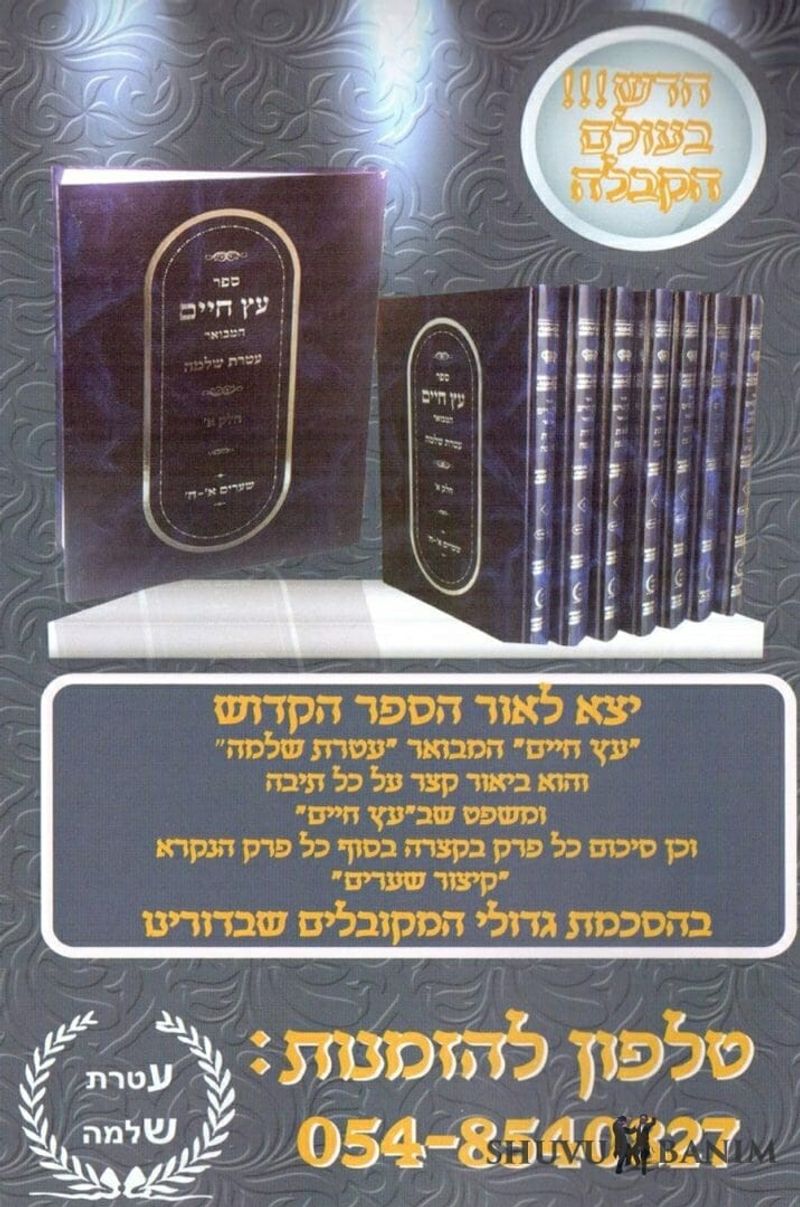
On the occasion of the upcoming publication, with G-d's help, of the unique Torah-Kabbalistic work—'Ateret Shlomo.' This is a comprehensive commentary on the entire holy book Etz Chaim (Tree of Life) by the holy Arizal, authored by one of the prominent students of Rabbi Berland shlit"a for decades, the chassid Rabbi Shlomo Elmaliah shlit"a. We sat down for a special conversation with the author. We have heard lessons from him in the teachings of Rebbe Nachman for nearly two decades, as he draws and provides from the Rebbe's Torah according to the true fragrance and knowledge as he received it from his teacher and master, Rabbi Eliezer Berland shlit"a.
When the Elmaliah family immigrated to the Holy Land, they were settled in Hatzor HaGlilit. The conditions of the place did not allow the youth to know the ways of the Torah, and with the active assistance of the authorities who aimed to make them "forget Your Torah," it was very difficult to maintain Judaism as it should be. Even the religious educational institutions did not provide tools for dealing with life beyond the Torah, and thus many did not withstand the situation and did not continue in a Torah life.
Ascending in Torah
With G-d's help, Reb Shlomo managed to escape the clutches of the street. His love for being in nature helped him, a place where he naturally felt a longing for Hashem. From there he received the awakening of teshuvah (repentance), and so he went to study in the Lithuanian yeshiva, Dvar Yerushalayim, headed by Rabbi Yoel Schwartz and Rabbi Horwitz.
"In Yeshivat Dvar Yerushalayim, we studied according to the accepted method in yeshivas, 'lomdus' (analytical study) and yeshiva-style depth. Once, when I returned from the yeshiva to our home, my father asked me what we were studying. I told him Tractate Kiddushin. 'Let's study together,' my father said, and indeed I presented the topic to him with all the methods and commentators we had learned. My father, Rabbi Chaim, who was a Rabbi in Hatzor and was a Torah scholar, was angry and said to me, 'Is this how one studies? This is not how our ancestors in Morocco studied. They examined every word, delving into the simple meaning (peshat) of the topic and did not run to see the commentators beforehand; rather, they tried to understand from within the text itself, particularly from the holy commentary of Rashi.'
My father was not satisfied until he took me to one of the sages of Morocco who lived in our city, the Kabbalist Rabbi David Suissa zt"l, who was already old and full of years. He sat with me and explained the study method as they learned in Morocco for several months, which has a special sweetness. From then on, I began to study according to the path Rabbi David set for me, and I no longer studied in the yeshiva way.
While I was at Dvar Yerushalayim, the boys once sat and laughed at the Breslovers, saying they go to the fields and scream and do strange things. But from what they said in disparagement of the Breslovers, a desire was awakened in me to know them and be like them, since what they told about them actually sounded very good to me. Without knowing the Breslovers, I would defend them from the mockery directed at them. I asked them if there were books by this Rabbi of theirs? They answered me that his books were banned, and only one book of his remained, called Likutey Moharan.
Searching for the Tzaddik
One thing led to another, and I obtained a Likutey Moharan and began to study it, and behold, I saw that his book indeed stirred me greatly. I felt that I had found an answer to something I had felt for a long time: that I study all kinds of books where all kinds of things are written, but it doesn't stir me to fulfill them despite my study, and here, when I study Likutey Moharan, the desire to fulfill is also awakened in me.
"When I told this to my friends, they reacted: 'You've already gone crazy...', but I knew it was something true, and I began to pray to Hashem to send me a Breslov chassid. My prayer was answered, and one day I met the chassid Reb David Ben Yishai. I told him I was looking for Breslov chassidim, and when he heard this, he brought me to our holy yeshiva, Shuvu Banim, in the Old City."
To describe his impression of the yeshiva he arrived at, Reb Shlomo uses the term 'volcano.' "It is impossible to describe what sublime holiness and light were in the yeshiva when I arrived. Rabbi Eliezer Berland shlit"a looked like a torch of fire, and everything around was a storm of Divine service that cannot be described. Mincha and Maariv (afternoon and evening prayers) together with the Rav's lesson lasted about six hours, while I understood almost nothing of the Rav's fiery and rapid speech, but I saw a magnificent sight I had never seen in my life."
In the Yeshiva of Rabbi Berland shlit"a
One of the things that particularly caught Reb Shlomo was the people. "After the Rav's lesson, I saw that the people were all immersed in sparks of holy fire, in great lights, and they had no time at all for idle talk or conversation. I saw how the people went with the words they had just received to pray to Hashem about them, to do Hisbodedus (personal prayer) so they would merit to fulfill them. People living on different levels. Stripped of physicality, whose only desire was how to serve Hashem."
Afterward, the yeshiva students went to rest and gather strength for Chatzos (the Midnight Lament). At three in the morning, the Rav shlit"a would arrive again for prayer and a lesson with immense strength and a special burning for Hashem. After the prayer and lesson, the regular schedule began, which included a Gemara lesson by the Maggid Shiur (lecturer), the Gaon Rabbi Fishel zt"l, who came specifically to teach Gemara to the yeshiva students despite his advanced age and the effort to reach the yeshiva.
Alongside the abundant spirituality, material conditions held almost no place. "We slept where the mikvah is currently located; plaster would fall on us from the ceiling at night, and it didn't bother anyone. Neither cold nor heat bothered the students, and certainly not this food or that. We were stripped of these things."
To illustrate this, Reb Shlomo describes an incident where one of the yeshiva students at the time suggested a shidduch (marriage match) for him. Reb Shlomo arrived at the meeting, and when the topic of housing and living conditions came up, Reb Shlomo told her that there was no need for closets in the house, and even beds were unnecessary, as one could sleep on the floor, etc. Of course, the shidduch fell through immediately. This happened several times.
However, there was one point that bothered Reb Shlomo. "Because of the intensity and time people spent on Divine service, when it came time for study, many times they could no longer hold on; they had no strength left, and I felt the study was not enough. Since I was already accustomed, thank G-d, to study, this bothered me. I felt I was very much lacking the study I was used to, so I decided to approach the Rav shlit"a about the matter."
An Important Question to the Tzaddik
"It is important to note that approaching the Rav was not such a simple thing. The awe we felt for the Rav was indescribable. Although the Rav has always been pleasant and welcoming to everyone, on our part as students, we had a sense of dread and fear of the Rav. When I finally entered to speak with the Rav, I remember with what immense humility I spoke to him. I told the Rav when I reached him that the Rav comes and delivers lessons and prayers like a flaming fire, and indeed we serve Hashem very much, but after the Rav leaves, people no longer have the strength to study, and in Rabbi Fishel's lesson, there are not many participants. I saw on the Rav's face that he was shocked that they weren't studying Gemara. I explained that it was hard for me that there wasn't enough study, and the Rav asked me what I thought of doing?
"I answered the Rav that I was thinking perhaps of moving to a yeshiva where they study more Gemara. The Rav answered me: 'Yes, go to Yeshivat Lev Yehuda, there you will study Gemara, and after the wedding, return to us.' I did not know that yeshiva at all, and I did not know it was a yeshiva of those who opposed the Rav, and that it was essentially established to try and provide an alternative to Shuvu Banim (a futile attempt, as the words of our Sages are known: 'Truth stands, falsehood does not stand.' And indeed, the place closed due to lack of interest...), but the Rav shlit"a in his humility sent me there, since they study Gemara there and it is a Breslov yeshiva.
"The next day, the Rav shlit"a came up to the yeshiva and gave a talk in which he screamed about the fact that they weren't studying Gemara, and said that if they didn't study Gemara he would close the yeshiva; there would be nothing if there was no Gemara. 'Because of you,' the Rav added, 'the diligent student Shlomo Elmaliah left the yeshiva.' I was no longer in the yeshiva and heard this afterward from my brothers-in-law, Reb Yitzchak and Reb Gideon Roda, who were present at the lesson.
Expert in Returning...
There in Lev Yehuda, there was indeed a lot of Gemara study, but on the other hand, there was none of the light that was with the Rav. I began to study Gemara there with great diligence. The Gaon Rabbi Gideon Ben Moshe was our Maggid Shiur. I was used to prayers like those with the Rav and the light I merited in Shuvu Banim, and slowly they began to try to speak against Shuvu Banim, saying it was an 'excess of light' and so on. But I paid no attention to them. I saw that they had none of the light of the Tzaddik at all.
There I had a part in the drawing close of the chassid Reb Nosson Heller to the Rav shlit"a. Reb Nosson studied in Lev Yehuda, and when he saw me praying as I was accustomed to with the Rav shlit"a, he asked me a bit about drawing close to Hashem and about guarding one's eyes, etc. I told him: 'If you want to merit guarding your eyes and guarding the covenant (Shmiras HaBris), it is only in Shuvu Banim! There is true holiness there.' That was part of what brought him close.
Anshei Middot (Men of Character)
Near the yeshiva in Musrara was a synagogue whose congregants, Jewish laymen, asked the yeshiva administration to provide them with a daily lesson. Thus, I began to teach the laymen there every evening. Simultaneously, I would go to Yeshivat Porat Yosef to hear lessons from Maran (our master) the Gaon Rabbi Ben Zion Abba Shaul (on the advice of our Maggid Shiur, his student Reb Gideon Ben Moshe). There I met the chassid Reb Shalom Arush shlit"a, who also came to hear the deep lessons of Rabbi Ben Zion, and that is how I met him.
Years later, when I married, I suggested the place to Rabbi Arush, where there was an option to develop a place of Torah, and he indeed began to teach there, developing the lessons in the place throughout the day, and thus essentially began to found his yeshiva, Chut Shel Chesed. In my place in the evenings, the chassid Rabbi Aryeh Leib Shapiro zt"l would come to deliver the lesson. He began to teach them Rebbe Nachman's holy book, Sefer HaMiddot (The Book of Traits), and consequently called the place Yeshivat 'Anshei Middot.'
With Rabbi Yechia Shneur zt"l
One evening, a messenger arrived from the holy Gaon and Kabbalist Rabbi Yechia Shneur zt"l and asked to call me. When I reached him, he told me that he wanted me to be his attendant (shamash) and come to his home to sleep there every night, and during the day I would study in the yeshiva. I joyfully agreed and thus merited to know him and be in his presence for a year. With Rabbi Yechia, I saw many heavenly and wondrous things, most of which cannot be put into writing. He had spiritual powers. He could speak with a person's soul while they were sleeping and ask them what was needed, as I saw with my own eyes.
His holy service was wondrous, and I will mention a few facts from it.
Every evening, Rabbi Yechia would go to sleep at eleven at night until one o'clock. Not only was this sleep minimal, but he would also wake up every ten minutes, wash his hands (netilat yadayim), and return to his bed. When he rose at one, he would enter his room and say the poem Adon Olam with great intention for half an hour! Afterward, he would engage in Kabbalah until the time for prayer arrived. I would accompany him to the mikvah and from there to the prayer, and he would always innovate insights and say words of Torah. I saw this with him even when I would walk with him sometimes. He was entirely Torah. He also had many manuscripts of Torah insights; once they were stolen from him, and it pained him greatly. After some time, he told me he already knew where they were.
The Shidduch
Near our yeshiva was a Chassidic yeshiva of the Gaon Rabbi Matisyahu Deutsch (who merited to study for a long period with the Rav shlit"a in his home). There they tried to help the students of Lev Yehuda find shidduchim, as the subject of shidduchim was very difficult for Breslovers then. Consequently, they recommended to us that when going out for a shidduch, we should hide our peyos (sidelocks) behind our ears and wear a short coat and a 'kneitsch' hat.
Since I had a reputation as a diligent student (matmid), a proposal was made to me from an important family, the Roda family. The prospective bride turned to her brothers to inquire about me, and her brothers, the chassidim Reb Gideon and Reb Yitzchak, answered her enthusiastically: 'Of course we know him; he studied with us for a period in Shuvu Banim with diligence, and the Rav spoke in his praise.' These were words from the heart, but because of them, she found out I was a Breslover, and she, having studied in a place of opponents (Misnagdim), did not want a Breslover...
Here help came from an unexpected place. The family, who did want the shidduch, and even the seminary who heard about me being a matmid, pressured her to continue with the shidduch, and thus with G-d's help, I merited to establish a home together with my wife Abigail a"h (of blessed memory). The one who officiated the wedding (mesader kiddushin) was Rabbi Yechia Shneur. Many of our people (Anash) came to my wedding, and it was a shock to the seminary and the Lithuanian midrashia to see that everyone in the hall were Breslovers...
In the Yeshiva of the Tzaddik
After my wedding, since I had no livelihood (parnassah), I began to study Safrus (scribal arts). Thus I established a connection with the chassid Rabbi Yehoshua Dov Rubinstein, who for many years has been involved in holy objects. During our conversations, Rabbi Yehoshua Dov suggested I come to the Rav shlit"a. I answered him that I already knew the place, and it didn't suit me because today I am already 'on the ground'..., the venom they gave me in the yeshiva had seeped in. Reb Yehoshua Dov told me that today the Rav had already changed the conduct in the yeshiva and there is Gemara study, and everything is more structured, etc. Therefore, I decided that at the next opportunity, I would go to the yeshiva.
The date was 13 Cheshvan 5747. That Shabbos I decided to come for Seudah Shlishis (the third meal) at the yeshiva. I arrived from the direction of Damascus Gate on my way to the yeshiva, and behold, before my eyes was a shocking sight: the holy Rabbi Eliyahu Aumedi hy"d (may G-d avenge his blood) lying on the ground with much blood flowing from him onto the street. I was there in the very first moments after his murder, and I immediately went up to the yeshiva and alerted the friends. I stayed there all night, including during the funeral and the riots with the Arabs who tried to interfere with the funeral. Of course, this shocking event did not cause me to return to studies in our yeshiva...
Another year passed until I again came to the lesson of the Rav shlit"a. The Rav then delivered a lesson for two or three hours with immense genius and vast knowledge. Dozens of books and sources. I was stunned. I didn't know at all that the Rav was such a genius. Until then, I had barely understood his words, especially since the lessons in the past were mainly in Likutey Halachos, and here I was exposed to his greatness in Torah. Since then, I was drawn to his great light. I returned to study in the yeshiva, where all day the Beis Medrash was full from wall to wall, and everyone was engaged in Gemara.
The Obstacles
At that time, the Rav shlit"a would deliver a lesson in our Beis Medrash in Meah Shearim before dawn, and there was a group of young men and married students who would hear him regularly. They were very drawn to the Rav and at a certain stage moved to Shuvu Banim. One of them began at a certain stage to manage the yeshiva in the Old City, but it did not please him that the yeshiva was a place for ba'alei teshuvah (returnees to the faith). It seemed more appropriate to him that it be a rooted Chassidic community. Therefore, he began to restrict the entry of ba'alei teshuvah to the yeshiva, while simultaneously showing additional students—usually ba'alei teshuvah—the door. I am talking about truly great students of the Rav.
The Rav shlit"a was pained by the phenomenon, but he did not intervene. It was also very important to the Rav that they study Gemara, and since the manager used this excuse, the Rav did not engage in it. I too was distanced from the yeshiva, and we always had great longings to draw close again. Meanwhile, a large group of the Rav's students sat and studied diligently in the Breslov 'Shul' in Meah Shearim.
One day, one of the friends approached the Rav—it was in the month of Tishrei—and asked him, 'What will be? How long will we be distanced like this?' The Rav shlit"a answered him: 'Don't worry, by Pesach he (the manager) will leave.' It sounded a bit strange; why would he leave here?!
In the month of Nissan that year, that same manager met me near my home. Seeing him, I immediately asked him to bring me back to the yeshiva, but to my surprise, that manager began to speak words of hatred and dispute against the Rav shlit"a, trying to pull me to his side and informing me that he was opening a new community based on former Shuvu Banim students and inviting me to join. Simultaneously, he tried to dissuade me from hearing the Rav's lessons.
I answered him: "You don't believe that the Rav shlit"a has Ruach HaKodesh (Divine Inspiration)? Behold, half a year ago, when you didn't even have a thought of leaving, the Rav shlit"a already said that by Nissan you would not remain here. And here we are on the eve of Pesach and you are leaving. You are welcome to hear this from the person involved." He was completely stunned. He had no answer.
I continued and said to him: "And as for you trying to prevent me from the Rav's lessons, I want you to show me another such Rabbi that when he speaks to you about Chatzos, you receive the strength to actually fulfill it. When he speaks to you about Torah, you immediately sit down to study. In every talk of the Rav, you immediately reach the practical application." Again, he was stuck without an answer.
I made sure to pass these things on, so that everyone would know the manager's opinion. Simultaneously, I ran to the Shul where the Rav's students sat and called them to come back. This was in coordination with the rest of the administration, and thus there was relief. Since then, I merited to study in the Beis Medrash of the Rav shlit"a and receive from his great spirit.
Heading the Kollels
When branches of the yeshiva began to open in various cities, I was sent to head the Kollel in Kiryat Ata and later the Kollel in Bat Yam. The Kollel was conducted according to the spirit and great leadership of the Rav, and for this purpose, I would stay during the weekdays at the Kollel and return home toward Shabbos. It must be said to the credit of my wife, Mrs. Abigail a"h, that she would send me with self-sacrifice for all the days of the week, taking upon herself the entire burden of managing the home. (G-d willing, in the series of articles on the Kollels, the amazing stories we heard from Reb Shlomo about this period will appear).
Once a year we had a lesson in the Rav's home in Jerusalem, where we saw in all the Rav's conduct, and particularly regarding the Kollels, the Ruach HaKodesh of the Rav. I saw many great and awesome stories, and I will tell one of them:
One of the prominent students in the Kollel had not merited to be blessed with children (lehipaked). In a lesson we had at the Rav's home, that student participated, and I had prepared him beforehand that he must ask for a blessing from the Rav, as here was his salvation. That student indeed approached the Rav and received his blessing that in the coming year he would merit a son. A year passed and he still was not blessed. This happened several times where he asked for the Rav's blessing and was not yet helped.
It is important to note that from a medical standpoint, there was no chance whatsoever that the couple would have children, but he understood that there is a power greater than the words of doctors—the power of the Tzaddik.
On one of the occasions we came to the Rav, I told that student that he must insist until he receives a promise from the Rav. 'Here is your salvation,' I clarified to him. 'You must insist until you see that you have succeeded.' And indeed, after the lesson, the student approached the Rav and asked for his blessing. The Rav blessed him again, but our friend felt that 'this wasn't it,' and returned to ask and entreat, announcing that he would not leave until he received a clear promise for children, until at a certain stage he burst into tears, which contained all the pain of so many long years of waiting for children. "Why is Hashem doing this to me?" he blurted out.
Suddenly the Rav's face became serious and he turned to him: "Do you know why you don't have children? Because of what you did such-and-such until the age of seventeen!" the age at which he had returned to the faith. The student's face changed colors. He could not believe his ears. All his actions in his life were revealed to the Rav in detail. When he recovered slightly, he asked the Rav: "What should I do now?" The Rav said to him: "Take a pen and paper and write down the obstacles you had." "But how will I remember everything?" he asked the Rav. The Rav replied: "I am giving you an hour to sit in the next room and remember. Afterward, burn the paper and then you will be blessed with children."
With Divine assistance, the student managed to write everything as the Rav instructed, and then merited the Rav's blessing. That same year the couple was blessed and merited a daughter, and today they have four children, may they increase.
I saw many stories with the Rav, truly the nullification of free choice, but I told this incident because in this story one sees the greatness of the Rav shlit"a, both that he knows all of a person's deeds, his power to instruct a person in rectification (tikkun) and the way of repentance, and also to bring about a complete salvation above nature.
Reb Shlomo also has a message learned from the story: With the Tzaddik, one must insist. If you do so, in the end, the salvation will surely come. One who leaves immediately when he doesn't get what he requested simply loses what he truly could have received.
From Heading the Kollel to the Yeshiva Benches
A difficult period passed over Reb Shlomo. At the peak of the success of the Kollels he was responsible for, someone became jealous of him and decided he must stop his success. He spoke with the administration with various claims and excuses until things reached the point where they informed him unequivocally: choose for yourself, either the Kollels or your affiliation with Yeshivat Shuvu Banim, including the children's studies in the institutions.
Reb Shlomo, may he be distinguished for a long life, together with his wife Mrs. Abigail a"h, made a firm decision: the children's education comes before everything. They would not leave or cause their children to leave, G-d forbid, the drawing close to Rebbe Nachman and his true student in the generation, the Rav shlit"a. Reb Shlomo 'cut' from all the Kollels sharply and left everything.
But his many students did not want to let him go. They continued to see him as their Rabbi and continued to come to him and did not leave him. Reb Shlomo, seeing that for the sake of the matter he must leave everything, rose and did an act. He decided to open... a pizza shop! No less.
The soul-suffering that accompanied this cannot be described. From the status of a revered Rabbi to the masses, Reb Shlomo becomes a pizza shop owner!? Some of his students who heard about it could not believe their ears and came to see with their own eyes if the rumor was true. Reb Shlomo's blood was spilled within him when they arrived and saw that it was indeed so, but he had reached a firm decision. He felt this is what Hashem wanted from him. The status and admiration he had were distasteful to him. He understood that Hashem did not want this honor, and so within a short period, Reb Shlomo remained alone.
The Holy One, Blessed be He, destined another task for him, and now he was on the way to it.
The Hidden Torah
Now that his students had left him, Reb Shlomo could leave the management of the shop to employees and return to study in our holy yeshiva in the Old City.
"One day Reb Nosson Saada turns to me and says that a certain respected Lithuanian student arrived and is interested in the yeshiva and the Rav, and asked me to explain to him and draw him close. I sat down with the student for a conversation that lasted from midnight until morning, in which I explained to him a bit of the Rebbe's Torah and about the Rav shlit"a. The result of the conversation was that the respected student left his Kollel in Bayit Vegan and moved to study in our yeshiva in the Old City.
"The Kollel where he studied was a Kollel for the study of Kabbalah of the teachings of the author of the 'Leshem' zt"l, and the student, who was well-versed in his teachings, asked me that we study the Leshem's teachings together in a chavrusa (study partnership). We reached a decision that during the day we would study Gemara, and at night from Chatzos the Leshem's teachings, the book HaDe'ah, 'Drushei Olam HaTohu' of the Leshem, which is a very deep book.
One must tell a bit about the Leshem. Rabbi Shlomo Elyashiv relates in the introduction to his book that from the day he became acquainted with Kabbalah, he studied only Kabbalah for eighteen hours a day! And he had a hidden teacher who studied with him, and then he merited all kinds of new revelations. Some of them appear in Sefer HaKlallim and Sefer HaDe'ah and more.
Thus we studied together for a year, while simultaneously I told the chassid Reb Moshe Tzanani shlit"a about this student who literally knew the Leshem's teachings by heart, and he too began to study the Leshem's books with him in a chavrusa.
At a certain stage, I felt that we were not studying correctly, since we did not have the foundation, which is the teachings of the holy Arizal. I said to my chavrusa: 'First we must study "Etz Chaim" (Tree of Life) upon which everything rests, and then we can return to studying the Leshem.' For the chavrusa this was difficult, but I reached the conclusion that I would not study Leshem now, only the books that explain the Etz Chaim. Thus I began to study the Etz Chaim with the Leshem's work 'Biur HaLikutim' on the Etz Chaim, but there he only explains eight gates from the Etz Chaim. I decided that I must now study the entire Etz Chaim well with all the commentators, and then return to other studies.
When I reached this study, I saw that it was not easy at all since there are many things requiring explanation. I bought all the commentators on the Etz Chaim with the goal of studying, and when I tried to study with them, I discovered there was no comprehensive and concise commentary on the Etz Chaim, besides the fact that there are subjects under dispute among the commentators. I yearned for there to be an organized commentary according to the words of the commentators, like the work the Kabbalist Rabbi Daniel Frish did on the holy Zohar.
With the Crown that Shlomo Crowned...
What encouraged me to start writing myself was the introduction of the Divine Kabbalist, the author of "Beis Lechem Yehuda," in which he explains that he made his work because a commentary on the entire Etz Chaim was lacking, and the works that exist are on specific subjects and not on everything, and therefore he wrote his work. However, I saw that even his work still does not explain every word, and things remained requiring explanation, and also because the words of the Beis Lechem Yehuda appear in many places at great length, and work is required to simplify them.
Another thing that caused me to start writing was the fact that although on the first part of the Etz Chaim up to Gate 25 there are many commentators, almost none of them explained the second part, which remained in a certain sense a sealed book.
The commentary book on Etz Chaim by Rabbi Shlomo Elmaliah
When I began to write the commentary, I invested my entire self only in this. From midnight until morning, and from the morning hours until sunset, I was entirely immersed in this work alone. Eighteen hours a day I sat on this sometimes. When I saw a dispute between the commentators, I would pray to Hashem to enlighten my eyes as to what the truth is, and thus I engaged in this work for eight years, while no one besides me, including my wife a"h, knew at all about my engagement in Kabbalah.
After I finished the commentary, I saw that it was very long, and therefore I sat down to write everything anew more concisely and by omitting explanations and pilpulim (dialectics) that were not necessary for the commentary itself. After I finished this with great Divine assistance, I wanted to know what the Rav's opinion was on the work, and I bought a plane ticket to Holland, to the Rav.
The Dreams that Came True
That week Reb Shlomo dreamed three dreams. Two of them he told in an interview for the Rav's information line, and the third dream he tells for the first time to 'Hischadshus':
In the week I traveled, I dreamed on Sunday that I arrived in Holland and saw the Rav shlit"a, and he was alone, and only I came to the Rav with excitement, hugging the Rav and telling him how much I missed him, and the Rav returned the love and hug. The dream came true in full, as I already told on the line.
On Monday I dream that behold, I am walking with the Rav, and the Rav shlit"a is adorned in tallis and tefillin. And behold, we pass by a river, and the Rav shlit"a jumps in his clothes to immerse in the river with the tallis and tefillin. I call to the Rav in the dream that the tefillin could get wet and become invalid, but the Rav already returns to me and shows me that the tefillin remained completely dry, and also the clothes are dry. I was in shock.
And how did the dream come true? Here are the facts: "We prayed with the Rav shlit"a on Shabbos under the open sky, and behold, in the middle of the Torah reading, it began to rain. People ran to cover the Sefer Torah, but the Rav said there was no need. The Rav invited me to the Torah, and to my amazement, I see that the Sefer Torah is completely dry! Not only that, but the Rav also looked completely dry; even his peyos did not remain dry. There is no natural explanation for this, but it is a reality that I saw with my own eyes.
The third dream is related to the reason I traveled to the Rav—to hear his opinion on the work. On the third night, I dream that the Rav shlit"a enters my house and asks me: "Shlomo, where is your work?" I am completely confused and ask the Rav: "Which work?" and the Rav answers me: "The work on the Etz Chaim." I go to the cabinet, take out a notebook from the manuscript and show it to the Rav. The Rav takes the notebook and starts to walk away. In the dream, I begin to plead for my life to the Rav to return the notebook to me since I have no copy of it, and when I photocopy the material I will bring it to the Rav. After pleading, the Rav turned to me, returned the notebook and smiled.
When I arrived in Holland, I prayed to Hashem that I would receive a clear answer from the Rav about the work, whether to print it. As mentioned, I had not yet told anyone about this work, and I was not capable of saying to the Rav outright: "I authored a work on Etz Chaim"... I was called to the Torah by the Rav and still didn't know how or if I would tell the Rav about the work. But then I saw there was no need.
After I went up to the Torah, the Rav suddenly began to speak about the importance and the obligation of studying the Etz Chaim, and that it is not a problem to study this holy book. The Rav turned to his student Rabbi Yosef Mann with an instruction that there should be Etz Chaim books here, and for fifteen minutes! he did not stop speaking about studying the Etz Chaim and that it is an obligation that in every home there should be an Etz Chaim. I stand near the Rav as if nailed to my place and cannot believe my ears. I already received the answer to my question. And indeed, throughout the entire Shabbos the Rav spoke about studying the Etz Chaim, and even more, at Melave Malka on Saturday night, the Rav lectured for several hours from the Etz Chaim, to the wonder of some of those present.
I returned to Israel. Arriving one day for prayer in our holy yeshiva, I see the holy Gaon and Kabbalist Rabbi Yehuda Sheinfeld who came to pray in the yeshiva. I found a suitable opportunity and told him that I wrote a commentary on Etz Chaim. His first question was, as befits a Kabbalist expert in manuscripts and their commentaries: "On the entire Etz Chaim? Also on the second part?" When I answered in the affirmative, he was in shock. I showed him the work and he was very impressed, and asked me to go show the work to the Gaon and Kabbalist Rabbi Amram Offman.
Rabbi Amram Offman studied a significant part of the work with the chassid Reb Asaf Chen, one of the halakhic authorities of our community, and from there the work passed to the Rosh Yeshiva of Shaar HaShamayim, the Kabbalist Rabbi Reuven Gross shlit"a, and he wrote an approbation (haskamah) for the work.
Afterward, I turned to publishers to assist me in preparing the book, but they turned me down, both because of the size of the quantity and because it is a book on Kabbalah and requires much responsibility.
In one of my searches, I unintentionally ended up in a large bookstore. I said to myself: "I'll try here too." The store owner, who also dealt in publishing, could not help me, but he suggested I turn to a certain Kabbalist who deals extensively in the publication of Kabbalah books, "and if he takes it upon himself, you can be at ease"...
Thus a connection was formed between me and the great Kabbalist Rabbi Yosef HaKohen shlit"a, who himself published several books on Kabbalah and also edited all the writings of the holy Arizal in his work called "Me'irat Einayim." When I showed him the material, he was completely stunned; he had never encountered such a comprehensive work on the Etz Chaim. He agreed to take the task upon himself, which besides its high costs would take at least a year and a half, according to his initial estimate. Everything had to be copied from the dense manuscript, edited, proofread, etc.
The great wonder that Rabbi Yosef told me is that he had exactly then finished editing the holy book Mevo Shearim, and prayed to Hashem to send him another book on Kabbalah to engage in to increase Torah. Reb Yosef decided to go to the grave of the Rebbe, Rabbi Gedalia Moshe of Zvhil zt"l, and do the famous segulah (spiritual remedy) of praying there for something one needs salvation for on Monday, Thursday, and Monday. At the Rebbe's grave, Reb Yosef prayed that Hashem send him a Kabbalah book to edit.
The day Reb Shlomo arrived with the work was the Monday on which he finished the segulah!!
The work took longer than expected, as the current edition now going to print is the fourth edition! For two and a half years they labored together with another Kabbalist, Rabbi Yitzchak HaKohen, to produce a beautiful and corrected work, proofreading, organizing, and correcting. Rabbi Yosef, who was very impressed by the work, asked Reb Shlomo how he merited this work? And then when Reb Shlomo told him the story of his great grandfather, the Kabbalist Rabbi Yehuda Elmaliah zt"l (whose story we brought at the beginning of the article), his mind was at rest. "This is the merit of ancestors (zechus avos), by whose power you merited this," he told him. Reb Shlomo, for his part, attributes the merit of publishing the book also to his teacher and master, the Rav shlit"a, and he feels that by his power he merited this work.
In the Merit of Righteous Women
With misty eyes, Rabbi Shlomo mentions the great part of his wife Mrs. Abigail a"h, that only by the power of her firm decision to take refuge with the Tzaddik, and by the power of the entire burden she took upon herself so that her husband could sit all day and night at his holy work, did he merit all this.
The book came before the table of kings, the table of the giants of Israel who expressed their amazement at the work in an extraordinary way and adorned it with their approbations. Foremost among them is the approbation of the Rav shlit"a, who wrote in his approbation the words he said to him when he went up to the Torah in Holland, that it is an obligation that there be in every home an Etz Chaim... The Rebbe of Toldos Aharon, who does not usually study new books, labored over the book for a long time, as testified by his attendant who was very impressed by this. The Rebbe even gave an approbation in his name, which is a rare thing for him.
Also the detail in the dream where the Rav takes the notebook from Reb Shlomo was fulfilled literally, as the Rav is the only one who received the full material before printing, and this was at his explicit request. The Rav shlit"a expressed more than once to his household his amazement at the work, and noted that he merited this in the merit of his wife Mrs. Abigail a"h. The Rav said that such a work has never existed, and that the author merited a free gift from Heaven.
And in conclusion, Reb Shlomo notes to us that although he heard from the Rav over the years many lessons in Kabbalah, he did not know the Rav's depth of analysis in this. In the current work, they encountered during their editing serious questions requiring a major decision. Rabbi Shlomo, who entered the Rav shlit"a, presented the three issues before him, and to his amazement immediately received clear answers, illuminating the subjects with a precious light. Answers that were pulled as if from a sleeve. It was a surprise to see the Rav's great power in the depth and analysis of Kabbalah, something one does not merit to see every day.
To order the work, you can call: 052-7869472. Home delivery with G-d's help.
The leaflet is courtesy of 'Hischadshus' magazine.
Subscribe to Our Newsletter
Receive Torah articles and inspiration directly in your inbox