
Between Prophecy and the Holocaust: The Chilling Story of the Survivor Who Believed in the Promise of Reb Yeshayale ben Reb Moshe of Kerestir
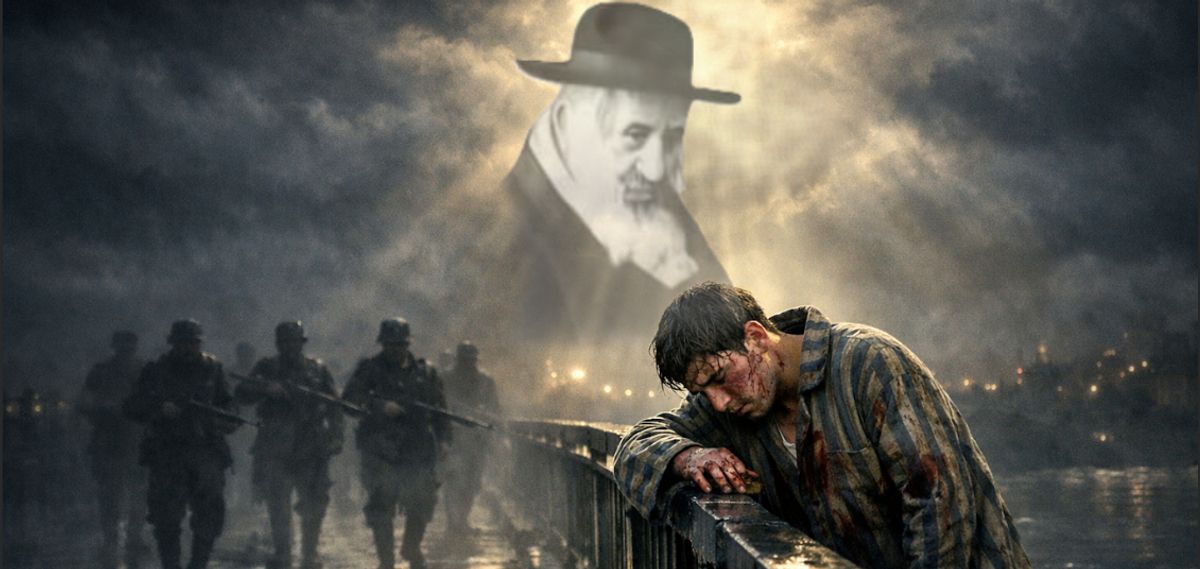
The Prophecy of Reb Yeshayale ben Reb Moshe Regarding the Terrible Holocaust
This was Reb Yeshayale ben Reb Moshe, by whom one can accomplish everything! Whatever a person wants—children! Healing! Curing cancer! There is nothing that cannot be accomplished there! He brings this down in a book, a book called "The Promise." The father of Ben Sasson (Bezanson) wrote the book, and the one who recorded this is Yitzchak Schwartz [whose grandfather was the meshamesh bakodesh (personal attendant) to Reb Yeshayale ben Reb Moshe].
An elderly man called him and said, "I have a tradition from my grandfather..." Yes, because the Maggid Shiur (Torah lecturer)—the Rosh Yeshiva—there was a yeshiva for children there, young men who managed to get accepted into the yeshiva. Here is the book, "The Promise," and here he brings the story. He says, "I have a tradition." This elderly man told him, "I was still a shamash (attendant), I was still an attendant for Reb Yeshayale." We are talking about the year 5670 (1910), thirty years before the Holocaust. He said that in another thirty years, there was going to be a Holocaust. It was at three o'clock in the morning, and suddenly his face turned completely red. He said, "I have something to tell you. In another thirty years, there will be a Holocaust here, the likes of which has not been seen since the creation of the world."
Reb Yeshayale's Promise to His Attendant That His Grandson Would Be Saved
"And anyone who serves me with faithfulness—he will already be ninety years old then, serving me now at the age of sixty—he will only see the beginning of it. But your grandchildren will manage to survive the Holocaust, and I take responsibility that all these grandchildren will be saved. I will watch over them."
The Story of the Grandson Who Was Saved in the Merit of the Promise
All of this was written by Yitzchak Schwartz [who was the grandson of that personal attendant]. There was a man named Shmuel, who said, "I see you bleeding." He was traveling at the time on what is called the Bodrog—the Bodrog is the river, the river we saw is called the Bodrog Kerestirer, that is the name of the river. So this Shmuel said to him, "I dreamed that you were covered in blood." He replied, "Dreams speak falsely," but it turned out to be a true dream.
Kristallnacht
Now, it was Kristallnacht. On the tenth of the month, a Friday, was Kristallnacht. They held marches in Germany, and the Nazis shouted at them, saying, "It is a pity they didn't kill all of you! Are you still alive at all?" On Kristallnacht, perhaps a hundred Jews were killed, but they burned down two thousand synagogues, went into homes, and murdered Jews.
The German Invasion of Hungary and the Collaboration with the Nazis
When they invaded on the fifteenth of March, the Sunday after Purim, they invaded Hungary, and everyone fainted. [Reading from a previous footnote describing the period when European countries surrendered to the Nazi beast and tried to appease them: "For a most ironic and painful example": Innocent French children being educated to love culture are brought by] their teachers to admire the works of famous painters on museum walls, while a significant portion of them were stolen from the deportees of Drancy-Auschwitz. A few years ago, I saw a tiny advertisement in a prestigious French newspaper inviting the descendants of the Drancy deportees to request these artworks back from the museums. There were artworks there... So he says [returning to the beginning of the footnote: "With this, Hungary equated itself with its European neighbors, without whose assistance the satanic initiative would not have been] carried out so quickly." Hundreds of thousands, hundreds of thousands were killed in Budapest, hundreds of thousands of victims, and all the Hungarians collaborated with the Nazis.
The Suicide Attempt in the Extermination Camp
Here [on page 138 in 'The Promise']: "I decided to commit suicide. It was already the end of the war, and I decided to commit suicide. [But before I would throw myself onto the barbed wire fence,] I thought to say goodbye to my schoolmate, whose name was Levi." He went to the adjacent barracks to tell him, "I am going to commit suicide," and I told him what had happened to me. "I looked at him and realized that he too would not survive much longer; he was fourteen years old, yet he looked like he was fifty."
The Glass That Cut His Foot - A Sign from Heaven
"The fence was about a hundred and twenty meters away, and I started running toward the fence." He had to run a hundred and twenty meters. A hundred and twenty meters takes about ten seconds; he had only ten seconds left to live. He ran eighty meters, leaving fifty meters, then thirty meters. "A soldier from one of the watchtowers began aiming his rifle at me." Anyone who ran to the fence was shot, or they touched the fence and were electrocuted. Suddenly, a shard of glass pierced my foot. As he was running to the fence to commit suicide, with only thirty meters left, a shard of glass entered his foot. He was barefoot, without shoes; he had been without shoes for a month or two. "A massive amount of blood poured out, and I saw someone aiming a bullet—aiming a rifle right at me. I had planned to keep running, "but something stopped me. What if the glass is a sign from Heaven?" Perhaps it was showing me how to save myself. And then he lived for another month, and the war ended.
The Attempt to Leave the Camp Through the Clinic
"I picked up the piece of glass, put it in my pants pocket, and went to the showers, where I undressed, washed myself, and washed my clothes. Then I returned to the barracks and lay down on my bunk, but not to sleep. All night long, I rubbed the sole of my foot with the glass to enlarge the wound so they would release me to the clinic. After two hours, my foot was bleeding so heavily," they told me that soon I would lose all my blood. So they told me to take some mud, because it had rained, and that would stop the bleeding. "At noon I got dressed and presented myself to the block doctor." He said, "You did this on purpose." He told me to present myself at six in the evening. "I waited impatiently for six o'clock. Would my injury be considered severe enough? I considered injuring my other foot as well." He wanted to injure another foot. "Ultimately, everything depended on the mood of the SS 'doctor.' If he didn't want to admit me, [nothing would stop him, and if he did want to admit me, my right foot was injured enough. Six o'clock finally arrived.]" — "Go to the clinic for treatment." Six o'clock arrived... "About a hundred prisoners stood in line outside the clinic, all naked." There were no clothes, no shirts, nothing. Everyone, including myself, was naked. "Finally, my turn came, and I stepped toward the French doctor." It was a French doctor; he was French, and he too was a prisoner. "He would have gladly admitted every prisoner," [but it was not up to him; the final word belonged to the SS officer.] The Frenchman cleaned my foot and said, "Alright, you can go." — "But Doctor, aren't you admitting me?" — "I cannot," he answered. "I have to turn away much more difficult cases." — "[Please, Doctor, admit me. I can't take this anymore; I have no more strength.]" — "I cannot, [I am forbidden. The orders forbid me, and as you know, the SS doctor makes the decision.] I know him well; he will not accept you with such an injury. I saw that all my pleas were useless." He begged, he begged...
The Horrors in the Camp
And after this, he [the author of the book 'The Promise' about Reb Yeshayale] brings at the end of the book that they were already about to shoot him, because they were marching on foot from Auschwitz. They marched on foot. For three weeks they were given no food, and they had to march on foot to reach some hangar, some barn, to be put there in the barn. And in that barn, they trampled one another; everyone died in the barn. [Reading from Chapter 25, 'The Trial,' page 156: "On the bunk above me lay a lucky old man who had no fewer than] twenty-three gold teeth in his mouth. [I am sure that in his wildest dreams he never imagined that these twenty-three sparkling artificial teeth] would save his life."
The Prisoners Who Killed the Kapo
Now he arrives, marching for some three days and three nights without eating, a hundred grams of bread a day; he eats nothing. [Now holding Chapter 28] 'The Death March.' Someone, his brother or his cousin, told him, "I am escaping, because it is possible to escape. There are only about two guards for a thousand people, so it is possible to escape. We are walking on foot, and there are forests here." So he gave me his dog tag, his number, and said, "Notify everyone if you find them alive—my mother, my father—tell them that you parted from me here on the death march." After that, he kissed them goodbye. However it happened, "his father and older brother were staying in Budapest." In short, he probably hid with non-Jews in some attic. ["Sammy knew], however, that his mother and two little sisters had been killed. My brother owed his life to Sammy; both of them were in Gusen and both worked there in the kitchen. One day my brother was peeling turnips and was caught putting a piece of turnip into his mouth. Everyone knew that the punishment for stealing from the kitchen, even the tiniest scrap, was death." (The book details how he saved him with mesirus nefesh (self-sacrifice) and killed the Kapo.) ["My brother also recounted that before the rumor spread], they placed the whip in his hand, and he was sent to the crematorium (that Kapo), with the whip still in his dead fingers. It turns out that he had once told his friends that if he were killed by a prisoner, they should murder twelve prisoners in revenge for his death, but his successor did not fulfill his promise [his wish]." So they managed to eliminate this Kapo.
The Death March
"That night, we slept on the summit of a wooded hill." We are talking about the month of April—the month of February, which is the coldest month, the coldest of the year. We are now just starting November. "When he got to his feet..." ... We were informed it was already the fourteenth of November.
"On that day, they were not shot. The conditions were slightly more comfortable; prisoners who lagged behind their group were not shot but were allowed to join the next group behind them. There was a distance of about a hundred meters between the groups, so the prisoners who lagged behind and found themselves in the gap between the groups were not under any supervision." Anyone who lagged behind on the death march was shot. ["At the beginning of the march, I was at the front of the second group. However, I couldn't keep up the pace and soon found myself in the third group, and then the fourth. As I passed between the groups, we reached a section of the road bordered by a thick forest. It was an excellent opportunity to escape to freedom], since none of the guards noticed me. However, I did not have the strength to do so. [Then I saw my cousin Sammy. He looked forward and backward, saw that no one was watching him, hugged and] kissed me, and then disappeared into the forest. [He quickly vanished from sight, but I heard him shout] — 'May Hashem be with you!' ['And with you!' I shouted back]."
A Moment Before Death – Reb Yeshayale Appears to Him
Now [Chapter 29, 'The Executioner and] the Miracle-Working Rabbi': Now [it is told] how he dreams of the Kerestirer. In short, he is now walking on the death march, already three days without food, and it is raining heavily. It is noted that they are in February. He reaches the town of Wels, [and at a distance of] three kilometers [from the town, he said:] "I cannot walk three kilometers." I reach the bridge over the Danube.
There [on the death march] he can no longer walk. He stands on the bridge and says Vidui (confession prayer). Every moment another gunshot is heard, another gunshot; anyone who lags behind [the death march] is shot. "Suddenly, I see the Kerestirer. As I am standing on the bridge, completely exhausted, he says to me [Reb Yeshayale in a vision], 'I am sending you a truck right now, and it will take you.' What truck? I don't see any truck. He says, 'The moment you see a truck, get on it.'"
The Truck That Reb Yeshayale Sent
Suddenly, he hears an explosion. A truck arrives, and the tire—the rear wheel—blew out. Now it is stopped for fifteen minutes to change the tire. In those fifteen minutes, I walk up behind the truck; this is the truck he sent me. Suddenly, "Is this the truck the Rebbe meant?" [I heard] another gunshot. Every gunshot means someone was just killed. Three soldiers were sitting there with a dog; there was a dog there too. Would they even let me get on? I am a Jew, and we are already at the end of the war. "Take me, take me, lift me up, I can't climb up anymore." Before the one walking behind me could shoot me, he says, "Go ahead, jump in." "I can't climb up." So a wicked blond German grabbed me. I thought he was going to start screaming at me, "Come here, Jew!" Suddenly, the one who was shooting all the stragglers says, "Get down! Why did you get on the truck? You don't have permission!" But the one who pulled me up was of a higher rank—he had some "falafel" (senior military insignia) here [on his shoulder]. He says, "I received an order to put him on the truck." "The lieutenant said he could stay. The rank of the SS beast"—they were all predatory beasts, demons like that—he was of a higher rank than the one shooting the stragglers. "He turned and went on his way, toward other unfortunate prisoners. I heard his pistol being cocked again and again." He cocks the pistol, and they finish changing the tire, and the truck drives off, with me inside the truck. "No one said a word to me, but each of them gave me something: the first a can of meat, the second a slice of black bread, and the third a jar of jam." Finally, "The truck stopped at the edge of a thick forest, and one of the soldiers quickly jumped out." He said, "Get off the truck, go into the forest." He jumped back onto the truck, and I got off. I saw the village of Gunskirchen, which was less than a kilometer away, but I couldn't walk.
The End of the War
"But there was no sign of any camp. Every time I lifted a foot to take a step, I had to muster all my remaining strength, but I was already barefoot and quickly lost my wooden clogs. After an hour or more of making very little progress, I reached a group of shouting SS thugs." I saw a massive pit, a giant trench with ten thousand dead bodies, and they were throwing in more and more prisoners, throwing them in every second. Some were already shouting, "Come on, enough already, the war is over!" We were just three days before the end of the war. He says, "It doesn't matter that it's over... the Führer said to eliminate all the Jews. What the Führer said is holy," some of the Nazis shouted. I slipped away. I see them in the forest throwing Jews into the pit, killing them and throwing them in, while some are shouting, "Stop already, the war is over!" And I found myself at the edge of a large mass grave. I saw ten thousand—with ten thousand corpses. He said, "If only all the politicians from the Nuremberg trials had seen what was happening. Stalin arrived there."
These words have been brought with slight editing, and if there is any error, it should be attributed to the transcriber and not, God forbid, to The Rav shlit"a.
Subscribe to Our Newsletter
Receive Torah articles and inspiration directly in your inbox