
Hashem Will Fight for You, and You Shall Remain Silent • Shabbos Chol HaMoed Pesach Class
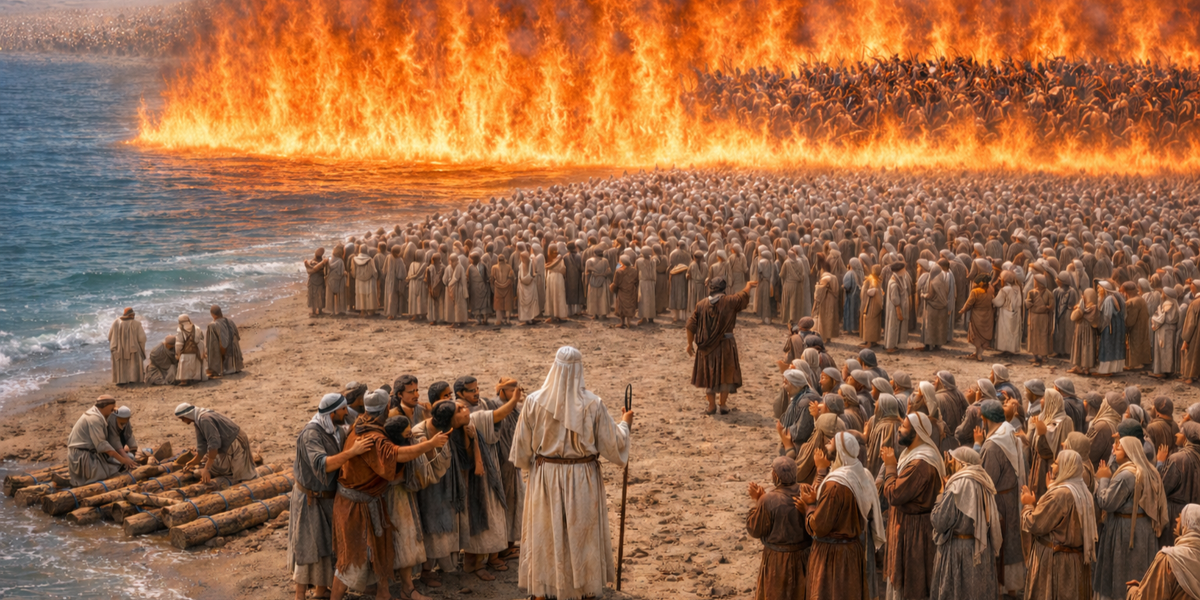
The following is the fascinating class delivered after the conclusion of the Mussaf prayer on Shabbos Chol HaMoed Pesach. Rabbi Berland shlit"a begins by explaining that Pharaoh was not moved at all by the wondrous miracles of Moshe Rabbeinu (Moses), since all of Egypt was filled with sorcerers. Later, Rabbi Berland shlit"a explains with sweet words about Miriam the Prophetess, of whom it is written "her father spat in her face," and how in her merit the sea was split. The Rav further explains the four groups into which the Jewish people were divided on the shores of the Red Sea. Finally, Rabbi Berland shlit"a explains the laws of the gatherer of wood and the blasphemer, the chronological order of these events, and how it is possible that Moshe Rabbeinu did not know simple laws.
Here is the full class:
Why did Pharaoh crow like a rooster at Moshe Rabbeinu?
So who crowed like a rooster? Pharaoh crowed at Moshe. This is what the Midrash says in Parashas Va'eira (Chapter 9), that Pharaoh made a "cock-a-doodle-doo" sound at Moshe. He said to him, "What are you doing playing with toys here? It is inappropriate. You are already a grown man." Moshe was already eighty years old, and Pharaoh claimed, "In my country, four-year-old children do these tricks." Moshe was eighty years old at the time. Well, that is still considered young; he could have lived to be two hundred years old if not for the sin of the Waters of Merivah (where he struck the rock).
Why was Miriam the Prophetess spat upon in her face?
Another terrible thing happened, where a father spat in his daughter's face, as it says, "If her father had but spit in her face" (Bamidbar 12:14). Why did he spit in her face? Poor thing. Even if she made a mistake, she would do teshuvah (repentance), so why spit in her face? Today, if someone spits in his daughter's face, the welfare services immediately arrive and take the children away. So where were the welfare services back then? Today it goes even further: if someone sees another person shouting at his daughter or spitting in her face and does not call welfare, then welfare will come and take his own children away! So back then, the welfare services wanted to come and take the children. But in the end, the plague of blood arrived, and then the frogs, and frogs entered their stomachs, so they simply did not have the time...
Only a person who remains silent in the face of humiliation can sing a song of praise
Ultimately, the sea split in her merit, and she merited to sing the Song of the Sea. Because if a person remains silent, he merits to sing the Song of the Sea. Rebbe Nachman says in Likutey Moharan (Torah 64) that only if a person remains silent can he sing, as the verse says, "Come, you shall sing from the peak of Amana" (Shir HaShirim 4:8).
And you shall remain silent - and then Hashem split the sea
There were four groups there: One group said, "Let us fight." A second group said, "Let us surrender, they will hang Moshe and Aharon, and we will return to Egypt." A third group said, "Let us make ropes, take boats, and cross the sea." The fourth group said, "Let us pray." But Hashem said to Moshe: "And you shall remain silent" (Shemos 14:14) — be quiet! They should not pray! The Zohar explains that they were forbidden to pray at that moment. Why? Because in what way were they better than the Egyptians? They were no better. These were idol worshippers, and those were idol worshippers. Both nations worshipped idols; in fact, they were good friends, they were together. It is written, "Draw forth and take for yourselves a sheep" (Shemos 12:21), because the Jewish people had also worshipped the sheep, the Egyptian deity. Therefore, they needed to remain silent. And in the end, Hashem did something that no one had ever dreamed of — He split the sea for them! Such a thing had never happened before, and will never happen again for all eternity!
Kaddish.
How could Moshe not know the simple laws?
We still have ten and a half hours until Minchah. We can manage to cover ten pages of Gemara, to learn from Tractate Sotah page 42 to 49. During the counting of the Omer, one should learn Tractate Sotah. And everyone should learn with his wife from the book Birkas HaPeiros (Volume 5) regarding the laws that Moshe did not know: the blasphemer, the wood-gatherer, Pesach Sheni, and the daughters of Tzelofchad. But what does it mean that Moshe did not know these laws? What did Moshe do in Heaven for forty days? Did he play backgammon or ping-pong? Did he throw stones at Arabs? What was Moshe doing up there for forty days, how could he not know these laws? Did he not know that a daughter can inherit? Every three-year-old child knows this.
The law of stoning for the wood-gatherer that needed to be clarified
Did he not know that one who desecrates the Shabbos is liable to death by stoning? The Gemara asks this. Rather, since the man gathered the wood specifically to demonstrate the laws of stoning (to show the people the severity of Shabbos), it was considered a melachah she'eina tzricha legufah (a labor not needed for its own intrinsic purpose). Therefore, perhaps he should not have been put to death for it, because only if a person gathers wood to make a fire is he executed. But here, it was a labor not needed for its own purpose. Yet Hashem said to Moshe: "Execute him, eliminate him, a targeted elimination." Furthermore, since there was a warning given to him—is it written twice?—if a person is warned that he will be sent to be killed, and despite all this he still blasphemes or gathers wood, then he must be crazy, completely insane! So perhaps he should not be executed, because it is written, "And the assembly shall save the manslayer" (Bamidbar 35:25), meaning the court must try to find a merit to save the accused. That is why Moshe did not know what to do. But it is obvious that he knew the basic laws.
The chronological order of the wood-gatherer and the blasphemer
This was already the second Shabbos. The first Shabbos was on the 24th of Nissan. In Marah, they received the laws of honoring one's father and mother, the Red Heifer, Shabbos, and civil laws. The laws of a daughter inheriting were given on that first Shabbos, the 24th of Nissan. The incident of the wood-gatherer occurred on the second Shabbos, the 1st of Iyar, and the wood-gatherer and the blasphemer happened at the same time. But how could it be that they happened together? The wood-gatherer was on the second Shabbos, while the incident of the blasphemer only happened after they divided the camps, which was in the second year, "on the first day of the second month, in the second year after they had come out of the land of Egypt" (Bamidbar 1:1). That is what is written in the Book of Bamidbar. If you study Bamidbar, how could it be that these events happened together? It was only a year later! Rather, the Malbim explains that in truth, right from the Exodus from Egypt they were already divided into camps, but it was not yet a formal commandment. In the second year, there was a Divine command to divide into camps, but from the very beginning, they were already divided according to camps.
Why did they kill the brother of Yaakov Avinu?
Already at the funeral of Yaakov—at Yaakov's funeral, Naftali missed his cue. Where was Naftali? He ran off. [He knows that I blame him, that because of him they killed Esav.] Why did he miss it? He did not bring the deed (proving Yaakov's right to the burial plot in the Cave of Machpelah). He was supposed to either manage to bring the deed in time or write a new one. Instead, they killed Esav. He was the brother of "Yankev" (Yaakov). Yankele had a brother—Esav—and they cut off his head. This is against the Geneva Conventions, against the Oslo Accords (Rabbi Berland shlit"a mentioned the Geneva Conventions and Oslo Accords in English). There will be a trial over this on Sunday in The Hague (in the Netherlands) to determine why they killed Esav!
Minchah is at half-past six [18:30]. Everyone should learn Tractate Sotah from page 42 to 49, and everyone should learn with his wife from the book Birkas HaPeiros (Volume 5) regarding the blasphemer, the wood-gatherer, Pesach Sheni, and the daughters of Tzelofchad.
Subscribe to Our Newsletter
Receive Torah articles and inspiration directly in your inbox