
"If You Have a Difficulty
Go to the Field and Cry Out to Hashem!" • The Daily Lesson from the Gaon and Tzaddik Rabbi Eliezer Berland shlit"a
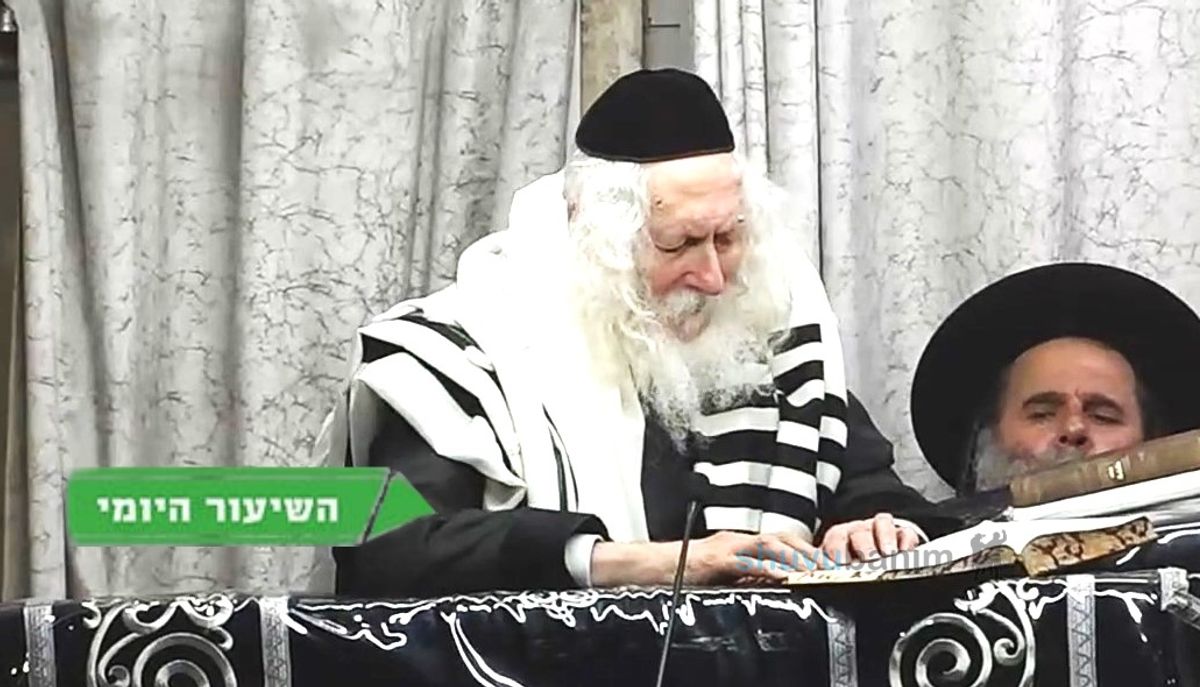
Before you is the full daily lesson as delivered by our teacher, the Rav, Rabbi Eliezer Berland shlit"a—yesterday after the Maariv (evening) prayer, Tuesday night, the 11th of Tammuz, Parshas Balak:
"So, they prepared a place for the boys to pray, because the boys aren't coming to the prayer. Only the girls are coming; the boys aren't coming at all. Now, with the new renovations, there is a special place for all the young men. This Shabbos we started at 4:15 and finished at ten to eight; after that, one can sleep for ten hours. One can sleep on Shabbos from eight to nine, and nine to seven is ten hours. We started the prayer after that at a quarter to eight and finished at 11:15—three meals with Melaveh Malkah (the meal following Shabbos); a person must be present for all of this. All the boys and girls must also be at the Melaveh Malkah and at Shlishudes (the third Shabbos meal) to hear the lessons and the words of encouragement. Regarding the lessons in the morning—in the morning there is no loudspeaker, but whoever heard, heard; we spoke from the balcony. We spoke about the daughter of Jephthah (Bat Yiftach); we spoke about how she was dominant, how she was assertive, how she was a very tough girl. She brought the knife to her father and said, 'Slaughter me with the knife. You said to slaughter, so slaughter.' She didn't give in to him; she didn't give in to her father. 'I will not let you off for a single word; that which you opened your mouth to say, you must fulfill.' He wanted to evade it, to say 'no, tomorrow, the day after.' Not tomorrow! Now! A 'deal now.' They want a 'deal now.' 'Slaughter me now.' And then he placed her on the altar; she brought him the knife. The knife dripped three drops; this entered all the lakes and all that—therefore, it is forbidden during the Tekufah (the seasonal turning point). Now is the Tekufah of Tammuz; this year it was the 15th of Sivan, so next year it will be the 15th of Tammuz—a leap year is the 15th of Sivan. But the Tekufah of Tammuz, he says, begins with three drops of blood. Therefore, at that exact second, it is forbidden to drink water; at that second, it is forbidden to drink water from the taps, only from closed bottles. So that was the daughter of Jephthah, who is now dancing in heaven; she went out with drums and dances toward her father. He thought a sheep, a goat, or a cow would come out. So a person needs to know that the woman is always more assertive than the man. The Gemara (Talmud) says that the woman was created from the bone; she has more assertiveness, more strength. 'Bold as a leopard, light as an eagle, swift as a deer, and mighty as a lion'—this was said about the daughter, about the woman. A girl at the age of thirteen has an IQ a million times higher than a man; she can know all the calculations of geometry, algebra, and mathematics. A person today needs to know all the calculations because we learn Eruvin (a tractate of the Talmud) and we learn Rashi on Samuel—Samuel I, 24:3. And every girl needs to study now during Bein HaZmanim (the intersession period); now is the 'big vacation' (summer break). For the boys, it only starts on the 12th of Av, and for some even on the 4th of Av—Thursday, the 4th of Av. But for the girls, the big vacation has already begun. They need to catch up on all the material they missed; every girl needs to study in the seminary to be a teacher or a principal. To catch up on all the material she missed in algebra and mathematics—these are all simple calculations—to know all of Rashi, all the calculations that Rashi brings us. To read a chapter every day in Joshua, Judges, and Samuel; then she will be able to be a seminary principal. She will know a chapter every day, and finish the whole Tehillim (Psalms) every day—now it is Bein HaZmanim. From eight in the morning until eight in the evening is twelve hours; it's possible to finish all the material even for next year, like Einstein—he would finish all the material for the next year, and in class, he would throw peels at the teachers, and once he threw a chair at a teacher and cracked her head open. Just like they opened Trump's ear—the one who shot doesn't know how to shoot. In America, they don't know how to shoot; there are no snipers. Instead of hitting him in the nose, they hit him in the ear; they don't know, they are all 'shlumiels' (clumsy people). Now they want to fire the head of the CIA... how... you want to shoot a person, it's only a hundred meters. What is a hundred meters? Any small child can aim at a hundred meters. What is a hundred meters? Any child at the age of three can aim his gun at a hundred meters, but the Americans are 'shlumiels'; they don't know how to shoot, they don't know anything. They don't know a thing, they know nothing; the Americans are the stupidest, all day long they have a lust for money, they don't know how to shoot a rifle at all. They know nothing. So a person needs to know that now we need—every girl needs to complete her material, and also the material for next year, and every girl can learn all the calculations. What Rashi says, 'like them and like them a hundred times'—we do a hundred times two, that's two seconds, it's 2, 4, 8, 16, 32, 64, after that 128, then 256, 512—within ten seconds we reached a thousand. After another ten seconds, a million; another ten seconds, we reach a billion; after that, forty seconds, we reach a thousand billion; fifty seconds, we reach a thousand billion. The moment we are at sixty seconds, we reach a trillion—eighteen zeros. After that, seventy seconds, we reach a thousand trillion; after that, eighty seconds, we reach a million trillion; after that, ninety seconds, we reach a billion trillion, until we reach a hundred. We already reached, within ten seconds, [a thousand] billion trillion. That is a number with thirty zeros. And if we do thirty zeros, that is twice a trillion—thirty-six zeros. If we do 180, we reach three trillions—that is called 127 zeros. This is called twelve, eighteen zeros, twenty-seven zeros, we reach after that seventy-two zeros. We reach four trillions—trillion, trillion, trillion—that is twenty-four; this is the secret of the 'Kad' (jug) of Rebecca (Rivka). Rebecca with her 'Kad' (jug) subdued all the Klipos (husks of impurity); Rebecca already subdued all the Klipos until the end of all generations. Therefore, three times 'Kad' (24x3=72) is 'Aryeh' (lion), these are the Clouds of Glory, this is 'Who and who are those who go'—Joshua and Caleb are the Gematria (numerical value) of 'Who and who are those who go.' All this is the Gematria of nine times 'Kad,' but if the jug is ten times 'Kad,' then it was seventy-two zeros, then she would have subdued Esau completely. Because Eliezer saw 'and her jug was on her shoulder'—he saw Esau, he wanted to turn back. He called me, and I told him to cancel the Shidduch (marriage match) immediately. I don't want such a woman who brings an Esau into the world; what kind of woman is this? Then immediately came Naftali of Ropshitz—now is the Yahrtzeit (anniversary of passing) of his grandson on Sunday, Rabbi Meir of Dzikov. It was exactly his 150th Yahrtzeit; he said, 'No, no, no, you don't see well, you don't know how to look.' Rebbe Nachman says in Torah 46, Part II—one needs to know Likutey Moharan by heart. Now during Bein HaZmanim, the boys also need to know Likutey Moharan by heart. During Bein HaZmanim, it's possible to know everything by heart: Likutey Moharan, Likutey Halachos; to finish the entire Likutey Moharan and all of Likutey Halachos in thirty days. What does the Rebbe say in Torah 46, Part II? 'Kushya' (difficulty) is the acronym for 'Shema Hashem Koli Ekra' (Hear, Hashem, my voice, I call). If you have a 'Kushya' (difficulty) regarding the Tzaddik, a difficulty regarding the Torah, a difficulty regarding Rashi—cry out to Hashem! Go to the field! So Eliezer went to the field. He cried out to Hashem. Rabbi Naftali of Ropshitz came with his grandson Rabbi Meir of Dzikov and said, 'You don't understand, you don't see, you don't know.' 'And the man was astonished at her, remaining silent'—'Machrish' (remaining silent) refers to Jacob and Esau. Jacob is the inner essence and Esau [is his Klipa—the external shell]. Therefore, Jacob could not kill Esau. Because Rebecca said, 'Why should I be bereaved of both of you in one day?' On the day that Esau dies, Jacob will die; on the day that Jacob dies, Esau will die. So how could Jacob kill Esau? On that same day, he too would die. So he had to wait until he came to the Me'aras HaMachpelah (Cave of the Patriarchs)—seventy days of embalming, and another fourteen days, which are the days of Chanukah; he arrived on the eve of Chanukah. And then Naphtali made a leap from Hebron to Alexandria to search the archives, the land registry, and the property taxes, but he didn't find the deed. Meanwhile, Chushim, who was deaf and mute—from whom there were initially 62,700, and later 64,400 [descendants] from one deaf-mute child—he said, 'I don't understand, what is this disgrace they are doing to my grandfather? Why are they laying him out like this outside?' They made signs to him; Naphtali jumped—what 'jumped'? 'In a second I'll take off his head!' He said, 'What is this here?' And then 'The Tzaddik shall rejoice when he sees vengeance,' and the eyes of Esau fell onto the bed of Jacob, and then they buried them both. The Arabs show 'Yusuf.' When we were in the Me'aras HaMachpelah forty-five years ago, they showed us 'Yusuf'; they said, 'Here Joseph is buried'—that is Esau. So the Arabs guard the place where he is buried; to this day they believe in Esau. We, we have Jacob; Jacob is called Israel—'And the days of Israel drew near to die.' It is written that only when Jacob married Leah did he reach the level of 'Israel.' Because Leah is 'Imma Ila'ah' (the Higher Mother); a person cannot 'love' a mother—a person can love his wife. A mother he can honor, admire, and listen to, but to love—he only loves his wife. So it is written, 'And Jacob loved Rachel,' but Leah is 'Imma Ila'ah.' Therefore, 'And the eyes of Leah were tender'—she spends the whole day only praying. The woman was created to pray; every day she needs to say Tehillim, every day she needs to say all the twenty-four books [of Tanakh]: Isaiah, Ezekiel, Hosea, then the Twelve Prophets, and after that to know the Megillas Esther (Scroll of Esther). Because Reb Noson says that every woman is a spark of Esther; every 'Kosher' (proper) woman—it is written in the word 'D' 24—the 'Kad' (jug) of Rebecca—every woman is a spark of Esther. So every woman needs to know all the calculations. And also what Rashi brings us in Chapter 24, Verse 3, and also what all of Eruvin... also every boy needs to know Tractate Eruvin, all the calculations. If the width is ten centimeters, then [the circumference] is thirty; if the width is twenty, it's sixty; if the width is thirty, it's ninety; and if the width is forty, it's 120 centimeters. The Gemara says, 'And it was not exact.' What is 'not exact'? Therefore, we study mathematics, that 'not exact' is 3.14. So we do the calculation again: if it's ten, it's 31.4; if it's twenty, 62.8; if it's thirty, it's already 94.2. '42' is the Name of MB (42-letter Name of G-d). And if it's forty, then we already reach 125.6. This is all when you multiply it accurately by 3.14. And after that, one needs to know the 'seventy cubits and a fraction.' Seventy cubits and a fraction—all this is Tractate Eruvin. When a person learns Tractate Eruvin, he needs to know all the calculations; a boy at the age of thirteen needs to know all the calculations, how to do 'seventy cubits and a fraction.' Seventy cubits and four handbreadths—how do we arrive at that? The Gemara mentions the courtyard of the Mishkan (Tabernacle). Now we learned about the Mishkan—what does the courtyard of the Mishkan have to do with 'seventy cubits and a fraction'? What does 'seventy cubits and a fraction' have to do with the courtyard of the Mishkan? But since Shuvu Banim [students] don't know math, they get confused. How much is the courtyard of the Mishkan? Fifty by a hundred. Fifty by a hundred is five thousand. What is the square root of five thousand? 70.2/3. We do the calculation in two seconds; afterward, everyone should do it at home. Review what we learned. So every girl needs to know all the geometry and all the mathematics. And boys also need to know; boys need to know, they need to know Eruvin, all the calculations. What is 'seventy cubits and a fraction,' what is width and diameter and a circle, and if the Sukkah is made in a circle, how much width is needed to fit twenty-four people in the circle? And all these calculations—we have a long Bein HaZmanim now, two months of Bein HaZmanim; every boy and every girl needs to know all these calculations. Both in Rashi on II Samuel 24:3, and in Eruvin—how to reach 'seventy cubits and a fraction,' how to reach a circle of 94.2 with a width of thirty. All these things must be studied and known now. Now it's possible to study until ten and sleep from ten until six, if all the boys come to the prayer. All the young men, all the girls. No young man is exempt from prayer; there is no such thing. Every young man needs to be there at 4:30, and we finish at eight, and after that, they sleep from nine until seven—ten hours. And after that, they come to Melaveh Malkah and hear the lessons and the words of encouragement about the daughter of Jephthah, whom in the end they didn't slaughter at all. Everyone should look in the Gemara and the Midrashim for where it is written that they didn't slaughter her. We know that they didn't slaughter Isaac, but no one knows that they didn't slaughter the daughter of Jephthah. This is a secret that no one knows. All this is said and explained in the lessons—that no one knows where they are written! No one knows... even Mashiach (the Messiah) won't say such Chiddushim (original Torah insights)! So everyone needs to know that in every lesson, completely new Chiddushim are said that are not written in any book in the world, only in very rare books, rare books that were only found in the Genizah (archive of sacred documents). The Meiri was found in the Genizah; entire books were found only in Genizahs. The Or Zarua was found in the Genizah. The... all sorts of very, very ancient books. Which explain the whole Sugya (Talmudic topic) of mustard and bees. Now, regarding mustard and bees, one needs to know: the Rabbis say that the mustard is harmful. Rabbi Yose says the opposite, the bees are harmful; one needs to know who is harmful, what is mustard, what are bees, it is written [-]. The whole Sugya of mustard and bees, all the Tosafos (commentaries)—one needs to know it all. A young man can study now until eleven all the Tosafos of mustard and bees; it is the most complicated Sugya. But if a young man puts his mind to it even a little, he can understand everything—every single thing that is written. One also needs to know the Etz Chaim (Tree of Life); the Rebbe says that one needs to know the Etz Chaim by heart at age seven. One just needs to know there are ten Sefiros (Divine emanations), four worlds, and five Partzufim (Divine personas), and after that, there are all the variations and all the methods. And it's possible to study now until the first of Elul to finish the entire Etz Chaim now, all the Zohars, the Zohar on the weekly portion. Now we are in the blessings of Balaam. How does Balaam merit such blessings? Because Balaam had the Da'as (knowledge/mind) of Moses; Balaam was a twin brother of Moses in the root; he was from the same root as Moses—'fallen and with open eyes,' knowing the knowledge of the Most High. The Gemara says that he was greater than Moses: 'fallen and with open eyes'—fallen. Moses only prophesied while awake, and he also in a dream; Moses only while standing, and he also while lying down. So the Sifrei counts three things: 'No one arose in Israel like Moses,' but among the nations of the world, Balaam was greater than Moses in three things. All this needs to be known and studied—all the Sifrei and the Sifra, all the rare and hidden books. We have Yosef Man who reveals all the books to us, brings them, photocopies them. And everyone needs to know that before ten o'clock one should not be in bed; from ten he is in bed until six—that is eight hours. And after that, at the age of eighteen, he can already sleep six hours; at the age of twenty, it's already possible to survive on four hours—we make it up on Shabbos. And may we merit the complete Geulah (Redemption) speedily in our days, Amen!"
Subscribe to Our Newsletter
Receive Torah articles and inspiration directly in your inbox