
Lesson for the Residents of Be'er Sheva at the Residence of the Gaon and Tzaddik
Rabbi Eliezer Berland shlit"a
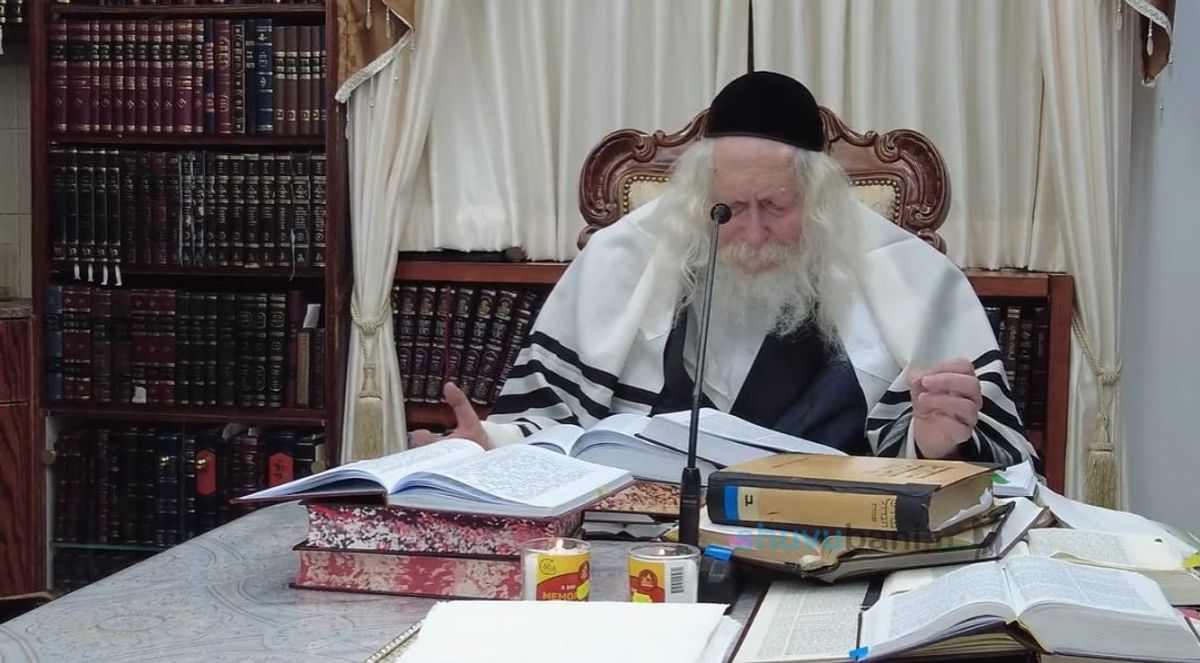
On Wednesday, Parshas Balak, the night of the 12th of Tammuz 5784, our fellow followers (Anshei Shlomeinu) from the city of Be'er Sheva entered for a lesson at the home of our teacher, the Rav, Rabbi Eliezer Berland shlit"a (may he live long and good days). Our teacher, the Rav shlit"a, delivered a lesson for about forty minutes; before you is a summary of the course of the lesson:
The Rav shlit"a began the lesson with the topic of the Haftarah (prophetic reading) of Parshas Chukas—the daughter of Yiftach the Gileadite—and expanded on the story of how Yiftach’s daughter greatly desired to be slaughtered and offered as a burnt offering. Moving from one topic to the next, he spoke about bitul (nullification) to the Tzaddik, citing the tribe of Benjamin who were the first after Nachshon ben Aminadav to jump into the sea. He brought the Gemara (Talmud) on the verse, "There is Benjamin, the youngest, ruling them (rodem)"—interpreting it as "rad yam" (descended into the sea), meaning the tribe of Benjamin were the first to descend into the sea. Regarding the continuation of the verse, "the princes of Judah, their heap (rigmatam)," he explained that the tribe of Judah pelted them with stones because they entered the sea out of order. He expanded on the concept of bitul (nullification) to the Tzaddik, adding that the tribe of Benjamin said that if the Tzaddik says to go, then there is no sea. He also cited what is written in Divrei HaYamim (Chronicles) regarding the tribe of Zebulun, of whom it is written "without a double heart (lo b'lev v'lev)," meaning they followed David in his war with total devotion.
Afterward, in the continuation of the lesson, he dealt with the greatness of Korach, citing the Likutey Halachos (the primary work of Reb Noson of Breslov) that Korach was above space and above time, and that he would fly with the Ark of the Covenant. Precisely because of his immense greatness, he was tested in the matter of bitul (nullification) to the Tzaddik. From this topic, he returned to the matter of Yiftach’s daughter who wanted Yiftach to slaughter her. He cited the Abudraham, who says that a Bas Kol (Heavenly Voice) went forth just as it did with Avraham Avinu (our forefather Abraham), saying "Do not stretch out your hand against the lad." Although he did not slaughter her, three drops of blood dripped from Yiftach’s knife, and therefore during the Tekufah (seasonal turning point) of Tammuz, when the incident with Yiftach’s daughter occurred, one does not drink water from the taps. The Rav shlit"a further added that with Avraham Avinu, three drops dripped from the knife when he came to slaughter Yitzchak (Isaac), and therefore during the Tekufah of Tishrei, when the Akeidah (Binding of Isaac) took place, one also does not drink water from the taps. He then brought the story of the daughter of Nechunya the Ditch-Digger who fell into a pit, and in the merit of his acts of kindness, he merited that Avraham Avinu raised her from the pit. It should be noted that during the lesson, the Rav shlit"a mentioned the immense greatness in Torah of the Gaon Rabbi Yehuda Deri zt"l (of blessed memory), the Chief Rabbi of Be'er Sheva.
Subscribe to Our Newsletter
Receive Torah articles and inspiration directly in your inbox