
"Nachshon ben Amminadab Intended in the Offering of His Sacrifice Until the End
of All Generations" • The Daily Lesson from the Gaon and Tzaddik Rabbi Eliezer Berland shlit"a
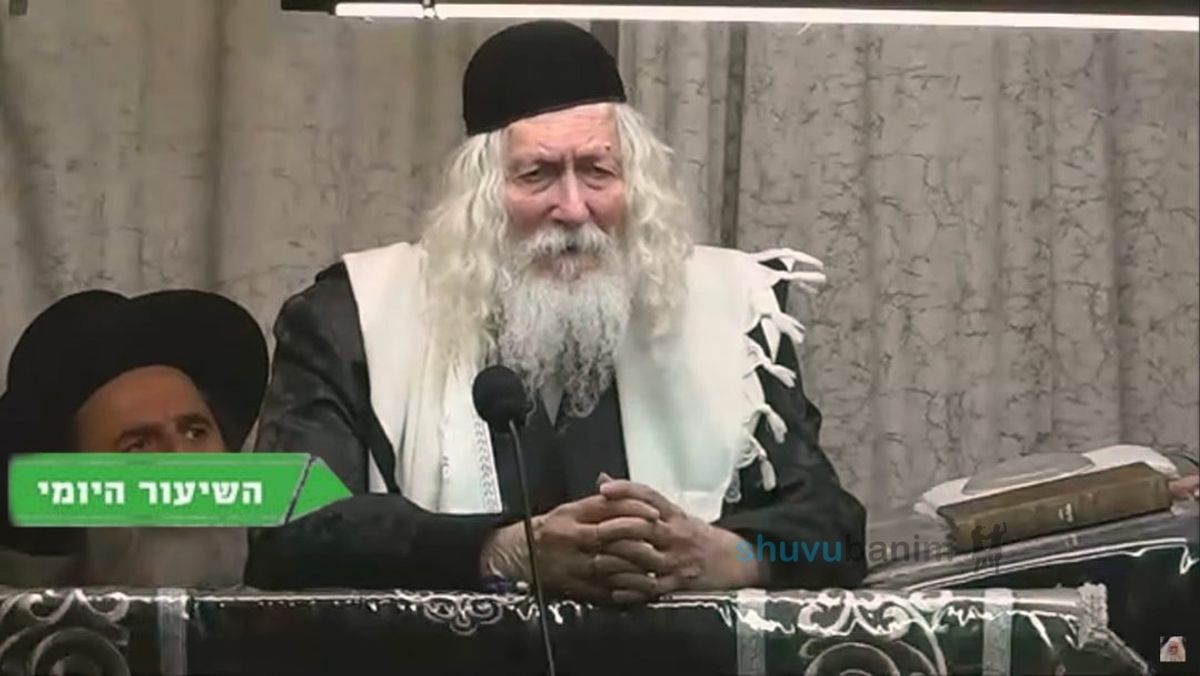
Before you is the full daily lesson as delivered by our teacher, the Rav, Rabbi Eliezer Berland shlit"a - yesterday after the Maariv (evening) prayer, Tuesday, Parshas Tazria, the night of the 2nd of Nissan:
"Today is Nachshon ben Amminadab: 'One young bull, one ram, one male lamb in its first year for a burnt offering. One male goat for a sin offering. And for a sacrifice of peace offerings: two oxen, five rams, five male goats, five male lambs in their first year.' This is twenty-one sacrifices. All the kings correspond to Menashe. 'One male goat for a sin offering'—for twenty-two years he slaughtered a thousand people a day. This was his custom every day, a thousand people; that is eight million and thirty thousand in twenty-two years. Nachshon ben Amminadab came and offered sacrifices for Menashe. 'One male goat for a sin offering.' And Yehoyachin was thirty-seven years in the dungeon, the thirty-seven exiles of Yehoyachin, until the release from Babylon. Belshazzar who drank 'alfa chamra' (a thousand measures of wine). Because Vashti said to Ahasuerus: 'You don't know how to drink. The horse-groom, the one who washes the horses, used to drink alfa chamra—a thousand bottles, a thousand jugs, a thousand barrels—and you couldn't see any effect on him. You, after half a glass, talk nonsense. What happened to you? What nonsense are you speaking?' So he says, 'This I will not forgive you for. Fine, you don't want to come, okay, I have a modest, holy, pure wife. But to say that I didn't know how to drink, that the horse-groom drank a thousand measures of wine and I don't know how to drink even half a glass? For this, you have no forgiveness, not on Yom Kippur (Day of Atonement) and not until the end of generations, and even when Mashiach (the Messiah) comes and at the Resurrection of the Dead, I will not forgive you for this—a thing that has no forgiveness forever and ever. No, one does not forgive for such a thing, there's no such thing, what, you don't know how to drink... there's no such thing!' So Vashti, 'poor thing,' the letters of her name are the same as 'yatush' (gnat) and twice 'nachash' (snake), so what was decreed upon her was decreed. 'As she had done'—the Megillah (Scroll of Esther) does not write what they did to her, the Midrash (homiletic teaching) says it, only 'as she had done' was decreed upon her. It doesn't write what she had—a tail grew on her, she had a growth, and Haman had an ointment that heals the growth immediately. They cut it for her—it was decreed upon her—they cut the growth for her, poor thing, they cut it, a fifteen-centimeter growth. And also leprosy, and therefore 'Vashti' is twice 'nachash' (snake). And Queen Esther entered because Haman wanted to bring in his daughter. Why was Haman so eager to hang Vashti? He wanted to bring in his daughter. So indeed, immediately after they hanged Vashti, the daughter entered, but she didn't have control over what was happening with her and they had to throw her out, poor thing... So after she threw a flowerpot at his head, he lifted his head—'mourning and with his head covered.' This was his dear daughter, his lovely daughter, his most precious one. So he entered the house 'mourning and with his head covered'—mourning for his daughter, with his head covered because of the flowerpot; it was a very expensive flowerpot, 'poor guy.' They threw the flowerpot at his head. So Nachshon intended all of this in all his sacrifices, until the end of all generations. And Yehoyachin brought up Zerubbabel after thirty-seven years that he was in the dungeon. Therefore he is called Zerubbabel because he was 'sown in Babylon' (Nizra be-Bavel), this is Nehemiah the King. And everything is in the merit of Queen Esther. As Reb Noson writes in Hilchos Milah 4:24, that all women are a spark of Queen Esther. Every righteous woman merits to be a spark of Queen Esther. The moment she breaks the 'Xiaomi' (smartphone) and she wears long [modest clothing], she will merit to bring the Geulah (complete Redemption) and the war will end speedily in our days, Amen!"
Subscribe to Our Newsletter
Receive Torah articles and inspiration directly in your inbox