
"Rabbi Meir of Dzikov Also Saw Our Father Jacob" • For the Hillula (anniversary
of passing) of the Author of the 'Imrei Noam', zy"a
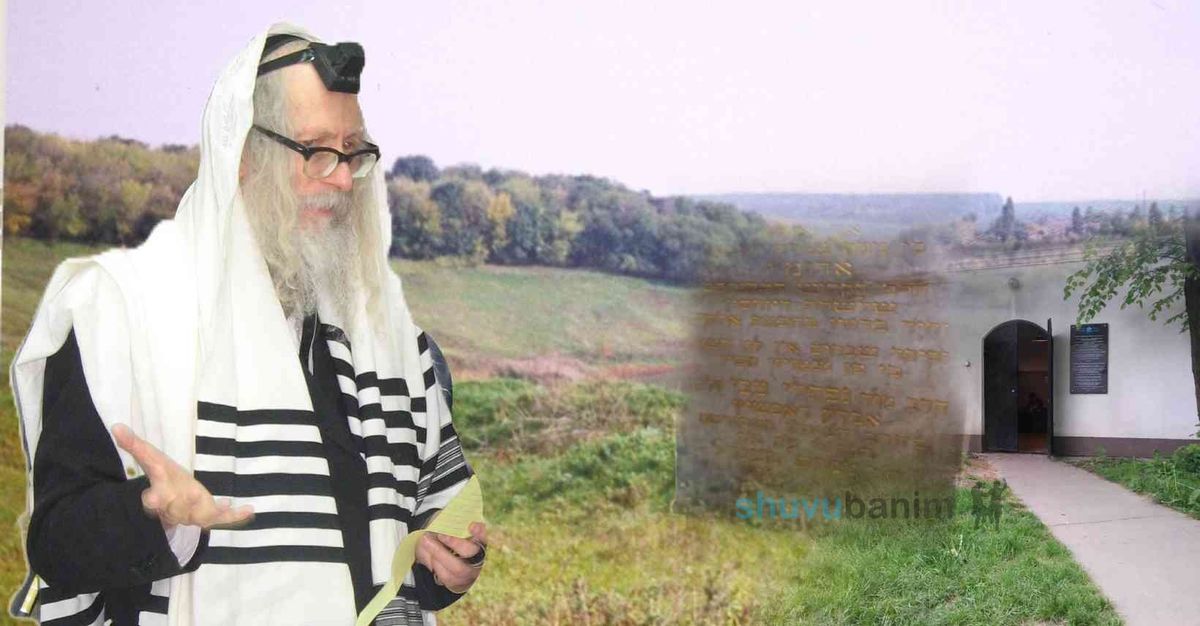
Today, the 8th of Tammuz, is the Hillula (anniversary of passing) of Rabbi Meir Horowitz zy"a (may his merit protect us), the second Dzikover Rebbe. He was the author of the holy book 'Imrei Noam' and the grandson of Rabbi Naftali of Ropshitz zy"a. The Gaon and Tzaddik Rabbi Eliezer Berland shlit"a (may he live long and good days) frequently mentions him in his lessons, particularly regarding his great insight into the verse, "And the man was astonished at her, remaining silent." Before you is a lesson in which the Rav shlit"a mentions the aforementioned explanation in his unique and special way:
"My angel shall go before you" (Exodus 23:23) refers to the angel Metat (Metatron). He [Eliezer] says, "How will I make a shidduch (marriage match)? How will I walk among such enemies?" Furthermore, two billion six hundred million—sixty thousand myriad—were killed [in the War of the Kings]. A myriad is ten thousand, and multiplied by two hundred and sixty, that is two billion six hundred million. So everyone is a goel dam (blood redeemer); from Hebron to Haran, we have an endless amount of blood redeemers. One had his father killed, another his brother, another his son—everyone is a blood redeemer. How will I go? How will I pass through? So he [Abraham] tells him, "This is not your concern, you just go out; 'My angel shall go before you.'" As soon as he goes out—with ten camels—as soon as he goes out, they all fly through the air. When one goes with the Tzaddik (righteous leader), everyone flies through the air! Everything flies through the air! A person wants to go with the Tzaddik, then he flies through the air, he flies through the air! But he says, "How will I find her?" Abraham says: a woman who is a "virgin, and no man had known her." He says there was only one such woman in all of Haran, so go find her—go find this woman! What, with a microscope? With an electronic device? How will you find her? How will you discover her? He says, "My angel shall go before you"—the angel will show you. But how?
It is written that on that day—in her life, Rebecca had never left the house, never in her life had she left the house. On that day, all the servants were sick, so they sent her to bring water from the well because the water had run out. So she went out; for the first time in her life, she left the house. And it was forbidden for young men to be in the streets; it is written that "at the time of evening, the time when the women go out to draw water." Only the water-drawers go, there are no boys—not one to whistle or do this or that, or one to ask "how are you" and say "I can escort you home," seeing she is carrying a heavy pitcher and coming to help her—nothing! There are no boys, no young men! Only in the last half hour before sunset, only the girls go, drawing from the well—a quarter hour to the spring—drawing from the eye of the spring and returning home, and they must return before sunset. If they return after sunset, their bones are broken.
If—in Afghanistan, in Tehran, in the territories—if a girl comes home after sunset, they break all her bones; there is no such thing [as being late]. They tie her to the fence with a rag in her mouth, in the rain, in the snow, it doesn't matter, and she screams, but with a rag in her mouth... from the moment she arrives until the morning—until Vatikin (the crack of dawn)—she is tied to the fence, and they also give her a bit of a "mashkanta" (mortgage/penalty/beating) just because she was five minutes late after sunset.
"At evening time"—she must arrive on time. And she needs to water ten camels. And he [Eliezer] says she must offer it, not that I should tell her; she must offer. A person comes and says, "Can I have a cup of water?" and you receive two cups of water. Why one cup? You immediately serve him double! Maybe he hasn't drunk all day, maybe he hasn't drunk; he is just arriving now from Uman, he hasn't drunk for three days, he was on the road for two days, didn't drink, didn't eat, they delayed him at the border, they told him "your passport isn't yours," finally he arrived, three days he didn't eat, he didn't drink—so bring him two cups. So he says, the woman to whom I say "a little water," a drop of water, and she says "not only shall you drink, but I will also bring for your camels"—and there was a miracle that there were no donkeys there, otherwise she would have brought for the donkeys too and she would never have finished—then the pitcher jumped up by itself, the pitcher jumped up by itself. And this was "at evening time"; if she is five minutes late, they break her bones, there is no such thing, it is forbidden to be late! It is forbidden for a girl to arrive after sunset at night, there is no such thing. And she says, "No, I will water your camels, I will water everything for you." "She is the one You have designated for Your servant Isaac, and through her I will know that You have shown kindness to my master." If she waters the camels as well; "She is the one You have designated for Your servant Isaac, and through her I will know that You have shown kindness to my master."
And then he was "astonished" (mishta'eh)—so we said, he saw Esau. How could he make this shidduch? But Rabbi Meir of Dzikov makes the calculations—one came whose name was Rabbi Meir of Dzikov, the grandson of Rabbi Naftali of Ropshitz; he arrived and said to me, "Calm down, calm down, the match is good, I recommend it." But I asked him, how is the match good? We see Esau; "and her pitcher (kaddah) was on her shoulder." He says, "Trust me," the grandson of Rabbi Naftali of Ropshitz, you can trust him; he gave the match, the whole match was because of him. Why? It is written in the 'Imrei Noam'; the Imrei Noam says, he calms the spirits. Everyone is in fear, they see Esau—"and her pitcher on her shoulder" (kaddah al shichmah) refers to Esau.
Because one can see on a person all the souls that he is destined to bring [into the world]. The Rebbe [Rebbe Nachman] says in Torah 69 that the Tzaddik knows all the souls a person needs to bring; he sees them. And they saw on the "screen" the souls—they saw Esau, they saw Esau. Then Rabbi Meir of Dzikov, the grandson of Rabbi Naftali of Ropshitz, arrived and said, "No; you are not seeing well, you don't know how to look. Look a bit better, deeper. What will you see? You will see Jacob as well!" They only saw Esau; Eliezer and I saw Esau. But Rabbi Meir of Dzikov, he also saw our father Jacob. He says, "No, she will have twins, I am telling you; Esau is just the kelipah (spiritual shell/impurity), the true son is Jacob." How did he see this? How does he see Jacob!? He said, "I see Jacob too, I see twins, I see two." So says Rabbi Meir of Dzikov. How does he see two? So he says it is simple; it is written "the man was silent" (macharish). What is "macharish"?
The Rebbe says, do you have a difficulty (kushya)? "Hear, O Hashem, my voice when I call" (Psalms 27:7)! You have a difficulty as to why Esau? Esau is "Hear, O Hashem, my voice when I call." A kushya (difficulty) is Torah 46, which explains to us what happened here, what happened with Esau, what happened with Eliezer that he saw Esau. Here is Torah 46: What is a kushya? If you have a difficulty, cry out to Hashem. A person has a difficulty and he rebels, becomes secular—"I have a question, I saw something that wasn't..." Regarding a kushya, the Rebbe says, give a [scream], go to the field and cry out to Hashem! What, did Abraham not see that Esau was here? Abraham sent me, Abraham sees until the end of all generations, Abraham surely saw! You have a difficulty with Abraham, a difficulty with the shidduch—you don't need to cancel it. One doesn't just cancel a shidduch; one needs to think, to go to the field to cry out to Hashem: "Hear, O Hashem, my voice when I call." Don't cancel the shidduch. You have a difficulty? "Hear, O Hashem, my voice when I call"!
So what did he do? "Macharish" (remaining silent)—he began to cry out to Hashem. "Macharish" (מחרייש) is the Gematria (numerical value) of Yaakov (Jacob) and Esav (Esau). Macharish is exactly—Resh (200) and Shin (300) is five hundred, Mem (40) and Yud (10) is fifty, plus Ches (8) is five hundred and fifty-eight. How much is Yaakov and Esav? Yaakov is one hundred and eighty-two, Esav is three hundred and seventy-six. Three hundred plus one hundred is four hundred, eighty and seventy is one hundred and fifty—we have now reached five hundred and fifty. We are left with another two (Beis) and six (Vav), which makes five hundred and fifty-eight.
Subscribe to Our Newsletter
Receive Torah articles and inspiration directly in your inbox