The Secret of the Synagogue's Sanctity: Turning the Body into a Living Torah Scroll
Lesson No. 35 | * Motzaei Shabbos Parshas Devarim, the night of the 10th of Menachem Av (delayed Tisha B'Av) 5755 - the night of the delayed Tisha B'Av in the Yeshiva
When a person enters the synagogue with absolute humility and refrains from secular talk, he turns his body into a living Torah scroll. Through the power of song, melody, and recognizing the virtue of every Jew, we can draw down new miracles and nullify all harsh decrees.
A story is told about a great tzaddik who was never late to the synagogue, except for one time. The congregation waited for him, and when he finally arrived, they asked him after the prayer: "Our Rebbe, what happened today? Why were you late?" The tzaddik replied, "I do not come to pray before I do hisbodedus (secluded prayer) and make an accounting of my soul, until I reach the clear realization that I am the worst of the entire congregation. Today, a man appeared in the synagogue who had become notorious in the city for an ugly deed, and he had already been thrown out of all the synagogues. Since I saw him, I had to go out and do hisbodedus for another half hour until I reached a true conclusion: After all, if I had failed in such a thing and gotten a bad reputation, out of sheer shame I would never have come to the synagogue again. And yet, thank Hashem, this Jew did come to the synagogue! If so, he is certainly greater and better than me."
"King David says in Midrash Rabbah: I am no better than Doeg, I am no better than Achitophel, but I do come to the synagogue."
When a person merits to nullify all of his physicality, his feelings of honor and selfishness, and comes to the synagogue out of humility—this synagogue becomes holy with the sanctity of the Beis HaMikdash (Holy Temple). On the Mishnah, "They stood crowded, yet prostrated themselves with ample space," the Bartenura explains that everyone pushed his friend above himself. When entering the synagogue, a person must see everyone as higher than himself and feel that he is the smallest of all, as the Ramban explains, that a person should view his own sins as intentional and his friend's sins as accidental.
The Human Body as a Torah Scroll
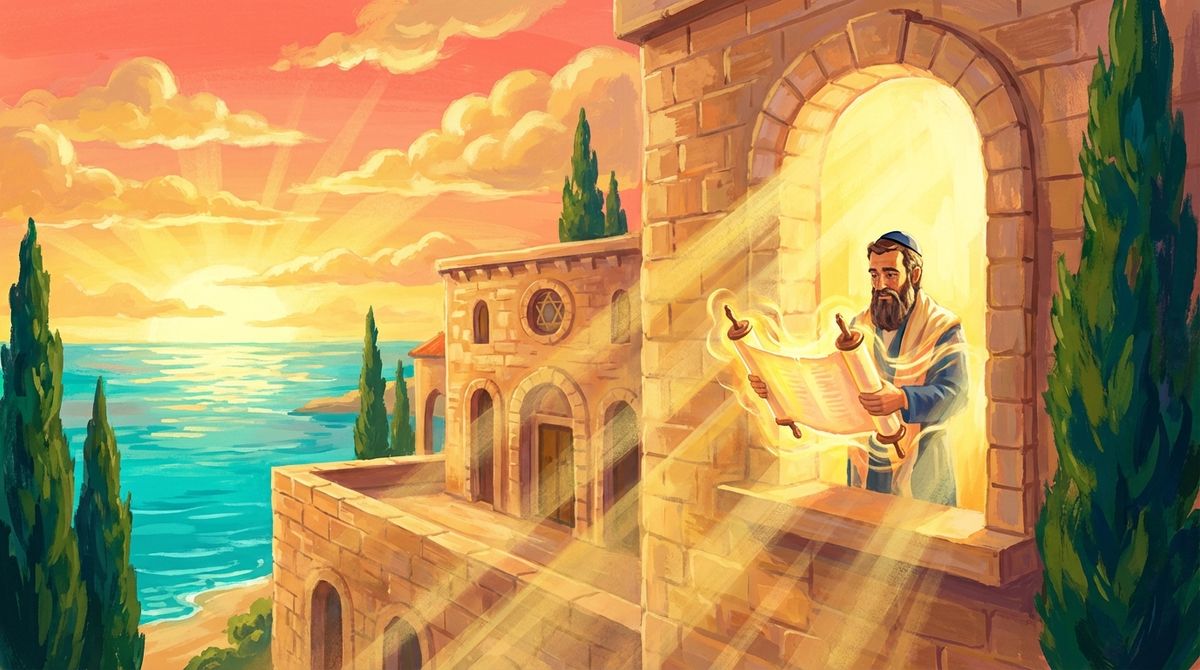
Reb Nosson of Breslov teaches that when a person enters the synagogue and utters only words of holiness, he turns his body into the aspect of a Torah scroll. A person is given a hundred and twenty years to live in order to engrave holy letters of Torah into his body. Aside from words of holiness, he has no business doing anything in the synagogue—no politics and no secular talk whatsoever. He comes to recite Tehillim (Psalms), Pesukei D'Zimrah (Verses of Praise), the reading of the Shema, Korbanos (the sacrifices), and the Shemoneh Esrei prayer.
"Just as the parchment is transformed into the sanctity of a Torah scroll through the holy letters, so too, a person who does not utter a single unnecessary word from his mouth becomes the Holy of Holies for all eternity."
In a Torah scroll, if a person added even one extra letter 'Yud'—he has invalidated the entire scroll. So too, a person must be careful that no secular letter is engraved in his body inside the synagogue. Furthermore, the person becomes holier than a Torah scroll, as the Sages said:
"How foolish are the people who stand before a Torah scroll but do not stand before a Torah scholar" (Makkos 22b).
A Torah scroll is written with allusions to six hundred thousand letters, but a Jew who speaks words of Torah and gives them life is the aspect of a Divine soul that contains infinity. The synagogue gives a person the strength, the drive, and the inspiration to continue speaking words of Torah twenty-four hours a day, in the aspect of "and you shall speak of them when you sit in your house, and when you walk on the way, and when you lie down, and when you rise up."
The Power of King Solomon and the Nullification of Decrees
We live in an era where there are terrible decrees and Jews are being killed, and we must know how to nullify these decrees. Reb Nosson (Hilchos Beis HaKnesses 5) explains that the one who merited to nullify all the decrees was King Solomon. In his days there was peace, all the nations bowed the knee, and the claim of the nations of the world, "You are robbers," was nullified.
How did King Solomon merit this? Because he was truly a man of peace, and he did not hold any kpeidah (grudge or strict judgment) against any Jew in the world. Therefore, he merited to rectify the mitzvah of Eruvin, which means to merge all the domains, perspectives, and opinions.
"King Solomon not only nullified his ego before every Jew, but he was certain that every Jew served Hashem more than him and with greater *mesiras nefesh* (self-sacrifice) than his own."
To understand the true mesiras nefesh (self-sacrifice) of a Jew, we can look at majestic figures like the pious Rabbi Michel Dorfman zt"l, who sat for many long years in Siberia under terrible and horrific trials that no ordinary mortal could withstand, and sacrificed his life for the observance of the Torah and traveling to Uman during the period of Communist rule. When one merits to see the virtue of every Jew, just as King Solomon saw, one merits to build the Beis HaMikdash and to build every synagogue with such sanctity that it nullifies all the accusers.
As the Meor Einayim says, when a person enters the synagogue, he must feel that he is the smallest of everyone. If he arrived late, he is certainly the smallest of everyone. And if he arrived early? He probably slept for twelve hours beforehand, and therefore managed to arrive early.
The Song of the Levites and the Renewal of the World
The synagogue includes within it all the aspects of the Beis HaMikdash: "Kohanim in their service, Levites on their platform, and Yisrael at their station." Reb Nosson explains (Hilchos Beis HaKnesses 6) that the immense power of the synagogue is revealed specifically through song and melodies.
In every song that we sing in the synagogue, there are two parts: gratitude for the past, and drawing down new miracles and wonders for the future. Every single day, new miracles occur and a creation takes place that never existed before. In order to awaken these miracles, which Hashem, may He be blessed, wants to conduct for us, we need song and melodies, such as the recitation of Mizmor L'Sodah (A Psalm of Thanksgiving), Shirat HaYam (The Song of the Sea), and the Shir Shel Yom (Song of the Day) that the Levites would sing.
"Ascribe strength to God; His majesty is over Israel, and His strength is in the skies. Awe-inspiring is God from Your sanctuaries; the God of Israel, He gives strength and power to the people" (Psalms 68).
The Shechinah (Divine Presence), so to speak, cries out to us: "Ascribe strength to God! Pray, sing, dance, shout, and cry. You do not know what miracles I will perform for you!".
Even a person who feels that he cannot utter a single sound from his mouth, yet nevertheless comes to the synagogue and cries out a silent scream from the depths of his heart – he is precisely the one who elevates all the prayers. When Hashem sees that Jews come to the synagogue with such intense yearnings, He gives strength and power to the people; the heart and the mind open up, and the person receives the strength to shout and cry.
Through song and melody, we merit to reveal the emunah (faith) in the renewal of the world, and we draw down the revealed miracles that we so desperately need today, until we merit the renewal of the world in the Future to Come and the resurrection of the dead, when it will be fulfilled: "See now that I, even I, am He, and there is no god with Me; I kill, and I make alive" – without harsh decrees, without evil rule, only the absolute revelation of Godliness.
Part 2 of 2 — Lesson No. 35
All parts: Part 1 | Part 2 (current)
Subscribe to Our Newsletter
Receive Torah articles and inspiration directly in your inbox