"These are the Journeys of the Children of Israel" • Parshat Matot-Masei from
the Gaon and Tzaddik Rabbi Eliezer Berland shlit"a
Wonderful Holy Words for the Weekly Torah Portion From the lesson delivered on Motzaei Shabbat (Saturday night) of Parshat Matot-Masei in the year 5777 (2017) from the Gaon and Tzaddik Rabbi Eliezer Berland shlit"a (may he live long and good days):
"These are the journeys of the Children of Israel"
"These are the journeys of the Children of Israel"—because just to reach the heights requires forty-two journeys. It is written that the Jewish people camped in 'Charadah' (Fear) because in Charadah they faced a terrible judgment. Afterward, it became 'Mitkah' (Sweetness). I studied all these names with the Rebbetzin (the Rav's wife); they were the ones who gave the names. In the desert, there are no names, and every place they reached, they gave it a name. In Charadah, they felt fallen fears. In Moserot (Bonds), they untied the bonds—they cast off the yoke. There, Aaron died because there was a power outage; for eight days there was no electricity, it was complete darkness. The Cloud used to illuminate for them, and since Aaron passed away (histalkus), the Clouds of Glory departed for eight days. People told everyone to return to Egypt.
Moserot—where they untied the bonds. Imagine, you read the verses and don't feel at all what was happening there. Suddenly, there are no Clouds of Glory; they are exposed in the desert to Amalek, the Amorite, the Hittite, and the Perizzite. "Amalek who dwells in the land of the Negev, and the Canaanite and the Hittite in the mountains." And the Jebusite—Abraham made a covenant with the Jebusite, and until King David, there was a covenant that we do not touch them. They were allowed to touch us, but we were forbidden from touching them. There was also a covenant with the Philistines. "And David took Metheg-ammah"—it is written regarding David that he took the contract; he revealed the contract. There is a contract to this day in the archives of Rome, the treaty made with the Romans during the time of the Second Temple. We helped them, but they didn't help us; they only destroyed the Holy Temple for us. We helped them conquer Egypt and everything. Antipater, the father of Herod, fought for the Romans. He built the Antipatris fortress; it's a two-thousand-year-old fortress in Rosh HaAyin. One should perform Hisbodedus (secluded prayer) once in the Antipatris fortress.
In Moserot, they suddenly fell. There was no electricity and no Clouds of Glory—nothing. Everything vanished. They were exposed to the Hittite, the Amorite, the Perizzite, and the Jebusite. There, Aaron died. And it took Moses time until he brought back the Clouds of Glory; he didn't bring them back immediately. It took him eight days to bring them back. Miriam's Well he brought back within two hours, but the Clouds of Glory took him eight days because what Aaron does, no one else can do. Aaron went from tent to tent, studying with every infant, with every child.
In Moserot, there were not yet prayers for the "nullification of fear." Now there are prayers for the nullification of fear, not to be afraid. No one had written prayers then. Out of great fear, [they felt] there was no choice but to return to Egypt. Everyone returned then, until the tribe of Levi stopped everyone. Shuvu Banim were a faction of Rashi, a faction of Tosafot—I don't know exactly—of Rabbeinu Tam, I don't know. Did they vote for Moses or for Korah? I can't remember for whom they voted. Shuvu Banim 3,000 years ago—they voted for Korah, they voted for Dathan and Abiram. For Moses, they certainly didn't vote; of that, I can be sure.
"And all the congregation assembled"—Moses was left with only seven people: just Aaron, Miriam, Eleazar, and Ithamar. They also included Miriam in the minyan (prayer quorum); that's four. Plus Eldad and Medad, that's six, and Moses makes seven. This is what the Midrash Rabbah says. After that, he brought down Abraham, Isaac, and Jacob, and then he had a minyan. Rabbi Shlomke of Zvhil zt"l (of blessed memory) would always bring down the Holy Patriarchs. If there were seven, he said, "It's no problem, I'll bring down the Patriarchs." He had a synagogue in the Beit Yisrael neighborhood, and he would arrive for Mincha (afternoon prayer) before Shabbat, and he never had a minyan because he didn't reveal himself; they didn't know who he was at all. He would sit on the sidewalk waiting for the bus, simply, across from the shul (synagogue), sitting on the sidewalk. The Breslov shul didn't exist yet. He's waiting for a bus to come. And there at the Kotel (Western Wall), there were no chairs; the British didn't allow chairs to be brought. Only at Chatzos (midnight prayer) did they manage to smuggle some in. Woe to him if he saw a chair—the policeman would give such a kick! Mordechai Luzer told me what a kick they received; the policemen would give kicks to those who would get up for Chatzos. The Kotel was a narrow road, a narrow alleyway; in all the pictures, they show this.
As soon as they reached Moserot, all the Clouds of Glory disappeared. No Clouds of Glory, nothing—everything vanished. There was no water. The Jewish people asked Moses, "Why do we need to search for the rock? After all, Moses can bring water out of any rock!" But Moses wanted to show them Miriam's rock, because from there, it is something else entirely. Water can come out of any rock; one can strike here and water will come out. "You struck the rock"—there is a Zohar in Beshalach that says it doesn't say "You struck on the rock," but "You struck in the rock," through prayer. The Zohar says explicitly that even in Parshat Beshalach, it was through prayer. What happened in Beshalach? He came with the staff and started giving such blows.
"And you shall strike the rock"—I have asked this question ten times since we started Parshat Chukat: Why in Beshalach is it written "And you shall strike the rock"? Rather, it refers to the Rock Above. For there is a rock, and above it is a rock, and above that is a rock. Water, after all, comes out of the rocks, from the flinty rock. And there is a Rock above all rocks, the Rock of all rocks. Moses had to reach the Rock of all rocks where Miriam reached. It's no problem to strike and have water come out; one can strike here or there, any stone. But we want fire to come out too, and oil, and honey—not just water. And that is only Miriam's rock, and Miriam's rock can also bring out fire. A person doesn't know that Hashem (God) does not overlook anything; He doesn't overlook even a single movement. This is the klippah (spiritual husk) of Sihon, king of the Amorites, and Og, king of Bashan. We read in Parshat Matot that Sihon purified Gilead and Og purified the land of Bashan. The Bashan of Og and the Gilead of Sihon are the most terrible klippos (spiritual husks) that seize a person and cause him to stumble. He must know how to go and fight, because Sihon takes a mountain of three parsa'ot (ancient measurement of distance); he takes all the prayers and throws them in one's face. The Rebbe (Rebbe Nachman) says in Torah 8 that everything you pray is thrown in your face if you do not know of the Tzaddik. Then a person can pray all the prayers in the world, finish the entire Book of Psalms every day, and everything is thrown in his face.
The lesson has undergone editing, and if any error has occurred, G-d forbid, it should not be attributed to our teacher the Rav shlit"a, but to the writer, and "may our error remain with us."
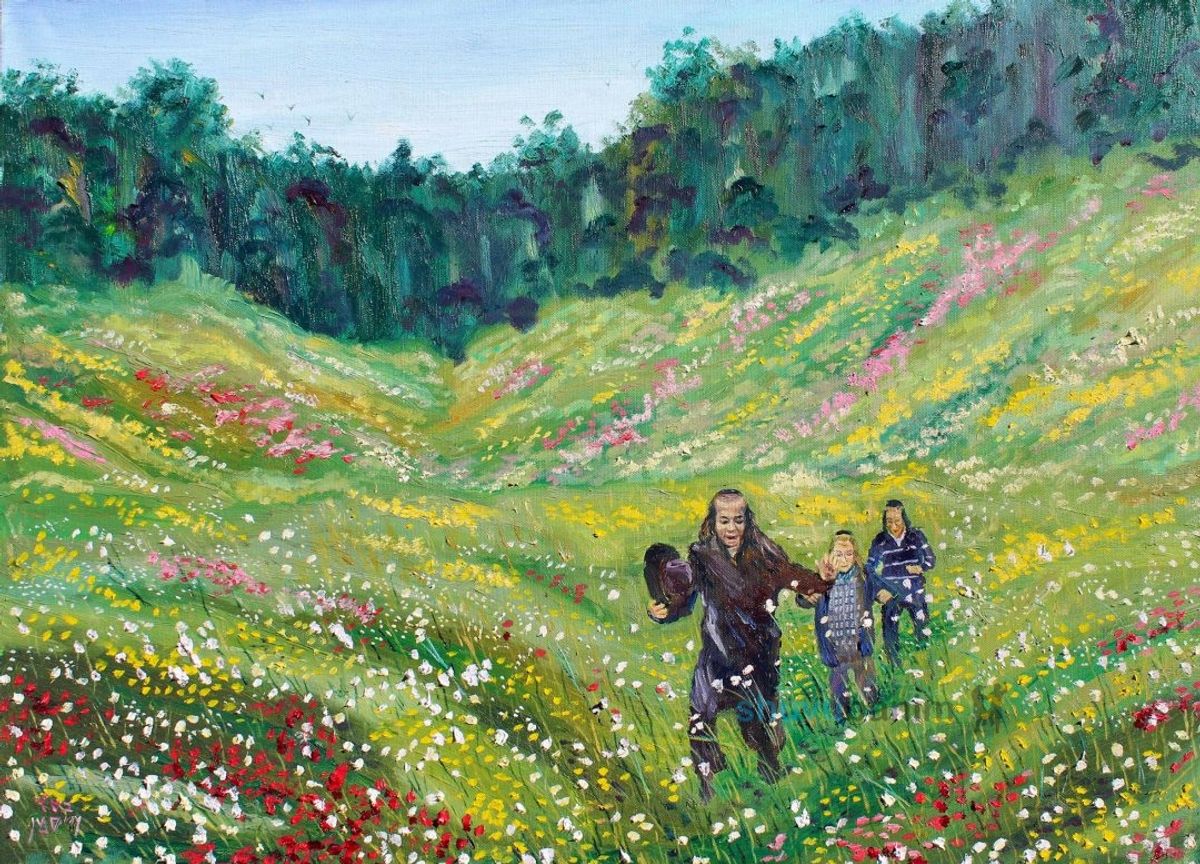
Illustration courtesy of the artist R' Yehoshua Wiseman. For purchase: www.yehoshuawiseman.com
The Shuvu Banim website system wishes you, the readers and followers,
a Shabbat Shalom and a blessed one!!!
Subscribe to Our Newsletter
Receive Torah articles and inspiration directly in your inbox